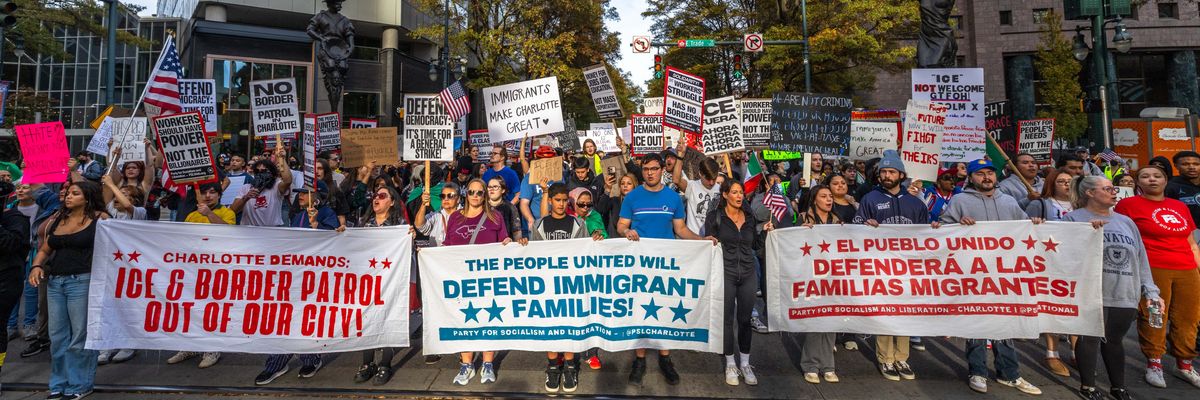
Protesters march through uptown after gathering at First Ward Park for the “No Border Patrol In Charlotte” rally on November 15, 2025 in North Carolina’s largest city. (Photo by Grant Baldwin/Getty Images)
“I want to keep my neighbors protected because they deserve protection and they deserve to live in a world where they’re not scared,” said one woman patrolling the streets of Charlotte with a whistle.
Backlash against the Trump administration’s assault on immigrant communities—in which some US citizens are also getting caught up—is growing in Charlotte, North Carolina this week, as over 30,000 students staged walkouts to protest the federal invasion, people rallied to condemn the arrest of day laborers, and communities mobilized to protect their friends and neighbors targeted by federal agents.
Hundreds of people gathered outside the Home Depot on North Wendover Road Wednesday morning, lining both sides of the street, holding signs supporting immigrants and denouncing US Immigration and Customs Enforcement (ICE) and Border Patrol agents, and cheering as motorists honked in support.
The protest came on the fifth—and reportedly penultimate—day of Operation Charlotte’s Web, which the Department of Homeland Security claimed targeted the “worst of the worst criminal illegal aliens.” The Mecklenburg County Sheriff’s Office said Thursday that it has been informed by federal officials that Operation Charlotte’s Web has wrapped up.
Over 100 people are protesting outside The Home Depot on Wendover Road in east Charlotte, calling on the company to stop allowing CBP & ICE onto their property to carry out operations against immigrants. pic.twitter.com/gMyTHODYte
The administration’s “worst of the worst” claim does not seem supported in the vast majority of the hundreds of arrests made in the Charlotte area, as ICE and US Customs and Border Protection (CBP) agents have targeted locations including a church, grocery stores, construction sites, homes, and hardware store parking lots where day laborers gather every morning in search of work.
“From guns being drawn on pedestrians, windows broken at restaurants and US citizens being detained and later released, it is clear that CBP’s main mission is to disrupt public safety and everyday life in Charlotte,” Zamara Saldivar of the Carolina Migrant Network toldWFAE at the Home Depot protest.
Protester Norm Perreault told the CharlotteObserver that “they say they’re deporting the worst of the worst, but day laborers are the best of the best.”
“We are here to support the immigrant community,” said former Charlotte mayor Jennifer Roberts.
Former Charlotte Mayor Jennifer Roberts, a Democrat, was also at the Home Depot demonstration, where she declared: “We are here to support the immigrant community. We know they’re an integral part of our economy, education, culture, and growth.”
“It’s time for them to leave,” Roberts said of the federal invaders. “We need business to get back to normal. We need our schools to be able to educate our children.”
On Monday, an estimated 30,000 Charlotte-Mecklenburg Schools students walked out of their classrooms in protest of the crackdown. Students marched, held signs, and chanted messages including, “No borders, no nations, stop the deportations!”
Wow. Thirty thousand students just walked out in Charlotte to protest ICE. When kids are willing to shut down an entire city to push back on state power, that’s a political awakening. pic.twitter.com/zx2wVhlmB8
“It’s stressful seeing my mom ‘cuz, like, she struggled with bills already going to work. I mean, even without her going to work, she’s struggling even more.” said one unidentified student protester from East Mecklenburg High School toldWCNC, discussing his family’s fear of being targeted during the crackdown.
Another unidentified East Mecklenburg High student lamented “little kids losing their parents by ICE and getting taken, seeing them cry, and that, like, it breaks my heart seeing them like that.”
East Mecklenburg High multilingual teacher David Gillespie toldWJBF that “a school should be a safe place for a child to come. They should be able to come here to get their education, they should be able to come here and spend time with their friends, socialize, they should feel secure.”
“I’m not sure which of my students I’m going to see again,” Gillespie said in a separate interview with WCNC. “Whether because their parents were involved in detainments or because their parents have to make that unfortunate safety calculus—Is it worth it to send my kids to school and put myself at risk?”
Parent Portia James toldWBTV that she supports the walkout as an avenue for “students to be able to say something and voice their opinion in a positive way.”
“This is not the kind of behavior that we want in Charlotte going forward,” James said of the federal crackdown.
This week’s demonstrations followed Saturday’s “No Border Patrol in Charlotte” rally and march, which drew thousands of protesters to First Ward Park and the city’s streets.
Concern is also growing over federal agents arresting and terrorizing US citizens who legally follow, monitor, and record their activities. Vigilant residents have been confronting federal agents, shouting, blowing whistles, and recording them. Federal agents have also seized US citizens who’ve shown proof of their citizenship.
🚨ICE/Border Patrol agents assaulted and kidnapped a U.S. citizen… then dumped him on the side of the road two miles away.
In the video, you can see agents uncuffing him, tossing his wallet and belongings onto the ground, and driving away. No apology. No explanation. Just… pic.twitter.com/CBE0iag9zZ
“Our country is facing a constant constitutional assault unlike we’ve experienced in many decades,” David Bier, director of immigration studies at the libertarian Cato Institute, said on X Wednesday. “Don’t give an inch of your freedom.”
Undaunted, some democracy defenders have taken to mocking the invaders:
ICE IN CHARLOTTE NC‼️ This is the appropriate energy needed for this moment in history‼️ pic.twitter.com/bzdFLSWLyt
Others are mobilizing to resist the invasion and protect their immigrant relatives, friends, and neighbors. Residents have formed volunteer patrols, parents and educators have monitored schools and surrounding areas for agents, and church parishioners armed with whistles are alerting community members when “la migra esta aquí”—the immigration agents are here.
On Saturday, Manolo’s Latin Bakery, which has operated in Charlotte for 28 years, was rocked as federal agents in tactical gearchased, tackled, and arrested people outside the business.
“I have seen these people in SUVs, cars that are not marked with their faces covered… throwing immigrants to the floor and taking them away,” owner Manolo Betancur toldQueen City News on Saturday, saying he would temporarily shut down his business.
“I’m going to close the door right now,” he said. “Yeah, I’m not going to risk my customers… I don’t want to risk myself even though I am an American citizen. Because the way they look, because they’re way that my accent, because the way that I talk, they’re just going to throw me down to the floor.”
Local resident Beth Clements toldCNN Thursday that she’s been outside the bakery for three days wearing a yellow vest and whistle.
“I’m going to walk the streets with my whistle,” she said, “and I want to keep my neighbors protected because they deserve protection and they deserve to live in a world where they’re not scared.”
Orcas discuss Donald Trump and the killer apes’ concept of democracy. Front Orca warns that Trump is crashing his country’s economy and that everything he does he does for the fantastically wealthy.Donald Fuhrump says that Amerikkka doesn’t bother with crimes or charges anymore, not being 100% Amerikkkan and opposing his real estate intentions is enough.
As Israel’s October 1 invasion of Lebanon unfolds, the media’s complicity in shaping public perception raises urgent questions, particularly when viewed through the lens of a controversial 1984 conference where influential advertising and media figures gathered to refine Israel’s narrative strategies. This conference laid the groundwork for a sophisticated propaganda campaign—Hasbara—that sought to sanitize Israel’s actions and cast its military operations in a favorable light. Today, as Western journalists whitewash, distort, and conceal [Israel’s ?] the realities of Israel’s deadly campaign of violence, the enduring legacy of this meeting becomes alarmingly clear, revealing how narratives crafted decades ago continue to shape the coverage of a conflict that claims countless lives.
In the first week of October, Israeli forces fired 355 bullets at a car containing a five-year-old, then shot at rescue workers who rushed to save her life. A horrific crime – yet, per many Western media headlines, she was simply a “girl killed in Gaza.” The circumstances and perpetrators of her death, if mentioned at all, were invariably buried at the bottom of reports, well hidden from the 80% of the news-consuming public who only read headlines, not accompanying articles.
By contrast, on October 15, Sky News was very keen that its viewers know the names and faces of four “teenage” IDF soldiers “killed” in a “Hezbollah drone attack,” humanizing and infantilizing individuals who, by mere token of their service in Israel’s military, are by definition, guilty of genocide. In passing, the same report briskly noted: “‘23 die’ in Gaza school strike.” Their identities, ages, and photos, let alone clarity on who or what murdered them, weren’t provided.
Moreover, the inverted commas incongruously hovering around the number of Palestinians killed subtly undermined that claim’s credibility while reducing the child victims to an afterthought compared to the considerably more important quartet of deceased IDF genocidaires. MintPress News senior staff writer Alan MacLeod put it succinctly when he Tweeted, “In years to come, students in university departments around the world will be studying the propaganda embedded in this headline. It’s truly incredible how much propaganda has been packed into 16 words.”
The mainstream media’s systematic use of distancing and evasive language, omission and other duplicitous chicanery to downplay or outright justify Israel’s murder of innocent civilians while simultaneously dehumanizing their victims and delegitimizing Palestinian resistance against brutal, illegal IDF occupation is as unconscionable as it is well-documented. Amazingly though, ‘twasn’t ever thus. Once upon a time, mainstream news networks exposed Israel’s war crimes without qualification, and anchors and pundits openly condemned these actions on live TV to audiences of millions.
The story of how Western media was transformed into Israel’s doting, servile propaganda appendage is not only a fascinating and sordid hidden chronicle. It is a deeply educational lesson in how imperial power can easily subordinate supposed arbiters of truth to its will. Comprehending how we got to this point equips us with the tools to assess, identify, and deconstruct lies large and small – and effectively challenge and counter not only Israel’s falsehoods but the entire settler colonial endeavor.
‘NEIGHBORHOOD BULLY’
On June 6, 1982, Israel invaded Lebanon. The effort was ostensibly intended to drive Palestinian Liberation Organization freedom fighters away from their positions on Israel’s northern border. But, as the IDF savagely pushed ever-deeper into the country, including Beirut, it became clear that ethnic cleansing, massacres, and land theft were – as in Palestine – the true goal. Throughout the Lebanese capital, news crews from major networks and reporters from the West’s biggest newspapers were waiting.
Israel’s rapacious bloodlust and casual contempt for Arab lives had hitherto been, by and large, successfully concealed from the outside world. Suddenly, though, scenes of deliberate IDF airstrikes on residential housing blocks, Tel Aviv’s trigger-happy soldiers running amok in Beirut’s streets, and hospitals overflowing with civilians suffering from grave injuries, including chemical burns due to Israel’s use of phosphorus shells, were broadcast the world over, to nigh-universal outcry. As veteran NBC news anchor John Chancellor contemporarily explained to Western viewers:
What in the world is going on? Israel’s security problem, on its border, is 50 miles to the south. What’s an Israeli army doing here in Beirut? The answer is we are now dealing with an imperial Israel, which is solving its problems in someone else’s country, world opinion be damned.”
From: “Hasbara: Israel’s Public Image: Problems and Remedies”
Global shock and repulsion at Israel’s conduct would only ratchet during the IDF’s resultant illegal military occupation of swaths of Lebanon. In September 1982, an Israel-backed armed Christian militia, Phalange, entered Sabra, a Beirut neighborhood home to many Palestinians displaced by the 1948 Nakba. Over a two-day span, they slaughtered up to 3,500 people while mutilating and raping countless others. Again, unfortunately for Tel Aviv, mainstream journalists were on hand to document these heinous crimes first-hand.
To say the least, Israel had an international PR disaster of historic proportions on its blood-soaked hands. The risk that further exposure of its genocidal nature might decisively and permanently shift global opinion in favor of the Palestinians and the Arab world more generally was significant. The attack on Lebanon had already spurred Western news outlets to critically reassess other illegal annexations and occupations in which Israel was and remains engaged. As ABC News reporter Richard Threlkeld commented at the time:
Israel was always that gallant little underdog democracy fighting for survival against all the odds. Now, the Israelis have annexed East Jerusalem and the Golan Heights, settled down more or less permanently on the West Bank, and occupied close to half of Lebanon. In the interests of self-defense, that gallant little underdog, Israel, has suddenly started behaving like the neighborhood bully.”
So it was that in the summer of 1984, the American Jewish Congress – a major Zionist lobby organization – convened a conference in Jerusalem, Israel’s Public Image: Problems and Remedies. It was chaired by U.S. advertising supremo Carl Spielgovel, who a decade earlier provided pro bono advice to the Israeli government on strategies for publicly communicating why Tel Aviv refused to adhere to the terms of the Henry Kissinger-brokered 1973 Sinai Accords. Spielgovel later recalled:
It occurred to me then that the Israelis were doing a good job at training their military people, and they were doing a relatively good job at training their diplomatic corps. But they weren’t spending any time training information officers, people who could present Israel’s case to embassies and TV anchormen around the world. Over the years, I made this a personal cause celebre.”
The 1984 Jerusalem conference offered Spielgovel and a welter of Western advertising and public relations executives, media specialists, editors, journalists, and leaders of major Zionist advocacy groups an opportunity to achieve that malign objective. Together, they hammered out a dedicated strategy for ensuring the “crisis” caused by news reporting on the invasion of Lebanon two years earlier would never be repeated. Their antidote? Ceaseless, methodical, and wide-ranging “Hasbara” – Hebrew for propaganda – for “changing people’s minds [and] making them think differently.”
‘BIG SCOOP’
The AJC subsequently published records of the conference. They offer extraordinarily candid insight into how multiple Hasbara strategies, which have been in perpetual operation ever since were birthed. For example, basic propaganda messages were agreed upon. This included messages that are echoed by Israel’s supporters to this day, emphasizing Israel’s regional importance to the U.S. and Europe, Western cultural and political values, geographic vulnerability, and supposed striving for peace in the face of implacable Palestinian belligerence and intransigence.
As Judith Elizur, an expert in “communications” from Tel Aviv’s Hebrew University, explained:
Because the ‘power dimension’ of Israel’s image is so problematic, it seems to me that Hasbara must concentrate on reinforcing other aspects of Israel that have a positive appeal – medicine, agriculture, science, archaeology…We have been too preoccupied with extinguishing political brush fires. We need to devote more of our resources to long-range image-making. We must recreate a multi-dimensional image of Israel which will assure us the basic support we require in times of crisis.”
There was extensive discussion of how to present “unpalatable policies” to Western populations, and counter the perception of Israel as “Goliath steamrolling” across West Asia, against adversaries “outgunned, outclassed and outmanned” with “no capacity to resist.” The necessity of training the Jewish diaspora in countering criticism of Israel was considered paramount.
AJC’s president lamented that “many American Jews” had condemned the invasion of Lebanon and “did us a terrible disservice.” Any such future “disagreement” would make it “very difficult for us to conduct Hasbara effectively.”
From: “Hasbara: Israel’s Public Image: Problems and Remedies”
Joseph Block, Pepsi’s former vice president of public relations, stressed the need for a dedicated, 24/7 Israel press operation “equipped to offer foreign journalists an occasional exclusive or scoop” and engage in other media outreach to balance critical coverage and get reporters and newsrooms ‘on side.’ Block lamented that had Israeli officials not “briefed NBC and other networks appropriately” and given them “a big scoop” during Lebanon’s invasion, “a different story would have reached America’s 90 million TV households”:
News doesn’t just jump into a camera. It’s directed. It’s managed. It’s made accessible. Public relations is a process that makes news available in a particular form. In the US, PR is as important as accounting, the law and the military…As a corporate spokesman for two of America’s top 50 corporations, I wish I had a shekel for every time I said, ‘no comment’ to a reporter. I was always careful, however, not to antagonize or intimidate the reporter. I knew I had to live with him or her.”
Yoram Ettinger, media analysis chief at the Israel Information Center, concurred, declaring that media framing on Israel’s actions needed to be determined in advance. “Actions” such as “blowing up houses,” which were “difficult to explain,” could be preemptively justified or at least relativized by placing them “in context” while “[drawing] analogies that others will understand.” This would “help others to interpret their meaning,” per Tel Aviv’s perspectives.
The Conference hoped such efforts would mean “our American friends will be able to take a more activist posture as amplifiers of our policy” and assist them in “tucking away the house problems in a back room.” It was also suggested that on an individual and organizational level, Zionist activists serve as a rapid reaction force, deluging news outlets with complaints en masse should their coverage of Israel be at all critical. One attendee boasted of their personal success in this regard:
One day CBS News Radio reported that an American soldier had been hurt by stepping on an Israeli cluster bomb at the Beirut airport. I called CBS to point out that no one had established the bomb was an Israeli one. One hour later CBS reported that an American soldier had stepped on a bomb; this time the report omitted any reference to Israel.”
‘FREQUENT VIOLATIONS’
Another significant recommendation came from Carl Spielgovel: creating a “training program” to bring carefully selected Israeli information specialists into U.S. advertising, PR agencies, and major news outlets. The initiative aimed to equip them with industry insights, ensure Hasbara efforts were maximized, and establish close relationships between Israeli officials and the organizations to which they were assigned.
These “specialists” would operate under the guidance of a U.S.-Israeli council described as “wise persons who can project different scenarios and how to cope with them” on complex issues like “annexation and Jerusalem.” Spielgovel was careful to clarify that he was “not suggesting that we make policy” but rather that “we should make the best minds available to help elucidate the consequences of certain policies.” The goal, he suggested, was to reinforce to the American public that Tel Aviv remains Washington’s “staunch political and military ally.”
Spielgovel further proposed that future AJC conferences should incorporate input from “young people” and people of color to better promote Tel Aviv’s image among diverse “constituencies.” He argued that “Hasbara needs to implant in the consciousness of the world the day-to-day existence” of Israeli citizens, requiring a steady stream of “stories in the arts, business, and cooking sections of U.S. newspapers.” Since then, a dedicated Hasbara program aimed at cultivating skilled Zionist advocates in the U.S. has operated continuously.
Buoyed by its success, the operation soon expanded to include school and university students worldwide, training them to act as vigorous advocates for Israel in classrooms and on campuses. Graduates of these Israeli-funded programs frequently enter influential fields, including journalism, where they continue to promote Hasbara narratives and defend Israel’s actions. The impact on Western media coverage of Palestine has been profound.
To a significant degree, the portrayal of Tel Aviv as “the gallant little underdog democracy fighting for survival against all the odds” has been firmly reestablished. Despite the ongoing crisis in Gaza, mainstream outlets seldom provide context for Palestinian resistance to Israel’s policies of annexation, occupation, and military actions. Coverage nearly always frames Israel’s actions as “self-defense” against “terrorist” threats, with Western journalists keenly aware of potential repercussions for diverging from this narrative.
From: “Hasbara: Israel’s Public Image: Problems and Remedies”
The rapid reaction force proposed at the 1984 AJC conference remains highly active. An extensive network of Hasbara-trained individuals and Israel lobby organizations is always on standby, ready to pressure and intimidate news outlets if coverage diverges from favorable framing or casts Israel in a critical light. As a senior BBC producer once confided to veteran media critic Greg Philo:
We wait in fear for the telephone call from the Israelis. The only issue we face then is how high up it’s come from them. Has it come from a monitoring group? Has it come from the Israeli embassy? And how high has it gone up our organization? Has it reached the editor or director general? I have had journalists on the phone to me before a major news report, asking which words can I use – ‘is it alright I say this’?”
An October exposé by Al Jazeera, citing testimony from BBC and CNN whistleblowers, detailed “pro-Israel bias in coverage, systematic double standards, and frequent violations of journalistic principles” at both networks. According to insiders, much of this was driven by concerns over how Israeli officials might perceive and react to certain coverage. Independent activists and journalists, however, are not bound by such institutional pressures—and since October 7, 2023, they have mounted a formidable challenge to Hasbara narratives.
Were it not for the persistent investigations by outlets like MintPress News, The Grayzone, and Electronic Intifada, unfounded allegations promoted by Israel since the outset of the Gaza conflict—such as claims of Hamas committing mass rape or beheading infants—might never have been thoroughly debunked and might still shape the “context” for Israel’s actions against Palestinians. Meanwhile, countless concerned citizens have actively challenged Western narratives on the conflict in real-time across social media, a groundswell of critique that may be fueling pushback within some mainstream newsrooms.
It is a poetic irony that the same information warfare techniques once honed under Hasbara are now being directed at Israel and its defenders. For decades, these methods allowed Israel to proceed with its gradual displacement of the Palestinian people, often with tacit approval from Western audiences. But those times seem to be fading. Today, critics and former targets of Israeli policy are effectively using these strategies, wielding what they see as their most potent tools—truth and justice.
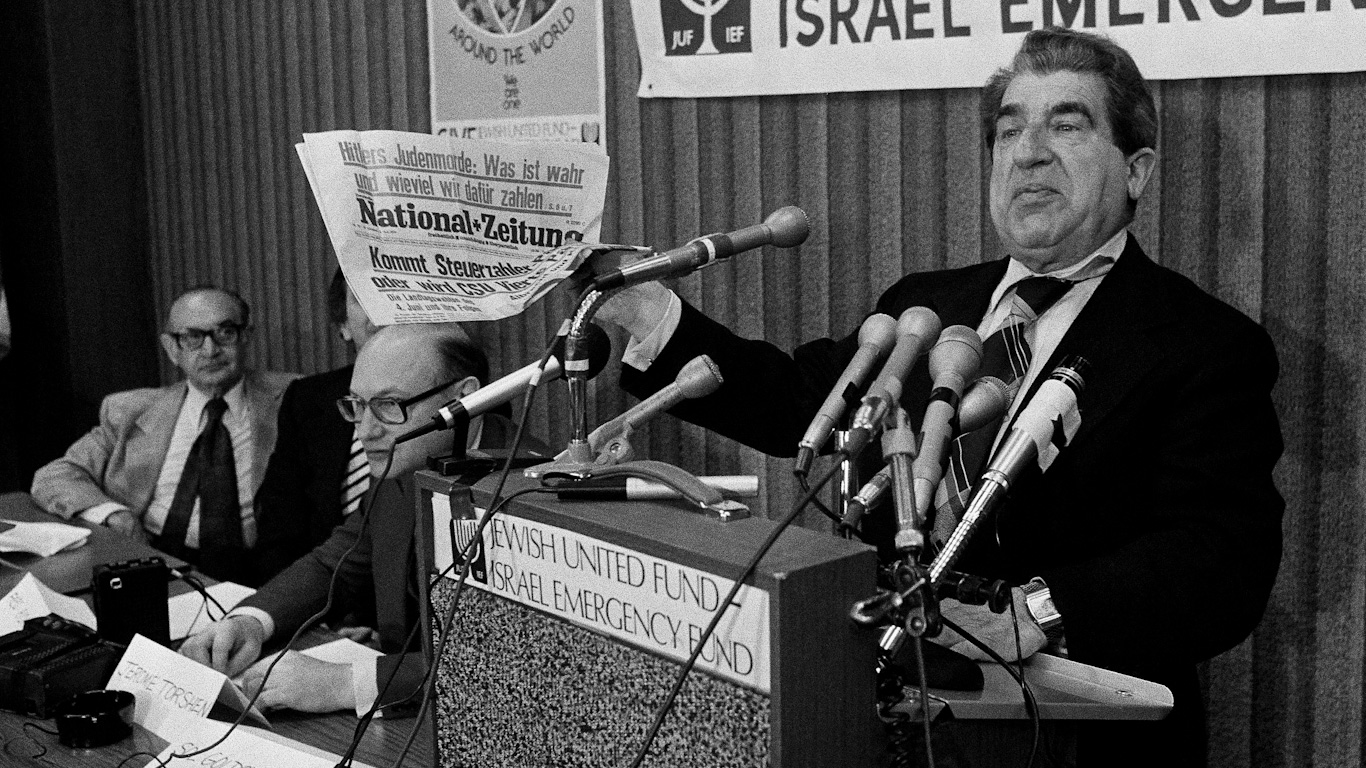
Feature image | Sol Goldstein, spokesman for a group of Jewish organizations, holds up a German language newspaper with headlines questioning the validity of the Holocaust, at a news conference in Chicago, June 14, 1978. Photo | AP
Kit Klarenberg is an investigative journalist and MintPress News contributor exploring the role of intelligence services in shaping politics and perceptions. His work has previously appeared in The Cradle, Declassified UK, and Grayzone. Follow him on Twitter @KitKlarenberg.
The views expressed in this article are the author’s own and do not necessarily reflect MintPress News editorial policy.
Sir Jeremy was Principal Private Secretary to Tony Blair from June 1999 to July 2003 and would thus have been party to every step of the scheming and untruths about the invasion and surely the plotting between Bush and Blair to attack, during their April 2002, three day meeting at the Bush ranch in Crawford, Texas.
Subsequently Heywood stepped into the same position when Gordon Brown became Prime Minister after Blair’s resignation, a post he held between January 2008 and May 2010, so would also have been party to the plans for, and structure of, the Chilcot Inquiry into the war, which was set up by Brown. Thus those involved in the bloodbath and invasion, convened the Inquiry into the illegality.
Gordon Brown, as Blair’s Chancellor of the Exchequer, wrote the cheques for the years of illegal UK bombings of Iraq and for the UK’s participation in “Operation Iraqi Liberation” (OIL.) He also wrote the cheques for Britain’s part in the disastrous invasion of Afghanistan.
According to Ministry of Defence figures, the total cost of UK military operation in Iraq, 2003-2009, was £8.4 Billion – ongoing since they are back bombing, with Special Forces in Northern Iraq – and it would be unsurprising if also elsewhere in the country, given Britain’s duplicitous track record. To 2013 the cost of UK operations in Afghanistan reached £37 Billion, also ongoing.
David Cameron, who voted to attack Iraq, told a news programme at the time: “You’ve got to do what you think right, even if it’s unpopular …”, near mirroring Blair’s “I know I’m right” of the same time. Cameron admires Blair, regarding him as a “mentor.” At every level of government past and present, there are vested interests in the truth on Iraq never coming out.