


https://morningstaronline.co.uk/article/economy-genocide-report-reckoning-beyond-rhetoric

 Israeli army vehicles moves in the Gaza Strip as seen from southern Israel on July 6, 2025
FRANCESCA ALBANESE, the United Nations special rapporteur on the situation of human rights in occupied Palestine, stands as a testament to the notion of speaking truth to power. This “power” is not solely embodied by Israel or even the United States, but by an international community whose collective relevance has tragically failed to stem the ongoing genocide in Gaza.
Her latest report, From Economy of Occupation to Economy of Genocide, submitted to the UN Human Rights Council on July 3, marks a seismic intervention. It unflinchingly names and implicates companies that have not only allowed Israel to sustain its war and genocide against Palestinians, but also confronts those who have remained silent in the face of this unfolding horror.
Albanese’s “economy of genocide” is far more than an academic exercise or a mere moral statement in a world whose collective conscience is being brutally tested in Gaza. The report is significant for multiple, interlocking reasons. Crucially, it offers practical pathways to accountability that transcend mere diplomatic and legal rhetoric. It also presents a novel approach to international law, positioning it not as a delicate political balancing act, but as a potent tool to confront complicity in war crimes and expose the profound failures of existing international mechanisms in Gaza.
…
Article continues at https://morningstaronline.co.uk/article/economy-genocide-report-reckoning-beyond-rhetoric
Original article by Brad Reed republished from Common Dreams under Creative Commons (CC BY-NC-ND 3.0).
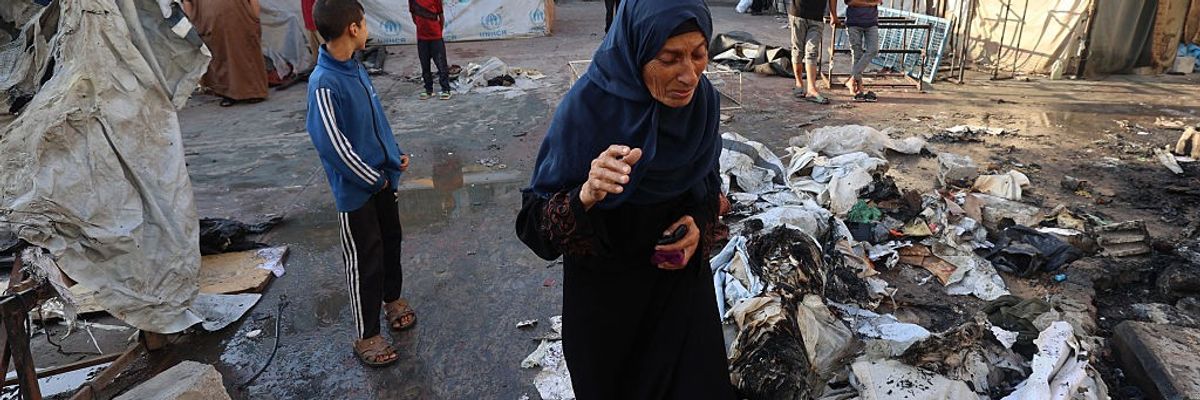
The Israeli government’s new plan to push all residents in Gaza to live in a camp built atop the ruins of the city of Rafah is drawing heavy criticism from experts who see it as a precursor for ethnic cleansing.
In an interview with The Guardian, Israeli human rights attorney Michael Sfard accused Israeli Defense Minister Israel Katz of laying out “an operational plan for a crime against humanity” with his announcement this week of an initiative to build a massive refugee camp at Rafah from which Palestinians would not be allowed to leave. Katz characterized the proposed camp as a “humanitarian city.”
Sfard said that the entire camp was being built as a pretext for the mass deportation of Palestinians from Gaza.
“It is all about population transfer to the southern tip of the Gaza Strip in preparation for deportation outside the strip,” he told The Guardian. “While the government still calls the deportation ‘voluntary,’ people in Gaza are under so many coercive measures that no departure from the strip can be seen in legal terms as consensual. When you drive someone out of their homeland that would be a war crime, in the context of a war. If it’s done on a massive scale like he plans, it becomes a crime against humanity.”
Dr. Amos Goldberg, a historian of the Holocaust at the Hebrew University of Jerusalem, picked apart the Israeli government’s claims that the camp in Rafah would be a “humanitarian city” where Palestinian civilians could live safely away from Israeli military operations being conducted against Hamas fighters.
“It is neither humanitarian nor a city,” Goldberg explained. “A city is a place where you have possibilities of work, of earning money, of making connections and freedom of movement. There are hospitals, schools, universities and offices. This is not what they have in mind. It will not be a livable place, just as the ‘safe areas’ are unlivable now.”
Ihab Hassan, a Palestinian human rights activist and director of the Agora Initiative, expressed a similar sentiment in an interview with The National.
“Israel’s Defense Minister Katz isn’t even hiding it any more—he’s openly calling for a concentration camp for Palestinians in Gaza,” he said.
Jeremy Konyndyk, the president of the Refugees International advocacy group, told Reuters that he wasn’t at all buying the Israeli government’s stated humanitarian intentions regarding the construction of the camp.
“There is no such thing as voluntary displacement amongst a population that has been under constant bombardment for nearly two years and has been cut off from essential aid,” he said.
Reuters reported Monday that a $2 billion plan for so-called “humanitarian transit areas” inside Gaza was recently discussed in the Trump White House.
President Donald Trump earlier this year called for the mass removal of Palestinians from Gaza so that the area could be rebuilt as an international beach resort that he described as the “Riviera of the Middle East.”
Original article by Brad Reed republished from Common Dreams under Creative Commons (CC BY-NC-ND 3.0).
This work by Middle East Monitor is licensed under a Creative Commons Attribution-NonCommercial-ShareAlike 4.0 International License.

Yemen’s Houthi group claimed responsibility on Monday for an attack on the bulk carrier Magic Seas in the Red Sea, which has left the vessel taking on water and is expected to sink, Anadolu reports.
In a televised statement, Houthi military spokesman Yahya Saree said the vessel was hit by “two unmanned boats, five ballistic and cruise missiles, and three drones” on Sunday.
“The operation directly hit the ship, leading to water ingress. It is now exposed to sink,” Saree said. “Our forces allowed the crew to safely evacuate.”
The Houthi spokesman said the Magic Seas and its affiliated company violated what the group called a “ban on entering occupied Palestinian ports,” in reference to Israeli ports. He did not name the vessel’s owner or operator.
Saree added that the attack followed several warnings sent to the ship, which he said were ignored by the crew.
The Houthis have intensified missile and drone strikes on Israel since the Israeli military resumed attacks on Gaza in March after two months of a shaky ceasefire.
Since November 2023, the group has also targeted commercial shipping in the Red Sea, the Gulf of Aden and the Arabian Sea in support of Palestinians in Gaza, where more than 57,500 people have been killed in an Israeli onslaught.
READ: Houthis fire 2 missiles at Israel in response to strikes on Yemeni ports and power station
This work by Middle East Monitor is licensed under a Creative Commons Attribution-NonCommercial-ShareAlike 4.0 International License.
This work by Middle East Monitor is licensed under a Creative Commons Attribution-NonCommercial-ShareAlike 4.0 International License.

French Foreign Minister Jean-Noel Barrot on Monday called for an “immediate” ceasefire in Gaza, stressing that they can “no longer wait”, Anadolu reports.
“I believe we can no longer wait, and it seems to me that the conditions are now in place to finally achieve an immediate ceasefire,” Barrot said during a brief press interaction.
He called for the “unhindered” release of all hostages and the “large-scale” access to humanitarian aid in Gaza, “where the Palestinian civilian population is suffering.”
As the EU accelerates its efforts to strike a transatlantic trade deal with the US, Barrot said: “We support the negotiations being led by the European Commission. We want a balanced agreement.”
READ: ‘Thousands of babies in Gaza lack proper nutrition’: UNICEF chief
“We do not want an asymmetrical agreement that would place us in a position of vassalage.”
He further voiced “hope” for reaching an agreement that “safeguards the interests of all parties,” stressing neither the US nor Europe wants a trade war.
Barrot further reassured that the French Embassy in Tehran is “fully aware” and “mobilized” over the disappearance of an 18-year-old French citizen in Iran.
Lennart Monterlos, who was cycling to Japan, has been reportedly missing since June 16, according to the broadcaster BFM TV.
READ: No reports of Hamas stealing aid in Gaza: EU Commission
This work by Middle East Monitor is licensed under a Creative Commons Attribution-NonCommercial-ShareAlike 4.0 International License.