Palestinians living in makeshift tents and ruined buildings in Jabalia Camp try to continue their daily lives under Israeli attacks in Gaza Strip on December 18, 2024. [Dawoud Abo Alkas – Anadolu Agency]
The Jabalia refugee camp in the northern Gaza Strip has become a “ghost town” with around 70% of homes and buildings completely destroyed in Israel’s deadly onslaught in the area, Israeli media said on Sunday, Anadolu Agency reports.
“As far as the eye can see lie miles and miles of destroyed homes. It’s hard to look away from the devastated remains of Jabalia’s refugee camp in northern Gaza,” Amos Harel, a military affairs analyst, writes in Haaretz newspaper.
The Israeli army estimates that 70% of the refugee camp’s buildings were completely destroyed.
“I could see that even the few buildings that are still standing were badly damaged,” Harel said.
Israel has launched a large-scale ground operation in northern Gaza since Oct. 5 to allegedly prevent the Palestinian group Hamas from regrouping. Palestinians, however, accuse Israel of seeking to occupy the area and forcibly displace its residents.
Since then, no sufficient humanitarian aid including food, medicine, and fuel has been allowed into the area, leaving the remaining population on the verge of imminent famine.
“The IDF (army) operated here twice before, in December 2023 and May 2024. But this time, the camp was taken apart,” Amos said.
“Jabalia has become a ghost town. Outside, you mainly see pack after pack of stray dogs roaming around and hunting for scraps of food.”
The Israeli onslaught in northern Gaza was the latest episode in a brutal Israeli war on the Gaza Strip that has killed more than 45,200 people, mostly women and children, since Oct. 7, 2023.
Last month, the International Criminal Court issued arrest warrants for Israeli Prime Minister Benjamin Netanyahu and former Defense Minister Yoav Gallant for war crimes and crimes against humanity in Gaza.
Israel also faces a genocide case at the International Court of Justice for its war on Gaza.
Pope Francis attends his weekly general audience in the Paul VI hall at the Vatican, on August 07, 2024 [Riccardo De Luca/Anadolu Agency]
Pope Francis on Saturday condemned the recent Israeli air strikes on Gaza, expressing sorrow over the bombing of children in the Gaza Strip the previous day, Anadolu reports.
“Yesterday, children were bombed. This is not war. This is cruelty. I want to say this because it touches my heart,” he told members of the Roman Curia, the Vatican’s central administration.
He also lamented that Israeli air strikes had prevented Cardinal Pierbattista Pizzaballa, the highest representative of the Catholic Church in the Holy Land, from entering Gaza.
Israel has killed more than 45,000 people, most of them women and children, in Gaza since the Oct. 7, 2023 Hamas attacks, and reduced the territory to rubble.
On Nov. 21, the International Criminal Court issued arrest warrants for Israeli Prime Minister Benjamin Netanyahu and former Defense Minister Yoav Gallant for war crimes and crimes against humanity in Gaza.
Israel also faces a genocide case at the International Court of Justice for its military campaign in the enclave.
The pontiff has also called for an investigation to determine if Israel’s attacks in Gaza constitute genocide, according to excerpts from an upcoming new book.
A diplomat at the United States’ State Department has resigned over the White House’s policy towards Israel’s ongoing war on the Gaza Strip, in the latest such resignation by an American official over the genocide.
According to The Guardian newspaper this week, Mike Casey – a US army veteran who served in Iraq and who was until recently the US State Department’s deputy political counsellor on Gaza – told the paper that he had handed in his resignation to the government back in July, ending four years at the State Department.
Casey’s decision to resign was rooted in a growing disillusionment with US policy – or the lack thereof – towards Israel and Palestine, and particularly with Washington’s clear bias toward Tel Aviv in all matters relating to its oppression of the Palestinians.
“We don’t have a policy on Palestine. We just do what the Israelis want us to do”, the former diplomat said. “I was too embarrassed to continue being an American diplomat. I knew I couldn’t go to another assignment and function.”
Now reportedly working at a local bank in Michigan, Casey recalled that he and his colleagues “would write daily updates on Gaza”, which government officials and the president Joe Biden himself would seemingly ignore, leading the diplomat’s team to joke that no one would read the reports even if cash were attached to them.
One such incident he cited was when Biden publicly questioned and denied in October last year the enormous death toll in Gaza at the hands of Israel’s occupation forces, which Casey had personally documented in a report. “I was the one writing the reports”, he said. “What’s the point of me writing this stuff if you’re just going to disregard it?”
The former diplomat added that “I got so tired of writing about dead kids”, expressing his frustration at “constantly having to prove to Washington that these children actually died and then watching nothing happen.”
Casey and his colleagues were also reportedly frustrated at the Biden administration’s repeated rejections of their strategies they proposed for Gaza’s reconstruction – another issue that the Israelis dictated the Americans on. “Every idea we came up with, [the Biden administration] would just say: ‘Well, the Israelis have another idea’”, he said.
An Israeli counter-proposal which Casey cited included letting local clans run the Strip after the war, an idea that American diplomats explained in “numerous reports and cables” why it wouldn’t work as it is “not in our interest to have warlords running Gaza”.
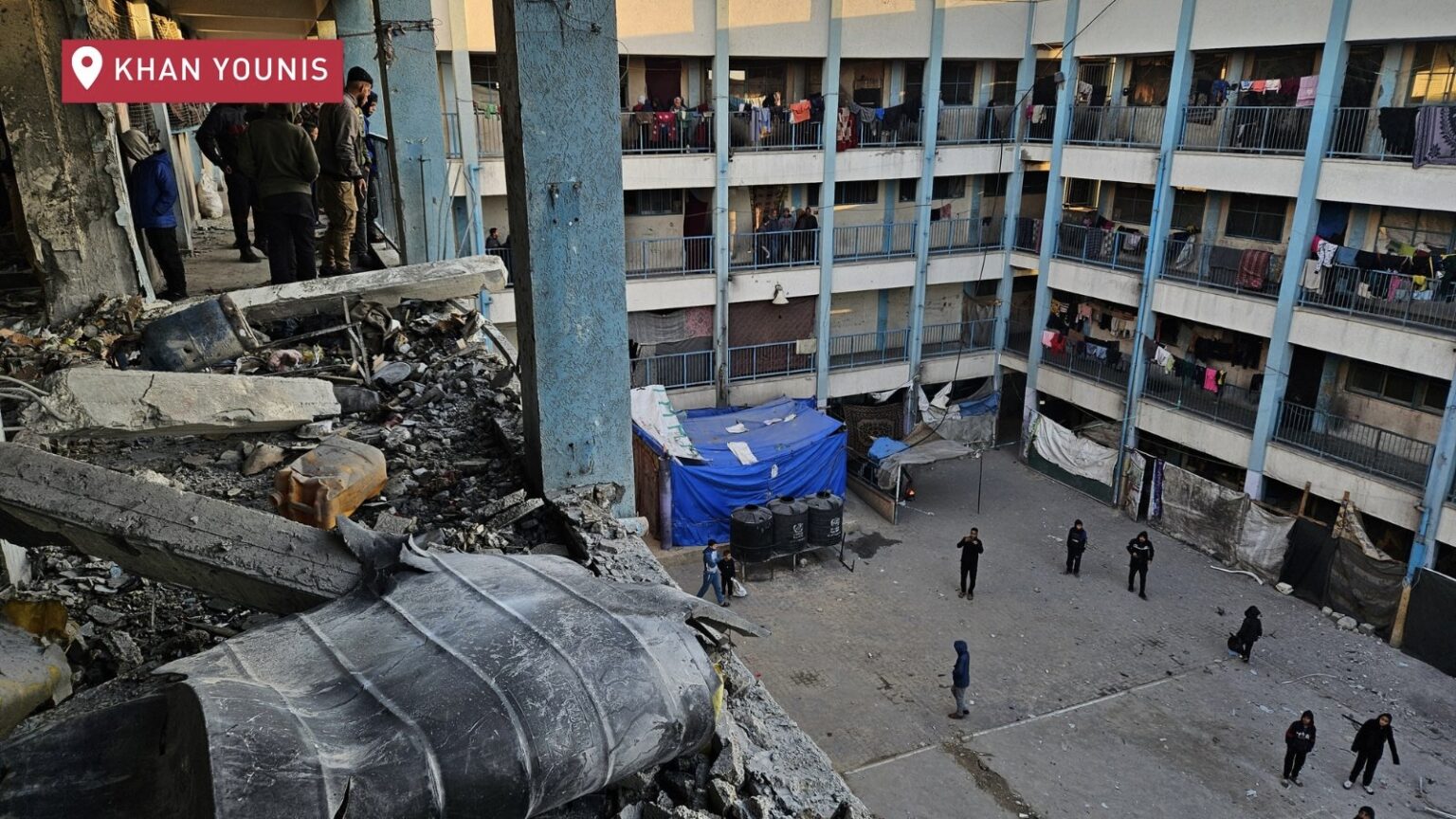
Impact of Israeli airstrike on an UNRWA school in Khan Younis. Photo via UNRWA
After 14 months of Israel’s genocide on Gaza, conditions for the millions of displaced remain perilous and Israel’s airstrikes are unrelenting.
It has become background noise. We know it is happening, but we can almost forget that it continues at a barbaric rate. The United Nations deputy special coordinator for Palestine, Muhannad Hadi, released a statement on December 13, 2024, that simply makes no sense: “I am very concerned about the rapidly deteriorating security and humanitarian situation in Gaza.” How can anything deteriorate in Gaza? Isn’t the situation as bad as it could get, the genocidal war of the Israelis grinding on?
If you are paying attention, you will find that every day there are more and more reports of bombing in northern Gaza. These bombings pulverize entire buildings and massacre entire families. On December 17, the commissioner-general of the UN Palestinian Agency (UNRWA) Philippe Lazzarini put the situation clearest: “We are getting out of words to describe the situation in Gaza…. My colleagues when they come back, they basically describe a post-apocalyptic environment, and people are just living among [garbage], sewage water, in the rubble, and struggling because they are confronted on a daily basis with death, hunger, and disease.”
Dead bodies
The day before Hadi made his statement, an Israeli airstrike hit a housing development in the Nuseirat refugee camp and killed large numbers of the al-Sheikh Ali family. It has become part of counting the death toll to track the elimination of entire families by Israeli bombs. A Euro-Med Human Rights Monitor report from October 2024 showed that 3,500 Palestinian families in Gaza “have suffered multiple losses since October 2023. Of these, 365 families have lost more than 10 members, while over 2,750 families have lost at least three.” These numbers will need to be updated. The Euro-Med report is called De-Gaza: A Year of Israel’s Genocide and the Collapse of World Order.
On December 11, 2024, before this round of bombardments and killings, a startling press briefing was given by Mounir al-Bursh (director general of the Palestinian Ministry of Health) and Mahmoud Basal (spokesman for the Palestinian Civil Defense Agency). Al-Bursh said that the Israeli troops fired on ambulances and prevented rescue workers from getting to the buildings to recover the injured and the dead. As a result, he said, “bodies are left in the streets and are eaten by dogs.” Basal, meanwhile, said that many of the injured were dying under the rubble because the rescue teams no longer had regular access to the bombed buildings and did not have the equipment to save people. This means that the Israelis are not only bombing residential areas and killing unarmed civilians, but they are also preventing the injured from being rescued and the dead from an honorable burial. Journalist Hossam Shabat, reporting from northern Gaza, wrote, “Due to the rising Israeli bombings and killings in northern Gaza, we have run out of body bags to bury the dead, and now we resort to using any piece of clothing or a blanket for their burial.”
Reports
Over the past few months, two reports have been published whose honesty enables the reader to feel the atrocities being committed against the Palestinians in Gaza.
First, in October 2024, the remarkable UN special rapporteur on Palestine, Francesca Albanese, published her 32-page report for the UN General Assembly. Her finding is clear: “The current genocide is part of a century-long project of eliminatory settler colonialism in Palestine, a stain on the international system and humanity, which must be ended, investigated, and prosecuted.” The legal case for the end not only of genocide but its basis, the occupation, is made very strongly. Anyone who reads Albanese’s report with an open mind will come to that conclusion.
Second, in December, Amnesty International released a 296-page document called You Feel Like You Are Subhuman: Israel’s Genocide Against Palestinians in Gaza. The most painful section to read is the evidence presented clinically by Amnesty of the genocidal words of Israeli officials that are then enacted by their soldiers. It is worth reading a few sentences from the Amnesty report:
Amnesty International analyzed 102 statements made by Israeli government officials, high-ranking military officers, and members of the Knesset made between [October 7, 2023, and June 30, 2024] which dehumanized Palestinians, or called for, or justified genocidal acts or other crimes under international law against them. Of these, it identified 22 statements that were specifically made by members of Israel’s war and security cabinets, who included Prime Minister Netanyahu, then Minister of Defense Gallant and other government ministers, by [high-ranking] military officers and by Israel’s president between [October 7, 2023, and June 30, 2024]. These statements appeared to call for, or justify, genocidal acts.
Also, the language used by Israeli officials was frequently repeated, including by soldiers in Gaza, apparently explaining the rationale for their [behavior]. This is evidenced by Amnesty International’s analysis of 62 videos, audio recordings, and photographs posted online showing Israeli soldiers in which they made calls for the destruction of Gaza or the denial of essential services to people in Gaza, or celebrated the destruction of Palestinian homes, mosques, schools, and universities.
For example, before the Israeli offensive on Rafah, Israeli minister of finance Bezalel Smotrich said at a public event, “There are no jobs half done. Rafah, Deir al-Balah, Nuseirat, destruction! Blot out the memory of [the people of] Amalek from under heaven.” This genocidal language was then replicated on the ground. Amnesty’s report affirms strongly that there is no other way to understand the Israeli campaign against the Palestinians in Gaza than as a genocide.
Rascal children
The Ministry of Health in Gaza says that since the genocide began, the Israelis have killed at least 45,059 Palestinians. Of them, at least 17,000 are children. Israel and its Western allies have spent considerable funds to deny these numbers. The right-wing Henry Jackson Society (based in the United Kingdom) has published a 40-page report that belongs in a juvenile debate. To complain about this or that individual case and not to see the extent of the bombardment and destruction, as revealed by reputed human rights organizations, is disingenuous. They would like to justify the killing of children by their dispute over statistics.
In 2014, during a previous terrible bombing of Gaza by the Israelis, the Palestinian poet Khaled Juma wrote about the children being killed then. Then, the Israelis killed 551 children, as recorded by the official UN inquiry. This time the number is 30 times as high and climbing. No debate about the exact numbers will change that.
Oh, rascal children of Gaza, You who constantly disturbed me with your screams under my window, You who filled every morning with rush and chaos, You who broke my vase and stole the lonely flower on my balcony, Come back— And scream as you want, And break all the vases, Steal all the flowers, Come back, Just come back…
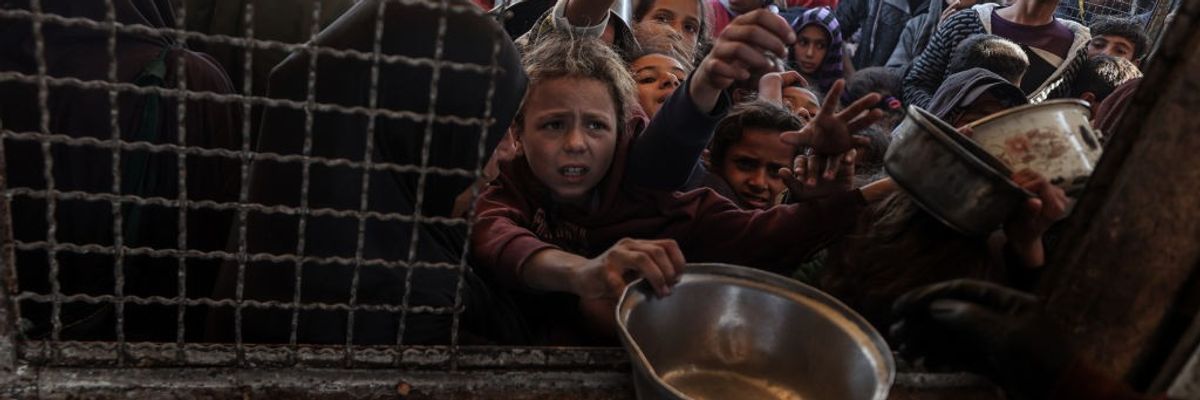
Palestinian children gather to receive bread in the al-Mawasi area of Khan Younis, Gaza on December 19, 2024. (Photo: Ali Jadallah/Anadolu via Getty Images)
“People in Gaza are struggling to survive apocalyptic conditions, but nowhere is safe, no one is spared, and there is no exit from this shattered enclave,” said the humanitarian group’s secretary-general.
The international humanitarian group Médecins Sans Frontières published a report Thursday detailing how the Israeli military has systematically destroyed conditions of life in the Gaza Strip over the past 14 months by dismantling the enclave’s healthcare system, forcibly displacing most of the population, choking off humanitarian aid, and reducing much of the territory to rubble.
MSF, also known as Doctors Without Borders, noted in its 34-page report that its staffers have witnessed and in some cases been the victims of large-scale “violence unleashed by Israeli forces,” which has “caused physical and mental damage on a scale that would overwhelm any functioning health system, let alone one already decimated by a crushing offensive and a 17-year-long blockade.”
While MSF secretary-general Christopher Lockyear stressed that the group doesn’t “have legal authority to establish intentionality” on the part of the Israeli military, “the signs of ethnic cleansing and the ongoing devastation—including mass killings, severe physical and mental health injuries, forced displacement, and impossible conditions of life for Palestinians under siege and bombardment—are undeniable.”
“People in Gaza are struggling to survive apocalyptic conditions, but nowhere is safe, no one is spared, and there is no exit from this shattered enclave,” said Lockyear, who visited Gaza earlier this year. “The recent military offensive in the north is a stark illustration of the brutal war the Israeli forces are waging on Gaza, and we are seeing clear signs of ethnic cleansing as Palestinians are forcibly displaced, trapped, and bombed.”
“What our medical teams have witnessed on the ground throughout this conflict,” he added, “is consistent with the descriptions provided by an increasing number of legal experts and organizations concluding that genocide is taking place in Gaza.”
Even if Israel’s assault ended today, MSF said, “its long-term impacts would be unprecedented, given the scale of the destruction and the extraordinary challenges of providing healthcare across the strip.”
“The cumulative physical toll and mental trauma caused by the extreme violence, loss of family members and homes, repeated forced displacement, and inhumane living conditions will scar generations,” the group added.
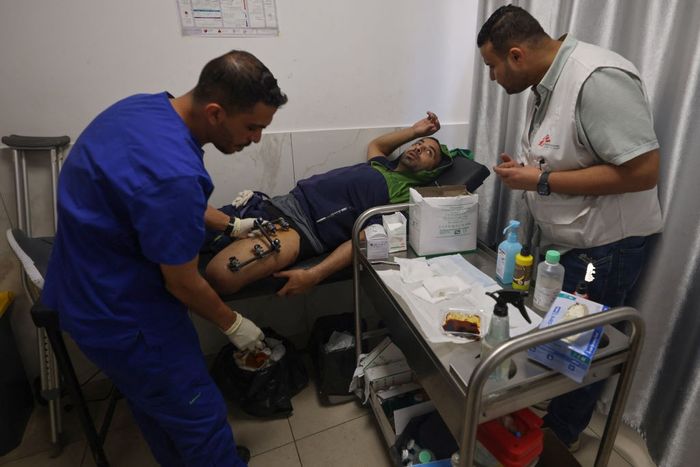
Medics care for patients at a clinic set up by Doctors Without Borders in Rafah, Gaza on April 24, 2024. (Photo: Mohammed Abed/AFP via Getty Images)
MSF’s report, titled Gaza: Life in a Death Trap, finds that Israel’s response to the Hamas-led October 7, 2023 attack “provoked the collapse of Gaza’s already-vulnerable healthcare system” and compromised its ability to provide humanitarian assistance with attacks on aid workers.
Since October 2023, at least eight MSF workers and “many of their family members” have been killed in Gaza, the group said Thursday.
“The pattern of attacks outlined above coupled with its foreseeable consequences and the denial of access to medical care and humanitarian assistance… effectively demonstrate Israeli forces waging a ‘war on the health of Gazans’ that has left the healthcare system in shreds,” the new report states.
The report quotes MSF staffers relaying their horrifying experiences working in Gaza’s barely functional hospitals and clinics without adequate supplies to treat the massive influx of Israeli airstrike victims.
“There are wounded lying everywhere,” Karin Huster, medical referent for MSF in Gaza, said in June. “Bodies are being carried out in plastic bags, the smell of blood is unbearable. Hundreds of people are in the hospital waiting for news of their loved ones injured in the bombardments.”
“Nothing justifies what I saw today,” Huster added. “These children, the three-month-old baby, the 7-year-old, the 12-year-old who died, the 25-year-old man, the 78-year-old woman, all with horrific injuries: Why did they deserve this?”
Human Rights Watch said Thursday that “Israeli authorities have deliberately inflicted conditions of life calculated to bring about the destruction of part of the population in Gaza by intentionally depriving Palestinian civilians there of adequate access to water, most likely resulting in thousands of deaths.”
“In doing so,” HRW added, “Israeli authorities are responsible for the crime against humanity of extermination and for acts of genocide.”
Doctors Without Borders said Thursday that “an immediate and sustained cease-fire must be implemented” and the “complete destruction of Palestinian life in Gaza and all things that make up the very fabric of society must stop.”
Additionally, the group urged Israel’s allies to end their unconditional support for the assault on Gaza and demanded an independent investigation into attacks on humanitarian workers.
“Israeli authorities continue to actively block MSF and other humanitarian organizations from providing lifesaving assistance to people trapped under siege and bombardment,” the group said. “States must leverage their influence to alleviate the suffering of people and enable a massive scale-up of humanitarian assistance across the Gaza Strip.”
Genocide denier and Current UK Prime Minister Keir Starmer is quoted that he supports Zionism without qualification. He also confirms that UK air force support has been essential in Israel’s mass-murdering genocide. Includes URLs https://www.declassifieduk.org/keir-starmers-100-spy-flights-over-gaza-in-support-of-israel/ and https://youtu.be/O74hZCKKdpAUK Foreign Minister David Lammy confirms that UK government and military are active participants in Israel’s genocides and that the F-35 parts that they suspended from supplying to Israel are instead simply diverted via the United States. He says see https://youtu.be/QILgUHrdWRE