A DeSmog collage of Reform UK leader Nigel Farage and former Conservative prime minister Liz Truss in front of a CPAC sign. Credit: Gage Skidmore (Nigel Farage and CPAC sign), Tim Hammond / No 10 Downing Street (Liz Truss)
The Reform leader has opted to join the pro-Trump conference as it comes to the UK.
Reform UK leader Nigel Farage has announced that he will be speaking at CPAC GB in July – the pro-Trump conference brought to the UK by disgraced former prime minister Liz Truss.
Reform sources speaking to The Guardian previously suggested that Farage would be “steering well clear” of the event, following Truss’ involvement.
However, over the weekend, Farage announced that he would be the “keynote” speaker at the event, which is also set to feature fellow Reform politician Matthew Goodwin, who lost the Gorton and Denton by-election in February.
“Farage likes to pretend he’s on the side of the ordinary working man, but he’s really a 1980s yuppie, with out of date Thatcherite ideas,” said Nick Dearden, director of the campaign group Global Justice.
“Farage said he wouldn’t turn up to CPAC GB, Liz Truss’ embarrassing attempt at a comeback, but he just couldn’t stay away because this is where he belongs – with the grifters of recently failed governments. No one should be in any doubt – Farage is part of Britain’s out of touch elite and offers no solutions to the problems Britain faces today.”
Truss, who was prime minister for 49 days in late 2022, was forced to resign after announcing £45 billion worth unfunded tax cuts and spending hikes – causing an economic shock. Experts have warned that Farage’s agenda, which echoes Truss’ economic policies, would cause similar financial repercussions.
Farage and Truss will be joined by Jacob Rees-Mogg, a former Conservative MP who was a senior minister under Truss and currently works for GB News, which employs Farage as a presenter. The Guardian also previously reported that Rees-Mogg had “no interest in making an appearance” at CPAC GB.
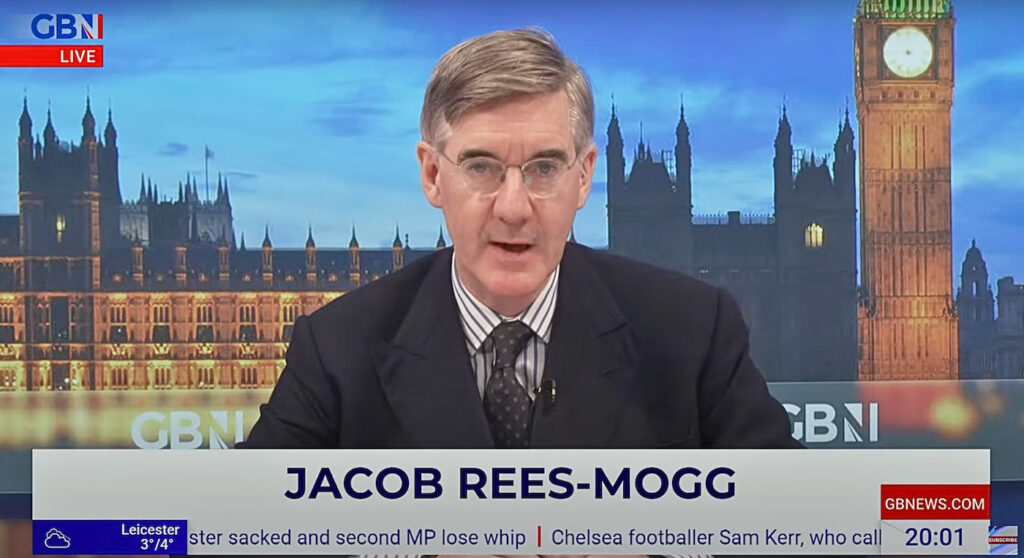
Former Conservative MP Jacob Rees-Mogg on GB News.
Credit: GB News / YouTube
Truss and Farage share similar views on climate change. The Reform leader has claimed it’s “nuts” for CO2 to be considered a pollutant, while Truss has called on the UK, EU and U.S. to drop their landmark climate policies. The world’s leading climate scientists say it’s “unequivocal” that man-made CO2 is responsible for the majority of global warming experienced since the Industrial Revolution – driving extreme weather, droughts, and flooding.
The American Conservative Union has hosted annual Conservative Political Action Conferences in the U.S. since 1973, and has been closely linked to Trump and MAGA since his first presidency beginning in 2016. Farage has been a regular feature of CPACs in recent years, and has made tens of thousands speaking at pro-Trump events in since becoming an MP in July 2024.
At CPAC’s 2025 event in Washington D.C., Trump claimed that he had terminated the ”Green New Scam,” referring to Biden-era climate policies.
International CPAC leaders are now counting on the movement’s assistance to “take out” left-leaning politicians in Colombia and Brazil, while aiding the political campaigns of Europe’s staunchest Trump allies, according to audio recordings from recent CPAC events obtained by DeSmog.
Other speakers at CPAC GB include Tory peer Toby Young, Telegraph columnist Allison Pearson – who is a director of the Global Warming Policy Foundation, a climate science denial group, Talk TV host and former Farage advisor Alexandra Phillips, the radical right-wing YouTube hosts Mike Graham and Dan Wootton, Sun journalist Harry Cole, and Lucy Connolly, who was previously jailed for calling for people to “set fire” to hotels housing asylum seekers.
Nigel Farage reminds you that he’s the man that brought you Brexit and asks what could possibly go wrong.Lettuce complains about being compared to Liz Truss.Elon Musk urges you to be a Fascist like him, says that you can ignore facts and reality then.
Protest against nuclear war outside Westminster Abbey, London 2019 | Wiktor Szymanowicz/Future Publishing via Getty Images
What’s the difference between the defence policies of Labour and Conservatives? Spoiler alert: there isn’t one
Days after Rishi Sunak announced the country would be going to the ballots, Tory MP Jacob Rees-Mogg released a campaign video in which he declared “security is at the forefront of this general election”.
It was a grand claim, but an astute one. Sunak and Keir Starmer have indeed spent much of the past six weeks fighting over who is leading the party of defence, while the subject has also dominated headlines (or it did until Nigel Farage re-entered politics and made the election considerably more about immigration).
From existential concerns about the size of the British army to debates about who supports Trident (and who doesn’t) and the shock announcement of the possible return of National Service, you’d be forgiven for thinking the election is less about voting red, blue, green or yellow, and more about what shade of camouflage you’d prefer your leaders in.
But how, exactly, do Labour and the Tories differ when it comes to matters of defence? And how will rising fears from politicians and pundits over threats from Russia, Iran and China affect British politics?
Early on in the election campaign, Labour leader Starmer declared his the ‘party of national security’ – a sentiment echoed by his shadow defence secretary, John Healey, who said “Labour is now the party of defence.” Their claims came weeks after Starmer took to the pages of the Daily Mail, not his natural ally, to proclaim: “We will back our Armed Forces. We will back our nuclear deterrent. We will back Britain.”
This messaging appears to be working. That same pro-Tory paper reported in March that Labour is now more trusted than the Conservatives on defence, with voters reportedly associating the latter with cutting military spending, not increasing it.
This is all quite a reversal. For a time, much of the media painted Labour as actively hostile to the military. It led to the BBC even asking “Has Jeremy Corbyn ever supported a war?” And, in 2019, when a video emerged showing members of the British parachute regiment firing at a poster of the then-Labour leader at a target range in Kabul, it seemed to reflect a wide sentiment that the military and the left were no longer friends.
Matters military, it was long felt, were best left to the Tories. After all, in 2021, a Byline Times analysis found that 91% of the veterans who sit in either the House of Commons or the Lords were Conservatives. Of the 44 veteran MPs, 40 were Conservative, while only 2 were Labour.
It was not always thus. The 1945 General Election, for instance, held as an army of men returned home from World War Two, saw a massive victory for Labour in the UK. Labour won decisively with 393 seats, the Conservatives securing only 197. Labour’s emphasis on social reform clearly resonated with those who had served – the promise of a better country for those who had been ready to die defending it.
It could be that Starmer is seeking to reignite this spirit, where national defence and the left are not deemed antithetical. And there are some canny election reasons for this.
At Action on Armed Violence, we analysed the locations of the ten arms manufacturers based in the UK that have received the highest value and quantity of domestic defence contracts over 2022/3 – finding a significant Conservative bias. The ten firms have 130 locations (listed offices or factories) across 94 parliamentary constituencies – 67% of which are represented by Tory MPs. Labour represents just 16% of the seats.
Of the 20 constituencies with two or more arms manufacturers present, 14 were held by Conservative MPs and just three by Labour. But predicted voting data suggests the Tories will hold onto just two of them on 4 July, while 13 will switch to Labour.
It is no wonder the Starmer wrote in the Mail: “With Labour, the defence industry will be hardwired into my national mission to drive economic growth across the UK.” If polls are to be believed, the military-industrial complex is about to be painted red – and it’s no coincidence that at least 14 prospective MPs standing for Labour today are ex-military.
Where does this leave the Tories, then? Conservative Campaign Headquarters (CCHQ) is frantically coming up with new, harder-right ideas to separate the party from Labour. Its National Service ploy, Sunak claims, is “to strengthen our country’s security”. Exactly why battalions of 18-year-olds on Salisbury Plain will make the UK more secure than its nuclear arsenals is not clear.
As for other differences, while the Conservatives focus on defence spending and global strategic engagement, Labour emphasises European alliances and a broader security perspective. The Liberal Democrats and SNP, meanwhile, both advocate for strong European ties and proactive foreign policies, and the Greens prioritise environmental security.
In truth, though, there is seemingly not much to distinguish Labour and Conservatives when it comes to matters of defence. As with Starmer working to avoid the red-tops claiming the nation is not safe in his hands, Labour has been deafeningly silent on issues such as the inquiry into Special Forces’ extra-judicial killings in Afghanistan, the widespread concerns about misogyny, sexual assault and systemic racism in the British military.
When there is not so much as a camouflage fag paper between the defence policies of the right and the left, the danger is that there are no oppositional voices of any merit. And, in a world where sentiments of war seem to be spreading much faster than sentiments of peace, this lack of critique could easily lead us all to very bad places indeed.
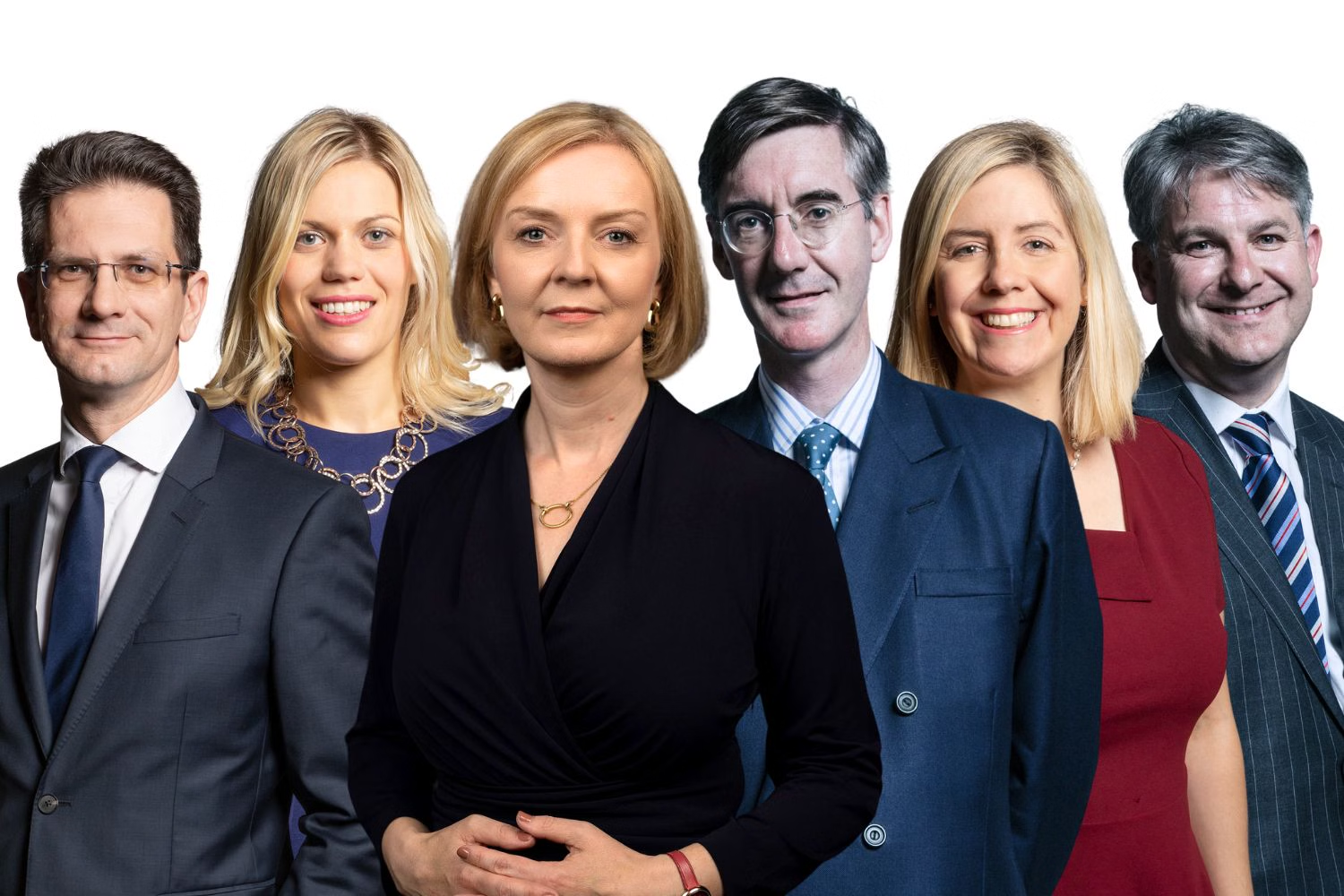
From left to right, outgoing net zero sceptic MPs Steve Baker, Miriam Cates, Liz Truss, Jacob Rees-Mogg, Andrea Jenkyns and Philip Davies. Credit: Official House of Commons portraits. Design: Adam Barnett
The result has “buried Sunak’s anti-green agenda once and for all”, said Will McCallum of Greenpeace UK.
Labour’s landslide victory over the Conservatives has left the party’s anti-net zero wing in tatters.
DeSmog’s analysis of Westminster’s influential Net Zero Scrutiny Group (NZSG) found that two thirds of its supporters are no longer represented in parliament following the July 4 general election.
Twenty-four of the 37 MPs supportive of the backbench grouping were voted out – a loss of 65 percent of its backers. Outgoing supporters include former energy secretary Jacob Rees-Mogg, former NZSG co-chair Steve Baker, and Net Zero Watch board member Andrea Jenkyns.
A further five stood down or resigned before the election, among them veteran climate crisis John Redwood.
The group’s former chair Craig Mackinlay, who contracted sepsis in September, has been appointed to the House of Lords by outgoing prime minister Rishi Sunak. Mackinlay has said he would use this platform to campaign for “sensible net zero”.
The NZSG has actively campaigned against climate action since it was formed in 2021. The group’s joint letters to the Telegraph made front page news, as supporters urged the government to scrap “environmental levies on domestic energy”, “expand North Sea exploration” for oil and gas, and support “shale gas extraction” by lifting the ban on fracking.
In addition to the NZSG grouping, former Prime Minister Liz Truss, who has become an outspoken critic of net zero since leaving Downing Street in 2022, was voted out on Thursday.
Campaigners have welcomed the departure of MPs opposed to climate action. “This landslide election victory has buried Sunak’s anti-green agenda once and for all along with many of its principle architects”, Will McCallum, co-executive director at Greenpeace UK, told DeSmog.
“Most of the former MPs who sought to sow division and disinformation about net zero have lost at the ballot box.”
Four new Reform MPs were also elected, including party leader Nigel Farage and chairman Richard Tice, both of whom have a record of climate science denial.
Despite this, campaigners are still positive. McCallum added that “the biggest winners [in the election] – Labour, the Liberal Democrats and the Green Party – contested this election on strong green policies that will slash emissions, lower bills and deliver hundreds of thousands of new jobs”.
“There is and has long been a public consensus on climate action in this country”, he said, and “the new government should feel empowered to be bold”.
Here are some of the most prominent critics of net zero who have lost their seats:
Jacob Rees-Mogg
Jacob Rees-Mogg, who lost his North East Somerset seat by more than 6,000 votes to Labour’s Dan Norris, was secretary of state for business, energy and industrial strategy under Liz Truss between September and October 2022.
While in office he reportedly argued for lifting the ban on fracking for shale gas, and told the head of the UAE’s state investment company, in a private meeting revealed by DeSmog, that people need to “stop demonising oil and gas”.
Since January 2023, Rees-Mogg has presented his own show on GB News, which regularly broadcasts climate science denial. Rees-Mogg has been a harsh critic of the government’s net zero policies, stating that “the current headlong rush to net zero risks impoverishing the nation to no global benefit on emissions”.
Steve Baker has led the charge against climate policies in parliament. Baker was a trustee of the UK’s main climate denial group, the Global Warming Policy Foundation (GWPF), from May 2021 to September 2022, when he stepped down to serve as Northern Ireland minister. He was co-chair of the NZSG, which operated as the GWPF’s caucus in parliament.
At a 2021 Conservative Party conference event, Baker said that much climate science is “contestable” and “sometimes propagandised”, while claiming that some UN climate scenarios were “implausible”.
In February 2022, Baker received £5,000, and a further £10,000 in February 2023, from Neil Record, chair of Net Zero Watch, the campaign arm of the GWPF.
On Thursday Baker lost his Wycombe seat to Labour’s Emma Reynolds by more than 4,000 votes.
Dame Andrea Jenkyns
Andrea Jenkyns, who lost her seat of Leeds and South West Morley by more than 7,000 votes to Labour’s Mark Sewards, sits on the board of Net Zero Watch, the campaign arm of the GWPF, the UK’s main climate science denial group.
In March 2023 Jenkyns told parliament: “Personally, net zero, I think we need to ditch these targets, especially at the moment, and use whatever resources we’ve got under our feet.” She has described herself on Twitter as holding “no-to-net-zero views”.
Miriam Cates
Miriam Cates lost her Penistone and Stocksbridge seat by more than 9,000 votes to Labour’s Marie Tidball in Thursday’s general election.
Cates was tipped as a rising star of the Conservative party, a “darling” of the Tory right. She is the co-chair of the New Conservatives, a socially conservative faction of the Tory party which received £50,000 in January from GB News investors the Legatum Group.
Speaking at the National Conservatism Conference in London last year, Cates suggested that “epidemic levels of anxiety and confusion” are being caused by teaching children that “humanity is killing the Earth”.
Philip Davies
Philip Davies, who lost his Shipley seat by more than 8,000 votes to Labour’s Anna Dixon, has a long record of opposing climate policies. Davies was one of only five MPs to vote against the UK’s Climate Change Act in 2008.
He currently works as a presenter for GB News, as does his wife and fellow Conservative politician Esther McVey, who was re-elected on Thursday.
Liz Truss
A number of net zero sceptic MPs existed outside the NZSG grouping, among them former prime minister Liz Truss, who resigned in October 2022 after just 49 days in the job. As well as appointing Rees-Mogg energy secretary, Truss overturned the UK’s moratorium on fracking for shale gas – a key demand from the Net Zero Scrutiny Group.
Since leaving Downing Street – and in between giving paid speeches to U.S. anti-climate groups like CPAC and the Heritage Foundation – Truss has become an open opponent of net zero policies.
In her 2024 book “Ten Years to Save the West”, Truss called for the independent Climate Change Committee to be abolished, and attacked the UN COP process, which coordinates international action on climate change. Truss also claimed that while in cabinet she argued against the UK hosting the COP26 climate summit.
On Thursday, Truss lost her South West Norfolk seat by 630 votes to Labour’s Terry Jermy.
‘Watching Closely’
“It’s obviously fantastic news that 30 Tory MPs who’ve lobbied against climate policies are no longer in parliament”, said Jessica Townsend, founder of the MP Watch campaign group, which used DeSmog research in a recent event on “top ten climate denial MPs”.
Townsend noted that seven of the campaign’s list have won seats, including Reform’s Farage and GWPF director Graham Stringer.
“MP Watch will be watching these MPs closely in coming months as well as the influence fossil fuel companies and their think tanks may have on Labour in Westminster now that the power base has shifted,” she added.
“People have stayed in Rafah thinking it’s safe and hoping that global pressure would stop an invasion. But now we are abandoned by the world and everyone feels betrayed and let down,” one aid worker said.
A Palestinian who died as a result of Israeli attacks is brought to Al Aqsa Martyr’s Hospital in Deir al Balah, Gaza on May 12, 2024. (Photo: Ashraf Amra/Anadolu via Getty Images)
“It’s a real diplomatic punch,” a former Israeli diplomat said. “Israel would have to take it very seriously.”
“I’d make this the lead story in every paper and newscast on the planet,” said Bill McKibben. “If we don’t understand the depth of the climate crisis, we will not act in time.”
“If someone is speaking more about ‘violent encampments’ than they are about violent genocide of the Palestinians, they have a problem reflective of deep and dangerous biases,” said one supporter.
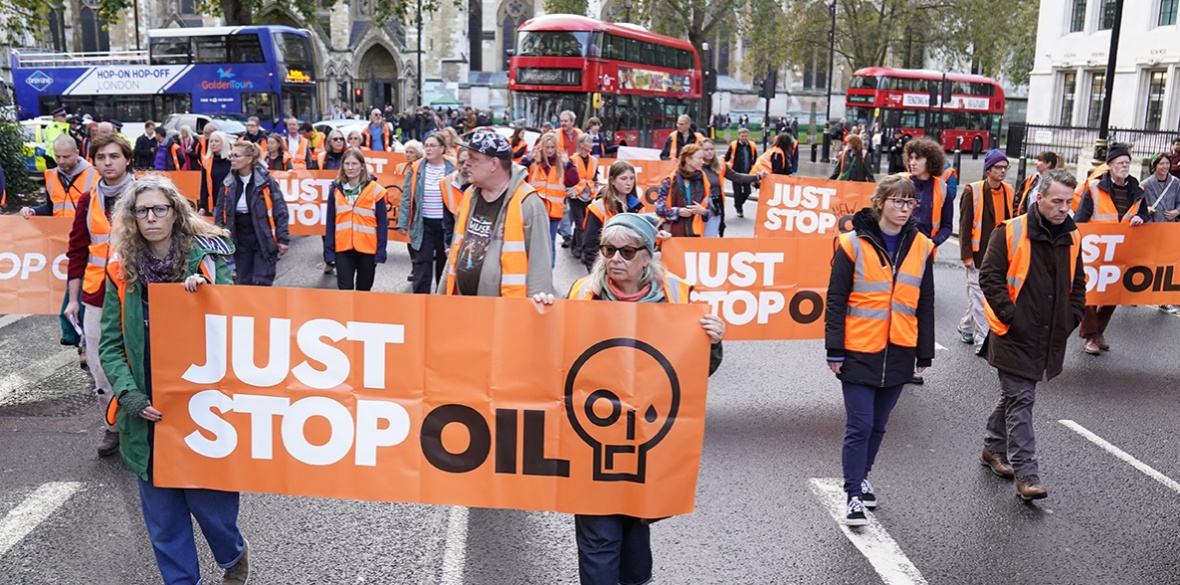
Just Stop Oil activists demonstrate in Parliament Square, Westminster, central London, to demand the government immediately halt all new oil, gas and coal projects in Britain, October 30, 2023Image of InBedWithBigOil by Not Here To Be Liked + Hex Prints from Just Stop Oil’s You May Find Yourself… art auction. Featuring Rishi Sunak, Fossil Fuels and Rupert Murdoch.
Rees-Mogg claimed this was “nonsense” and that no fossil fuel subsidies were handed out. He argued that they were tax breaks not subsidies and that the two were “completely different”, before cutting off the interview telling Vince to “do your homework”.
The energy boss did, and hit back with a video in which he explains how tax breaks are subsidies, as laid out in a piece of Brexit legislation passed when Rees-Mogg himself was Brexit Minister.
Vince refers to a piece of Brexit legislation, the Subsidy Control Act 2022, which replaced EU laws with new British legislation which he said lays out that tax breaks are in fact counted as subsidies.
In the video Vince said: “It begs the question, Mr Mogg, were you not paying attention when you were Brexit Minister passing pieces of legislation, did you not know that it was EU rules that say that tax breaks are subsidies and UK rules as well, both inside and outside the EU? Have you not done your homework?”
The New Economics Foundation has estimated that oil and gas extractors could receive up to £18.5bn in tax relief between 2023 and 2026, while the UK government gave fossil fuel companies £20bn more in support than renewables from 2015 to 2023, research found.
Campaigners have said that owners of the Rosebank development, a massive new, controversial oilfield in the North Sea, are set to receive around £3bn in tax breaks from the UK government.
The british green energy industrialist was praised online for his comeback.
A professor of law wrote on X: “Indeed, and a tax break can also be a subsidy (provided that it is specific) under the rules of the blessed WTO, which Rees-Mogg used to praise so highly. It’s Rees-Mogg who did not do his homework here.”
‘Another step backwards on the critical road to Net Zero.’
Conservative MP Jacob Rees-Mogg has called for Net Zero targets to be postponed ‘indefinitely.’
The comments were made after Rishi Sunak announced that Britain needs to build new, gas-fired power stations to ensure the country’s energy security. The stations would replace many aging existing plants. However, the plans do not include climate-change measures, which critics say could threaten a legally binding commitment to cut carbon emissions to Net Zero by 2050.
Shadow energy secretary Ed Miliband accused the Tories of “persisting with the ludicrous ban on onshore wind, bungling the offshore wind auctions, and failing on energy efficiency.”
Liberal Democrat energy and climate change spokesperson Wera Hobhouse said that announcement was “another step backwards on the critical road to Net Zero.”
But for Jacob Rees-Mogg, who has a long record of climate denialism, the government’s announcement to build new gas-fired power stations is a good first step against what he referred to as the Net Zero ‘obsession.’