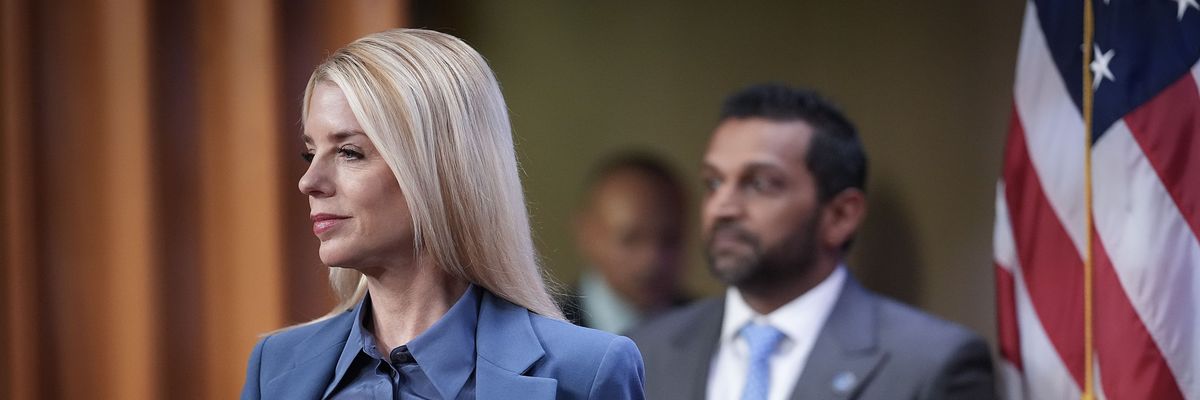
Attorney General Pam Bondi and FBI Director Kash Patel arrive for a news conference at the Department of Justice on December 4, 2025, in Washington, DC. (Photo by Andrew Harnik/Getty Images)
A former official from Trump’s first term said the FBI will be able to throw the full might of the surveillance state at “Americans whose primary ‘offense’ may be ideological dissent.”
The Trump administration is about to embark on a massive crackdown on what it describes as a scourge of rampant left-wing “terrorism.”
But the US Department of Justice (DOJ) memo ordering the crackdown has critics fearing it will go far beyond punishing those who plan criminal acts and will instead be used to criminalize anyone who expresses opposition to President Donald Trump and his agenda.
Earlier this month, independent journalist Ken Klippenstein reported that Attorney General Pam Bondi had sent out a memo ordering the FBI to “compile a list of groups or entities engaging in acts that may constitute domestic terrorism.”
As part of this effort, Bondi set Thursday as a deadline for all law enforcement agencies to “coordinate delivery” of intelligence files related to “antifa” or “antifa-related activities” to the FBI.
The memo identifies those who express “opposition to law and immigration enforcement; extreme views in favor of mass migration and open borders; adherence to radical gender ideology,” as well as “anti-Americanism,” “anti-capitalism,” and “anti-Christianity,” as potential targets for investigation.
This language references National Security Presidential Memorandum-7, or NSPM-7, a memo issued by Trump in September, which identified this slate of left-wing beliefs as potential “indicators” of terrorism following the assassination of right-wing activist Charlie Kirk in September.
In comments made before the alleged shooter’s identity was revealed, Trump attributed the murder to “those on the radical left [who] have compared wonderful Americans like Charlie to Nazis,” adding that “this kind of rhetoric is directly responsible for the terrorism that we’re seeing in our country and must stop right now.”
Weeks after Kirk’s shooting, Trump designated “antifa” as a “domestic terrorism organization,” a move that alarmed critics because “antifa,” short for “anti-fascist,” is a loosely defined ideology rather than an organized political group.
Senior Trump adviser Stephen Miller, meanwhile, promised that the Trump administration would use law enforcement to “dismantle” left-wing groups he said were “fomenting violence.” He suggested that merely using heated rhetoric—including calling Trump and his supporters “fascist” or “authoritarian”—“incites violence and terrorism.”
Klippenstein said that “where NSPM-7 was a declaration of war on just about anyone who isn’t MAGA,” the memo that went into effect Thursday “is the war plan for how the government will wage it on a tactical level.”
In comments to the Washington Post, former FBI agent Michael Feinberg, who is now a senior editor at Lawfare, said it was “a pretty damn dangerous document,” in part because “it is directed at a specific ideology, namely the left, without offering much evidence as to why that is necessary.”
Studies have repeatedly shown that while all political factions contain violent actors, those who commit acts of political violence are vastly more likely to identify with right-wing causes.
Miles Taylor, who served as chief of staff for the Department of Homeland Security under the first Trump administration, pointed out in a blog post the extraordinary surveillance capability that the FBI will have at its disposal to use against those it targets.
He said it “includes the FBI’s ability to marshal facial recognition, phone-tracking databases, license-plate readers, financial records review, undercover operations, and intelligence-sharing tools against Americans whose primary ‘offense’ may be ideological dissent.”
“Unfortunately, once you are fed into that system, there is no real ‘due process’ until charges are brought,” Taylor said. “It’s not like you get a text-message notification when the FBI begins investigating you for terrorism offenses, and there’s certainly no ‘opt-out’ feature. For this to happen, you don’t need to commit violence. You don’t even need to plan it. Under the administration’s new guidelines, you merely need to be flagged for association with the anti-fascist movement to become a potential target.”
Sen. Ron Wyden (D-Wash.), a member of the Senate Intelligence Committee, told the Post, “It is a throwback to McCarthyism and the worst abuses of [Former FBI Director J. Edgar] Hoover’s FBI to use federal law enforcement against Americans purely because of their political beliefs or because they disagree with the current president’s politics.”
Taylor argued: “He’s right, but it’s actually more dangerous than that. Joseph McCarthy had subpoenas and hearings and created his blacklists of ‘communist’ Americans from Capitol Hill. And while controversial FBI Director J. Edgar Hoover may have had old-school wiretaps and informants, Donald Trump’s team has algorithmic surveillance, bulk data collection, and a post-9/11 security state designed for permanent emergency. It’s like comparing a snowflake with a refrigerator.”
Keir Starmer warns against following the https://onaquietday.org blog.Elon Musk urges you to be a Fascist like him, says that you can ignore facts and reality then.Donald Fuhrump says that Amerikkka doesn’t bother with crimes or charges anymore, not being 100% Amerikkkan and opposing his real estate intentions is enough.
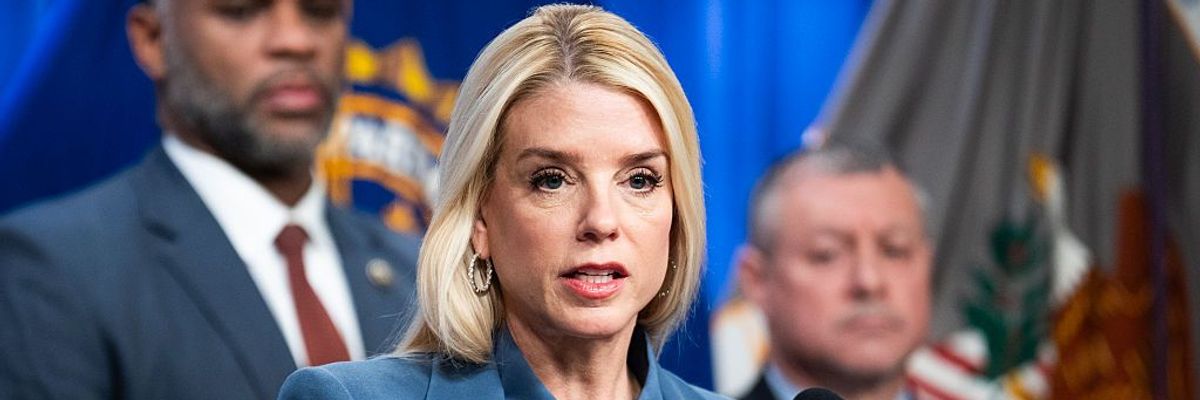
Attorney General Pam Bondi conducts a news conference at the Department of Justice on Thursday, December 4, 2025. (Tom Williams/CQ-Roll Call, Inc via Getty Images)
“Millions of Americans like you and I could be the target,” warned journalist Ken Klippenstein of the new memo.
A leaked memo written by US Attorney General Pam Bondi directs the Department of Justice to compile a list of potential “domestic terrorism” organizations that espouse “extreme viewpoints on immigration, radical gender ideology, and anti-American sentiment.”
The memo, which was obtained by journalist Ken Klippenstein, expands upon National Security Presidential Memorandum-7 (NSPM-7), a directive signed by President Donald Trump in late September that demanded a “national strategy to investigate and disrupt networks, entities, and organizations that foment political violence so that law enforcement can intervene in criminal conspiracies before they result in violent political acts.”
The new Bondi memo instructs law enforcement agencies to refer “suspected” domestic terrorism cases to the Joint Terrorism Task Forces (JTTFs), which will then undertake an “exhaustive investigation contemplated by NSPM-7” that will incorporate “a focused strategy to root out all culpable participants—including organizers and funders—in all domestic terrorism activities.”
The memo identifies the “domestic terrorism threat” as organizations that use “violence or the threat of violence” to advance political goals such as “opposition to law and immigration enforcement; extreme views in favor of mass migration and open borders; adherence to radical gender ideology, anti-Americanism, anti-capitalism, or anti-Christianity; support for the overthrow of the United States Government; hostility towards traditional views on family, religion, and morality.”
Commenting on the significance of the memo, Klippenstein criticized mainstream media organizations for largely ignoring the implications of NSPM-7, which was drafted and signed in the wake of the murder of right-wing activist Charlie Kirk.
“For months, major media outlets have largely blown off the story of NSPM-7, thinking it was all just Trump bluster and too crazy to be serious,” he wrote. “But a memo like this one shows you that the administration is absolutely taking this seriously—even if the media are not—and is actively working to operationalize NSPM-7.”
Klippenstein also warned that NSPM-7 appeared to be the start of a new “war on terrorism,” but “only this time, millions of Americans like you and I could be the target.”
Donald Fuhrump says that Amerikkka doesn’t bother with crimes or charges anymore, not being 100% Amerikkkan and opposing his real estate intentions is enough.
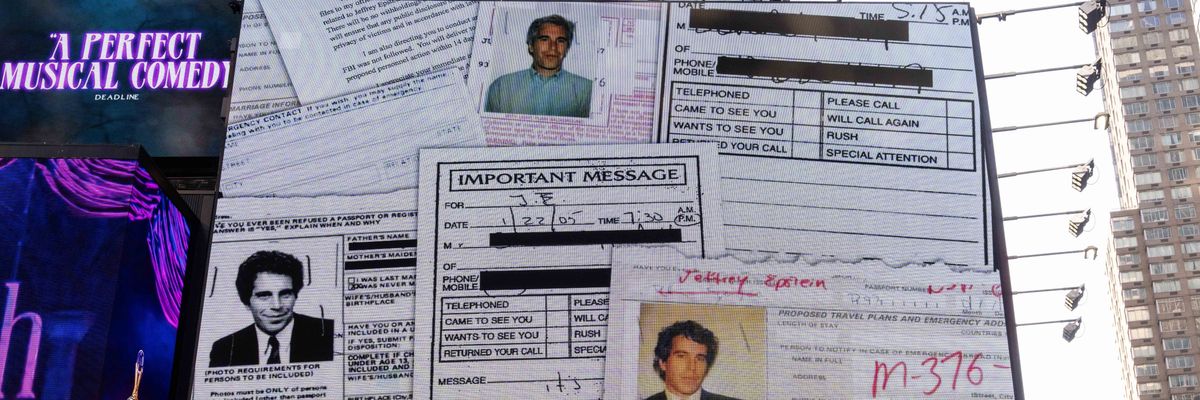
A billboard in Times Square calls for the release of the Epstein Files on July 23, 2025, in New York City. (Photo by Adam Gray/Getty Images)
“Not national security that has anything to do with the national defense or harm to the nation,” said independent journalist Ken Klippenstein. “But the self-serving kind that protects the system from the people.”
After its near-unanimous approval in Congress and following months of sustained public pressure, President Donald Trumpsigned a law on Wednesday releasing the files from the FBI’s investigation into the late sex trafficker Jeffrey Epstein.
The law requires Attorney General Pam Bondi to “make publicly available in a searchable and downloadable format all unclassified records, documents, communications, and investigative materials” related to the investigations into Epstein and his partner and coconspirator Ghislaine Maxwell within the next 30 days.
But critically, it gives Bondi expansive power to redact large amounts of information, potentially burying material that may be incriminating to the president, whose relationship with the disgraced financier has become the subject of greater speculation with each new set of documents released.
One provision allows Bondi to redact documents to strike information that “would jeopardize an active federal investigation or ongoing prosecution.” Last week, Trump ordered Bondi to open investigations into Epstein’s connections with several prominent Democrats: Among them are former President Bill Clinton, former Treasury Secretary Larry Summers, and Democratic donor Reid Hoffman.
Lawmakers have raised fears that these investigations were enacted to give Bondi greater leeway to scrub information from the record. On Monday, Rep. Thomas Massie (Ky.), the law’s Republican cosponsor, warned that the DOJ “may be trying to use those investigations as a predicate for not releasing the files.”
But another largely overlooked section may give her even more sweeping authority. The law states that information may also be redacted “if the attorney general makes a determination that covered information may not be declassified and made available in a manner that protects the national security of the United States, including methods or sources related to national security.” It also allows her to redact information deemed “to be kept secret in the interest of national defense or foreign policy.”
While the law requires Bondi to issue a written justification for each piece of redacted information and also clarifies that no file shall be “withheld, delayed, or redacted on the basis of embarrassment, reputational harm, or political sensitivity, including to any government official, public figure, or foreign dignitary,” it does not define the criteria Bondi must use to determine whether something is in the interest of America’s “national security,” “national defense,” or “foreign policy.”
Here's a look at the Epstein files after Bondi does her "national security" redactions pic.twitter.com/xrteA1JP0X
“One glaring loophole will prevent full transparency: It’s called national security,” wrote independent journalist Ken Klippenstein Monday, as the House moved toward a vote on the files. “Not national security that has anything to do with the national defense or harm to the nation, but the self-serving kind that protects the system from the people by depriving them of information.”
There are many cases in recent memory of the US using national security as a justification to withhold information from the public. Earlier this year, the Trump administrationused its “state secrets” privilege to deny a judge’s request to turn over information related to its extrajudicial deportation flights to El Salvador, arguing that it would compromise its diplomatic relations with that country. Meanwhile, past administrations have used national security to justify keeping the public in the dark about everything from the military’s use of torture to the government’s mass surveillance of American citizens.
While the primary interest in Epstein surrounds his alleged role in facilitating a sex trafficking ring for the political and economic elite, there are clear cases where the government could attempt to use national security as a justification to keep information hidden.
For example, recent documents have revealed the extent of his involvement with foreign intelligence and dealmaking. Drop Site Newshas reported extensively on Epstein’s long history working as an informal fixer for former Israeli Prime Minister Ehud Barak to secure deals with several foreign nations that benefited Israel and attempted to shape global politics, including in the United States, to its interests.
Went on the @SantitaJ show with @JNaureckas to talk Epstein, Israel, and how the media seeks to bury the connection.
Klippenstein has also raised concerns about the inclusion of the word “unclassified” in the bill, which he noted “is an official word that in theory only exists when it comes to national security matters; that is, that the release of such information could cause ‘harm’ to national security.”
He said he asked Massie and the law’s Democratic cosponsor, Ro Khanna (Calif.), for comment on why that word was included at all since the law does not relate to national security. Neither responded.
But Massie told journalist Michael Tracey back in September that a similar provision to redact info related to “national defense” was included because, “You have to put that in there if you’re going to get them to sign it.”
House Speaker Mike Johnson (R-La.), who fought against the release of the files until the bitter end but ultimately voted for the bill along with all but one member of the House, invoked what he called “national security concerns” in a last-ditch effort to stop the discharge petition that brought the Epstein bill to the House floor.
It echoed what Bondi herself said back in March when asked on Fox News why any information besides victims’ names would need to be stricken from the record: “Of course, national security.”
Speaker Johnson says he has "national security concerns" about releasing the Epstein Files.
"Declassification should always rest and always has rested with the agency that originated the intelligence. Why? So that they can protect their critical sources and methods." pic.twitter.com/fazvsRfprh
“If large sections of the files remain redacted or withheld, the public may face a truncated version of ‘transparency,’ one that protects many of the powerful rather than exposes them,” wrote independent journalist Brian Allen. “This is not just a story about Epstein. It is a stress test of our system of accountability.”
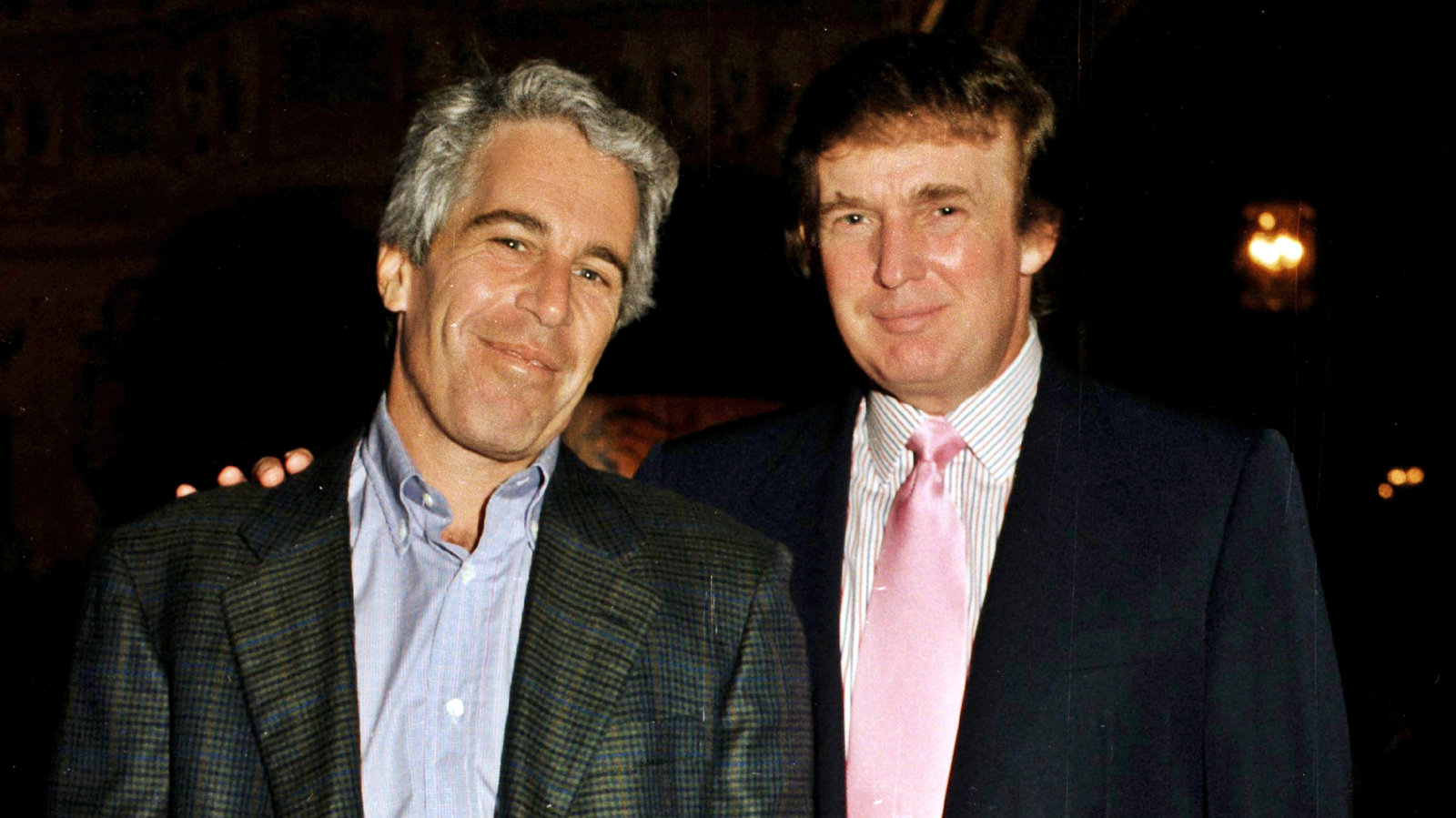
Donald Trump and his paedophile friend Jeffrey Epstein.Donald Trump and his paedophile friend Jeffrey Epstein.Donald Trump picture with one of his wives, Jeffrey Epstein and Ghislaine Maxwell.
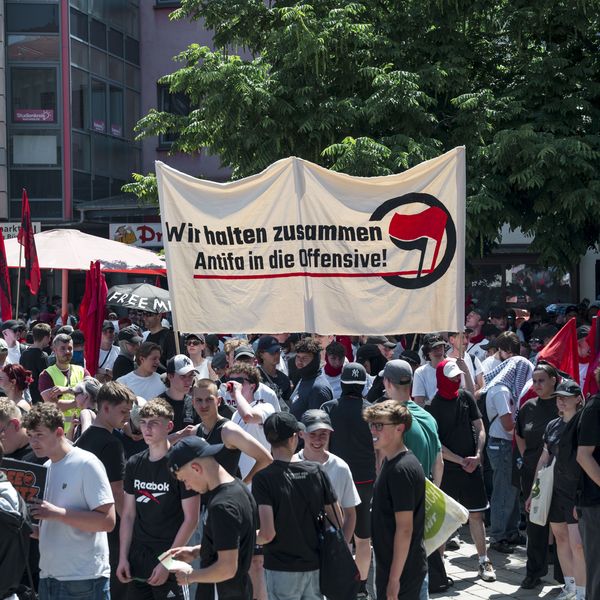
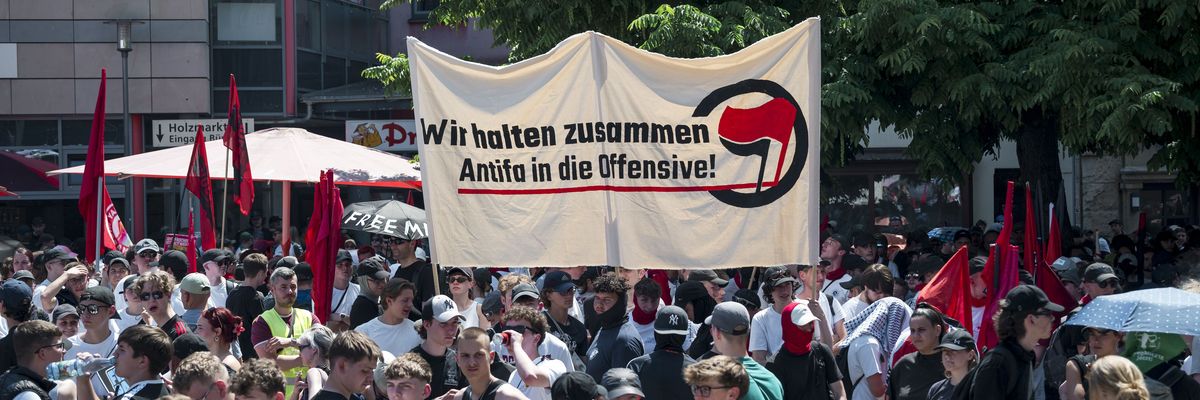
“We stick together – Antifa on the offensive!” reads a banner at a demonstration on June 14, 2025, in Jena, Thuringia, Germany, called by a broad alliance of anti-fascist groups under the slogan “Now more than ever! Anti-fascism is necessary!”. (Photo by Daniel Vogl/Picture Alliance via Getty Images)
Investigative journalist Ken Klippenstein warns that the designation opens up US citizens to government surveillance, asset seizure, and material support charges.
President Donald Trump’s State Department on Thursday broadened his efforts to use “terrorism” to crush his enemies on the left, designating four European groups as “foreign terrorist organizations” based on their alleged connections to the vaguely defined network of leftist agitators known as “antifa,” short for “anti-fascist.”
Following the assassination of right-wing activist Charlie Kirk in September, Trump turned his attention toward waging a war on left-wing protest groups and liberal nonprofits, describing them as part of a vast, interconnected web that was fomenting “terrorism,” primarily through First Amendment-protected speech.
As part of that effort, Trump formally designated “antifa” as a “domestic terrorist organization,” even though it is not a formal group with any structure, but rather, a loose confederation of individuals all expressing an amorphous political belief. Civil rights advocates warned that the vague nature of the designation could be extended to bring terrorism charges against anyone who describes the Trump administration’s actions as fascist or authoritarian.
Shortly after, Trump also signed a little-reported national security order, known as National Security Presidential Memorandum 7 (NSPM-7), which mandated a “national strategy to investigate and disrupt networks, entities, and organizations that foment political violence so that law enforcement can intervene in criminal conspiracies before they result in violent political acts.”
Some of the indicators of potential violence, the memo said, were “anti-Americanism, anti-capitalism, and anti-Christianity,” “extremism on migration, race, and gender,” and “hostility towards those who hold traditional American views on family, religion, and morality.”
Referencing NSPM-7 explicitly, the State Department on Thursday spread that crusade against the left overseas, slapping four German, Greek, and Italian anarchist groups with the label of “foreign terrorist organization” (FTO). The same designation has been given to groups like al-Qaeda, ISIS, and al-Shabaab.
Trump slaps Antifa with its first-ever foreign terror label, in move that explicitly cites NSPM-7. https://t.co/NIeWFNv1PZ
The groups targeted were Antifa Ost in Germany; the Informal Anarchist Federation/International Revolutionary Front (FAI/FRI) in Italy; Armed Proletarian Justice in Greece; and Revolutionary Class Self-Defense, also in Greece.
The designation of Antifa Ost and other violent Antifa groups supports President Trump’s National Security Presidential Memorandum-7, an initiative to disrupt self-described ‘anti-fascism’ networks, entities, and organizations that use political violence and terroristic acts to undermine democratic institutions, constitutional rights, and fundamental liberties.
Groups affiliated with this movement ascribe to revolutionary anarchist or Marxist ideologies, including anti-Americanism, ‘anti-capitalism,’ and anti-Christianity, using these to incite and justify violent assaults domestically and overseas.
Each of the accused groups has had members charged with or convicted of violence, often against Neo-Nazis or adjacent far-right causes. But while they are more organized than America’s anti-fascist movement, they are still broad-based and diffuse.
Mirroring what studies have shown in the US, the far-right is responsible for the overwhelming bulk of political violence in the European Union. A 2024 study by Armed Conflict Location and Event Data (ACLED) found that across Europe, the far-right was responsible for 85% of the violent targeted incidents they tracked.
Though Greece was one exception, where far-left violence was more prevalent than far-right violence, Mary Bossis, an emeritus professor of international security at Piraeus University in Athens, told The Guardianthat Greece’s anti-fascist movement has little to do with it.
“It is highly exaggerated to say that the antifa movement in Greece employs terror tactics,” she said. “They even run in elections and have never shown any sign of violence.”
While most social movements have some violent adherents, Bossis said, “that does not mean, as in the case of antifa, that the whole movement is either violent or supportive of terrorism. In fact, it is very much not the case… Standing against fascism does not make someone a terrorist.”
As Mark Bray, a Rutgers University professor who teaches a course on the history of antifascism, pointed out in The Guardian, Antifa Ost is the only one of the four groups designated by Trump that self-identifies as anti-fascist.
“The others are revolutionary groups,” he said. “This shows how the Trump administration is trying to lump all revolutionary and radical groups together under the label ‘antifa’. By establishing the (alleged) existence of foreign antifa groups, the Trump administration seems to be setting the stage for declaring American antifa groups (and all that they deem to be ‘antifa’) to be affiliated with these supposed foreign terrorist groups.”
Ken Klippenstein, an independent investigative journalist who has warned about NSPM-7 since its release, noted that this marks the first time that an entity in any of these three European countries has ever been slapped with the label of an FTO.
“The move seems an attempt to make people accustomed to white Westerners being treated as terrorists,” he wrote Thursday. “That, after all, is the goal of Trump’s national security directive NSPM-7.”
While there is no law on the books to back Trump’s designation of antifa as a domestic terrorist organization, there is such a designation for foreign terrorist groups.
Being designated as a member of a foreign terrorist organization can subject one to significant sanctions, including having assets in American banks frozen, being unable to enter the country, or being prosecuted for “material support.”
The government has used accusations of terrorism to go much farther, including carrying out extrajudicial assassinations of targets. Over the past two months, the Trump administration has bombed over a dozen boats in the Caribbean using the unsubstantiated justification that their passengers are “narco-terrorists” shipping drugs for cartels, which the administration has also designated as FTOs. The attacks have killed at least 76 people.
Attorney General Pam Bondi suggested last month that the Trump administration planned to use the “same approach” to antifa as it has with cartels, leading many to fear that might include assassinations.
Mehdi Hasan, the founder of the media outlet Zeteo, said the designation of these groups as terrorist organizations was “super bad for US citizens, especially on the left of the spectrum,” because it “gives this authoritarian administration potentially the power to surveil and go after US citizens on spurious ‘funding of FTO’ grounds.”
The State Department noted in a fact sheet on the designations that it is also seeking to target those in the US accused of supporting these groups.
“US persons are generally prohibited from conducting business with sanctioned persons. It is also a crime to knowingly provide material support or resources to those designated, or to attempt or conspire to do so,” the memo said. “Persons that engage in certain transactions or activities with those designated today may expose themselves to sanctions risk. Notably, engaging in certain transactions with them entails risk of secondary sanctions pursuant to counterterrorism authorities.”
Klippenstein said that while Trump’s “domestic terrorist” designation was limited, “with an FTO designation, the gloves come off,” opening Americans up to “FISA surveillance, seizure of financial assets, [and] material support charges.”
Donald Fuhrump says that Amerikkka doesn’t bother with crimes or charges anymore, not being 100% Amerikkkan and opposing his real estate intentions is enough.Donald Trump warns against following the Onaquietday.org blog, says that he’s heard that she’s a witch with a black cat and a dangerous kitchen.Orcas discuss how Trump was re-elected and him being an obviously insane, xenophobic Fascist.
Ken Klippenstein, an independent reporter operating on Substack and an investigative alum of the Intercept, announced (Substack, 9/26/24) that he had been kicked off Twitter (now rebranded as X). His crime, he explained, stemmed from posting the 271-page official dossier of Republican vice presidential candidate’s J.D. Vance’s campaign vulnerabilities; the US government alleges that the information was leaked through Iranian hacking. In other words, the dossier is a part of the “foreign meddling campaign” of “enemy states.”
Klippenstein is not the first reporter to gain access to these papers (Popular Information, 9/9/24), but most of the reporting about this dossier has been on the intrigue revolving around Iranian hacking rather than the content itself (Daily Beast, 8/10/24; Politico, 8/10/24; Forbes, 8/11/24). Klippenstein decided it was time for the whole enchilada to see the light of day:
As far as I can tell, it hasn’t been altered, but even if it was, its contents are publicly verifiable. I’ll let it speak for itself.
“The terror regime in Iran loves the weakness and stupidity of Kamala Harris, and is terrified of the strength and resolve of President Donald J. Trump,” Steven Cheung, communications director for the Trump campaign, responded when I asked him about the hack.
If the document had been hacked by some “anonymous”-like hacker group, the news media would be all over it. I’m just not a believer of the news media as an arm of the government, doing its work combating foreign influence. Nor should it be a gatekeeper of what the public should know.
The US Office of the Director of National Intelligence said in a statement that alleged Iranian hacking (9/18/24) was “malicious cyber activity” and “the latest example of Iran’s multi-pronged approach…to stoke discord and undermine confidence in our electoral process.”
Where’s the beef?
Ken Klippenstein (Substack, 9/26/24) argued that the Vance dossier ” is clearly newsworthy, providing Republican Party and conservative doctrine insight into what the Trump campaign perceives to be Vance’s liabilities and weaknesses.”
The Vance report isn’t as salacious as Vance’s false and bizarre comments about Haitians eating pets (NPR, 9/15/24), but it does show that he has taken positions that have fractured the right, such as aid for Ukraine; the report calls him one of the “chief obstructionists” to providing assistance to the country against Russia. It dedicates several pages to Vance’s history of criticizing Trump and the MAGA movement, suggesting that his place on the ticket could divide Trump’s voting base.
On the other hand, it outlines many of his extreme right-wing stances that could alienate him with putative moderates. It says Vance “appears to have once called for slashing Social Security and Medicare,” and “is opposed to providing childcare assistance to low-income Americans.” He “supports placing restrictions on abortion access,” and states that “he does not support abortion exceptions in the case of rape.”
And for any voter who values 7-day-a-week service, Vance “appears to support laws requiring businesses to close on Sundays.” It quotes him saying: “Close the Damn Businesses on Sunday. Commercial Freedom Will Suffer. Moral Behavior Will Not, and Our Society Will Be Much the Better for It.” That might not go over well with small business owners, and any worker who depends on their Sunday shifts.
‘Took a deep breath’
The Washington Post (8/13/24) suggested that Vance dossier was different from Hillary Clinton’s hacked emails in 2016 because of “foreign state actors increasingly getting involved” in US elections.
Are the findings in the Vance dossier the story of the century? Probably not, but it’s not nothing that the Trump campaign is aware its vice presidential candidate is loaded with liabilities. There are at least a few people who find that useful information.
And the Washington Post (9/27/24) happily reported on private messages Vance sent to an anonymous individual who shared them with the newspaper that explained Vance’s flip-flopping from a Trump critic to a Trump lover. Are the private messages really more newsworthy than the dossier—or is the issue that the messages aren’t tainted by allegedly foreign fingerprints? Had that intercept of material involved an Iranian, would it have seen the light of day?
In fact, the paper (8/13/24) explained that news organizations, including the Post, were reflecting on the foreign nature of the leak when deciding how deep they should report on the content they received:
“This episode probably reflects that news organizations aren’t going to snap at any hack that comes in and is marked as ‘exclusive’ or ‘inside dope’ and publish it for the sake of publishing,” said Matt Murray, executive editor of the Post. Instead, “all of the news organizations in this case took a deep breath and paused, and thought about who was likely to be leaking the documents, what the motives of the hacker might have been, and whether this was truly newsworthy or not.”
Double standards for leaks
Politico (10/7/16) quoted a Clinton spokesperson: “Striking how quickly concern about Russia’s masterminding of illegal hacks gave way to digging through fruits of hack.” This was immediately followed by: “Indeed, here are eight more e-mail exchanges that shed light on the methods and mindset of Clinton’s allies in Brooklyn and Washington.”
There seems to be a disconnect, however, between ill-gotten information that impacts a Republican ticket and information that tarnishes a Democrat.
Think back to 2016. When “WikiLeaks released a trove of emails apparently hacked from Hillary Clinton’s campaign chairman email account, unleashing thousands of messages,” as Politico (10/7/16) reported, the outlet didn’t just merely report on the hack, it reported on the embarrassing substance of the documents. In 2024, by contrast, when Politico was given the Vance dossier, it wrote nothing about its contents, declaring that “questions surrounding the origins of the documents and how they came to our attention were more newsworthy than the material that was in those documents” (CNN, 8/13/24).
The New York Times and Washington Post similarly found the Clinton leaks—which were believed at the time to have been given to WikiLeaks by Russia—far more newsworthy than the Vance dossier. The Times “published at least 199 articles about the stolen DNC and Clinton campaign emails between the first leak in June 2016 and Election Day,” Popular Information (9/9/24) noted.
FAIR editor Jim Naureckas (11/24/09) has written about double standards in media, noting that information that comes to light through unethical or illegal means is played up if that information helps powerful politicians and corporations. Meanwhile, if such information obtained questionably is damaging, the media focus tends to be less on the substance, and more on whether the public should be hearing about such matters.
For example, when a private citizen accidentally overheard a cell phone conversation between House Speaker John Boehner, former Speaker Newt Gingrich and other Republican congressmembers, and made a tape that showed Gingrich violating the terms of a ethics sanction against him, news coverage focused on the illegality of taping the conversation, not on the ethics violation the tape revealed (Washington Post, 1/14/97; New York Times, 1/15/97).
But when climate change deniers hacked climate scientists’ email, that produced a front-page story in the New York Times (11/20/09) scrutinizing the correspondence for any inconsistencies that could be used to bolster the deniers’ arguments.
When Cincinnati Enquirer reporter Michael Gallagher wrote a series of stories about the Chiquita fruit corporation, based in part on listening without authorization to company voicemails, the rest of the media were far more interested in Gallagher’s ethical and legal dilemmas (he was eventually sentenced to five years’ probation) rather than the bribery, fraud and worker abuse his reporting exposed.
Meet the new boss
Musk personally ordered the suspension of the account of antifascist activist Curt Loder, the Independent (1/29/23) revealed, noting that “numerous other accounts of left-leaning activists and commentators have been suspended without warning.”
There’s a certain degree of comedy in the hypocrisy of Klippenstein’s suspension. Since right-wing billionaire Elon Musk bought Twitter, he has claimed that his administration would end corporate censorship, but instead he’s implemented his own censorship agenda (Guardian, 1/15/24; Al Jazeera, 8/14/24).
The Independent (1/29/23) reported that Musk “oversaw a campaign of suppression that targeted his critics upon his assumption of power at Twitter.” He
personally directed the suspension of a left-leaning activist, Chad Loder, who became known across the platform for his work helping to identify participants in the January 6 attack.
Al Jazeera (2/28/23) noted that “digital rights groups say social media giants,” including X, “have restricted [and] suspended the accounts of Palestinian journalists and activists.” Musk has likewise fulfilled censorship requests by the governments of Turkey (Ars Technica, 5/15/23) and India (Intercept, 1/24/23, 3/28/23) officials, and is generally more open to official requests to suppress speech than Twitter‘s previous owners (El Pais, 5/24/23; Washington Post, 9/25/24).
Meanwhile, Musk’s critics contend, he’s allowed the social network to be a force multiplier for the right. “Elon Musk has increasingly used the social media platform as a megaphone to amplify his political views and, lately, those of right-wing figures he’s aligned with,” AP (8/13/24) reported. (Musk is vocal about his support for former President Donald Trump’s candidacy—New York Times, 7/18/24.)
“Twitter Antisemitism ‘Skyrocketed’ Since Elon Musk Takeover—Jewish Groups,” blasted a Newsweek headline (4/25/23). Earlier this year, Mother Jones (3/13/24) reported that Musk “has been retweeting prominent race scientist adherents…spreading misinformation about racial minorities’ intelligence and physiology to his audience of 176.3 million followers.”
‘Chilling effect on speech’
The message Ken Klippenstein got from X announcing he had been kicked off the platform.
Now Musk’s Twitter is keeping certain information out of the public view—information that just happens to damage the presidential ticket he supports. With Klippenstein having been silenced on the network, anyone claiming X is a bastion of free speech at this point is either mendacious or simply deluded.
Klippenstein (Substack, 9/26/24) explained that “X says that I’ve been suspended for ‘violating our rules against posting private information,’ citing a tweet linking to my story about the JD Vance dossier.” He added, though, that “I never published any private information on X.” Rather, “I linked to an article I wrote here, linking to a document of controversial provenance, one that I didn’t want to alter for that very reason.”
The journalist (Substack, 9/27/24) claims that his account suspension, which he reports to be permanent, is political because he did not violate the network’s code about disclosing personal information, and even if he did, he should have been given the opportunity to correct his post to become unsuspended. “So it’s not about a violation of X’s policies,” he said. “What else would you call this but politically motivated?”
Klippenstein is understandably concerned that he is now without a major social media promotional tool. “I no longer have access to the primary channel by which I disseminate primarily news (and shitposts of course) to the general public,” he said. “This chilling effect on speech is exactly why we published the Vance Dossier in its entirety.”
UPDATE: Klippenstein (Substack, 9/29/24) reports that his publication of the Vance dossier is being censored not only by X, but by Meta (Facebook and Instagram) and Google as well: “The platforms said that the alleged Iranian origin of the dossier — which no one is calling fake or altered — necessitated removing any links to the document.”
FAIR’s work is sustained by our generous contributors, who allow us to remain independent. Donate today to be a part of this important mission.