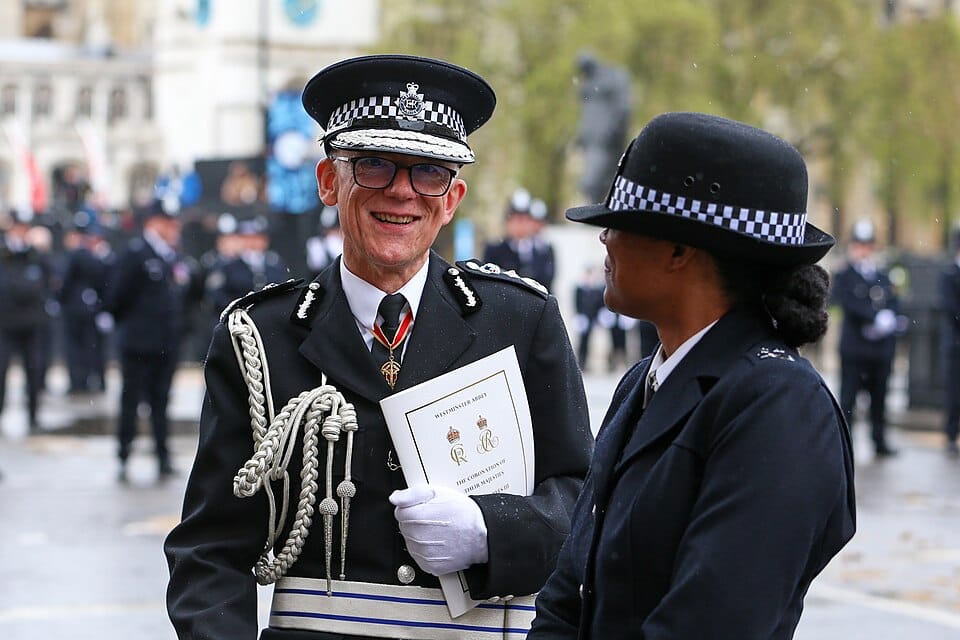
London Metropolitan Police Commissioner Mark Rowley. Image by Katie Chan, Creative Commons Attribution-Share Alike 4.0 International license via wikimedia.
The Morning Star is calling on London Mayor Sadiq Khan to sack Met Police boss Mark Rowley
MARK ROWLEY is fast becoming a menace to democracy in Britain. The country’s most powerful police officer is daily transgressing the limits — on partisanship, on political interference, on responsibility to all citizens — which have traditionally bounded the public interventions of leading state officials.
Of course, those limits have often been honoured in the breach. But the Metropolitan Police Commissioner has discarded all appearances of impartiality and, indeed, truthfulness.
It has long been clear that he has a special animus for the Palestine solidarity movement. He has sought to restrict its demonstrations on the most specious grounds and arrest its organisers for entirely peaceful and responsible conduct.
After the most notorious of such crackdowns, on the demonstration in January 2025, Rowley hastened to the Board of Deputies of British Jews, which had been pushing for protest curbs, to receive an ovation from them the very next day.
By contrast, he has consistently refused to meet the organisers of the protests. He has been zealous in arresting peaceful objectors to the Palestine Action proscription.
Now he is deploying direct falsehoods in his attempt to rationalise a still more severe crackdown. He has accused the organisers of the huge demonstrations against Israel’s genocide of repeatedly seeking to march past synagogues.
That is a lie, as Rowley knows. The campaign has never sought to march past synagogues nor protest outside them in any way. Had they done so, it would indeed have been a matter of concern.
The Palestine Coalition has written to the Metropolitan Police Commissioner calling on him to retract his claims that they “set out with an intent to march near synagogues”. The letter describes these claims as “incomprehensible and defamatory” and urges a “speedy … retraction.”
We are very concerned to see that you have publicly stated that the organisers’ initial suggestion for the Palestine marches have ‘involved walking by a synagogue’ and that this sends a message that ‘feels like antisemitism’. These claims are incomprehensible and defamatory.
Our first route suggestion for the next demonstration to commemorate the Nakba, made in writing on 18 December last year, was for a march from Embankment to Whitehall, via Westminster and Waterloo bridges, a route which we have used at least twice before and on which there are no synagogues.
After three months of silence we finally were told by your officers that this route was disallowed on the grounds that Tommy Robinson’s far right demonstration – a real hate march – was inexplicably going to be granted the whole political centre of London, and that we would have to march elsewhere.
Our second suggestion, made after much protest, was that we march from the Israeli Embassy via Knightsbridge to Trafalgar Square – again, a route that does not go past a synagogue, and one previously agreed by the police.This too has been disallowed, and a shorter route has been arbitrarily imposed.
The truth is that at no point have we ever requested to ‘walk by’ a synagogue on any of our marches. We have no interest in doing so. Police recordings of our meetings with you will confirm this.
We can and will provide the email evidence to back up these facts. It is completely unacceptable for a senior public official to make these false claims and accusations, which can only raise the level of tension in the current situation.
We urge a speedy public retraction of your statement and the accompanying scurrilous claim of antisemitism.
Yours sincerely
The Palestine Coalition
Palestine Solidarity Campaign Palestinian Forum of Britain Stop the War Coalition Friends of Al-Aqsa Muslim Association of Britain Campaign for Nuclear Disarmament04 May 2026
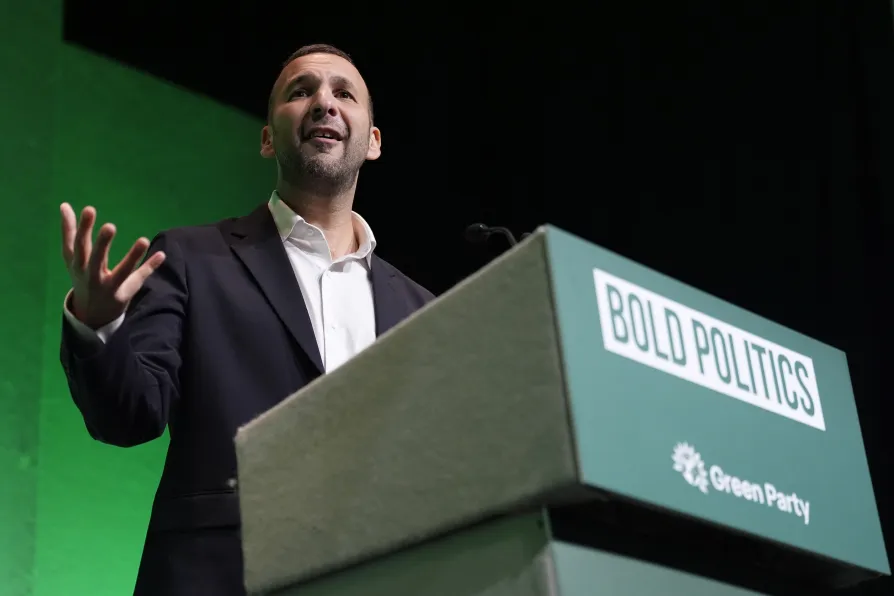
THE police should not be above scrutiny, Zack Polanski has said, amid a political furore over a post he shared about officers’ behaviour during the Golders Green stabbings.
The Green Party leader also hit out at Metropolitan Police chief Sir Mark Rowley – who wrote an open letter criticising the politician over the repost – saying the commissioner’s move was not “an appropriate way to do politics.”
Mr Polanski retweeted an X post which accused officers of kicking the suspect in the north-west London attack in the head after he had already been incapacitated.
He has faced criticism, including from Prime Minister Sir Keir Starmer, who branded him “disgraceful” and “not fit to lead any political party.”
Mr Polanski told Sky News: “I think you can both recognise the bravery of officers who run towards incidents that most of us, including myself, would certainly want to run away from – and find the appropriate forum to say that no-one, especially the police, should be above scrutiny.
“The reason why I’ve apologised is I accept that wasn’t the appropriate forum.”
This work by Middle East Monitor is licensed under a Creative Commons Attribution-NonCommercial-ShareAlike 4.0 International License.
Pro-Palestinian activists stage a solidarity protest outside Royal Courts of Justice as co-founder of Palestine Action Huda Ammori takes Home Secretary to High Court over proscription of the group as terror organization in London, United Kingdom on July 4, 2025. Ammori is seeking to block the proscription coming into effect. [İlyas Tayfun Salcı – Anadolu Agency]
Amnesty International UK has urged the Metropolitan Police against mass arresting peaceful demonstrators expressing support for the recently banned group, Palestine Action, ahead of a major protest planned in London on Saturday, Anadolu reports.
The protest organized by the activist group, Defend Our Juries, is expected to draw hundreds.
Since the group’s ban on July 5 under the Terrorism Act, more than 200 people across the UK have been arrested for displaying slogans such as “I Oppose Genocide. I Support Palestine Action.”
Police have indicated they may arrest hundreds more this weekend, and prison authorities have been asked to prepare for a potential influx of detainees, after the justice ministry initiated a “capacity gold demand,” according to reports.
Amnesty UK Chief Executive Sacha Deshmukh urged officers to exercise restraint and uphold international human rights law, in a letter to Metropolitan Police Commissioner Mark Rowley.
“Peaceful protesters must be free to express themselves this weekend without fear of reprisals, said Deshmukh. Arresting people on terrorism offences for peacefully holding a placard flies in the face of international human rights law.”
“At a time when people are quite rightly outraged by the genocide they see being perpetrated in Gaza, it is more crucial than ever that there is space to peacefully express that outrage,” he also said.
The letter argues that criminalizing protest slogans supportive of Palestine Action breaches the UK’s international obligations to protect freedom of expression and assembly.
It adds that under international law, protest speech can only be criminalized if it incites violence, serious property damage, hatred or discrimination — criteria which, Amnesty notes, are not met by holding a placard.
The letter also references the High Court’s recent decision to grant a full hearing to a judicial review challenge against the proscription.
The Court ruled that the case raised “serious issues to be tried,” meaning the legal foundation for arrests under sections 12 and 13 of the Terrorism Act is now in doubt.
The UN High Commissioner for Human Rights also publicly criticized the UK’s decision to ban Palestine Action.
And the UN Special Rapporteur on Counter-Terrorism and Human Rights has been granted permission to intervene in the judicial review.
Defend Our Juries, which focuses on civil disobedience and protest trials, has led peaceful demonstrations in Westminster since the Palestine Action ban took effect. The protest on Saturday is expected to include up to 500 demonstrators who are expected to hold placards in open defiance of the ban.
Amnesty International has urged police to focus on facilitating peaceful protest rather than suppressing it.
“I call again on the Met police to think carefully before making rash decisions this weekend – their job is to facilitate peaceful protest, not shut it down,” said Deshmukh.
In June, the government announced a ban under the Terrorism Act 2000 after activists from Palestine Action spray-painted planes at a Royal Air Force base, an act being investigated under counter-terrorism laws.
The ban was later passed in the House of Commons and the House of Lords in July.
This work by Middle East Monitor is licensed under a Creative Commons Attribution-NonCommercial-ShareAlike 4.0 International License.
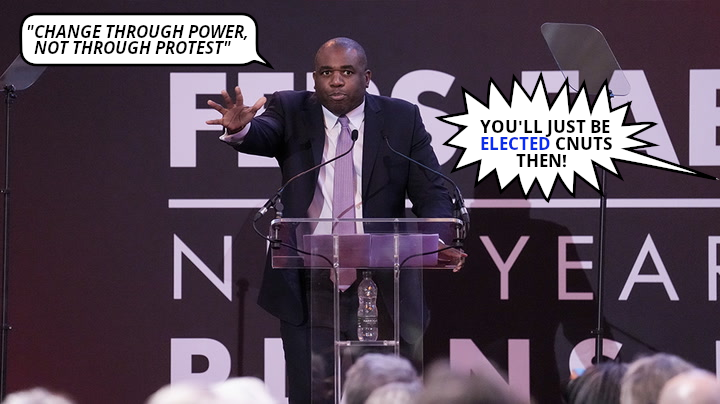
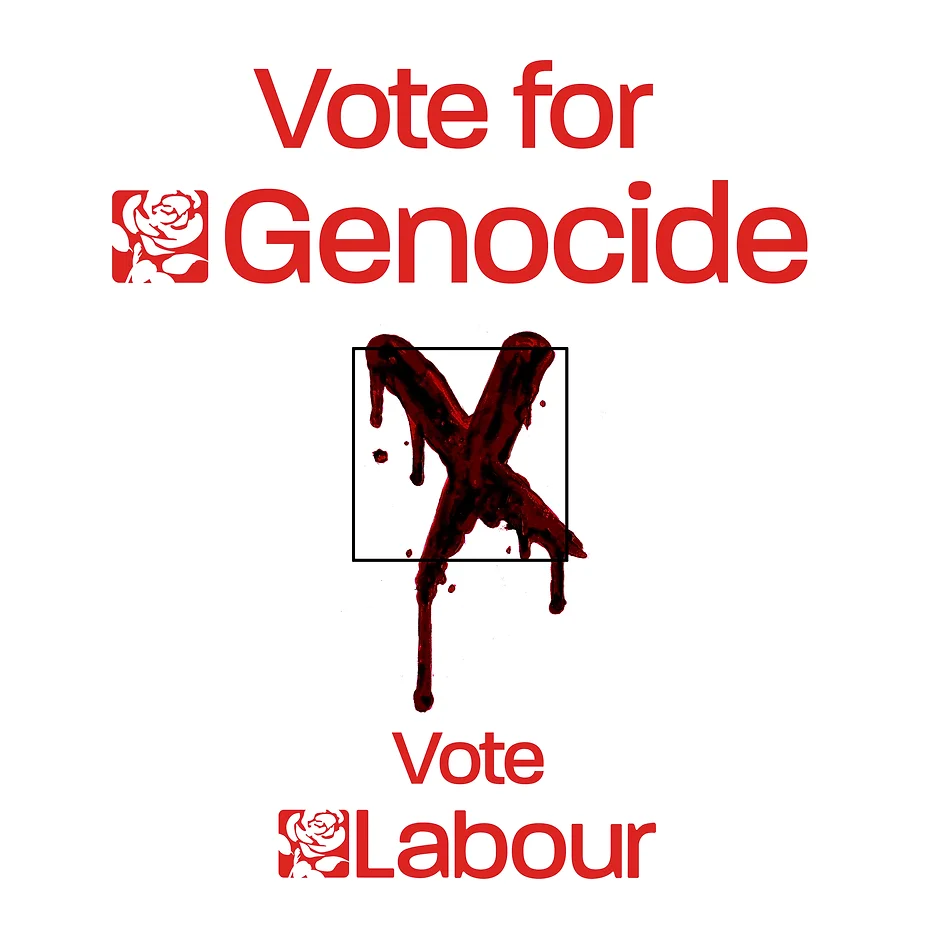
Keir “I support Zionism without Qualification” Starmer supporting genocide.UK Labour Party Shadow Foreign Secretary repeatedly heckled at a speech to the Fabian Society over his and the Labour Party’s support for and complicity in Israel’s genocide of Gaza.Vote Labour for Genocide.
Palestine Action joke that appeared in the UK satirical publication ‘Private Eye’.
Sharing a Private Eye cartoon led to the arrest of a retired head teacher under the Terrorism Act
Full legal review set for September
High Court cites ‘recipe for chaos’ if legality of order isn’t reviewed as soon as possible
Dilemma sharpens for Met Chief ahead of mass protest on 9 August
“Recipe for chaos”
Today, 30 July, the High Court granted permission to Huda Ammori, co-founder of Palestine Action, to bring a full judicial review against the order of the Home Secretary, Yvette Cooper, proscribing the group as a ‘terrorist organisation’.
The ruling comes as a blow to Cooper, whose lawyers argued vigorously that the application should be refused, on the basis that the Terrorism Act contains a statutory process to apply for de-proscription.
Such a process can take years, however, whereas the judicial review is now due to be heard in September.
Mr Justice Martin Chamberlain rejected the Home Secretary’s position stating that:
“[T]he proscription order is likely to give rise to a substantial interference with rights guaranteed by the common law and by Articles 10 and 11 ECHR …
If the legality of the proscription order can properly be raised by way of defence to criminal proceedings, that would open up the spectre of different and possibly conflicting decisions on that issue in Magistrates Courts across England & Wales or before different judges or juries in the Crown Court. That would be a recipe for chaos. To avoid it there is a strong public interest in allowing the order to be determined authoritatively as soon as possible.”
He granted Huda Ammori leave to bring a full judicial review on the basis that it is arguable that:
1. The order is a disproportionate interference with Articles 10 and 11 of European Convention on Human Rights [the rights to freedom of expression and peaceful assembly]; and that
2. The Home Secretary should have consulted PA before making it and, by failing to do so, acted in breach of natural justice and/or contrary to Article 6 ECHR [the right to a fair hearing].
Dilemma for Met Commissioner ahead of mass protest on 9 August
It sharpens the dilemma for Sir Mark Rowley, the Met Commissioner, ahead of what is expected to be a mass protest of more than 500 people planned for 9 August [1A]. It would already be a huge and costly operation for the Met to arrest so many people for holding cardboard signs, people who are motivated by horror at the genocide in Gaza and a desire to uphold democratic freedoms. The prospect of the order being ruled unlawful opens up the further possibility that all those arrested and detained will later be awarded compensation payments for unlawful arrest.
As some of his colleagues have shown around the country, police have discretion as to whether to conduct arrests or not. Police in Totnes, Derry and Kendall for example have chosen to leave peaceful protestors be. On 9 August, Sir Mark will face a stark choice – to risk his own reputation with an absurd and costly operation to arrest 500 peaceful protestors for terrorism offences, or to undermine the Home Secretary’s position by applying common sense and allowing peaceful protestors to exercise their democratic rights.
A spokesperson for Defend Our Juries, the groups organising the protests, said:
“Yvette Cooper has no-one to blame for this crisis but herself. She was warned by her advisers that the ban would be “novel and unprecedented”, which is Whitehall mandarin-speak for ‘mad’.
If it wasn’t the police or the intelligence agencies pushing for the ban, who was it?
One of the grounds for the High Court’s ruling today was the Home Secretary’s failure to consult appropriately. While she consulted with the Israeli government and Elbit Systems on the merits of the order (and no prizes for guessing their position) she failed to consult with those adversely affected, such as Palestine Action and civil liberties organisations.
If you only consult with those who stand to benefit from your proposal, those who are committing and supporting genocide, but not those who will be adversely affected, not those who are acting to prevent genocide, your bias is already exposed.
We are confident the High Court will soon strike down this absurd and repugnant order, made at the bidding of the perpetrators of genocide.”
Chorus of criticism, mockery and defiance
The ruling comes amid a crisis of credibility for the order, which has been lambasted by lawyers, politicians and the UN alike, and openly mocked and defied across the country, on the streets, in print and online, already resulting in over 200 arrests for Terrorism Act offences.
In the House of Lords last week, former Secretary of State for Northern Ireland Lord Hain asked: “How have we got to the point where peacefully holding up a placard about the carnage in Gaza is equated with terrorism by Al Qaeda on 9/11 or Islamic State on countless occasions. And shouldn’t the police be concentrating on real terrorism and real crime, not targeting peaceful protesters?” [1]
Derry City and Strabane District Council ignored legal advice to pass a motion calling for the immediate overturning of the proscription, with Councillors openly wearing “We Are All Palestine Action” shirts.[1B].
Speaking to Al Jazeera, the former chief political commentator of The Daily Telegraph, Peter Oborne, warned that Yvette Cooper’s controversial ban of Palestine Action could lead to her resignation: “If the general populace comes to the conclusion that this is a stunt by the Starmer government … this legislation won’t take, people will regard it as ridiculous … you’ll end up having thousands of people coming out in support of Palestine Action, thousands of people declared terrorists. The law will suddenly look an ass, this government will lose a great deal of political credibility and in due course the Home Secretary might have to resign.” [2]
Tayab Ali, a leading lawyer at Bindmans, said:
“I would be extraordinarily surprised if the British Courts don’t strike [the ban] down. This is such an overreach.” [3]
After Private Eye satirised the ban with a cartoon, a retired head-teacher was arrested for displaying a copy of the cartoon, despite it being available in newsagents across the UK [4]. The comedian, Rosie Holt, has mocked “The new face of terrorism. It’s old, it’s wrinkly, it’s elderly and it’s dangerous.” [5]
On Friday, the UN Human Rights Chief, Volker Türk issued a press release stating:
“[The ban] appears to constitute an impermissible restriction on rights [to freedom of expression, peaceful assembly and association] that is at odds with the UK’s obligations under international human rights law.” [5A]
Previously, five UN Special Rapporteurs had written to the UK Government counselling against the use of Terrorism Act powers against Palestine Action [5B]. Amnesty International has spoken out against the ban, saying:
“Government embarrassment at security breaches is no proper basis for excessive and disproportionate interferences with human rights. It is precisely this kind of unlawful government action that critics of the UK’s terrorism laws warned would come one day.” [5C]
Shortly before the proscription, more than 23 organisations, led by the European Association of Lawyers for Democracy & World Human Rights, criticised the use of Terrorism Act powers against the Filton 18, members of Palestine Action, in a paper headed, “United Kingdom: The “Filton 18” case is a warning sign of democracy and rule of law decline” [5D], citing evidence political interference in the legal process by the Israeli government:
“Judicial independence and impartiality is a fundamental aspect of the right to a fair trial and the protection of human rights, and a prerequisite to the rule of law …
Documents obtained on 29 April 2025 through a Freedom of Information request have revealed that the UK government has shared contact details of counter-terrorism police and prosecuting authorities with the Israeli embassy in September 2024, during the investigation into the Filton 18 action and shortly after the Attorney General’s Office met with the Israeli ambassador to the UK. The documents disclosed were almost entirely redacted. However, documents disclosed in August 2023 evidence that the Israeli authorities have previously attempted to pressure the UK government to intervene in judicial proceedings relating to UK protests.
These communications, and the lack of transparency concerning their contents and whether these relate to the proceedings against Palestine Action members, raise serious questions around the independence and impartiality of prosecuting authorities in the Filton 18 case. These concerns are strengthened by the UN experts’ opinion that the use of anti-terrorism laws against the Filton 18 lacked a credible basis and may have pursued an ulterior purpose.”
On Saturday, police in Shenstone arrested a man in a wheel-chair, for wearing a T-shirt in support of Palestine Action. [6]
Home Office insinuations against Palestine Action contradicted by their own evidence
As part of the legal process, the Home Office was required to disclose the evidence available to the Home Secretary in support of proscription. It emerged that Home Office insinuations that Palestine Action is violent and funded by Iran were directly contradicted by the assessments provided to her.
The government’s Proscription Review Group (PRG) advised in March 2025 that a ban on Palestine Action would be “novel and unprecedented”, because “there was no known precedent of an organisation being proscribed… mainly due to its use or threat of action involving serious damage to property”. [7]
The Joint Terrorism Analysis Centre (JTAC) assessment noted: “PA media channels highly likely will only share footage, or encourage, instances of property damage. PA branded media will highly unlikely explicitly advocate for violence against persons”. [7]
On 23 June, the day of Cooper’s statement to parliament, the Times published a report saying “Iran could be funding Palestine Action, Home Office officials claimed”. This went on to be widely reported. Yet the JTAC assessment of Palestine Action’s sources of funding makes no mention of Iran, stating that Palestine Action “is primarily funded by donations, which can be made directly through their website or via crowdfunding. Other forms of revenue include the sale of merchandise”. [7]
Writing for Declassified, John McEvoy, the historian, film-maker and reporter, said:
“The discrepancy between the Home Office press briefings and the official intelligence reports raises the prospect that a state-linked disinformation campaign was waged against Palestine Action in order to manufacture public consent for proscription.” [7]
Yvette Cooper defied warnings from advisers to push through the ban
Strikingly, the Home Secretary was warned by her own advisers that proscription risked substantiating claims of pro-Israeli bias. A Community Impact Assessment produced by the Ministry of Housing, RICU (Research, Information and Communications Unit), and NPCC (National Police Chiefs’ Council), stated:
“Other reports documented Israeli embassy officials purportedly attempting to get the attorney general’s office to intervene in court cases. In the context of such reports, proscription could provide fertile ground for actors attempting to substantiate a pattern of bias”. [7]
The report goes on to say that a ban “could be seen as the partial realisation of Lord Walney’s efforts, which dissenting actors could argue were coloured by pro-Israel bias”. [7]
In May last year, Lord Walney, published a report calling for Palestine Action and Just Stop Oil to be banned. Successive governments falsely presented Lord Walney to the public as an ‘independent’ adviser on political violence and disruption. [8]
Lord Walney in fact has close ties to the Israeli government and is a paid lobbyist for the arms industry. [9] On 14 February this year, following a Defend Our Juries campaign to sack him, his role was removed, although the Home Office stated, his work would “continue to inform our approach”. [10]