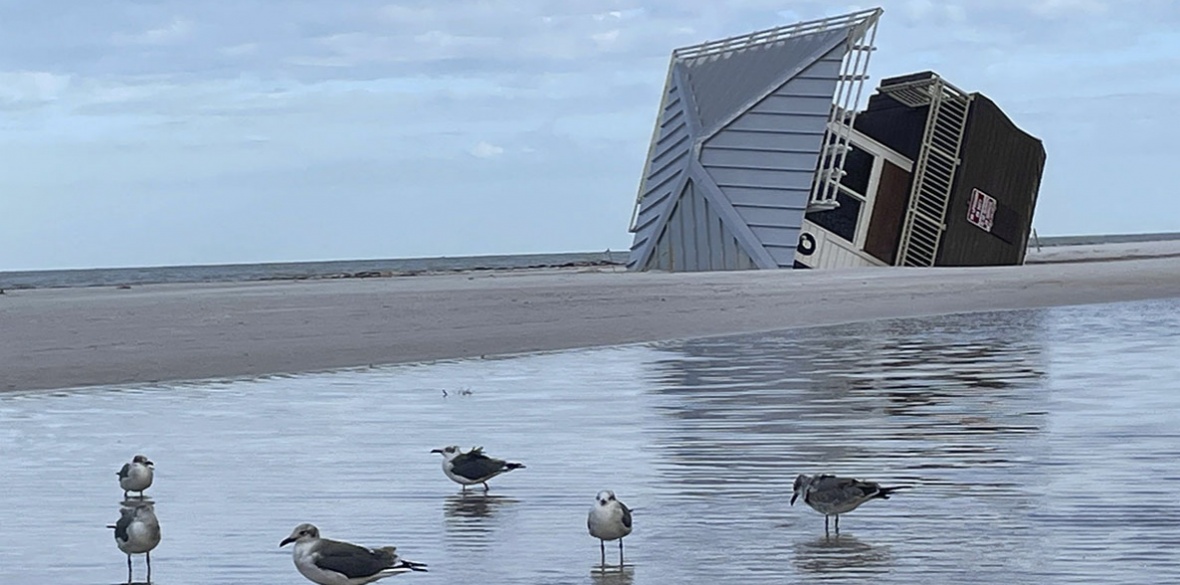
A lifeguard hut rests on its side after Hurricane Milton, October 11, 2024, at Clearwater Beach, Fla.
RICH countries received strong criticism at the Cop29 conference in Azerbaijan today for wanting to spend more on wars and weapons than on preventing climate change.
“Global military spending stands at $2.5 trillion (£1.9trn) annually,” Panamian climate envoy Juan Carlos Monterrey Gomez told delegates at the faltering annual talks sponsored by the United Nations.
“For some, $2.5trn dollars to kill each other, it’s not enough, but $1trn to save lives is unreasonable.”
“Causing our own extinction is the most ridiculous thing. At least the dinosaurs had an asteroid. What is our excuse?”
Palestinian Environment Quality Authority chairwoman warned that Israel is committing “ecocide” after over a year of bombardments in Gaza.
“Protection of the environment is actually not an ancillary issue, it is not a secondary option, it is a basic right that is related to all of us as human beings,” she said.
…
Brazilian President Luiz Inacio Lula da Silva urged developed nations to consider moving their 2050 emission goals forward to 2040 or 2045.
“The G20 is responsible for 80 per cent of greenhouse-effect emissions,” he said. “Even if we are not walking the same speed, we can all take one more step.”
Meanwhile, a new scientific study has found that climate change has made Atlantic hurricanes about 18mph stronger in the last six years.
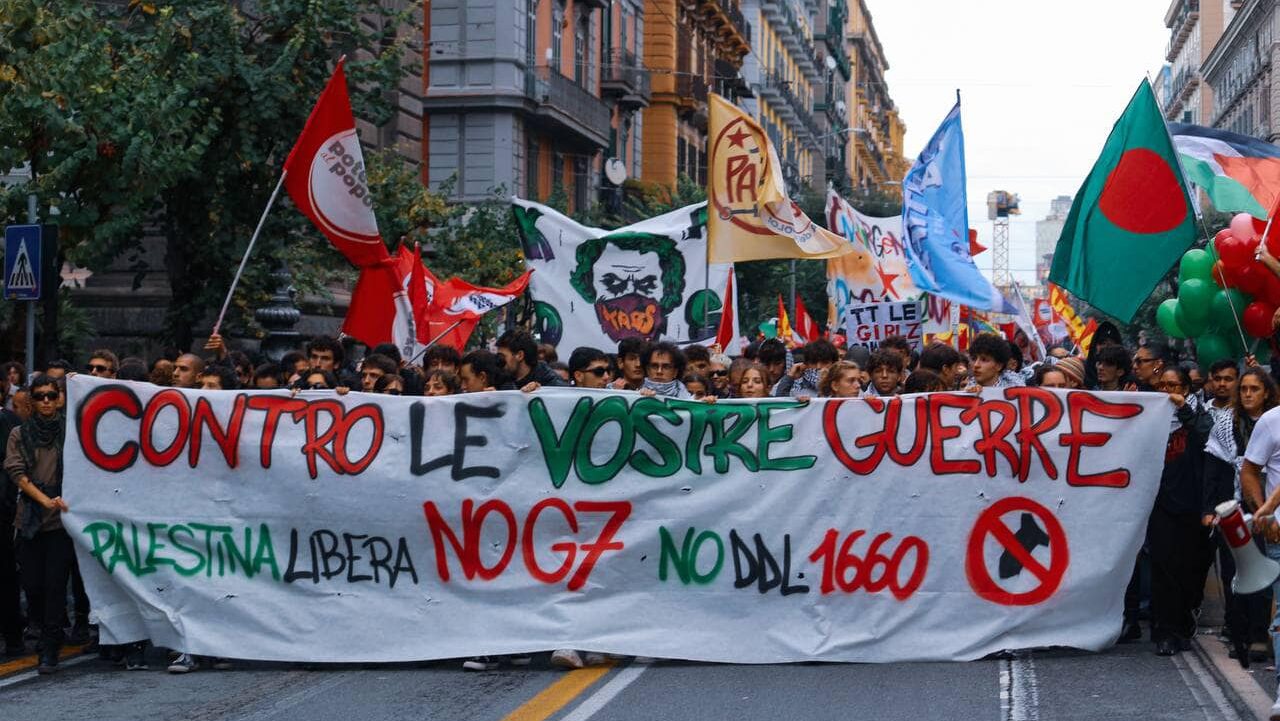
Over 2,000 people took to the streets of Naples against soaring military spending in Europe and increased repression of dissent as G7 defense ministers convened for high-level talks
Thousands of people took to the streets of Naples on October 19, demonstrating against the G7 military agenda and Italy’s proposed reforms that would limit the freedom to dissent. Protesters, representing a host of organizations including student associations, trade unions, and community centers, rallied against Prime Minister Giorgia Meloni’s government’s policies, demanding a shift in priorities toward social needs instead of military spending. Side by side with the protest in Naples, demonstrations were held in dozens of cities across Italy, as reported by the left political party, Power to the People (Potere al Popolo).
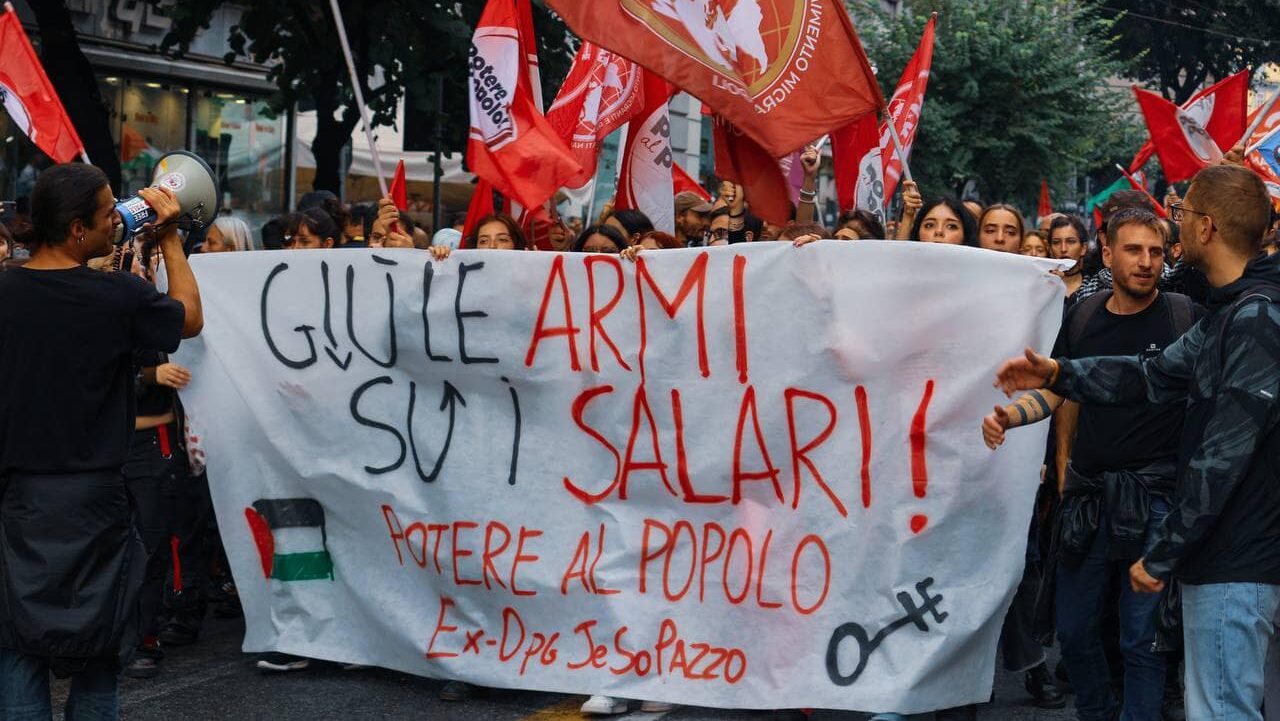
Protesters carrying a banner reading “Cut the weapons, raise the wages!”. Source: Ex OPG occupato – Je so’ pazzo/Facebook
The protest was organized to counter a G7 defense ministers’ meeting that took place in Naples from October 18 to 20, with a focus on global military goals. The meeting was seen by protesters as yet another example of Western countries deepening their involvement in wars, including the ongoing genocide in Gaza and the war in Ukraine, instead of pursuing agendas of social justice and peace. In the lead-up to the meeting, local activists voiced their opposition, stating that “lords of war” were not welcome in their city.
“Never has so much been spent on war, and as a result, war is rampant everywhere,” the associations organizing the march asserted during the preparations. “We refuse to host a meeting in our city that supports the war economy our government has chosen to follow.”
Two central issues dominated the protest in Naples: the West’s support for Israel as it continues to exterminate the people of Gaza and the increasing repression of dissent at home, embodied in Meloni’s proposed security bill. Many protesters pointed out the link between military aggression abroad and domestic policies that seek to criminalize dissent. European countries continue to actively repress solidarity with Palestine and others, like Italy, are doing so while attempting to silence voices against their policies.
The new security bill seeks to impose severe restrictions on protests, including strikes and environmental activism. Progressive associations argue that this is a blatant attempt to stifle opposition and consolidate power, and some of them saw Saturday’s protest as a test run for the government’s strategy of suppressing future mobilizations. Days before the protest, authorities tried to restrict the march route, forcing organizers to end the demonstration a kilometer away from the G7 meeting site.
Despite these attempts, protesters refused to be stopped. They briefly broke through the set course of the rally, marching in areas originally declared off-limits by the authorities. In response, police deployed tear gas and used other forms of violence against them. Naples’ historic center has systematically been blocked off to popular protests, and things are set to get worse if the new bill is passed, protesters said. Because of that, community groups including Ex OPG – Je so’ pazzo called upon people to continue resisting.
“We believe this repressive project must be stopped, and more importantly, we see it as a reflection of the Meloni government’s fear of what might still be burning beneath the surface of the seeming calm in the country,” they said.
Saturday’s protest marked an important moment of resistance against the shrinking of democratic space in Italy, as well as to the strengthening of the armament agenda in Europe. Demonstrators announced they were ready to continue fighting against the security bill and expressed determination to challenge Meloni’s government over announced cuts to social support.
“Today, this square is sending a loud message: if the government thinks it can ignore social needs, public healthcare, workers’ rights, and housing in favor of pouring billions into military spending, it’s headed in the wrong direction,” said Chiara Capretti from Power to the People.
Introducing a wealth tax would indicate this is a progressive government. But that seems unlikely
Taking as his theme the need to “fix the foundations” after “14 years of rot” under Tory rule, new Labour prime minister Keir Starmer this week delivered a message that should bring discomfort to everyone in the months and perhaps years to come.
Those “14 years of rot” are of no surprise to voters; indeed, they helped ensure a landslide Labour victory in the election in July. But Starmer’s plans to resolve them appear likely to be far harsher than many voters expected.
The chancellor of the Exchequer, Rachel Reeve, has made numerous hints that hard times are ahead. Her October budget will be uncompromising in its commitment to raising revenue to help fill a fiscal hole reckoned to be around £20bn – but much of this money seems likely to be taken from the poorer sections of society, not the rich.
Labour will retain unpopular policies introduced by the Conservatives – the ‘bedroom tax’ and limiting child benefit allowances to the first two children, for example – while introducing its own cost-cutting measures, such as reducing the winter fuel allowances for many pensioners.
These actions contribute to a growing sense that the Starmer government will prove to be decidedly right-of-centre in a country beset with deep divisions of wealth and poverty. Some areas may see an improvement, such as labour rights, but even there, it is a matter of the devil in the detail.
One area where the government does apparently have cash to spash, though, is military spending, which is set to be substantially increased despite the manifest failures in Afghanistan, Iraq and Libya, and the deeply unpopular Israeli wars on Gaza and the West Bank.
Labour’s attitude to Israel is certainly unlikely to change, with the Department for Business and Trade reporting on efforts to strike a new trade deal with the country, saying: “Our teams will be entering negotiating rooms as soon as possible, laser-focused on creating new opportunities for UK firms.” An official from the British Embassy in Israel also recently wrote of the “tremendous opportunity for collaboration between Israeli and British companies”.
A full-scale Strategic Defence Review is also underway, and there are few if any indications that it will start by addressing the grievous failures of the past two decades. If previous experience is anything to go by, it will likely also omit the main challenge to international security: climate breakdown. Without that, the review will not be worth the paper it is written on. Net zero secretary Ed Miliband may be doing his best to maintain the idea of a green transition but the issue would be sidelined by any major increase in government spending.
On the domestic front, less than two months into the new Labour government the contrast between Food Bank Britain and the ludicrous levels of runaway wealth is apparent. It was coincidentally yet powerfully illustrated just four days before Starmer’s pre-budget speech, by a full-page property advertisement from Sotheby’s in the Financial Times.
Of the seven properties on sale, one was a relatively modest three-bedroom apartment in Chelsea, on sale for a mere £5m, while the others included a six-bedroom house in Belgravia offered at £18m and a nine-bedroom/five-bathroom place near Regent’s Park for £20m. Another Regent’s Park number was on sale for £25m million, which at least had 7 bathrooms for the 6 bedrooms. Trumping all was a triplex number in Knightsbridge – £50m with exclusive access to Hans Place Gardens.
While we have to wait for the October budget announcements, we can be reasonably sure that there will be some attempts to raise modest amounts from the wealthier sectors of society, possibly involving changes in capital gains and inheritance taxes. But the best indicator of a changed government would be one willing to bring in wealth taxes, especially those directed at the super-rich.
Onee of Britain’s largest trade unions, Unite, recently proposed a 1% per annum tax on those with net assets of over £4m, which would include property, shares and bank holdings but not mortgaged property. That is estimated to yield £25bn a year but would be bitterly opposed, with the Daily Mail informing us that: “Millionaires are looking to flee the UK in their droves to escape Labour’s tax raids – with a record number of wealthy Britons tipped to leave the country this year.”
As things stand, the budget is expected to include substantial cuts in public spending that could be at least partly avoided by such a wealth tax, and it is worth noting that some European countries such as Switzerland and Spain have already introduced them. At least Britain’s wealthy won’t be fleeing “in their droves” to those countries.
If adopted in October, in even a modest form, a wealth tax would be a reasonable marker for a progressive government. If not, then an opportunity will be missed for placing Labour in a more progressive place in the political spectrum than currently seems at all likely.
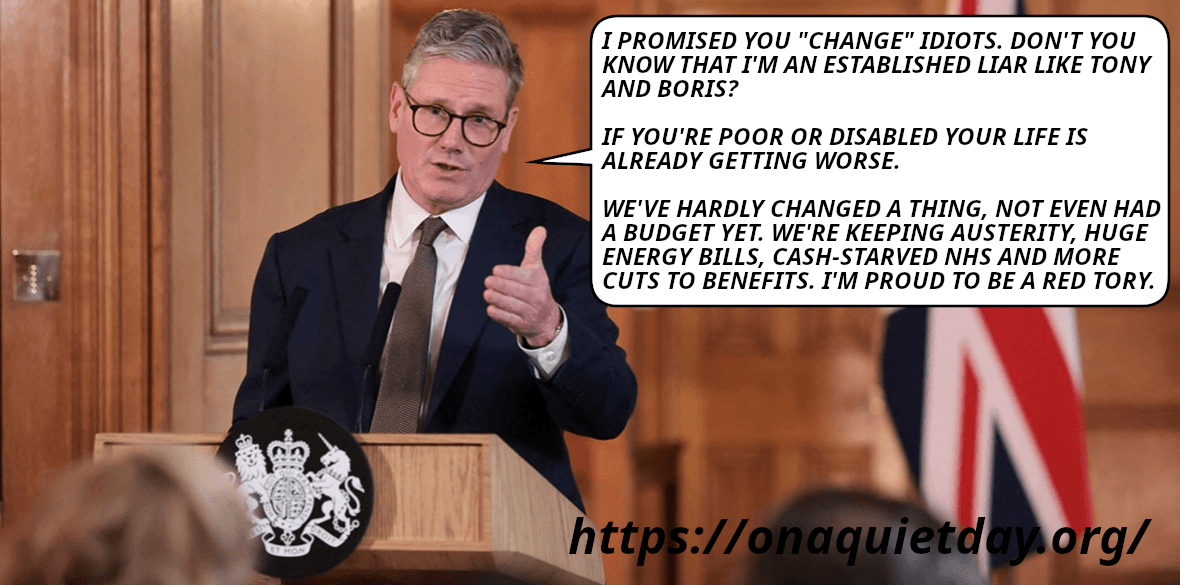
Keir Starmer confirms that he is continuing Tory policies and that he’s proud to be a red Tory.Keir Starmer says pensioners can freeze to death and poor children can starve and be condemned to failure and misery all their lives.
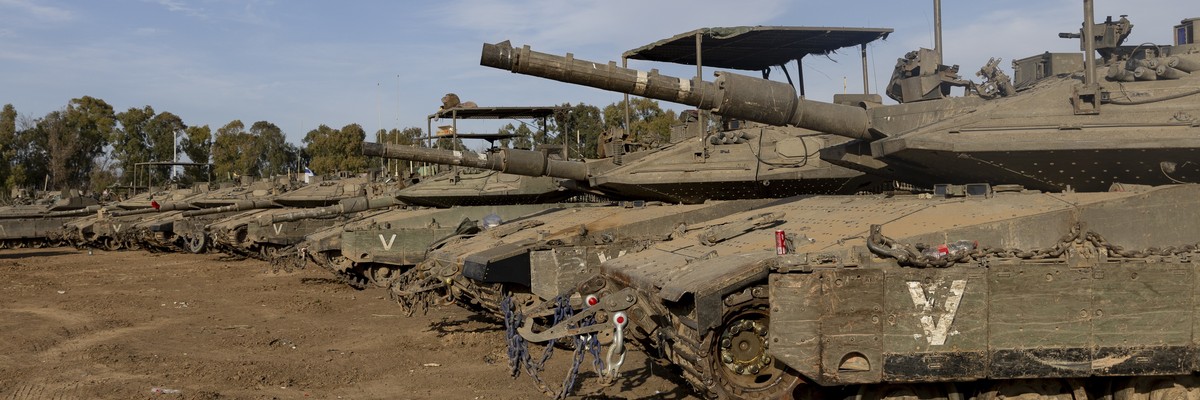
A row of tanks is pictured in southern Israel on March 14, 2024. (Photo: Amir Levy/Getty Images
“Can we get some healthcare please, or maybe feed some of the 40 million+ Americans who can’t get enough food?” asked the watchdog group Public Citizen.
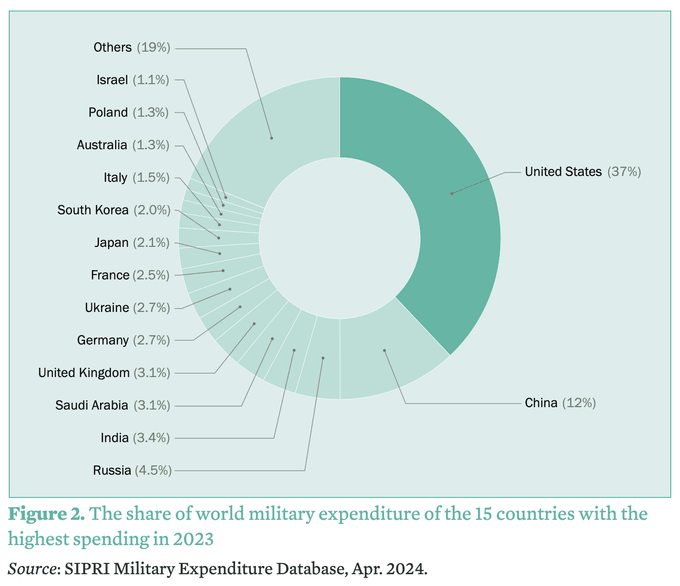
New research published Monday shows that global military spending increased in 2023 for the ninth consecutive year, surging to $2.4 trillion as Russia’s assault on Ukraine and Israel’s war on the Gaza Strip helped push war-related outlays to an all-time high.
The Stockholm International Peace Research Institute (SIPRI) recorded military spending increases in every geographical region it examined last year, from Europe to Oceania to the Middle East. Last year’s global increase of 6.8% was the largest since 2009, SIPRI said.
The United States was by far the largest military spender at $916 billion in 2023, up 2.3% compared to the previous year. The next biggest spender was China, which poured an estimated $296 billion into its military last year—three times less than the U.S.
“Can we get some healthcare please, or maybe feed some of the 40 million+ Americans who can’t get enough food?” asked the watchdog group Public Citizen in response to SIPRI’s report, which found that the U.S. accounted for 37% of the world’s total military spending last year.
A separate analysis of U.S. military spending in 2023 found that 62% of the country’s federal discretionary budget went to militarized programs, leaving less than half of the budget for healthcare, housing, nutrition assistance, education, and other domestic priorities.
Together, SIPRI found, the top five biggest military spenders last year—the U.S., China, Russia, India, and Saudi Arabia—accounted for 61% of global military outlays.
“The unprecedented rise in military spending is a direct response to the global deterioration in peace and security,” Nan Tian, senior researcher with SIPRI’s Military Expenditure and Arms Production Program, said in a statement. “States are prioritizing military strength but they risk an action-reaction spiral in the increasingly volatile geopolitical and security landscape.”
In the Middle East, military spending jumped by 9% last year—the highest annual growth rate in the past decade. Israel, which relies heavily on weapons imports from the U.S., spent 24% more on its military last year than in 2022, according to SIPRI, an increase fueled by the country’s devastating assault on Gaza.
SIPRI found that NATO’s 31 member countries dumped a combined $1.3 trillion into military expenditures in 2023, accounting for 55% of the global total.
U.S. military spending, which is poised to continue surging in the coming years, made up 68% of NATO’s 2023 total.