Dr. Mustafa Barghouthi: the US could restrain Israel, but has chosen not to

Spread the love

Original article by Aseel Saleh republished from peoples dispatch under a Creative Commons Attribution-ShareAlike 4.0 (CC BY-SA) license.

Dr. Mustafa Barghouthi. Photo: Wikimedia Commons

According to a report released by Brown University’s Costs of War project, from October 7, 2023 to September 30, 2024, the US sent 17.9 billion dollars in military aid to Israel, which accounts for the largest amount of military funding ever granted to Israel in a single year. Israel’s ongoing genocide against the Palestinian people, as well as its 76-year project of colonization of Palestine would not be possible without the vital military, financial, diplomatic, and political support of the United States.

The US presidential elections, which will see Democrat Kamala Harris face off against far-right Republican Donald Trump, are set to be held on Tuesday, November 5. The elections are being held over a year into Israel’s genocidal war on Gaza, and the result of the elections may cast a shadow on the current situation in particular, and the Palestinian cause in general.

To discuss more about the impact of US policy, and the possible repercussions of the US presidential elections on the Palestinian cause, Peoples Dispatch interviewed prominent Palestinian politician, physician, and activist Dr. Mustafa Barghouthi.

Dr. Mustafa Barghouthi is the Secretary General and co-founder of the Palestinian National Initiative, and member of the Palestinian Legislative Council (PLC).

Peoples Dispatch: What has the last year of Israeli genocide revealed about US policy towards the region?

Dr. Mustafa Barghouthi: It has revealed that the United States can restrain Israel if it wants, but it did not, which makes the United States complicit in the genocide being carried out by Israel against the Palestinian people. A clear example that proves that the US has an influence on Israel, is its ability to restrain the Israeli aggression on Iran.

Peoples Dispatch:  Were people expecting more from Democrat Joe Biden?

Dr. Mustafa Barghouthi: The Palestinian people were completely disappointed by Biden and his administration, including his State Secretary, Defense Secretary and National Security Advisor, who all came to take part in Israel’s war cabinet meetings, and gave their blessing to Israel during its genocidal aggression on Gaza. They further sent American fleet, ships, aircrafts to support Israel. Biden has provided Israel with no less than 17.9 billion dollars of military equipment, and more than 50,000 tons of explosives and weapons. All of that was used in committing the genocide against the Palestinian people.

Peoples Dispatch: Are any major changes expected if either Kamala or Trump gets elected? Does the outcome of these elections impact the Palestinian struggle?

Dr. Mustafa Barghouthi Trump’s election may make the situation even worse, while it is still unclear about Kamala Harris, who maybe will be more sensitive regarding the changes that are happening inside the Democratic Party, where the majority of the younger generation are against the policy of Biden in relation to what has been happening in Gaza and to Palestinians in general.

However, so far she could not make any definite decision or take any definite position to stop the genocide against the Palestinian people. Like Biden, Harris continued with the biased approach towards Israel. This needs to be completely changed, because when it comes to the reputation of the United States it has been negatively affected by the policy of this administration, not only in Palestine but also worldwide. We shouldn’t forget that Kamala Harris was the US vice president during the genocide, she was not outside the administration. Perhaps, she will adopt a different approach in comparison to Biden, but that needs to be proved in reality and in action.

Peoples Dispatch: With regards to the broader region, one of Trump’s pet projects while president was advancing normalization with Israel. What is your view of how Israel’s genocide has impacted the process of normalization? Have there really been major setbacks? Will these setbacks be recovered or is it irreversible?

Dr. Mustafa BarghouthiThe war crimes in Gaza did not affect the existing normalization agreements between three Arab countries and Israel. Unfortunately, it has not changed at all, but the war crimes in Gaza and the genocide have restrained other countries from proceeding in normalization with Israel. Even the countries that maintained normalization agreements with Israel, are very embarrassed about the current situation, because their peoples are against normalization. It is not apparent yet whether the genocide will have further impact on normalization. The largest popular protest against normalization is happening in Morocco, and it is the most important country among the three countries that normalized with Israel”, the prominent Palestinian politician said, referring to Morocco, United Arab Emirates (UAE) and Bahrain, which signed the US-backed normalization agreements with Israel known as “the Abraham Accords” in 2020.

Keep reading Peoples Dispatch for analysis and news on the US elections from a perspective you won’t see on mainstream media.

Original article by Aseel Saleh republished from peoples dispatch under a Creative Commons Attribution-ShareAlike 4.0 (CC BY-SA) license.


Continue ReadingDr. Mustafa Barghouthi: the US could restrain Israel, but has chosen not to

Morning Star Editorial: ‘Fixing the foundations of the economy’ must address the structure of ownership and wealth

Spread the love
Image of cash and pre-payment meter key

https://morningstaronline.co.uk/article/fixing-foundations-economy-must-address-structure-ownership-and-wealth

AFTER months in which Labour argued that such is the dire state of the economy that Tory spending limits must be maintained, the Chancellor of the Exchequer now says that further cuts in public expenditure are needed.

The question raised by any talk about varying the structure of taxation is where taxes fall. The richest 10 per cent of families hold 43 per cent of all wealth. The bottom 50 per cent — and be sure that this includes the greater proportion of people who see themselves as working class — possess less than 10 per cent of wealth.

When the overwhelming majority of voters, including Tory voters, see public ownership of rail, mail, water and energy as desirable this is not simply a yearning for the more efficient delivery of these services and utilities than private ownership is able to provide. More, it is an expression of a clear understanding that revenues from these myriad transactions should not be privately appropriated but applied to the common good.

The present Labour administration has, with rare exceptions, ruled out the recovery into public ownership of privatised sectors and, less performatively than Gordon Brown in his day but no less systematically, has assured the corporate world that not only are the foundations of private ownership safe but that Labour, even more than its Tory predecessors, holds appeasing the bond markets a central part of its economic strategy. Hence the cuts announced today.

Reeves’s dilemma is highlighted by the necessity to find £1 billion to fund the juniors doctors’ pay increase; something similar for the teachers and a backlog of other public-sector pay claims.

Under this system spending is always about priorities. But there is money about. She is already committed by Starmer’s diktat to find £57.1bn in defence spending in 2024-25 which is a 4.5 per cent increase in real terms. No cuts there!

A bigger source of revenue would result from taxing wealth at the same level as income by raising the capital gains and dividend tax rates to the level at which workers pay on their wages.

An even bigger windfall would result from a socialist economy in which all rents, interest and profits arising from human economic activity were held in common rather than being privately acquired.

https://morningstaronline.co.uk/article/fixing-foundations-economy-must-address-structure-ownership-and-wealth

Continue ReadingMorning Star Editorial: ‘Fixing the foundations of the economy’ must address the structure of ownership and wealth

Military interests are pushing new nuclear power – and the UK government has finally admitted it

Spread the love

Original article by Andy Stirling republished from the Conversation under a Creative Commons Attribution-No Derivatives licence.

Ben Birchall / Alamy

The UK government has announced the “biggest expansion of the [nuclear] sector in 70 years”. This follows years of extraordinarily expensive support.

Why is this? Official assessments acknowledge nuclear performs poorly compared to alternatives. With renewables and storage significantly cheaper, climate goals are achieved faster, more affordably and reliably by diverse other means. The only new power station under construction is still not finished, running ten years late and many times over budget.

So again: why does this ailing technology enjoy such intense and persistent generosity?

The UK government has for a long time failed even to try to justify support for nuclear power in the kinds of detailed substantive energy terms that were once routine. The last properly rigorous energy white paper was in 2003.

Even before wind and solar costs plummeted, this recognised nuclear as “unattractive”. The delayed 2020 white paper didn’t detail any comparative nuclear and renewable costs, let alone justify why this more expensive option receives such disproportionate funding.

A document published with the latest announcement, Civil Nuclear: Roadmap to 2050, is also more about affirming official support than substantively justifying it. More significant – in this supposedly “civil” strategy – are multiple statements about addressing “civil and military nuclear ambitions” together to “identify opportunities to align the two across government”.

These pressures are acknowledged by other states with nuclear weapons, but were until now treated like a secret in the UK: civil nuclear energy maintains the skills and supply chains needed for military nuclear programmes.

The military has consistently called for civil nuclear

Official UK energy policy documents fail substantively to justify nuclear power, but on the military side the picture is clear.

For instance, in 2006 then prime minister Tony Blair performed a U-turn to ignore his own white paper and pledge nuclear power would be “back with a vengeance”. Widely criticised for resting on a “secret” process, this followed a major three volume study by the military-linked RAND Corporation for the Ministry of Defence (MoD) effectively warning that the UK “industrial base” for design, manufacture and maintenance of nuclear submarines would become unaffordable if the country phased out civil nuclear power.

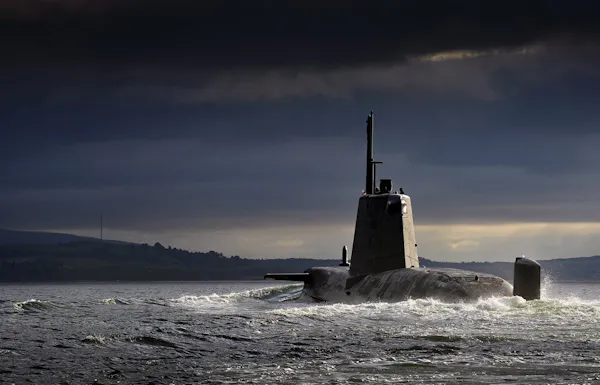
The UK navy has ten nuclear-powered submarines. Defence Imagery / flickrCC BY-SA

A 2007 report by an executive from submarine-makers BAE Systems called for these military costs to be “masked” behind civil programmes. A secret MoD report in 2014 (later released by freedom of information) showed starkly how declining nuclear power erodes military nuclear skills.

In repeated parliamentary hearingsacademicsengineering organisationsresearch centresindustry bodies and trade unions urged continuing civil nuclear as a means to support military capabilities.

In 2017, submarine reactor manufacturer Rolls Royce even issued a dedicated report, marshalling the case for expensive “small modular reactors” to “relieve the Ministry of Defence of the burden of developing and retaining skills and capability”.

The government itself has remained coy about acknowledging this pressure to “mask” military costs behind civilian programmes. Yet the logic is clear in repeated emphasis on the supposedly self-evident imperative to “keep the nuclear option open” – as if this were an end in itself, no matter what the cost. Energy ministers are occasionally more candid, with one calling civil-military distinctions “artifical” and quietly saying: “I want to include the MoD more in everything we do”.

In 2017, we submitted evidence to a parliamentary public accounts committee investigation of the deal to build Hinkley Point C power plant. On the basis of our evidence, the committee asked the then MoD head (who – notably – previously oversaw civil nuclear contract negotiations) about the military nuclear links. His response:

We are completing the build of the nuclear submarines which carry conventional weaponry. We have at some point to renew the warheads, so there is very definitely an opportunity here for the nation to grasp in terms of building up its nuclear skills. I do not think that that is going to happen by accident; it is going to require concerted government action to make it happen.

This is even more evident in actions than words. For instance hundreds of millions of pounds have been prioritised for a nuclear innovation programme and a nuclear sector deal which is “committed to increasing the opportunities for transferability between civil and defense industries”.

An open secret

Despite all this, military pressures for nuclear power are not widely recognised in the UK. On the few occasions when it receives media attention, the link has been officially denied.

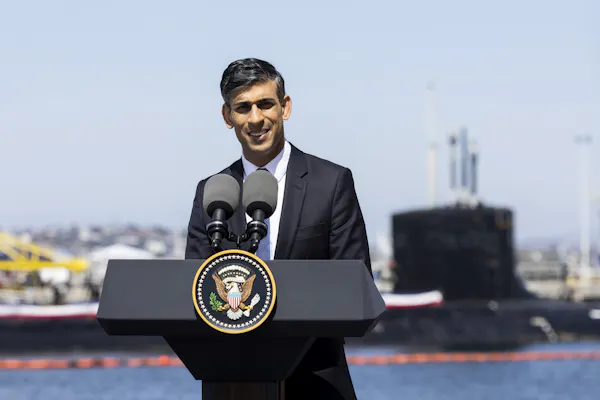
UK prime minister Rishi Sunak announces a US-UK-Australia nuclear submarine deal in March 2023. Etienne Laurent / EPA

Other nuclear-armed states are also striving to maintain expensive military infrastructures (especially around submarine reactors) just when the civilian industry is obsolescing. This is true in the USFranceRussia and China.

Other countries tend to be more open about it, with the interdependence acknowledged at presidential level in the US for instance. French president Emmanuel Macron summarises: “without civil nuclear power, no military nuclear power, without military nuclear, no civil nuclear”.

This is largely why nuclear-armed France is pressing the European Union to support nuclear power. This is why non-nuclear-armed Germany has phased out the nuclear technologies it once lead the world in. This is why other nuclear-armed states are so disproportionately fixated by nuclear power.

These military pressures help explain why the UK is in denial about poor nuclear performance, yet so supportive of general nuclear skills. Powerful military interests – with characteristic secrecy and active PR – are driving this persistence.

Neglect of this picture makes it all the more disturbing. Outside defence budgets, off the public books and away from due scrutiny, expensive support is being lavished on a joint civil-military nuclear industrial base largely to help fund military needs. These concealed subsidies make nuclear submarines look affordable, but electricity and climate action more costly.

The conclusions are not self-evident. Some might argue military rationales justify excessive nuclear costs. But history teaches that policies are more likely to go awry if reasons are concealed. In the UK – where nuclear realities have been strongly officially denied – the issues are not just about energy, or climate, but democracy.


The Conversation asked the UK Department for Energy Security and Net Zero to comment but did not receive a reply before the publication deadline.

Don’t have time to read about climate change as much as you’d like?
Get a weekly roundup in your inbox instead. Every Wednesday, The Conversation’s environment editor writes Imagine, a short email that goes a little deeper into just one climate issue. Join the 30,000+ readers who’ve subscribed so far.

Original article by Andy Stirling republished from the Conversation under a Creative Commons Attribution-No Derivatives licence.

Continue ReadingMilitary interests are pushing new nuclear power – and the UK government has finally admitted it

Boris Johnson’s crap water cannons

Spread the love

Boris Johnson’s water cannon farce reveals why he will never be prime minister by Adam Bienkov

“…

The inspectors found the weapons have as little as two years’ operational life left before they have to be turned into scrap. Recurrent problems with the pump and the “critical failure” of the tank would be hugely costly to repair and there could be significant problems finding spare parts for vehicles that are now at the end of their operational life. Day-to-day operation and maintenance of the weapons would also be complicated by the lack of any manuals available in English. Meanwhile the time needed to make essential repairs could leave the weapons out of service for significant periods of time.

Bullingdon Tory idiot Boris Johnson

In short, the Home Office found the weapons to be seriously dangerous, hugely difficult and expensive to maintain and operate, and shortly in need of a trip to the scrap yard.

Given the majority of these problems were public knowledge in Germany before Johnson agreed to buy the weapons, it is incredible that he still went ahead anyway. It is especially baffling given that he was repeatedly warned against buying the weapons, not just by his opponents, but by his own former policing deputy and his own party on the London Assembly. Last year, when Johnson pushed ahead with their purchase anyway, a senior member of his City Hall team told me that Boris would “live to regret” his decision. How right they were.

In fact, Johnson’s more sensible advisers aside, the only people to have come out of this sorry saga well are the negotiators of the German police force. The ingenuity and financial sense of the Germans has been somewhat called into question in recent weeks. However, they can hardly be faulted for their prudent management of this particular deal. It is difficult at the best of times to dispose of obsolete and life-threatening military hardware. But for the Germans to get a foreign politician to actually pay 300,000 euros for the privilege of disposing of the defunct weapons for them was a particularly impressive feat.

…”

Continue ReadingBoris Johnson’s crap water cannons