16 killed by police in Kenya on anniversary of historic anti-Finance bill protests

Spread the love

Original article by Nicholas Mwangi republished from peoples dispatch under a Creative Commons Attribution-ShareAlike 4.0 (CC BY-SA) license.
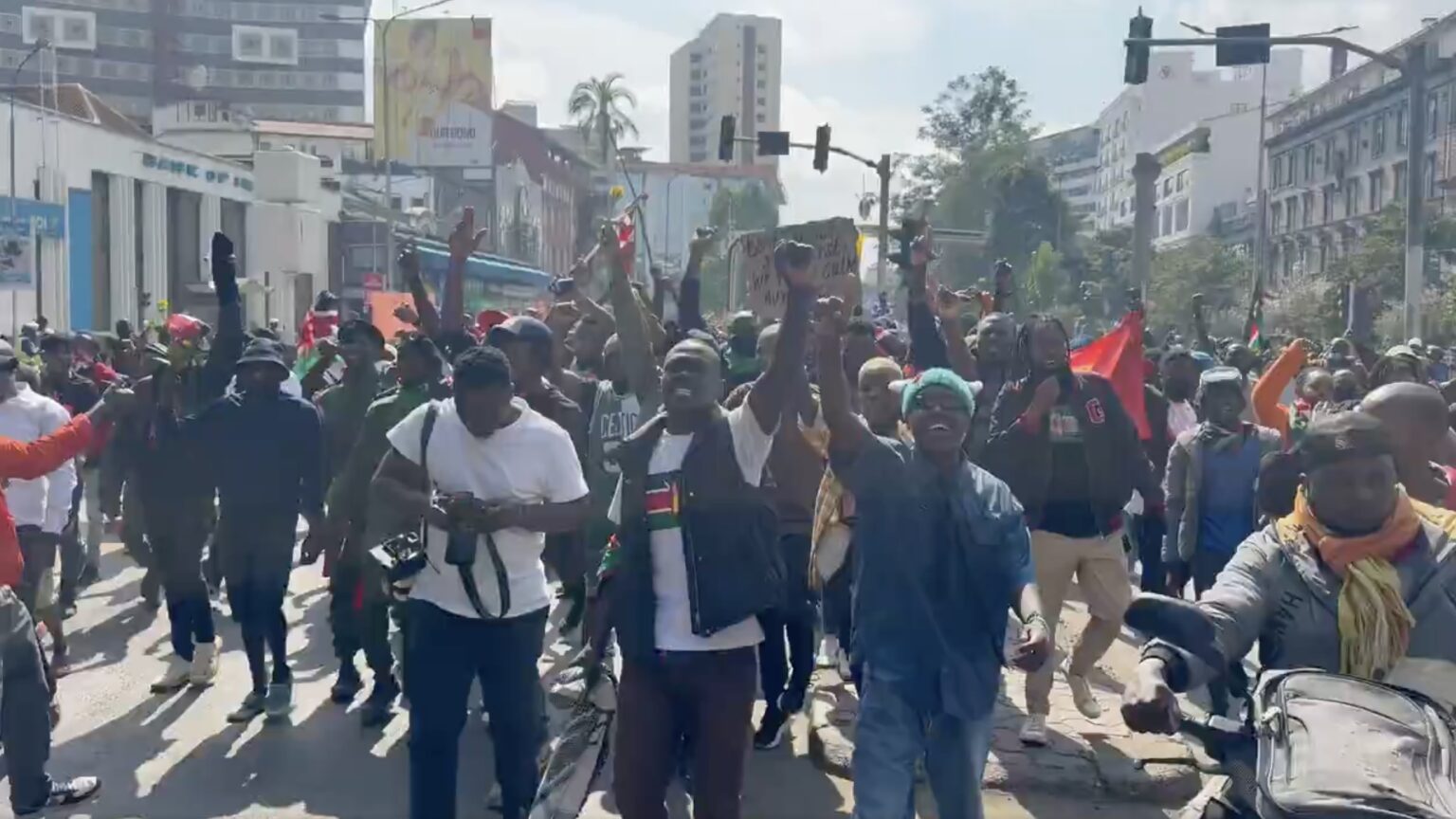
Revolutionary Youth League of Kenya on the streets of Nairobi on June 25. Photo: Screenshot

What was meant to be a solemn commemoration of the first anniversary of the historic anti-Finance Bill protests in Kenya turned chaotic on Tuesday as police clashed with demonstrators across several cities. Police used tear gas and water cannons against largely peaceful protesters, who had gathered to honor those killed during last year’s unrest and to demand justice over recent cases of police brutality and enforced disappearances.

At least 16 people were confirmed dead, with hundreds injured, after law enforcement agencies used excessive force to suppress the gatherings.

“The protests now symbolize indictments of the system itself – a system defined by authoritarianism, police violence, austerity, foreign domination, and the privatization of every public good. The state responded as expected – not with dialogue, but with bullets,” Rodgers, a grassroots organizer with the Nairobi chapter of the Social Justice Movement, told Peoples Dispatch.

The 2024 Finance Bill protests

Last year’s demonstrations, which began in response to the controversial Finance Bill 2024, led to a brutal crackdown that left over 60 young people dead, hundreds injured, and many arrested. The bill, championed by the government of President William Ruto, was widely criticized for introducing punitive taxes on essential goods and services amidst a cost-of-living crisis.

This year’s protests were organized to honor those who lost their lives during the 2024 demonstrations. However, they also served as a platform to raise alarm over recent developments, including the killing of a popular blogger in police custody and a worrying surge in abductions of activists and dissenters.

Read more: Amid economic hardship and repression, Kenyans reject the Finance Bill 2024

Media blackout raises alarm

In what many have called a blatant attempt to stifle freedom of the press, the Communications Authority of Kenya (CA) ordered a suspension of live TV coverage of the protests. Several local stations, including Citizen TV, NTV, KTN were either switched off or restricted, preventing real-time reporting of the police response and protest.

Many people also condemned the presence of infiltrators and hired goons among the protestors. These individuals were allegedly used to discredit the demonstrations by engaging in looting and property destruction tactics used as part of a wider strategy to delegitimize grassroots mobilization and participation in protests.

Despite the violent disruptions, the anniversary protests saw thousands of Kenyans across the country take to the streets. Demonstrators carried placards bearing the names of those killed in 2024 and chanted slogans demanding accountability, justice, and police reform.

Voices from the protests

In dialogue with Peoples Dispatch, Rodgers, a grassroots organizer with the Nairobi chapter of the Social Justice Movement, reflected on the deeper meaning behind the protests:

“The June 25 protest went beyond just being a memorial. It was a continuity of a political statement from the people that they will not fear to remain defiant in the face of systemic oppression. Exactly one year since mass uprisings shook the country in opposition to the punitive Finance Bill 2024 and broader economic injustice, the people came back to the streets with even more clarity and unity.”

We just arrived where comrade Alex Maasai was murdered by Ruto thugs and the Kenya Police, in the morning we visited Central police where Albert Ojwang’ was murdered my Lagat and his criminal gangs #OccupyUntilVictory pic.twitter.com/87b6SI5UiR

— Booker Ngesa Omole ☭ (@BookerBiro) June 25, 2025

Rodgers emphasized that what distinguished this year’s protests was not only their scale – reaching 27 of Kenya’s 47 counties – but the emergence of a clearly articulated political program from below.

Citing reports confirming that between 8 and 16 people were killed and over 400 injured, Rodgers also condemned the regime’s attempt to suppress the truth by shutting down live broadcasts, which he said “exposed repression on free speech and its fear of truth, transparency, and the voice of the people.”

“The people are now conscious that the crisis in Kenya is political as much as it is systemic. It is a crisis of legitimacy, where the ruling class governs through force and deception, abandoning constitutional obligations like Article 43 on economic and social rights.”

He described the protest movement as part of a broader class struggle – pitting a parasitic elite backed by global capital against a rising mass of organized working poor and peasants demanding land, food, dignity, freedom, and power.

“Yesterday was important because it proved this movement is not spontaneous. It is becoming strategic, conscious, and unafraid.”

Unmet demands and growing anger

In the days leading up to the anniversary, momentum had been building both online and offline. Young people, civil society groups, university students, and artists held vigils, digital campaigns, and forums across the country. Yet many of the core grievances that sparked the protests in 2024 remain unresolved:

  • Runaway corruption
  • A bloated government
  • Growing public debt
  • Youth unemployment
  • The erosion of democratic space

As the country grapples with the fallout of this week’s events, people are calling for an independent investigation into the killings, injuries, and abductions. They are also demanding the immediate reinstatement of press freedoms and the prosecution of those responsible for unlawful police actions.

The anniversary protests have made it clear: Kenya’s youth are not willing to be silent, and the demand for social justice is far from over.

Original article by Nicholas Mwangi republished from peoples dispatch under a Creative Commons Attribution-ShareAlike 4.0 (CC BY-SA) license.

Continue Reading16 killed by police in Kenya on anniversary of historic anti-Finance bill protests

At least 16 people killed and 400 injured in Kenyan protests

Spread the love

https://www.theguardian.com/world/2025/jun/25/people-dead-injured-in-kenyan-protests

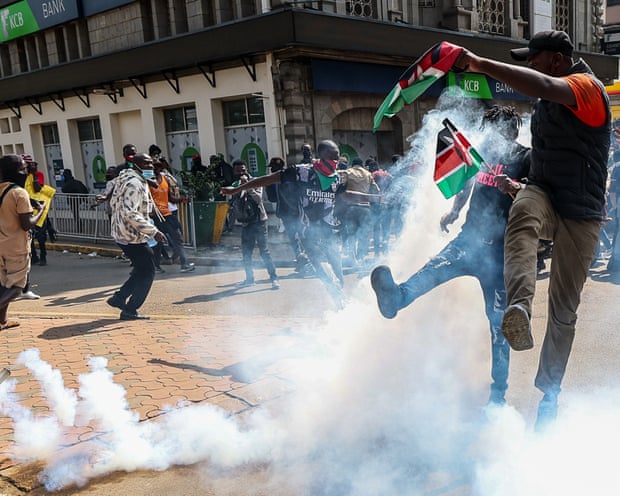
Demonstrators kick back teargas canisters shot by police during a protest in the central business district of Nairobi, Kenya, 25 June 2025. Photograph: Daniel Irungu/EPA

Police clashed with people marching in Nairobi and other areas to honour those killed in protests last year

At least 16 people have been killed and 400 injured in Kenya as a nationwide demonstration to honour those killed during last year’s anti-government protests turned chaotic, with police clashing with protesters in different parts of the country.

Amnesty Kenya’s executive director, Irũngũ Houghton, said the death toll had been verified by the government-funded Kenya national commission on human rights. “Most were killed by police,” he said.

A joint statement from groups supporting the protests said 83 people were seriously injured and at least eight people were being treated for gunshot wounds.

“We pray for our nation, dialogue and a way forward from the political impasse facing Kenya,” said the statement from the Law Society of Kenya (LSK), the Police Reforms Working Group and the Kenya Medical Association.

Thousands of Kenyans took to the streets early on Wednesday to pay tribute to more than 60 people who died last year when police opened fire on a crowd that tried to storm parliament while MPs inside passed legislation to raise taxes.

Article continues at https://www.theguardian.com/world/2025/jun/25/people-dead-injured-in-kenyan-protests

Continue ReadingAt least 16 people killed and 400 injured in Kenyan protests

Amid economic hardship and repression, Kenyans reject the Finance Bill 2024

Spread the love

Original article by Nicholas Mwangi republished from peoples dispatch under a Creative Commons Attribution-ShareAlike 4.0 (CC BY-SA) license.

Police heavily repressed the protests against the Finance Bill 2024 on Tuesday June 18. Photo: Mathare Justice Center

Hundreds were arrested and brutalized in Nairobi by police forces during protests against the government’s finance bill

On Tuesday June 18, the streets of Kenya’s capital were the site of a major showdown, as peaceful protesters advocating for the rejection of the Finance Bill 2024 were met with brutal repression by state forces. According to human rights groups in Kenya, between 300-400 protesters were arrested as they rallied against the punitive tax measures proposed by the government. The protest organized by a wide variety of civil society organizations and left groups was violently disrupted by police forces attempting to prevent the demonstrators from reaching the parliament building, where organizers had planned to launch a sit-in at 2 pm.

Despite the heavy-handed police attacks with water cannons, and tear gas, the protesters persisted throughout the day, ensuring their voices were heard by those in power and not allowing their right enshrined in article 37 of the constitution – “Assembly, demonstration, picketing and petition” to be compromised. This article outlines that every person has the right, peaceably and unarmed, to assemble, to demonstrate, to picket, and to present petitions to public authorities.”

The tension and public dissent exerted considerable pressure on the government. This was evident as President William Ruto convened an early meeting with members of parliament. The outcome of this meeting saw some “compromises” in the government’s stance on the contentious finance bill. The parliamentary finance committee announced the government’s U-turn at a press briefing on Tuesday, attended by the president and ruling party lawmakers. They announced the decision to withdraw certain proposed taxes, including those on cooking oil, mobile money services, and motor vehicles. The concession was clearly a direct response to the mounting public outcry nationwide.

However, the selective removal of these taxes has done little to appease the masses. Many view it as a strategic move by the government to placate the population while still pushing through other unpopular measures. The finance bill of 2024, in its entirety, remains widely rejected by the masses. The protesters’ message is clear: they demand a complete overhaul of the proposed financial policies, not just a piecemeal reduction of specific taxes.

Ruto’s neoliberal Finance Bill

The Finance Bill 2024, much like its predecessor in 2023, has stirred controversy and discontent across Kenya due to its stringent and, many argue, draconian proposals. This widespread dissatisfaction is deeply rooted within the broader context of an already high cost of living, which will be increased by the proposed new taxes. Beginning last week, Kenyans have voiced their disapproval with the finance bill by taking to social media, where they posted the contacts of Members of Parliament (MPs) and encouraged each other to reach out to their leaders, urging them to reject the bill.

The Finance Bill 2024, officially published by the National Assembly on May 9, 2024, outlines the Government of Kenya’s proposed tax measures for the financial year 2024-2025. Among the numerous changes proposed are significant amendments to Income Tax, Value Added Tax (VAT), and Excise Duty, as well as modifications to the administration of taxes in Kenya. One of the most contentious proposals in the bill is the imposition of a 16% Value Added Tax on financial transactions, and among basic commodities.

Many protested as they believe this will worsen their financial hardships rather than alleviate them. The protests are set to continue, with the third round of Parliament scheduled for June 20th.

The government’s justification for raising taxes, claiming it is necessary for Kenya to live within its means, is hypocritical given its extensive and often unnecessary expenditures. For instance, the government has increased its borrowing target for the fiscal year starting in July to Sh 597 billion, a substantial sum that raises questions about fiscal responsibility. A closer look at government spending reveals significant outlays that contrast sharply with its message.

According to Business Daily, the latest budget control data show a significant rise in travel perks for foreign and local trips, with an increase of Sh 1.62 billion from the Sh 12.4 billion spent in a similar period the previous year. The Parliamentary Service Commission’s spending has also surged by 18.5% to Sh 1.86 billion, and the bill for Members of Parliament (MPs) has grown by 4% to Sh 4 billion. Such figures highlight a pattern of lavish expenditure that stands in stark contradiction to the government’s narrative of financial prudence.

Further, the bill has received backing from the International Monetary Fund (IMF), despite widespread public outcry against it. This support from the IMF is not surprising as they did the same last year, and many Kenyans feel that the country has been effectively mortgaged to the institution. Historically, the IMF’s involvement has brought about economic policies and austerity measures that are seen as an attack on the working class and the marginalized peasants alike, often leading to increased economic strain for the average citizen.

Organized resistance poses more serious challenge to government

What distinguishes the current wave of protests from previous ones is the nature of their organization. Unlike past protests that were primarily mobilized by opposition party leader Raila Odinga against the government, these demonstrations have been driven by different organizations and particularly on online platforms, which have successfully translated their digital activism into tangible, on-the-ground action. This movement has seen an unexpectedly high level of participation from “Gen Z” and the middle class, groups that have traditionally been less involved in these demonstrations.

As the protests continue, the Kenyan government will continue to face mounting pressure to address the economic concerns of the masses. In the last two months there have been three major protests organized by grassroots movements among them against state demolitions on the informal settlements of the downtrodden coming to terms with the recent flood crisis that killed many and destroyed properties of unknown value. The fight for total liberation continues.

Nicholas Mwangi is a member of the Ukombozi Library in Kenya.

Original article by Nicholas Mwangi republished from peoples dispatch under a Creative Commons Attribution-ShareAlike 4.0 (CC BY-SA) license.

Continue ReadingAmid economic hardship and repression, Kenyans reject the Finance Bill 2024

Rich Nations Have Delivered Mere ‘Pittance’ to Help East Africa Tackle Climate Crisis: Oxfam

Spread the love

Original article by JAKE JOHNSON republished from Common Dreams under Creative Commons (CC BY-NC-ND 3.0).

“We have an abundance of clean, renewable energy,” said one African activist. “But to unlock it, Africa needs funding from countries that have got rich off our suffering.”

As the first-ever Africa Climate Summit kicked off in Nairobi, Kenya on Monday, an analysis by the humanitarian group Oxfam found that rich nations have delivered just a small fraction of the aid that East African nations say they need each year to meet their climate goals.

Unlike rich countries that account for a disproportionate share of planet-warming greenhouse gas pollution, East Africa has contributed “almost nothing” to global carbon emissions that are driving record-shattering heat worldwide, Oxfam’s new report notes. In 2021, according to one recent estimate, the average North American emitted 11 times more carbon dioxide than the average African.

The World Meteorological Organization pointed out Monday that Africa is responsible for less than 10% of global carbon emissions.

Yet “East Africa is one of the world’s worst-hit regions by climate change and is now experiencing its worst climate-induced extreme weather, fueling an alarming hunger crisis,” Oxfam’s report states. “Over 31.5 million people are currently facing acute hunger across Ethiopia, Kenya, Somalia, and South Sudan.”

Those countries, which suffer billions of dollars worth of climate-related damage each year, have said they will need at least $53.3 billion annually to meet critical targets under the Paris Climate Agreement. According to Oxfam, wealthy countries provided just $2.4 billion in aid to East African nations in 2021.

More broadly, Oxfam noted, high-income countries pledged that they would provide $100 billion a year by 2020 to help lower-income countries fight climate chaos.

“Oxfam estimates that in 2020 the real value of financial support specifically aimed at climate action was only around $21 billion to $24.5 billion—much less than officially reported figures suggest,” the group’s report states.

Fati N’Zi-Hassane, Oxfam’s Africa director, said Monday that “even by their own generous accounts, polluting nations have delivered only pittance to help East Africa scale up their mitigation and adaptation efforts.”

“Nearly half the funds (45%) they did give were loans, plunging the region further into more debt,” N’Zi-Hassane added.

Climate finance is expected to be a major topic of discussion at the Nairobi summit, which comes after months of scorching heat on the continent.

“Africa is seen as a sunny and hot continent,” Amadou Thierno Gaye, a research scientist and professor at Cheikh Anta Diop University in Dakar, toldBloomberg in July. “People think we are used to heat, but we are having high temperatures for a longer duration. Nobody is used to this.”

The Associated Press reported Monday that “there is some frustration on the continent about being asked to develop in cleaner ways than the world’s richest countries—which have long produced most of the emissions that endanger climate—and to do it while much of the support that has been pledged hasn’t appeared.”

Mohamed Adow of Power Shift Africa told AP that “we have an abundance of clean, renewable energy and it’s vital that we use this to power our future prosperity. But to unlock it, Africa needs funding from countries that have got rich off our suffering.”

In addition to calling on rich nations to contribute the aid they’ve promised to support Africa’s renewable energy transition, African civil society groups are urging their leaders to reject fossil fuel expansion, specifically warning against the completion of TotalEnergies’ East African Crude Oil Pipeline (EACOP).

A recent Human Rights Watch report warned that more than 100,000 people in Uganda and Tanzania are set to “permanently lose land to make way for the pipeline and Tilenga oilfield development.” One analysis indicates the pipeline could result in 379 million tonnes of planet-warming emissions over its lifespan—more than 25 times the combined annual emissions of Uganda and Tanzania.

Zaki Mamdoo, coordinator of the Stop EACOP Coalition, said Monday that “the African Climate Summit could provide the platform needed for the continent to dramatically shift its trajectory and future—from one that is set to bear the brunt of climate collapse, to one of energy security and prosperity driven by decentralized and people-centered renewables.”

“For this to happen,” said Mamdoo, “African leaders will need to rise to the occasion and make firm commitments to significantly upscale renewable energy developments while resisting and withdrawing any and all support for exploitative and destructive projects like the East African Crude Oil Pipeline.”

Original article by JAKE JOHNSON republished from Common Dreams under Creative Commons (CC BY-NC-ND 3.0).

Continue ReadingRich Nations Have Delivered Mere ‘Pittance’ to Help East Africa Tackle Climate Crisis: Oxfam