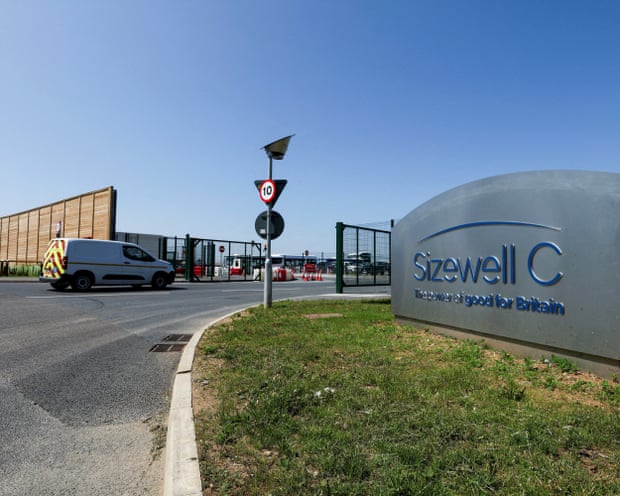
The NAO overall savings for households from the plant could be outstripped by the cost of supporting its construction until almost halfway through its 60-year operational life. Photograph: Chris Radburn/Reuters
National Audit Office says potential benefits are ‘considerable but uncertain’ while risks are ‘immediate and substantial’
The cost of the government’s £38bn nuclear plant in Suffolk is subject to “significant uncertainty” and may outweigh the benefits for UK households until at least 2064, according to the government’s spending watchdog.
The National Audit Office (NAO) has warned that although the potential benefits of the Sizewell C nuclear plant are considerable, they remain uncertain. The risks, however, are “immediate, substantial and borne by the public”.
The government claims the nuclear reactor, expected to generate the equivalent of enough low-carbon electricity to power 6m homes when it begins operations in the late 2030s, could save £2bn a year from the electricity system compared with using other low-carbon technologies.
However, for households the overall savings could be outstripped by the cost of supporting its construction until almost halfway through its 60-year operational life. The project could take even longer to “break even” if there are cost overruns or delays, the NAO warned.
“Sizewell C is a project of exceptional scale, complexity and significance for taxpayers,” said Sir Geoffrey Clifton-Brown, the chair of the public accounts committee, which oversees the work of the NAO. “Experience from comparable nuclear projects in the UK and overseas highlights their vulnerability to delays and cost overruns.”
…
Stop Sizewell C said the risks surrounding the project “could easily turn Sizewell C into a financial disaster” while the funding model meant its investors were “the only ones who can’t lose”.
The NAO has urged the government to mitigate the risk by using “close monitoring, greater transparency to parliament, and by securing value for money from the significant public and private investment”.
A government spokesperson said investing in large-scale nuclear power was the “only way to get our country off the rollercoaster of volatile global gas markets”.
What about big renewable then e.g. generation from tides? We reliably have huge tides.
Britain’s flagship home insulation programme has received a damning verdict from the National Audit Office. Under the Energy Company Obligation (ECO) scheme, tens of thousands of households have been left with faulty or even dangerous installations. It’s a result, the auditors say, of weak oversight, poor skills and confused accountability.
This report is troubling not only because of the human cost but because it exposes a deeper failure of governance in how the UK tries to decarbonise home heating. It’s a complex task that demands long-term stewardship, but is instead being left to the market.
The ECO was designed to make energy suppliers help households cut emissions and bills. Suppliers are the companies that buy electricity or gas from generators and sell it to you – the company named on your bills is your supplier. In theory, the ECO means these suppliers meet government-set carbon or energy saving targets by funding insulation and heating upgrades for households, with regulators checking that installations qualify.
The ECO was preceded by two other schemes that operated on the same principle. For years, they worked reasonably well for simple and low cost measures like loft or cavity wall insulation. But in 2013, the ECO was launched and expanded to cover more complex and expensive retrofits like solid wall insulation – an unprecedented shift.
So what went wrong?
The National Audit Office’s latest findings confirm fears that this was an approach set up to fail. Many installations require major remediation, some pose immediate health risks. The problems are familiar: an under-skilled workforce, uncertified installers, weak regulation and oversight.
Individually, these problems could be fixed. The government could improve installer training, tighten audits and crack down on fraud. But together, they reveal a deeper problem: a misplaced belief that market-based tools can deliver foundational change.
Energy efficiency obligations such as ECO work well for standardised, low-risk actions, like swapping bulbs or improving boilers. But, as we warned back in 2012, they are less suited to complex, capital-intensive retrofits of millions of households that require lots of coordination and long-term financing.
The UK’s energy efficiency governance still sits at arm’s length from the realities in people’s homes. Responsibilities are split confusingly between suppliers, Whitehall departments, auditors and local authorities, and it can often seem like no one is really in charge.
That’s why the failings highlighted in the National Audit Office report are not just implementation glitches or down to some “bad apple” installers. They’re failings of a governance model designed for incremental change, not the transformation required for net zero.
German lessons
If the UK really wants to retrofit millions of homes, it should look to what’s worked in other countries. Germany’s long-running KfW loan programme is one example. For more than three decades it has supported high-performance refurbishments through low-interest loans and grants. Successive German governments have recognised that the returns – in jobs, tax revenues, economic stimulus – have consistently outweighed the upfront cost.
By contrast, ECO has been repeatedly restructured, with shifting targets and funding levels that make it hard to plan ahead. Treating home retrofit as a short-term obligation rather than a long-term national project has left the UK far behind its peers.
Retrofitting homes is inherently local (you can’t pick up your house and move it to a different area). Local authorities should therefore play a much stronger role in coordinating delivery, enforcing quality, and linking retrofit to other social goals such as tackling fuel poverty.
Getting councils involved would align retrofit with local priorities rather than distant central government targets. It could also rebuild trust among people who may understandably be wary of such schemes.
The UK’s forthcoming warm homes plan is a chance to reset. The government should take a hard look at the tools at our disposal and think about what is needed to foster the creative and courageous policy needed to decarbonise our homes.
A view of HMP Northeye in Bexhill-on-Sea, East Sussex, which the Home Office bought for £15 million
Government urged to put ‘clear distance between it and the cruel, wasteful camps policy held by the previous one’
THE HOME OFFICE failed to rule out housing asylum-seekers in an asbestos-filled former prison today after the government’s spending watchdog blasted the Tories for wasting £15 million on it.
Tory ministers Robert Jenrick and Oliver Dowden “cut corners” and made “poor decisions” when they paid for the Northeye site in East Sussex, a damning National Audit Office (NAO) report said.
The “rushed and misjudged” decision was made despite the “technical due diligence and approvals process not having been undertaken.”
Shadow justice secretary Mr Jenrick announced that Northeye would be developed to house 1,200 people a month after an environmental review had identified a contamination risk from “asbestos-containing materials in existing buildings and contaminated ground” in February 2023.
The diligence report also estimated the cost of repairs to buildings at the site to be £20m.
…
Jeff Newnham, who leads the Save Northeye campaign against the development, told the Star that the asbestos-contamination risks were widely known following a fire at the former prison in the 1980s.
Labour said the report “raises serious questions about [new Tory leader] Kemi Badenoch’s judgement to appoint someone to her shadow cabinet who has no regard for public money.”
But the Home Office declined to rule-out housing asylum-seekers at the site themselves when asked by the Morning Star today.
The department has not finalised its plans for Northeye but insisted that it “will always act in the best interests of the taxpayer.”
Government criticised for spending £400m on Rwanda scheme while more than 1.2m wait for social housing
A housing charity accused the government of “pandering to dog-whistle politics” with the deal. Getty Images
The government could have increased the number of social homes built across England last year by more than a fifth using the money it has committed to its Rwanda asylum scheme.
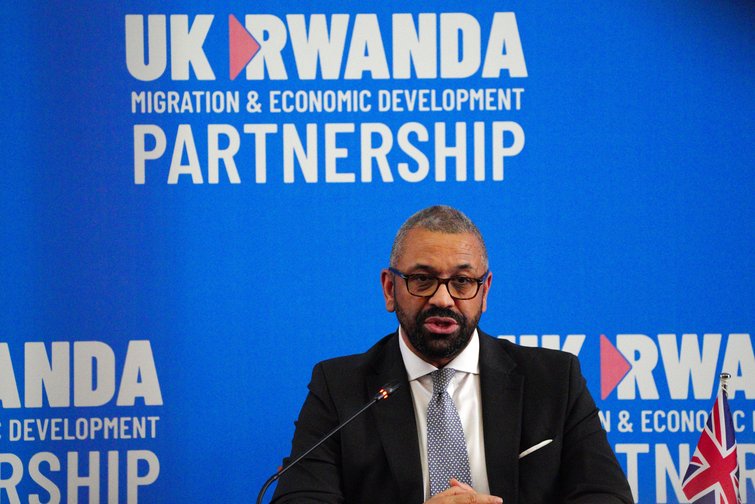
Home secretary James Cleverly confirmed on Wednesday that the government’s agreement to deport asylum seekers who enter the UK irregularly to the African country will have cost almost £400m by 2027.
The total sum would be enough to completely fund an estimated 2,131 new social homes, which is more than 22% of the 9,561 completed in England in the year to April 2023. The average government grant required to build a new home for social rent in England is £183,000, according to estimates by the National Housing Federation.
More than 1.2 million households were waiting for social housing in England as of March 2023, statistics published by the Department for Levelling Up, Housing and Communities (DLUHC) show.
The figures also show 7,620 social homes were completed in the year to April 2022, but a much higher number, 27,849, either sold or demolished – a net loss of more than 20,000. No figures have yet been published for social homes lost in the most recent year.
The government gave £140m to Rwanda in 2022 as part of its deal with the county and last week the Home Office’s most senior civil servant confirmed that a further £100m was given to the country in 2023. They added that a further payment of £50m is “anticipated” in 2024.
Cleverly, this week, told Parliament that the UK plans to give a further £50m to Rwanda annually in 2026 and 2027.
The overall costs of the Rwanda scheme could reach far higher that the £390m already committed by the government. An earlier economic impact assessment of the Illegal Migration Bill said that it would cost £63,000 more to remove a person to a third country, such as Rwanda, than having their asylum claim processed in the UK.
Rishi Sunak claimed in November that the policy “will literally save us billions in the long run”, but has not provided any figures to back this up.
On Tuesday, the National Audit Office confirmed that it would publish a report assessing the costs of the Rwanda scheme in 2024.
The inquiry was prompted by criticism from Labour MPs Meg Hillier and Diana Johnson, the chairs of the Public Accounts Committee and the Home Office Select Committee respectively, who said that there has been a “lack of clarity around value for money”.
Robina Qureshi, the CEO of Positive Action in Housing, said openDemocracy’s findings show that the government has put “pandering to dog-whistle politics” and “giving asylum contractors huge profits” over people’s futures.
“They haven’t been providing for society,” she said. “Instead they are sitting on their social media accounts trying to promote their own careers, and giving multi-million-pound contracts to asylum contractors. But nothing’s been done to help anyone that really needs it.
“When you build social homes, it increases the pool of houses that are available for anyone who’s in need.”