Gustav Agneman, Norwegian University of Science and Technology
In 2018, a colleague and I, together with a team of Greenlandic research assistants, conducted one of the most comprehensive surveys to date on public opinion in Greenland. We travelled to 13 randomly selected towns and settlements across the island nation, conducting in-person interviews with a representative sample of adult residents.
The survey explored a wide range of topics. We asked for views on climate change, economic matters – and the prospect of independence from Denmark. Until recently, this was the latest poll on what the people of Greenland thought about this issue.
Greenland, a former Danish colony, is currently an autonomous territory within the Kingdom of Denmark. This political arrangement grants Greenland extensive self-rule, including control over most domestic affairs, as well as its own prime minister and parliament. However, Denmark retains authority over foreign policy, defence and monetary policy.
While our survey results were covered in Greenlandic and Danish media upon their release, they received scant international attention. This changed abruptly on January 15, when newly re-elected US president Donald Trump reposted an old news article about our results. The headline stated that two-thirds of Greenlandic citizens support independence.
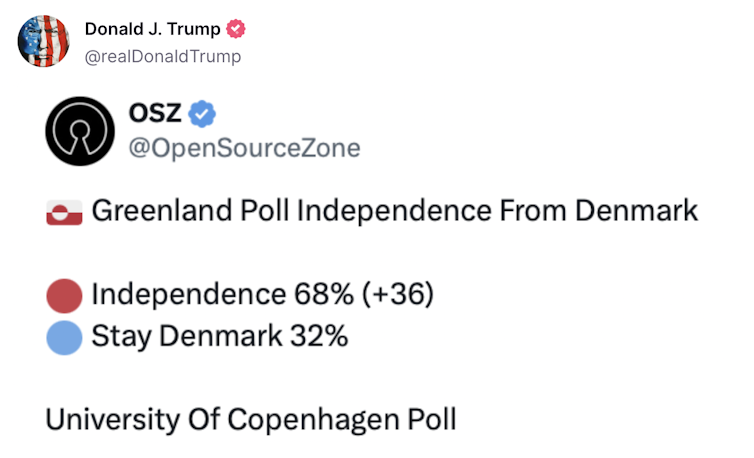
Trump did not add a comment in the post but the insinuation was clear given his recent statements about annexing Greenland from Denmark: Greenlandic residents want independence from Denmark, and therefore, they might be open to other political or economic arrangements with the US.
“I think we’re going to have it,” Trump recently said after a phone call with the Danish prime minister, Mette Frederiksen, who told him the land was “not for sale”. Trump has in the past spoken of somehow “purchasing” Greenland but has since moved on towards speaking in more assertive terms about taking control of the territory.
Back in 2018, when we conducted the survey, Trump had not yet revealed any plans to annex the island nation. It was a scenario we could hardly even have imagined and therefore did not ask our participants about. As such, regardless of how Trump framed them, the survey results in no way indicated that the population harboured a desire to join the US.
In fact, a recent survey conducted by Sermitsiaq (a Greenlandic newspaper) and Berlingske (a Danish newspaper) directly addressed this question and found that only 6% of respondents wanted Greenland to leave Denmark and instead become part of the US.
In the study I published based on the 2018 data collection, I reported that a majority of the Greenlandic population aspired to independence. Two-thirds of the participants thought that “Greenland should become an independent country at some point in the future”.
Opinions were more divergent regarding the timing of independence. When asked how they would vote in an independence referendum if it were held today, respondents who stated a preference were evenly split between “yes” and “no” to independence.
The Act on Greenland Self-Government, passed in 2009, grants the Greenlandic government the legal authority to unilaterally call a referendum on separating from the political union with Denmark. According to the law, “the decision regarding Greenland’s independence shall be taken by the people of Greenland”.
During the 15 years since its passage, the option to call a referendum has not been exercised. This is likely due to the potential economic consequences of leaving the union with Denmark.
Each year, Denmark sends a block grant that covers approximately half of Greenland’s budget. This supports a welfare system that is more extensive than what is available to most Americans. In addition, Denmark administers many costly including national defence.
This backdrop presents a dilemma for many Greenlanders who aspire to independence, as they weigh welfare concerns against political sovereignty. This was also evident from my study, which revealed that economic considerations influence independence preferences.
For many Greenlanders, the island nation’s rich natural resources present a potential bridge between economic self-sufficiency and full sovereignty. Foreign investments and the associated tax revenues from resource extraction are seen as key to reducing economic dependence on Denmark. Presumably, these natural resources, which include rare earths and other strategic minerals, also help explain Trump’s interest in Greenland.
As Greenland’s future is likely to remain at the centre of a geopolitical power struggle for some time, it is crucial to remember that only Greenlanders have the right to determine their own path. What scarce information is available on their views suggests that while many aspire to independence, it is not driven by a desire to join the US.
Gustav Agneman, Associate Professor, Department of Economics, Norwegian University of Science and Technology
This article is republished from The Conversation under a Creative Commons license. Read the original article.