‘Not Our War’: US Allies Rebuff Trump Demands to Help Clean Up His Iran Disaster

Spread the love

Original article by Brad Reed republished from Common Dreams under Creative Commons (CC BY-NC-ND 3.0).

South Korean protesters hold placards during a protest against Trump’s request to dispatch warships to the Strait of Hormuz in front of the US embassy in Seoul on March 16, 2026. (Photo by Jung Yeon-je / AFP via Getty Images)

“What does Trump expect from a handful of European frigates that the powerful US Navy cannot do?” said one German official.

US allies are giving President Donald Trump the cold shoulder after he demanded that they send their militaries to help him reopen and secure the Strait of Hormuz, which has been shut down by the Iranian government in response to US and Israeli attacks.

Reuters chief national security correspondent Phil Stewart collected reactions from several US allies to Trump’s demands in a Monday social media post, and they show little appetite for helping the president out of the jam he created when he launched an unprovoked and unconstitutional war with Iran more than two weeks ago.

RECOMMENDED…
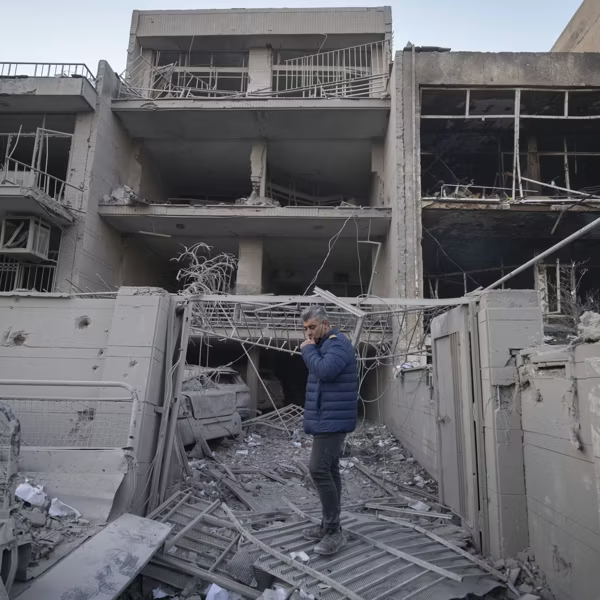
U.S.-Israeli Attack On Police Headquarters

Warnings of Further Catastrophe After Trump Says Only Deal for Iran is ‘Unconditional Surrender’

image shoes US military planes headed to the midde east

‘The Tankers Just Keep Coming’: US Military Movements Spike Fears of Imminent Attack on Iran

German Defense Minister Boris Pistorius spoke bluntly about his country’s unwillingness to get involved in what has become a regional conflict in the Middle East that has sent global energy prices soaring and is threatening to upend the global economy.

“What does Trump expect from a handful of European frigates that the powerful US Navy cannot do?” Pistorius asked. “This is not our war, we have not started it.”

UK Prime Minister Keir Starmer stated flatly that his nation would not be “drawn into the wider Iran war,” and insisted that only a diplomatic solution could ease the crisis.

“We are working with others to come up with a credible plan for the Strait of Hormuz to ensure that we can reopen shipping and passage through the Strait,” he said. “Let me be clear, that won’t be and it’s never been envisioned to be a NATO mission.”

Catherine King, a member of Australian Prime Minister Anthony Albanese’s cabinet, said there were no plans to have the Australian military participate in Trump’s efforts to reopen the strait.

“We won’t be sending a ship to the Strait of Hormuz,” King said. “We know how incredibly important that is, but that’s not something that we’ve been asked or that we’re contributing to.”

Japanese Prime Minister Sanae Takaichi didn’t completely rule out sending escort ships to help oil tankers navigate the strait, but she emphasized there are no plans to do so at the moment.

“We have not made any decisions whatsoever about dispatching escort ships,” said Takaichi. “We are continuing to examine what Japan can do independently and what can be done within the legal framework.”

Trump started publicly calling on US allies to assist in reopening the strait in a Saturday Truth Social post, in which he said “hopefully China, France, Japan, South Korea, the UK, and others, that are affected by this artificial constraint, will send Ships to the area so that the Hormuz Strait will no longer be a threat by a Nation that has been totally decapitated.”

Trump repeated his demands to US allies while talking with reporters on Air Force One on Sunday, arguing that getting the strait reopened was in the interest of all nations.

“Really, I’m demanding that these countries come in and protect their own territory, because it is their territory,” Trump said. “You could make the case that maybe we shouldn’t be there at all, because we don’t need it. We have a lot of oil.”

Original article by Brad Reed republished from Common Dreams under Creative Commons (CC BY-NC-ND 3.0).
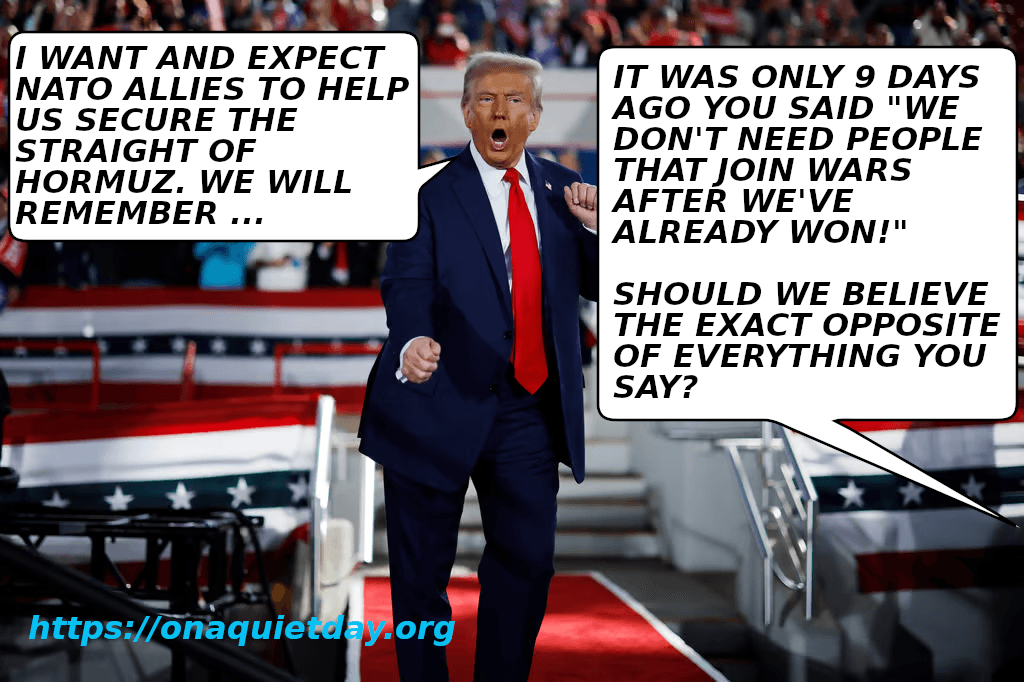
Donald Trump calls for help from NATO allies in securing the Straight of Hormuz despite saying only 9 days ago that they don't need people to join wars after they've already won.
Donald Trump calls for help from NATO allies in securing the Straight of Hormuz despite saying only 9 days ago that they don’t need people to join wars after they’ve already won.
Climate science denier Donald Trump confirms that he knows nothing about democracy and that more liquid gold is being secured according to his policy of global privateering.
Donald Trump explains why he established his Bored of Peace

Continue Reading‘Not Our War’: US Allies Rebuff Trump Demands to Help Clean Up His Iran Disaster

Israel’s War with Iran Isn’t America’s Fight—And Voters Know It

Spread the love

Original article by Medea Benjamin republished from Mint Press News under a Creative Commons Attribution-NonCommercial-ShareAlike 3.0 International License.

When Israel launched a surprise military strike on Iran last week, it did more than risk igniting a catastrophic regional war. It also exposed long-simmering tensions in Washington—between entrenched bipartisan, pro-Israel hawks and a growing current of lawmakers (and voters) unwilling to be dragged into another Middle East disaster.

“This is not our war,” declared Rep. Thomas Massie (R-KY), one of the House’s most consistent antiwar voices. “Israel doesn’t need U.S. taxpayers’ money for defense if it already has enough to start offensive wars. I vote not to fund this war of aggression.” On social media, he polled followers on whether the U.S. should give Israel weapons to attack Iran. After 126,000 votes (and 2.5 million views), the answer was unequivocal: 85% said no.

For decades, questioning U.S. support for Israel has been a third rail in Congress. But Israel’s unprovoked attack on Iran—coming just as the sixth round of sensitive U.S.-Iran nuclear talks were set to take place in Oman—sparked rare and unusually direct criticism from across the political spectrum. Progressive members, already furious over Israel’s war on Gaza, were quick to condemn the new offensive. But they weren’t alone.

Rep. Pramila Jayapal (D-WA) called Israel’s strike “reckless” and “escalatory,” and warned that Prime Minister Netanyahu is trying to drag the U.S. into a broader war. Rep. Chuy García (D-IL) called Israel’s actions “diplomatic sabotage” and said, “the U.S. must stop supplying offensive weapons to Israel, which also continue to be used against Gaza, & urgently recommit to negotiations.”

Rep. Summer Lee (D-PA) was even more blunt. “The war criminal Netanyahu wants to ignite an endless regional war & drag the U.S. into it. Any politician who tries to help him betrays us all.”

More striking, however, were the critiques from moderate Democrats and some Republicans.

Sen. Tim Kaine (D-VA), a longtime advocate for requiring congressional approval before the U.S. gets involved in new wars, blasted Israel for jeopardizing planned U.S.-Iran diplomacy. “The American people have no interest in another forever war,” he wrote. Sen. Jack Reed (D-RI), Ranking Member of the Senate Armed Services Committee, warned that strikes “threaten not only the lives of innocent civilians but the stability of the entire Middle East and the safety of American citizens and forces.”

Some pro-Israel Democrats are feeling comfortable speaking out on this conflict because it fits their anti-Trump critique. Sen. Maria Cantwell (D-WA) said:

We are at this crisis today because President Trump foolishly walked away from President Obama’s Iran nuclear agreement under which Iran had agreed to dismantle much of its nuclear program and to open its facilities to international inspections, putting more eyes on the ground. The United States should now lead the international community towards a diplomatic solution to avoid a wider war.”

Adding to this diverse chorus of opposition are some Republicans from the party’s non-interventionist wing. Sen. Rand Paul (R-KY) declared, “War with Iran is not in America’s interest. It would destabilize the region, cost countless lives, and drain our resources for generations.” Rep. Warren Davidson (R-OH) lamented that “some members of Congress and U.S. Senators seem giddy about the prospects of a bigger war.”

And in a rare show of agreement with progressive critics, Rep. Marjorie Taylor Greene (R-GA) blasted the hawks in both parties. “We’ve been told for the past 20 years that Iran is on the verge of developing a nuclear bomb any day now. The same story. Everyone I know is tired of U.S. intervention and regime change in foreign countries. Everyone I know wants us to fix our own problems here at home, not bomb other countries.”

Of course, many in Congress rushed to support Israel. Senate Republican leader John Thune said, “Israel has determined that it must take decisive action to defend the Israeli people.” Democratic Sen. John Fetterman (D-PA) voiced full support for the strike and urged the U.S. to provide Israel “whatever is necessary—military, intelligence, weaponry.”

The most crass was Senator Lindsey Graham, who posted:

Game on. Pray for Israel.”

But these crude pro-war responses, once guaranteed to go unchallenged, are now being met with resistance–and not just from activists. With public opinion shifting sharply–especially among younger voters, progressives, and “America First-ers” – the political calculus on unconditional support for Israel is changing. In the wake of Israel’s disastrous war in Gaza and its widening regional provocations, members of Congress are being forced to choose: follow the AIPAC money and the old playbook–or listen to their constituents.

If the American people continue to raise their voices, the tide in Washington could turn away from support for a war with Iran that could plunge the region into deeper chaos while offering no relief for the suffering people of Gaza. We could finally see an end to decades of disastrous unconditional support for Israel and knee-jerk support for catastrophic wars.

Feature photo | Israelis gather next to a direct hit site following an Iranian missile strike against Israel, June 16th 2025. Matan Golan | AP

Medea Benjamin is co-founder of Global Exchange and CODEPINK: Women for Peace. She is the co-author, with Nicolas J.S. Davies, of War in Ukraine: Making Sense of a Senseless Conflict, available from OR Books in November 2022. Other books include, “Inside Iran: The Real History and Politics of the Islamic Republic of Iran” (2018); “Kingdom of the Unjust: Behind the U.S.-Saudi Connection” (2016); “Drone Warfare: Killing by Remote Control” (2013); “Don’t Be Afraid Gringo: A Honduran Woman Speaks from the Heart” (1989), and (with Jodie Evans) “Stop the Next War Now” (2005).

The views expressed in this article are the author’s own and do not necessarily reflect MintPress News editorial policy.

Original article by Medea Benjamin republished from Mint Press News under a Creative Commons Attribution-NonCommercial-ShareAlike 3.0 International License.

Continue ReadingIsrael’s War with Iran Isn’t America’s Fight—And Voters Know It