No wonder England’s water needs cleaning up – most sewage discharges aren’t even classified as pollution incidents
Alex Ford, University of Portsmouth
England’s privatised water industry may one day be considered a textbook case study of failed corporate responsibility, regulation and governance. The Cunliffe review, the recent report into England’s privatised water industry, concluded that the financial regulator, OfWat, needs to be disbanded and a new water regulator will be introduced.
For that to work effectively, better pollution monitoring and more clearly defined pollution incident criteria are essential. While politicians and water companies have claimed to be reducing pollution incidences, they might not strictly be tackling sources of pollution, so communications must be carefully scrutinised for disinformation.
The UK’s environment minister Steve Reed MP has described the water industry as “broken”. The public have rising water bills. Water companies owe over £60 billion in debts and have left the country with uncertain water security in the face of climate change.
The Environment Agency (EA) in England recently announced that serious pollution incidents in 2024 rose by 60% to 75 from 47 in the previous year. The EA classifies pollution incidents using a four-point scale called the common incident classification scheme. Trained EA officers consider the evidence reported via their incident hotline to assess its credibility and severity.
Get your news from actual experts, straight to your inbox. Sign up to our daily newsletter to receive all The Conversation UK’s latest coverage of news and research, from politics and business to the arts and sciences.
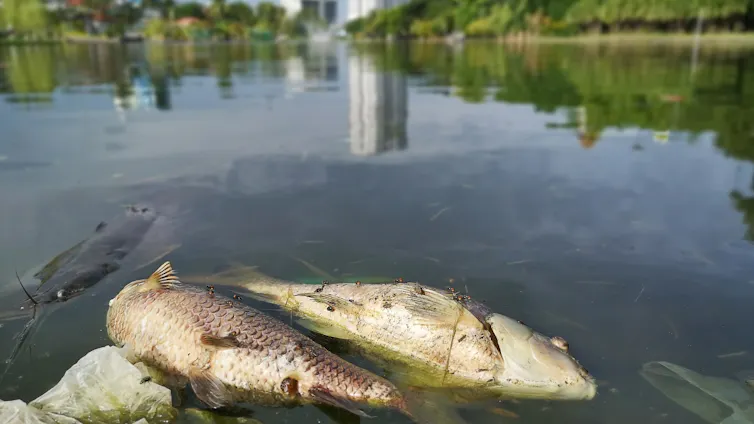
Category 1 is for major incidents, 2 for significant, 3 for minor incidents and 4 for no impact. Category 1 and 2 typically involve visible signs of dead fish floating. For salmon, if more than 10 adult or 100 young fish are dead, this is category 1. With fewer than ten adult and 100 young fish dead, it’s category 2.
No dead fish, no serious problem? The EA can also record damage on protected habitats as “pollution incidents” but these are harder to substantiate without investigative research that takes time and money.
Last year, more than 450,000 sewage discharges were recorded by event duration monitors. These are devices fitted to the end of overflow pipes that indicate when and for how long they have been discharging.
These discharges represent 3.6 million hours of untreated sewage going into our rivers and coasts. These contain chemical contaminants including pharmaceuticals, detergents and human pathogens. Only 75 incidents were recorded as serious or significant in 2024. Another 2,726 were classed as minor.
So lots of sewage discharges are not being classified as pollution incidents, despite containing pollutants. The EA advises its investigating officers to “record substantiated incidents that result in no environmental impact, or where the impact cannot be confirmed, as a category 4”.
The EA has been criticised for turning up late to 74% of category 1 and 2 pollution incidents and for being pressured to ignore low-level pollution – all claims that they have denied. However, they admit they are constrained by finances. Any new regulator must be adequately resourced and independent.

In their recent report into pollution incidences, the EA states that they respond to all category 1 and 2 (serious and significant) water industry incidents and will be increasing their attendance at category 3 (minor) incidents. They highlight that more inspections will identify more issues. This shows some acceptance that the more incidents they attend, the more would be substantiated or recorded appropriately.
Most sewage discharges would not have been reported to, or recorded by, the EA as pollution incidents because they were permitted discharges from combined stormwater overflows. Water companies are allowed to discharge untreated wastewater under exceptional rainfall or snowfall conditions to prevent sewage backing up through the pipes.
Extra water flow in rivers from rainfall is meant to dilute chemical contaminants in wastewater. However, some discharges can last days or weeks. The EA is currently investigating whether water companies have been breaching their permits and discharging untreated wastewater when there is low or even no rainfall.
What counts as pollution?
The UN classifies pollution as “presence of substances and energy (for example, light and heat) in environmental media (air, water, land) whose nature, location, or quantity produces undesirable environmental effects”. This definition differs markedly from the EA’s working definition of pollution incidents.
Many sewage discharges containing low concentrations of pollutants won’t kill fish but might still be harmful to fish larvae or small insects, for example.
However, the broad picture from EA data is that invertebrate communities at least are in a better state than they were three decades ago before wastewater treatment plants were upgraded following the EU’s Urban Wastewater Directive.
Some pollutants bioaccumulate through the food chain, so they become concentrated in top predators such as orcas. Some chemicals mimic reproductive hormones even in low concentrations and can feminise fish, for example. High levels of nutrients from agriculture and sewage in rivers can cause fungal diseases in seagrass meadows.
Other families of chemicals build up in wildlife and people, such as persistent “forever chemicals”, much of which comes from wastewater discharges. Continued discharges of antibiotics into waterways might not be classified as pollution incidents but still pose a substantial risk to human and ecosystem health through bacteria developing antibiotic resistance.
The government has just committed to cut sewage pollution by 50% by December 2029 based on 2024 data. But it’s not yet clear whether these involve cutting the frequency of discharges, the duration or both.
This data could also be manipulated so that a large number of small discharges can be consolidated into one official discharge event. Currently, the volume of discharges from stormwater overflows isn’t known. Without this vital data we can’t ascertain the risk posed by their contaminants.
Don’t have time to read about climate change as much as you’d like?
Get a weekly roundup in your inbox instead. Every Wednesday, The Conversation’s environment editor writes Imagine, a short email that goes a little deeper into just one climate issue. Join the 45,000+ readers who’ve subscribed so far.
Alex Ford, Professor of Biology, University of Portsmouth
This article is republished from The Conversation under a Creative Commons license. Read the original article.


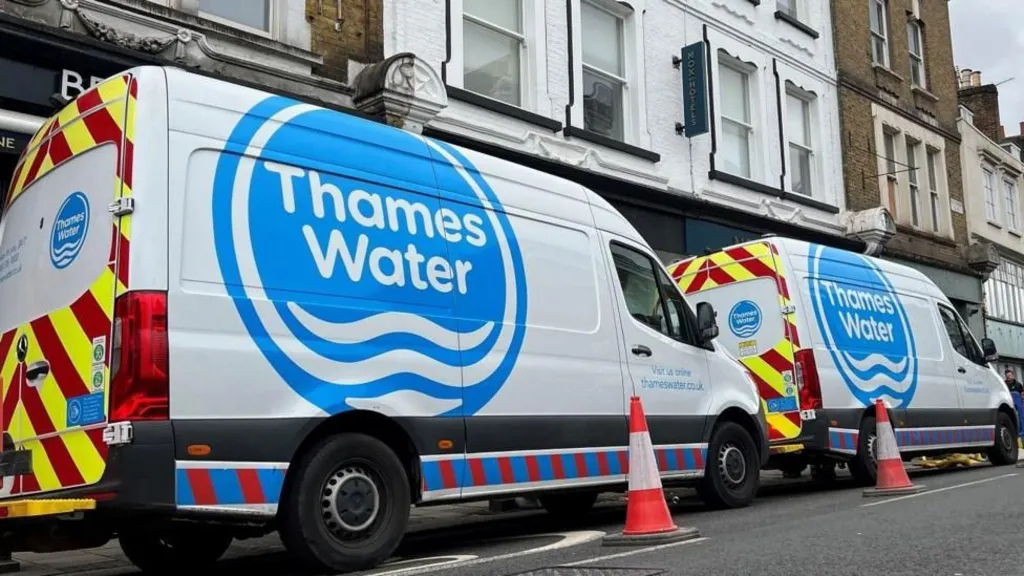
 A worker from Thames Water delivering a temporary water supply from a tanker to the village of Northend in Oxfordshire