Twenty years after “No to the FTAA”, Latin American movements reaffirm their anti-imperialist commitment

Spread the love

Original article by Pablo Meriguet republished from peoples dispatch under a Creative Commons Attribution-ShareAlike 4.0 (CC BY-SA) license.
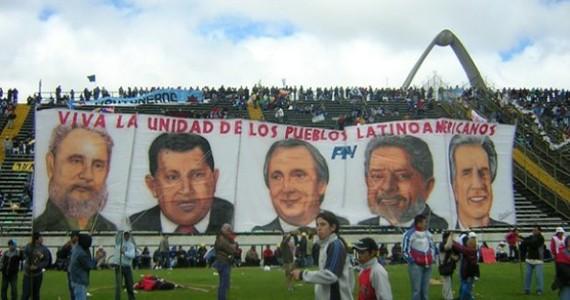
In 2005, in the city of Mar del Plata, the presidents of the brother countries of the Americas, Lula da Silva, Hugo Chávez, Evo Morales, and Néstor Kirchner stood firm against the United States. Photo: X

The meeting in Mar del Plata paid tribute to the moment when several Latin American presidents defeated the US attempt to establish a regional free trade agreement.

In the same place where the regional free trade project was “buried” two decades ago, 150 delegates from various social movements in Brazil, Uruguay, Bolivia, Cuba, Mexico, Portugal, Haiti, Palestine, Chile, Nicaragua, Peru, and Paraguay gathered to reaffirm the anti-imperialist spirit that led to the regional rejection of the FTAA project, they say.

“The world faces greater levels of inequality, injustice, and authoritarianism, with a growing concentration of financial and technological power that deepens poverty and limits the autonomy of countries in the Global South,” the delegates said in the event’s final declaration.

The meeting was also attended by the governor of Buenos Aires, Axel Kicillof, who stated that the rejection of the FTAA in 2005 was a “new declaration of independence” for Latin American countries. “The rejection of the FTAA was a victory for Latin American sovereignty, voiced by a group of presidents with enormous courage, represented in our country by Néstor Kirchner. Twenty years after that historic milestone, we have a responsibility to continue building unity, because there is no possibility of development for our countries outside the framework of regional integration. We cannot afford not to have a project on behalf of our people, because Argentina and the countries of Latin America are not anyone’s backyard,” Kicillof wrote in X.
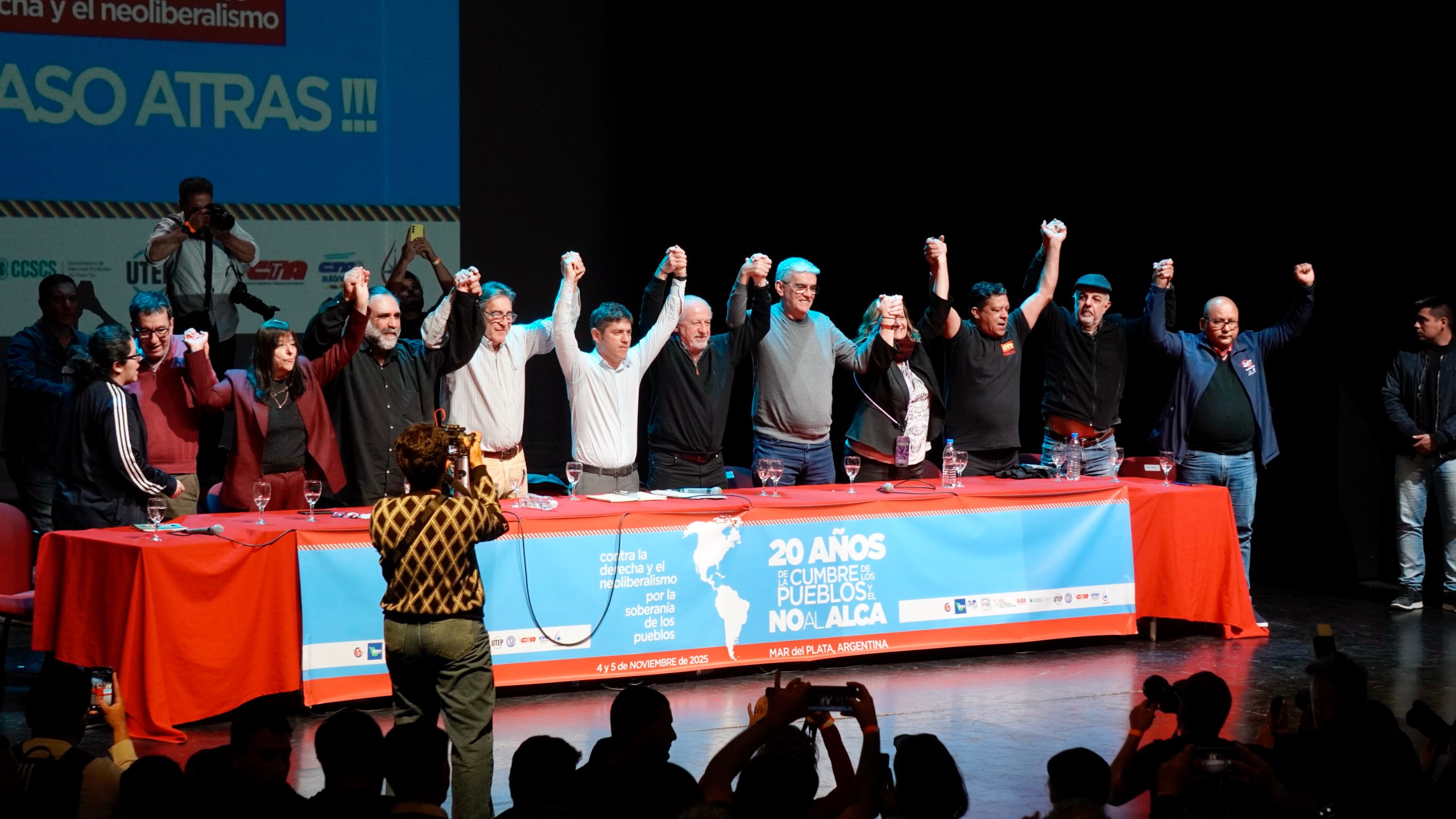
Peoples Summit No al ALCA
Delegates from dozens of Latin American countries reaffirm the anti-imperialist spirit of the “No to the FTAA” summit in 2005.

For his part, the Secretary of Foreign Affairs of the Argentine Workers’ Central Union (CTA), Adolfo Aguirre, stated: “In this very place, in front of the President of the United States, George W. Bush, and before the eyes of the whole world, our peoples, workers, together with leaders such as Néstor Kirchner, Hugo Chávez, and Luiz Inácio Lula da Silva, marked a turning point. We said no to surrender, no to dependence, no to the model that wanted to turn our America into the backyard of economic power.”

Twenty years ago, the anti-imperialist slogan was born

Twenty years ago in Argentina, several political leaders from the Latin American left gathered at a People’s Summit, whose fundamental slogan was the rejection of the Free Trade Area of the Americas (FTAA), an initiative promoted, among others, by the George W. Bush administration. The FTAA sought to significantly reduce customs barriers between American countries.

According to popular and left-wing forces in Latin America and the Caribbean, the agreement would have promoted a regional market in which the United States would have had an enormous advantage over other countries and which, in the long run, would have led to the destruction of the still immature regional industry to benefit the interests of large US companies.

However, the economic and geopolitical project did not prosper due to fierce and coordinated opposition from several Latin American presidents, including Néstor Kirchner (Argentina), Hugo Chávez (Venezuela), and Luiz Inácio Lula da Silva (Brazil), among others. The political maneuver took place in Mar del Plata, during the Summit of the Americas, where Bush and his entourage suffered a severe setback. Thus, the proposal that had been in the works and planned since 1994 in Miami and was definitively defeated.

The Summit of the Americas is considered by several experts to be a turning point in the geopolitical relations of the American continent. New progressive and pro-sovereignty processes joined those of Argentina, Brazil, and Venezuela, giving rise to an attempt at regional integration that to this day is pushed by progressivism and boycotted by Washington’s neoliberal allies.

While the summit was taking place, thousands of people from left-wing and progressive movements and political parties gathered at a parallel conference with the slogan “No to the FTAA,” which was eventually attended by several political leaders. Among them, Hugo Chávez made a statement in his speech that would go down in history: “ALCA (FTAA in Spanish), al carajo! (FTAA, go to hell!)”.

A historic event

The region has undoubtedly changed its political composition. The seemingly unstoppable rise of progressive governments is now fragmented due to the emergence of new right-wing and neoliberal projects, such as those of Javier Milei in Argentina and Daniel Noboa in Ecuador, and the recent victory of the Bolivian right after more than 20 years of left-wing governments, among others.

However, in several countries, progressivism managed to regain government, as in the case of Lula da Silva himself, or managed to remain in power, as in the case of the United Socialist Party of Venezuela. Also, in other countries such as Colombia with Gustavo Petro and Mexico with Andrés Manuel López Obrador and Claudia Sheinbaum, progressive governments took office for the first time in their recent history.

In this sense, the dispute over governments in Latin America remains open, and much of the structure of that dispute can be found in what happened in Mar del Plata 20 years ago, where one regional project was buried and another was established, for almost a decade, as the model for regional integration around a position that, although it had its clear limits, always declared itself sovereign and independent.

Original article by Pablo Meriguet republished from peoples dispatch under a Creative Commons Attribution-ShareAlike 4.0 (CC BY-SA) license.
Continue ReadingTwenty years after “No to the FTAA”, Latin American movements reaffirm their anti-imperialist commitment

Peru’s latest president José Jerí faces mounting pressure after killing of protester

Spread the love

Original article by Pablo Meriguet republished from peoples dispatch under Creative Commons Attribution-ShareAlike 4.0 (CC BY-SA) license.

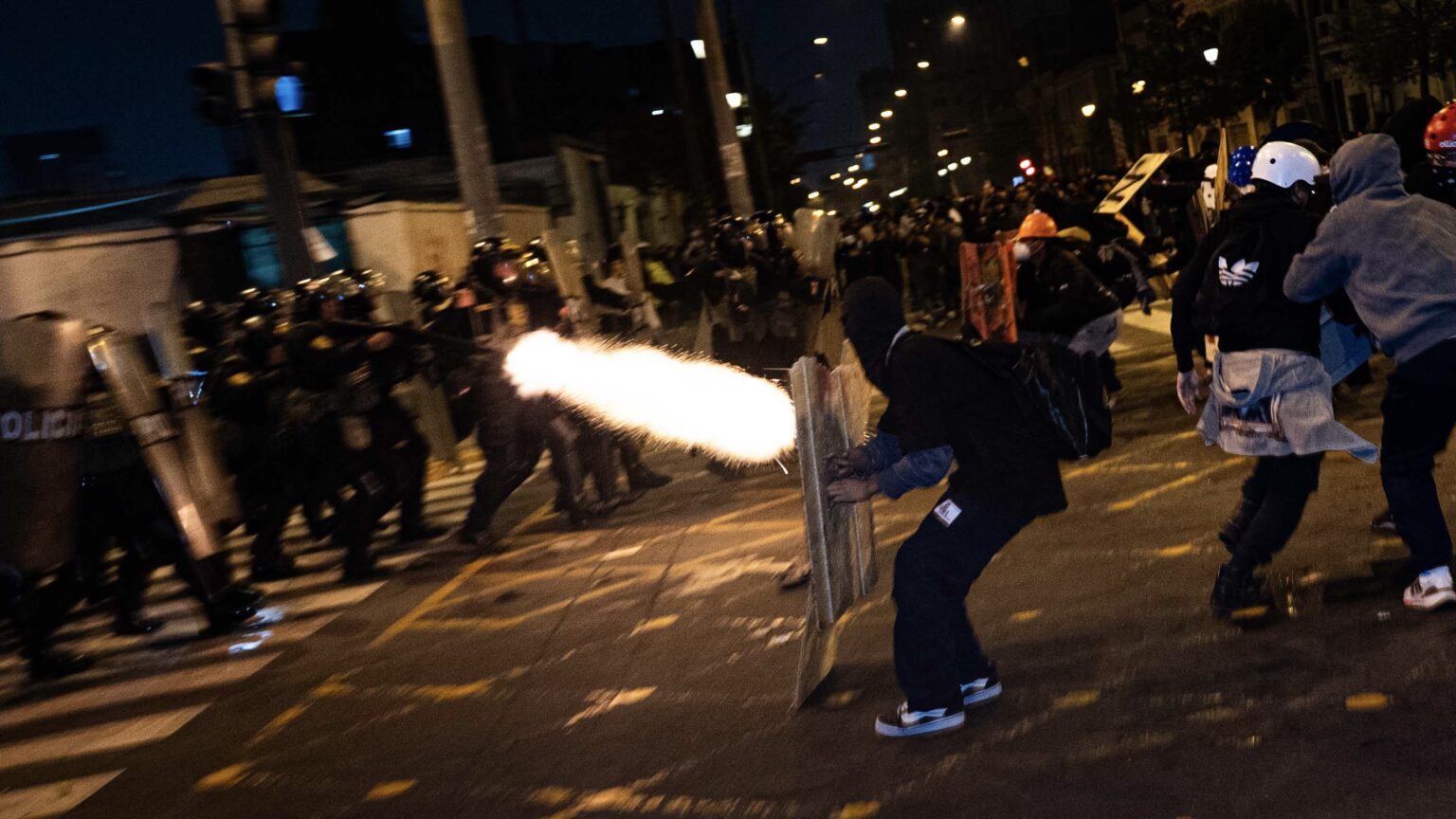
Police shoot at protesters in Lima, Peru. Photo: Juan Mandamiento / Wayka

Protests have not subsided despite Boluarte’s removal from office. Now, Jerí’s newly formed government faces an attempt at censure just days after he accepted the position.

Peru’s right-wing Congress gambled that their removal of highly unpopular Dina Boluarte and the subsequent swearing in of José Jerí as President of Peru would perhaps bring down the intensity of the protests in the country and ultimately lead to their dissipation.

However, in Lima (the capital) and other cities such as Arequipa, Cusco, and Puno, protests have continued and even grown in strength. The state repression of the protests also appears to be a constant, as this too has persisted and intensified. According to human rights organizations and local media outlets, the latest protests have been met with heavy repression by Peruvian security forces resulting in the death of 32-year-old hip hop artist Mauricio Ruiz on October 15. Dozens have also been injured.

The National Human Rights Coordinator (CNDDHH) denounced the violent repression and return of killings of protestors by police: “The field monitoring team of the National Human Rights Coordinator has confirmed the death of young Mauricio Ruiz Sanz during the day of protest … We express our deep outrage and solidarity with his family, and we demand an immediate, thorough, and independent investigation to clarify the facts and determine who is responsible.”

According to the CNDDHH, the perpetrator of the murder was an undercover police officer who, upon being discovered by protesters, attempted to flee and shot Ruiz, who died a few minutes later at Loayza Hospital in downtown Lima, very close to the epicenter of the demonstrations (around the National Congress).

In the aftermath of Ruiz’s death, artists collectives, student organizations, and progressive movements have organized vigils and recommitted themselves to the struggle against the repressive and corrupt Peruvian state.

Peru faces a deep structural crisis

The continuation of protests following Boluarte’s removal from office confirms that the crisis facing the country goes beyond one leader. Before Boluarte’s removal, protesters were demonstrating not only against her government (the most unpopular in Peru’s recent history), but also against a political structure and system that does not meet the needs of the Peruvian people.

Read More: Peru after the soft coup

The serious security crisis and increasing social inequalities, in addition to the radicalization of the neoliberal program that shows no signs of reversing, are factors that have led thousands of Peruvians, especially young people, to demand a complete overhaul of Peruvian politics, which seems unable to break out of its current cycle of instability.

The recent Peruvian government is faltering

As the protests show no signs of letting up and outrage has intensified following the violent repression, the administration of controversial right-wing President Jerí is already on unstable ground. Amid the outcry over the killing of the young artist, President Jerí wrote on X: “I mourn the death of 32-year-old citizen Eduardo Ruiz Sanz. My thoughts are with his family at this time. May the investigations determine the facts and responsibilities objectively.” Notably, most of Jerí’s other posts in the last several days are focused on condemning protesters and highlighting the toll the protests have taken on law enforcement.

And yet, just a few days after accepting the position, Jerí is facing a motion of censure by the very Congress that elected him president a few days ago. According to several legislators, the alleged killing of protester Ruiz by security forces is a sufficient reason to demand Jerí’s censure, which requires 66 votes to be carried out.

Read More: José Jerí: Peru’s eighth president in a decade

If Jerí is removed from office, congressman and former army general Roberto Chiabra would assume the presidency. Chiabra was a significant military figure during the internal armed conflict of the 1990s and the war with Ecuador in Cenepa in 1995. He later served as commander-in-chief of the army during the administration of Alejandro Toledo (2001-2006) and subsequently as defense minister in that administration.

At the moment, there is maximum tension in Peru, where news of the rapid succession of presidents seems to be repeating itself due to the inability of the political forces to sustain a government. In addition, demonstrations seem to be increasing in intensity and the number of participants, so the coming weeks are not expected to be easy in the South American country.

Original article by Pablo Meriguet republished from peoples dispatch under Creative Commons Attribution-ShareAlike 4.0 (CC BY-SA) license.

Continue ReadingPeru’s latest president José Jerí faces mounting pressure after killing of protester

Protests continue in Peru, as polls register 96% rejection of Boluarte

Spread the love

Original article by Pablo Meriguet republished from peoples dispatch under a Creative Commons Attribution-ShareAlike 4.0 (CC BY-SA) license.
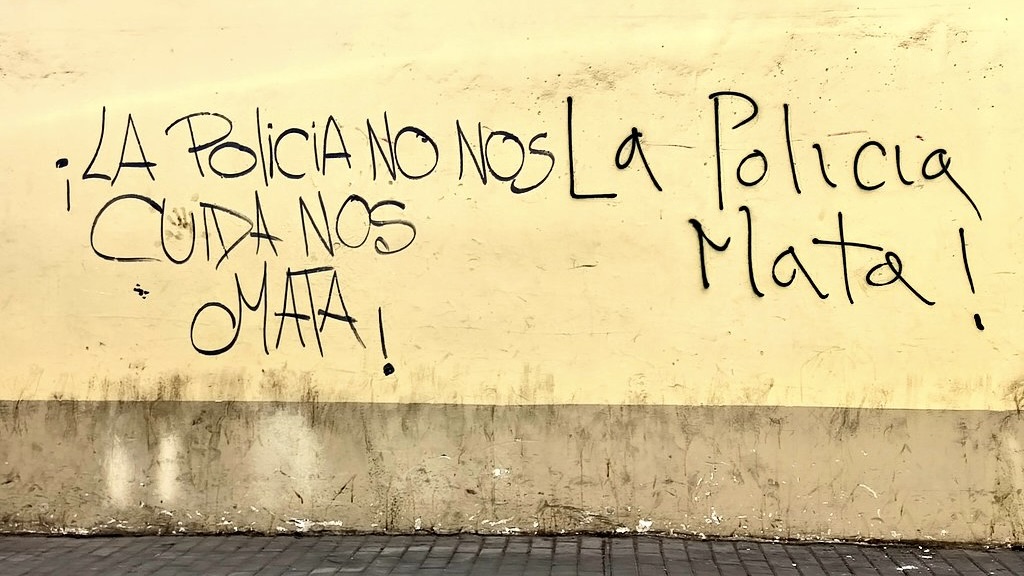
Graffiti in Lima condemning police repression of protests. Photo via Joxe Carlos / X

Protesters are demanding an end to the government with the highest disapproval rating on the entire continent. Boluarte, however, says she will not resign.

Another massive mobilization took place on October 4 in Lima, Peru’s capital, against the government of Dina Boluarte. With this mobilization, it has now been three weeks in a row that thousands of Peruvians have taken to the streets to demand an end to the proposed pension reform, corruption, insecurity, and police abuse.

But, as several analysts have pointed out, the protests are no longer focused solely on specific issues, but on raising the demand for an end to the Boluarte government. Boluarte took office after the overthrow of then-President Pedro Castillo, and led to the deaths of more than 60 Peruvians following massive protests between 2022 and 2023.

Protests in Lima

On Saturday, October 4, the streets of downtown Lima were once again filled with cries against the government and the national congress. The demonstrations were attended by young people, university students, workers, transport workers, and various collectives who denounced the Peruvian state structure as corrupt due to the presence of political and economic mafias. The General Confederation of Workers of Peru (CGTP) also joined the demonstration.  

The demonstration marched through the city center along Abancay Avenue until it reached the National Congress, one of the institutions most criticized by the protesters. It did not take long for the police, as has been customary during the Boluarte administration, to quickly repress the protesters. Tear gas, pellets, and baton blows were the order of the day.

The resistance

However, journalist Ricardo Rodríguez argues that perhaps the most important aspect of the protests is not the repression, but rather the ability of Peruvians to mobilize in the face of a government that refuses to step aside: “It’s not just about bullets, tear gas, or arrests. What those in power fear – and are already beginning to feel – is that these young people are not just taking to the streets: they know, they understand, they articulate. They organize in a decentralized manner; they mobilize without waiting for permission; they use social media not as a showcase but as a tool for coordination; they demand not crumbs, but real change.

Rodríguez also pointed out that there is a spirit of rejection not only of the current government, but of a system that offers no opportunities for growth for Peruvians, felt most strongly among young people: “Many reject the economic model that offers them precariousness, miserable wages, and old age without decent pensions. The proposed reform is not the only cause: it is the trigger for accumulated resentment against decades of broken promises and state neglect.”

Transport workers’ strike

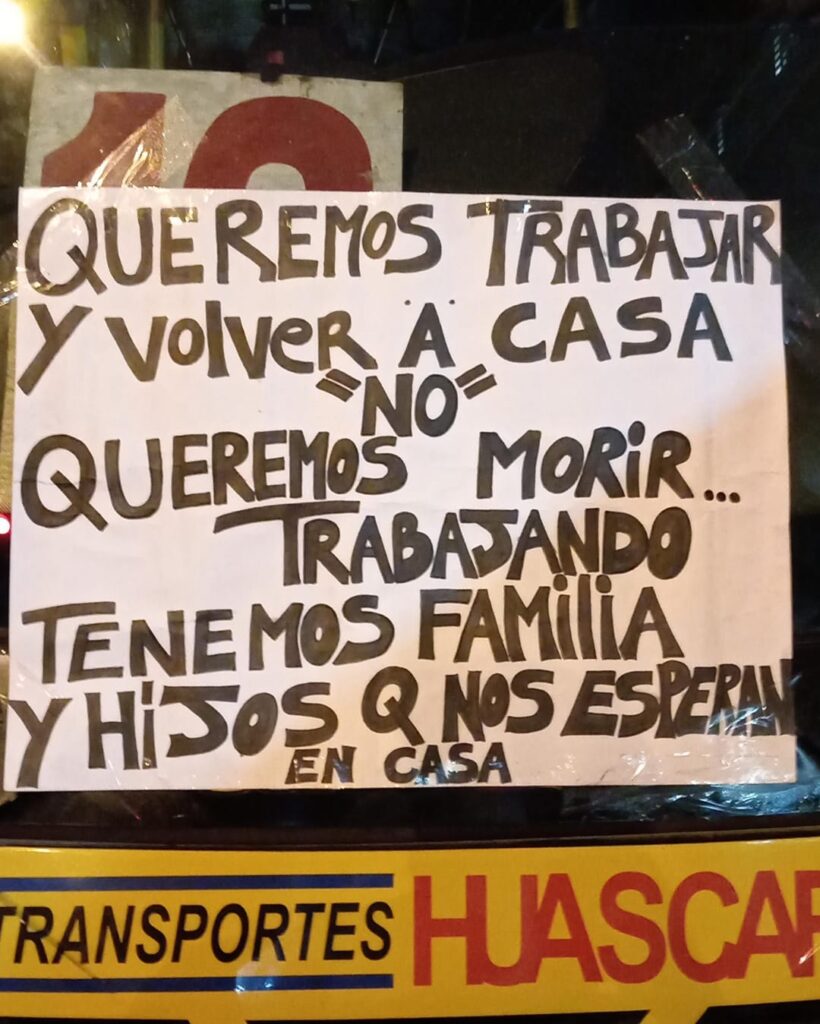
In addition to the demonstrations on Saturday, October 4, several dozen transport companies in Peru staged protests against the government of Dina Boluarte on October 7.

Their main demand is that the government take action to stop the growing wave of insecurity and extortion suffered by transport workers at the hands of organized crime groups. Attacks on transport workers have caused the deaths of 47 drivers.

At various points in Lima, transport workers stopped work and gathered in the streets to demand a change in the state’s security policy, even blocking roads to make themselves heard.

France 24 correspondent Francisco Zacarías reported that there were clashes between protesters and police. He also stated that President Boluarte “downplayed” the transport strike and said that the protests “will not solve the problem,” which has further provoked the transport unions.

Transport workers strike Lima
Sign on a bus reads “We want to work and return home. We do NOT want to die working. We have family and children that wait for us at home.” Photo via X

Almost total rejection of the Boluarte government and Congress

Currently, Peru’s Congress has one of the lowest approval ratings among the country’s various state institutions, reaching almost total rejection. Not far behind, President Boluarte has a 96% disapproval rating, according to an IPSOS poll.

In this regard, IPSOS CEO Alfredo Torres stated: “This is something that has never been seen before in history, nor has it been seen in other countries. A poor approval rating for any president is 20% in favor and 80% against, but a 96% disapproval rating is extremely high. It is absolute rejection, absolute distrust. People no longer expect anything. It is also outrageous that scandals continue to emerge and nothing happens.”

“I will not resign,” says Boluarte

Faced with periodic protests and a huge crisis of legitimacy, President Boluarte stated that she has no intention of leaving power before the 2026 elections. According to Boluarte, Peru has become a prime destination for foreign investment, so her administration is more than justified.

“If those small-time leaders believe that with riots, violence, hatred, and the desire to impose an anarchic world, they are going to change the history of Peru … We are seeing other countries that have done the same and have failed governments,” Boluarte said.

However, Boluarte will still have to endure protests that seem to be increasing in frequency in line with the disapproval of her mandate.

Original article by Pablo Meriguet republished from peoples dispatch under a Creative Commons Attribution-ShareAlike 4.0 (CC BY-SA) license.

Continue ReadingProtests continue in Peru, as polls register 96% rejection of Boluarte

Record Amazon Basin Drought Impacts 420,000 Children: UNICEF

Spread the love

https://www.ecowatch.com/amazon-basin-drought-impacts-children-unicef.html

In Brazil’s Amazon region, more than 1,700 schools and 760 health centers have been shuttered or become inaccessible due to drought. A scene from Tabatinga, Amazonan State, Brazil in October 2024. UNICEF / UNI671256 / Diogenes

drought in much of South America impacts more than 420,000 children living in the Amazon basin, according to new estimates from UNICEF.

The record-breaking drought — ongoing since last year — has left rivers in the region at an all-time low, a press release from UNICEF said.

The lack of rain has affected river transportation and water supplies for Indigenous children and their communities in ColombiaBrazil and Peru. Families use the rivers to access and transport waterfood, fuel and medical supplies. The children also use them to travel to school.

“For centuries the Amazon has been home to precious natural resources. We are witnessing the devastation of an essential ecosystem that families rely on, leaving many children without access to adequate food, water, health care and schools,” said Executive Director of UNICEF Catherine Russell in the press release.

Food insecurity caused by the drought has increased malnutrition risk in the region’s children, while restricted access to drinking water could lead to an increase in infectious diseases, UNICEF said, as AFP reported.

“Food insecurity caused by drought increases the risk of malnutrition, stunting and wasting, and death in children,” the press release said. “Research has also found that pregnant women who experience droughts are likely to have children with lower birth weights.”

In the Brazilian Amazon, more than 760 medical clinics and over 1,700 schools have become inaccessible or were forced to close due to low river levels.

Article continues at https://www.ecowatch.com/amazon-basin-drought-impacts-children-unicef.html

Continue ReadingRecord Amazon Basin Drought Impacts 420,000 Children: UNICEF