Labour considers expanding private sector role in NHS, undermining the already fragile public health system

Spread the love

Original article by Peoples Health Dispatch republished from peoples dispatch under a Creative Commons Attribution-ShareAlike 4.0 (CC BY-SA) license.
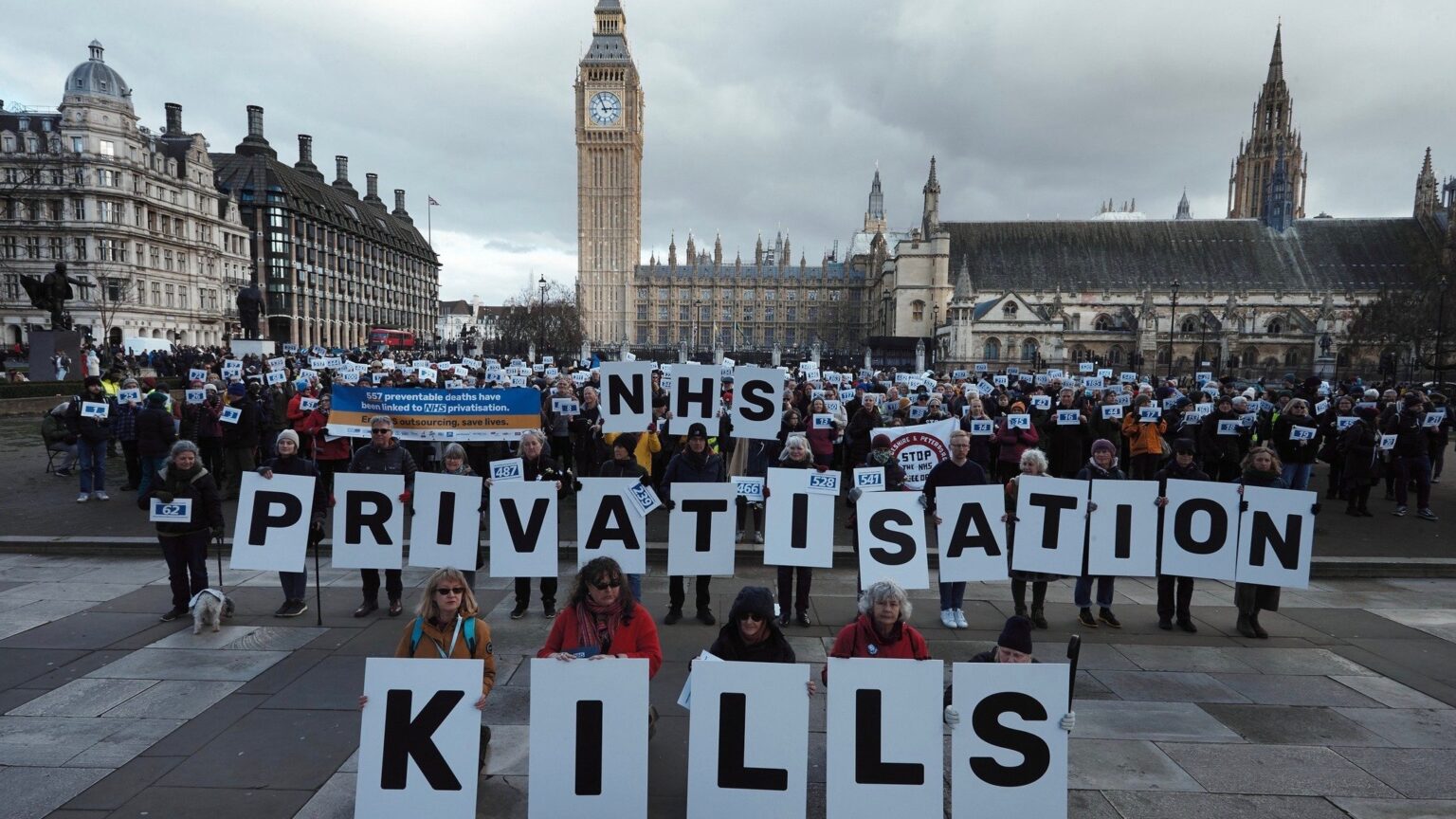
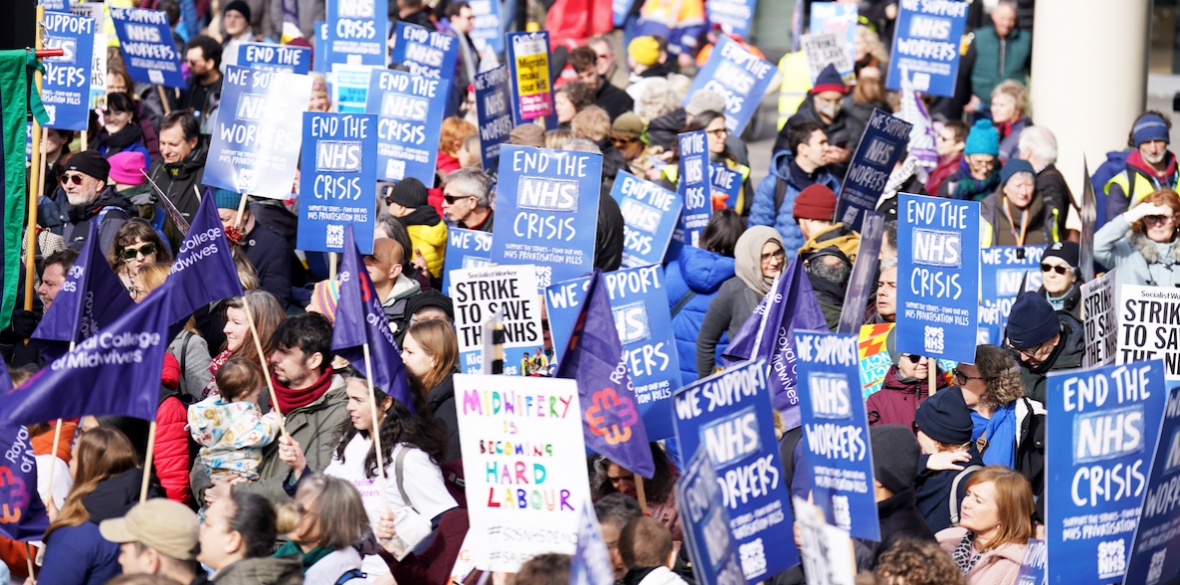
Protest against privatization of the NHS in the UK, February 25, 2023. (Photo: We Own It) 

The UK Labour government is considering increasing the role of private healthcare providers, weakening NHS capacities

The Labour Party is considering a major expansion of the private sector’s involvement in the National Health Service (NHS) as it attempts to reduce waiting lists in the United Kingdom. Recently, the Independent Healthcare Providers Network (IHPN) wrote to Keir Starmer’s government, stating that private providers are ready to spend £1 billion to accommodate more NHS patients—if the government guarantees them long-term work.

While the offer has been welcomed by officials from the Department of Health, health activists have raised alarms over the plan. The We Own It campaign warned that a resurgence of the Private Finance Initiative (PFI) policy, as essentially proposed by the private sector, would lead to higher debt, staffing shortages, and diminished NHS training capacities.

Read more: The NHS at 75 years: A sharp turn needed to fight health inequities

This wouldn’t be the first time private capital has been welcomed by a Labour administration. When Tony Blair was Prime Minister, PFI entrusted the private sector with financing the construction of hospitals to fill gaps in the NHS network. The NHS would then pay back the costs of building such infrastructure—with interest—over the course of 25 years or more, eventually becoming the owner.

However, earlier reports indicated that while the NHS gained £13 billion in assets through PFI, it also ended up with £80 billion in debt. This meant that until at least 2022, some NHS trusts spent more on servicing debt to the private sector than on medical supplies.

There is no indication that the current government would introduce stronger safeguards when implementing a new phase of the initiative, dubbed PFI 2.0. If anything, the situation might worsen. While the previous round of PFI left some infrastructure for the public sector, PFI 2.0 foresees nothing of the sort. The additional capacities would be entirely private, with the only public involvement being the money paid to them.

“PFI 2.0 would not only drastically expand private provision in the health service, it will also dramatically increase how much is sucked out of the NHS in profits,” We Own It suggested in its analysis. Currently, private companies siphon £10 million weekly from the NHS. Guaranteeing even more private contracts would add to that burden, leaving fewer funds to invest in the NHS’s own capacities.

Labour fails to grasp importance of publicly-owned NHS

According to a recent inquiry, these capacities are in dire need of strengthening, as health activists have claimed for decades. The inquiry indicated that years of austerity have left a deep mark on the NHS, and it was this—not staff inefficiency—that led to the crisis. Unfortunately, the inquiry failed to underline the importance of breaking ties with the private sector and keeping the NHS publicly-owned, according to the group Keep Our NHS Public.

Even if it did, it is highly likely that Health Secretary Wes Streeting would not understand the importance of such a strategy. Speaking at a party conference in September, Streeting expressed enthusiasm about “reform,” a code word used by governments for “anything but public investment in public capacities.”

“Reform or die. We choose reform,” the Health Secretary said. His approach has left activists understandably worried that the government is sticking to a vague health reform agenda instead of making material commitments to protect the NHS.

Rather than pursuing a shift from “analog to digital,” Keep Our NHS Public argued, the government should pledge to move away from underfunding, fragmentation, and outsourcing. As health workers and their trade unions have raised multiple times, a true strategy to protect the NHS must also include a commitment to improving working conditions and ensuring fair salaries.

If the private sector’s role is expanded, this would not be a realistic option. “The private sector does not have its own staff,” We Own It warned. “They steal staff, trained at huge public expense, from the NHS.”

Further involvement of the private sector would also reduce the NHS’s capacity to train new staff, the group stated. The procedures usually handled by the private sector are often critical for the hands-on experience needed by medical trainees. With fewer procedures of this kind being performed in NHS hospitals, these learning opportunities would disappear, condemning new generations of health workers to lower-quality education and undermine patient care.

“If PFI 1.0 was one of the nails in the coffin of the NHS as we know it, PFI 2.0 is the true end of our NHS as a public service that works for patients, not profit,” We Own It warned.

People’s Health Dispatch is a fortnightly bulletin published by the People’s Health Movement and Peoples Dispatch. For more articles and to subscribe to People’s Health Dispatch, click here.

Original article by Peoples Health Dispatch republished from peoples dispatch under a Creative Commons Attribution-ShareAlike 4.0 (CC BY-SA) license.

Continue ReadingLabour considers expanding private sector role in NHS, undermining the already fragile public health system

Labour’s public-private plans are just a return to the dreaded PFI era

Spread the love

https://morningstaronline.co.uk/article/labours-public-private-plans-are-just-return-dreaded-pfi-era

Shadow Chancellor Rachel Reeves in the shadow of Tony Bliar.

SOLOMON HUGHES warns Reeves’s proposed national wealth fund hands City financiers control over billions in public money for big business — and we get… to pay!

HOW will Keir Starmer’s Labour try to “grow the economy?” The short answer is it is going to try to use public money to persuade international investors to put cash into “growth” industries.

It’s the return of the public-private partnership. The big danger is that, like Labour’s last public-private partnership, the private corporations will get all the growth, while the public sector gets ripped off.

The main economy-grower Starmer is promoting is Rachel Reeves’s proposed national wealth fund. It will invest in key industries like “green energy” and other modern manufacturing sectors.

There is a strong Labour case to run a national bank investing in key industries: the 1945 Labour government set up two such banks, the Industrial and Commercial Finance Corporation and the Finance Corporation for Industry, which lent growth capital to small- and medium-sized industries or larger manufacturing firms respectively.

Labour argued that the City avoided investing in these crucial sectors, exacerbating the 1930s Depression. Both government-founded investment funds were very successful. Jeremy Corbyn’s Labour proposed similar publicly owned national investment banks.

But Reeves’s plan makes public money subordinate to private investment. She told the last Labour conference: “For every pound of investment we put in, we will leverage in three times as much private investment.”

Labour plans to invest £7.3 billion in the fund, and so attract around £22bn private “co-investment.” Reeves says private money will be attracted because the government cash will be “encouraging and derisking investment” from international finance: investors will assume that if the government has a stake in, say, a car battery factory, that it is a “sure thing” and won’t be allowed to go bust or lose money for shareholders.

But what happens if the publicly backed investments hit trouble? Say the car batteries come out too expensive, reducing profits, or need extra investment to fix production problems — will the private investors insist that the public investor take the losses? And if the profits are bigger than expected, will both parties benefit equally?

There are some major signs Reeves’s deals will favour the big private investors. First, because it is putting in more of the money, they can call more of the shots. This is not really a national wealth fund because most of the money will not be national.

https://morningstaronline.co.uk/article/labours-public-private-plans-are-just-return-dreaded-pfi-era

Continue ReadingLabour’s public-private plans are just a return to the dreaded PFI era

Morning Star: Our NHS at 75: we have still faith, now we need to fight

Spread the love
People on Warren Street in London, ahead of a Support the Strikes march in solidarity with nurse 11 March 2023

https://morningstaronline.co.uk/article/e/our-nhs-at-75-we-have-still-faith-now-we-need-to-fight

Image reads Accident & Emergency, A & E

Today the NHS is in a deep crisis. Its millions-long waiting list condemns patients to seriously delayed treatments, often painfully, sometimes dangerously. Its hospitals are so overloaded ambulances line up outside, waiting hours to discharge patients.

Those who can afford it are going private: the number paying for private hospital treatment has risen by nearly a third since 2019.

This raises demand for trained medical workers in the private sector, with reports earlier this year that doctors were being offered £5,000 to recruit NHS colleagues to undertake private work, accelerating a vicious cycle in resource competition when the NHS already carries over 100,000 vacancies.

The logic is towards a two-tier healthcare system in which those who can pay get faster treatment while the “universal” health service is reduced through under-resourcing to basic cover for the poor.

Preventing this means challenging the two main drivers of NHS decline: underinvestment and privatisation.

NHS sign

Since Tony Blair first introduced private provision within the NHS, the service itself has become a lucrative source of private profit. Extortionate PFI contracts, state collusion with big pharma over drug prices and reliance on private providers all waste NHS money.

The last risks turning our health service into a commissioner rather than a provider of services, a brand name that masks a for-profit health system.

That betrayal of Bevan’s vision is the current prospectus from both Tories and Labour. Saving the NHS means building a mass campaign for real solutions to its twin crises: a serious increase in investment, and an end to all private-sector involvement.

https://morningstaronline.co.uk/article/e/our-nhs-at-75-we-have-still-faith-now-we-need-to-fight

Continue ReadingMorning Star: Our NHS at 75: we have still faith, now we need to fight

Our NHS can’t afford privatisation – why MPs must back the NHS Bill this Friday

Spread the love
Continue ReadingOur NHS can’t afford privatisation – why MPs must back the NHS Bill this Friday