Outrage After Israeli Occupation Forces Shoot Live Rounds at Foreign Diplomats in West Bank

Spread the love

Original article by Brett Wilkins republished from Common Dreams under Creative Commons (CC BY-NC-ND 3.0).

Members of an international diplomatic delegation scramble for cover after coming under Israeli fire during a May 21, 2025 visit to the besieged Jenin refugee camp in the illegally occupied West Bank of Palestine. (Photo: Mohammad Ateeq/AFPTV/AFP via Getty Images)

Among those shot at were representatives of three nations that threatened “concrete actions” if Israel doesn’t end its assault and siege on Gaza and others that support a genocide case against the country.

Israeli occupation forces fired what they called “warning shots” at a large delegation of international diplomats visiting the besieged Jenin refugee camp in the West Bank on Wednesday, an incident many critics said was an attempt to intimidate countries that just two days earlier issued an ultimatum to stop annihilating Gaza and others that have joined a genocide case against Israel.

Palestinian officials were briefing a group of more than 20 diplomats about the crisis in the illegally occupied West Bank—where Israeli soldiers and settlers have killed and wounded thousands of Palestinians including hundreds of children since October 2023 while pushing ahead with massive land theft and colonization—when they came under fire.

According to the Israeli Foreign Ministry, the delegation “deviated” from the route approved by Israeli occupation authorities “and entered an area where they were not authorized to be,” prompting Israel Defense Forces (IDF) soldiers to fire “warning shots to distance them away.”

“The IDF regrets the inconvenience caused,” the ministry added.

Israeli soldiers intentionally fired at a delegation of about 30 Arab & EU diplomats, ambassadors and consuls, visiting Jenin refugee camp, in the West Bank. Israel claims “it was an accident” and that they fired “warning shots” because they “felt in danger”. Israel was trying to intimidate them.

[image or embed]
— Anonymous ( @youranoncentral.bsky.socialMay 21, 2025 at 6:06 AM

Israeli media reported IDF troops fired shots in the air. However, video footage of the incident appears to show soldiers aiming their guns and firing straight ahead in the direction of the diplomats as they scrambled for cover. Israeli officials have often been caught lying about the actions of IDF troops in Palestine.

The delegation included diplomats from the European Union and countries including Austria, Brazil, Bulgaria, Canada, Chile, China, Egypt, France, India, Japan, Jordan, Lithuania, Mexico, Morocco, Poland, Portugal, Romania, Russia, Spain, Sri Lanka, Turkey, and the United Kingdom.

On Monday, three of those countries—France, the United Kingdom, and Canada—issued a rare joint statement condemning Operation Gideon’s Chariots, the ongoing Israeli campaign to conquer and indefinitely occupy all of Gaza and ethnically cleanse much of its population.

On Tuesday, the U.K. announced it is suspending negotiations with Israel on a free trade agreement, explaining that “it is not possible to advance discussions on a new, upgraded FTA” with a government “that is pursuing egregious policies in the West Bank and Gaza.”

Israeli Prime Minister Benjamin Netanyahu and Yoav Gallant, his former defense minister, are wanted by the International Criminal Court for alleged war crimes and crimes against humanity in Gaza including extermination and forced starvation.

The U.K. additionally sanctioned three far-right Israeli extremists, including settler leader Daniella Weiss, as well as three illegal settlement outposts and two groups “that have supported, incited, and promoted violence against Palestinian communities in the West Bank.”

Also on Tuesday, European Commission Vice President Kaja Kallas—who is the E.U.’s foreign policy chief—said the 27-nation bloc would review its political and economic agreement with Israel in light of the “catastrophic” situation in Gaza.

Brazil, Chile, China, Egypt, Jordan, Mexico, Spain, and Turkey have either joined or expressed support for the South Africa-led genocide case against Israel currently before the International Court of Justice—which last year found that Israel’s 58-year occupation of the West Bank, including East Jerusalem, and Gaza is an illegal form of apartheid that must be ended as soon as possible.

Israel’s 592-day assault and siege on Gaza has left more than 189,000 Palestinians dead, maimed, or missing and over 2 million others forcibly displaced, starved, or sickened, according to the Gaza Health Ministry.

The Palestinian Authority Ministry of Foreign Affairs condemned what it called Wednesday’s “heinous crime” against the diplomats.

“The delegation was undertaking an official mission to observe and assess the humanitarian situation and document the ongoing violations perpetrated by the occupying forces against the Palestinian people,” the ministry said. “This deliberate and unlawful act constitutes a blatant and grave breach of international law and of the fundamental principles of diplomatic relations as enshrined in the 1961 Vienna Convention on Diplomatic Relations.”

Kallas said Wednesday that “any threats on diplomats’ lives are unacceptable.”

“Israel is also a signatory to the Vienna Convention, I mean the obligation to guarantee the security of all foreign diplomats,” Kallas noted. “We definitely call on Israel to investigate this incident and also hold accountable [those] who are responsible for this.”

The governments of other countries whose diplomats were targeted on Wednesday condemned the incident, with some, including France and Italy, summoning their Israeli ambassadors.

Original article by Brett Wilkins republished from Common Dreams under Creative Commons (CC BY-NC-ND 3.0).

Experiencing issues with this image not appearing. I suspect because it's so critical of Zionist Keir Starmer's support of and complicity in Israel's genocides.
Genocide denier and Current UK Prime Minister Keir Starmer is quoted that he supports Zionism without qualification. He also confirms that UK air force support has been essential in Israel’s mass-murdering genocide. Includes URLs https://www.declassifieduk.org/keir-starmers-100-spy-flights-over-gaza-in-support-of-israel/ and https://youtu.be/O74hZCKKdpA
UK Labour Party government ministers Keir Starmer, Angela Rayner and Rachel Reeves explain that they are partners complicit in Israel's Gaza genocide. The UK has provided Israel with arms, military and air force support. They explain that they don't do gas chambers but do do forced marches, starvation, destroy hospitals, mass-murders of journalists and healthcare workers.
UK Labour Party government ministers Keir Starmer, Angela Rayner and Rachel Reeves explain that they are partners complicit in Israel’s Gaza genocide. The UK has provided Israel with arms, military and air force support. They explain that they don’t do gas chambers but do do forced marches, starvation, destroy hospitals, mass-murders of journalists and healthcare workers.
Continue ReadingOutrage After Israeli Occupation Forces Shoot Live Rounds at Foreign Diplomats in West Bank

North Atlantic’s Largest Marine Protected Area Created by Portugal’s Azores Islands

Spread the love

https://www.ecowatch.com/portugal-azores-islands-marine-protected-area.html

Dolphins off the coast of the island of San Miguel in the Azores. Juan Miguel Cervera Merlo / iStock / Getty Images Plus

The regional assembly of the Azores Islands — a nine-island archipelago in Portugal — has approved the North Atlantic’s largest marine protected area.

Its creation will allow Portugal to meet the United Nations goal of safeguarding 30 percent of the planet’s land and sea by the end of the decade.

“We have acted in advance of the international conservation goals for 2030 with the creation of the largest marine park in the North Atlantic, with fully protected areas and highly protected areas,” Bernardo Brito e Abreu, maritime affairs adviser to the Azorean government, told Reuters.

The new marine sanctuary will encompass nearly 115,830 square miles, providing protection for its vast and unique biodiversity — including deep-sea corals and hydrothermal vents.

https://www.ecowatch.com/portugal-azores-islands-marine-protected-area.html

Continue ReadingNorth Atlantic’s Largest Marine Protected Area Created by Portugal’s Azores Islands

Youth Challenge 32 European Nations in ‘Truly Historic’ Climate Trial

Spread the love

Original article by Isabella Kaminski republished from De Smog.

Portuguese young people claim their human rights have been violated, while accused countries argue the lawsuit should be thrown out.

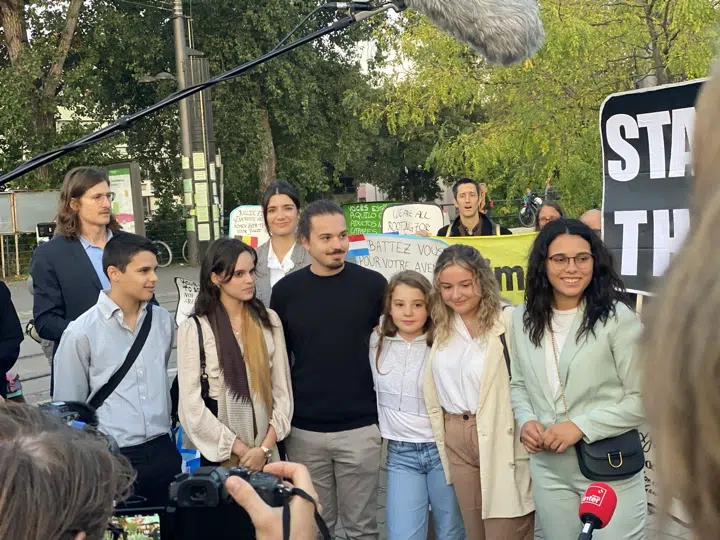
Portuguese youth, from left, André dos Santos Oliveira, Sofia dos Santos Oliveira, Martim Duarte Agostinho, Mariana Agostinho, Cláudia Duarte Agostinho and Catarina dos Santos Mota talk to the press before their landmark hearing in front of the European Court of Human Rights in Strasborg, France. Credit: Courtesy of the Global Legal Action Network (GLAN)

After Portugal experienced massive wildfires and extreme heat waves this summer, six children and youth from the nation appeared in the European Court of Human Rights Wednesday for a landmark lawsuit against 32 European nations charged with violating their human rights due to the impacts of climate change.

At the hearing in Strasbourg, France, lawyers representing six Portuguese young people said the youth were being discriminated against by state inaction in cutting greenhouse gas emissions, the effects of which have been “foreseeable for decades.” 

Inadequate action to curb global emissions, the lawyers argue, violates the youths’ rights to life, privacy and family life, and to be free from torture, inhuman or degrading treatment. Additionally, it violates their rights to be free from discrimination on grounds of their age, the lawyers said. All of these are enshrined in the European Convention on Human Rights, which the court is responsible for upholding. 

This case is “truly historic,” said Sébastien Duyck, senior attorney at the Center for International Environmental Law. It forces the national governments in the suit “to lay out a legal defense justifying the gap between their climate policies and what science says is needed to avoid climate breakdown.”

Cláudia Duarte Agostinho, age 24, Catarina dos Santos Mota, 23, Martim Duarte Agostinho, 20, Sofia dos Santos Oliveira, 18, André dos Santos Oliveira, 15, and Mariana Agostinho, 11, are suing 32 countries, including all EU member states, the United Kingdom, Norway, Turkey, Switzerland and Russia, for failing to act on the climate crisis. It is unprecedented  that so many governments have to defend themselves in front of any court in the world.

In 2017, damaging wildfires in Portugal, made worse by climate change, killed more than 100 people and sparked the youths to file the lawsuit, which began in 2020. Over the past three years, the young people’s legal team filed a number of supporting documents, including a detailed climate science briefing. The documents show that the current global trajectory for cutting greenhouse gas emissions falls far short of keeping the global temperature rise under the 1.5C threshold agreed by states at the COP27 climate talks last year.

Portugal hit hard by climate change

Portugal describes itself as the European country most affected by the adverse impact of climate change. Since 1976, it has seen a significant trend in heat waves and tropical nights, with high temperature records broken in 2018, 2019 and 2022. This summer, severe drought hit the country and wildfires blazed again.

The young people live in Lisbon and Leiria, parts of Portugal that are particularly at risk. And according to the Intergovernmental Panel on Climate Change, the country faces “hard limits” to its ability to adapt.

The young claimants in the lawsuit point to research by Climate Action Tracker, which calculates a “fair share” of emission cuts for the 32 countries at the center of the case, based on their levels of development, capacity and/or historic responsibility. Most of these cuts are higher than the states’ current goals for the year 2030.

To address this, they want all 32 states to increase their climate ambitions and meet these goals by cutting the production and export of fossil fuels, lowering their consumption emissions, and forcing companies domiciled within their territories to clean up their global supply chains. 

The lawsuit describes the young people as both current and future victims of climate change, outlining the existing effects on their physical and mental health.

It notes the dangerous impacts of extreme heat, including heatstroke and the exacerbation of chronic conditions such as asthma and other  respiratory problems experienced by Martim Duarte Agostinho, Catarina dos Santos Mota and André dos Santos Oliveira. During periods of extreme heat, some of the youth in the suit have had had to stop playing and exercising outdoors, while extremely hot nights have made it difficult to sleep, leaving them more tired and less able to study and work.

A psychological assessment showed they were all experiencing symptoms of anxiety or depression. The three also describe a form of mental suffering called “moral injury” caused by an awareness of the failure by those in authority to protect them.

The severity of all these impacts, the legal team concludes, will only get worse if nations can’t meet the 1.5C warming threshold. Although climate change affects everyone, lawyer Alison Macdonald argued in court that it will have a disproportionate impact on the young people at the heart of the case, “as they will have to live longer with the consequences of the respondents’ failures.”

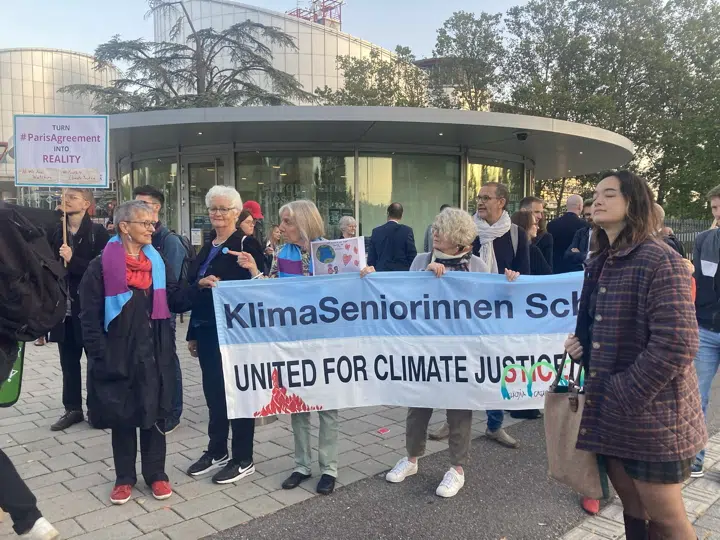
This is the third climate case heard by the European Court of Human Rights this year. In March, a group of older Swiss women known as the KlimaSeniorinnen argued that they were disproportionately affected by the climate crisis and wanted the court to order Switzerland to do more to cut its emissions. This was followed the same day by a claim brought by a former French politician who also argued France was breaching his human rights.

The court wants to hear all three of these cases before making a final decision. There are a handful of other climate-related cases pending before it.

Swiss women involved in another European climate lawsuit support the Portuguese youth at the courthouse in Strasbourg. Credit: Courtesy of the Global Legal Action Network (GLAN)

But the claimants in the Portuguese youth case have some big technical hurdles to overcome before judges even begin to consider the merits of their lawsuit.

The governments named in the lawsuit submitted individual responses to the court, and all except Russia and the Netherlands also submitted a joint statement, which says the states recognise the severity of the threat of climate change and the need for urgent action.

But it says the case should be thrown out for failing to meet the court’s basic rules on admissibility. These include the requirement to have exhausted all national legal options before filing a claim at the ECHR. Ignoring this, it says, would involve “radically overhauling” legal precedent.

The young people’s legal team argues that the rule should be lifted in their case because climate change is such an urgent issue and because it would be a practically and financially unreasonable burden, taking huge legal resources, time, and money, for the group. 

All states. except Portugal, also argue they should not be held to account for harms in another country. The claimants contend that the impacts of greenhouse emissions do not respect national boundaries.

Representing 30 states in court, UK lawyer Sudhanshu Swaroop said the lawsuit requires the court to “exceed its mandate.”

“The applicants in reality are asking the court to build a new model of extra-territorial jurisdiction, contrary to legal principles and with the effect that any person on the planet that claims to be affected by climate change could claim,” he noted. 

He added that these issues are being addressed through the UN Framework Convention on Climate Change (UNFCCC) and that the young people “are asking the courts to act as legislators rather than judges, and to legislate for a global challenge without having global jurisdiction.”

Ricardo Matos, a lawyer for Portugal, said the young people could not claim to be victims of the 2017 wildfires, and were effectively trying to bring an actio popularis – a claim on behalf of the wider public rather than themselves as individuals. The European Convention on Human Rights does not allow such claims.

The governments also argued that the young people are not ‘victims,’ pointing out they cannot prove that they suffer more than the general population by virtue of their age. 

The young people’s legal team believes these hurdles can be overcome. “This court is uniquely well placed to address these legal issues in the transnational way that climate change requires,” Macdonald told the court. “Piecemeal regulation across Europe represents no effective remedy.”

According to Climate Action Network, which submitted a third-party intervention, a successful judgment in this case would be “like a new, legally binding treaty, directly obligating 32 European governments to act urgently on the climate crisis.” 

It also wields “remarkable influence” in the broader context of global litigation, said Duyck, “given that the European Court of Human Rights holds a prominent role in setting legal precedents within Europe and beyond.”

Speaking outside the court after the hearing, the oldest claimant, Cláudia Duarte Agostinho, said what she had just heard was “very sad.” 

“The governments have just said that what’s happening all around us is not important,” she added. “They are minimising the effects that climate change has on our human rights. 

“Outside the courtroom they say all the right things about the climate emergency,” she continued. “But today they are denying the reality that what we are experiencing is getting worse and worse.”

Travel to report on this lawsuit was supported by a grant from the Foundation for International Law for the Environment.

Original article by Isabella Kaminski republished from De Smog.

Continue ReadingYouth Challenge 32 European Nations in ‘Truly Historic’ Climate Trial

Europe’s olive oil supply running out after drought – and the odd hailstorm

Spread the love

https://www.theguardian.com/world/2023/sep/28/europes-local-olive-oil-supply-runs-almost-dry-after-summer-of-extreme-weather

Heatwaves around Mediterranean have damaged harvests and forced producers to import from South America

Olive grove
Olive oil groves by Birding In Spain, CC BY-SA 4.0 <https://creativecommons.org/licenses/by-sa/4.0>, via Wikimedia Commons

Europe has almost run out of local olive oil supplies and is set for more shortages, after extreme weather damaged harvests for a second year.

The world’s largest producer has said it is having to import supplies from South America to keep up with demand.

“Today it is almost physically impossible to buy olive oil. It is sold out,” Walter Zanre, the chief executive of the UK arm of Filippo Berio, said.

Olive trees have been cultivated around the Mediterranean for thousands of years, with Spain alone producing half of the world’s supply of olive oil, but wildfires and soaring summer temperatures mean the future of this ancient industry is looking increasingly uncertain.

Global production is expected to fall to 2.4m tonnes according to the International Olive Council, less than last year’s harvest and well short of global demand of about 3m tonnes, after drought and heatwaves of more than 40 degrees hit production in Spain.

Extreme weather in other important growing regions including Greece, Italy and Portugal as well as Turkey and Morocco has added to the crisis.

https://www.theguardian.com/world/2023/sep/28/europes-local-olive-oil-supply-runs-almost-dry-after-summer-of-extreme-weather

Continue ReadingEurope’s olive oil supply running out after drought – and the odd hailstorm