Ecuadorian people deal a crushing blow to neoliberalism in Noboa’s referendum

Spread the love

Original article by Peoples Dispatch republished from peoples dispatch under a Creative Commons Attribution-ShareAlike 4.0 (CC BY-SA) license.
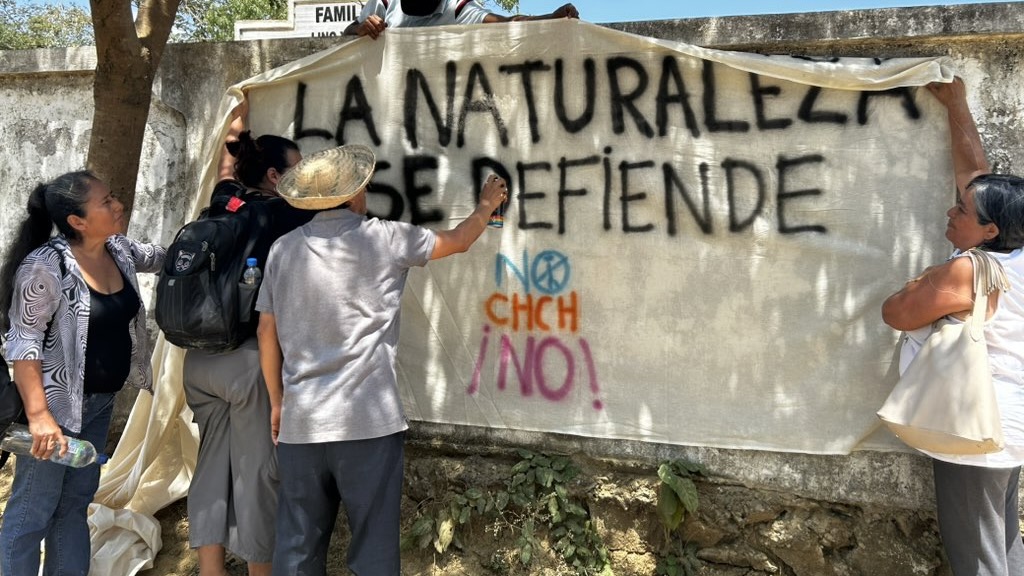
Community members in Santa Elena, Ecuador, painting a banner reading “Defend nature, VOTE NO”. The grassroots nature of the “NO” campaign appears to have given it greater success. Photo: NOchchNO / X

The government has suffered a harsh and resounding defeat to its political and economic plans. In this article, we present the results and offer some explanations for the outcome of November 16.

In a massive defeat for President Daniel Noboa’s neoliberal program, Ecuador overwhelmingly voted “No” on all four questions in the national referendum held on November 16. The result is a crushing blow for the government, who had hoped a victory would help pave the way for a structural transformation of the Ecuadorian state.

The election was organized at the request of right-wing President Noboa who called for a referendum in September of this year, hoping to achieve the economic elites’ long-awaited dream of converting Ecuador’s legal framework into a neoliberal one.

What were the referendum’s four questions?

The first question asked Ecuadorians whether foreign military bases should be allowed in Ecuador, something that is prohibited by the current constitution. Noboa appealed to the deep sense of insecurity felt by people in the country as a result of the historic crisis of violent crime, in which drug trafficking gangs are fighting over territory.

The government claimed that the installment of foreign military personnel would help reduce insecurity, although the opposition argued that it was an excuse to align the country with Washington’s geopolitical interests.

The next two questions were called “bait questions” by the opposition. They argued that the questions were less overtly ideological and employed a kind of electoral populism to exploit the widespread dissatisfaction with the political class, with the hope of garnering support for the more extreme parts of the referendum. The “bait questions” had to do with reducing the number of legislators and eliminating state funding for political parties.

The opposition, however, claimed that both measures would have benefited the ruling party, as they would have reduced the representation of small provinces and prevented political parties without wealthy contributors from running election campaigns.

Finally, the most important question had to do with the creation of a constituent assembly to draft a new neoliberal constitution, which is the great desire of the country’s economic elites.

Read More: Neoliberalism or not? Ecuador heads to the polls on November 16

Though the government was not particularly vocal about this, its silence about its intentions only provoked anxiety among voters, who saw this obscurity as a sign that the new constitution would reduce rights won in past decades.

The results

After the initial results were announced, several media outlets repeated the phrase “No one expected these numbers.” The latest polls had predicted that Noboa would win on all four questions, although it was known that the gap between the YES and NO votes had narrowed on the questions about military bases and the convening of a constituent assembly.

However, the president’s defeat was crushing. Not even on the so-called “bait questions” did Noboa manage to win over the majority of Ecuadorians, who clearly said “No” to the executive branch’s neoliberal project.

According to the National Electoral Council (CNE), with almost all the votes counted, these are the results:

The presidency’s reaction

The government had prepared celebrations in Quito and Guayaquil, but the YES campaign headquarters were empty and the few Noboa supporters present were clearly shocked. Many expected the president to make statements to the press and his supporters, but Noboa did not appear.

He left only a brief message on X: “We consulted the Ecuadorian people, and they have spoken. We fulfilled our promise: to ask them directly. We respect the will of the Ecuadorian people. Our commitment remains unchanged; it is strengthened. We will continue to fight tirelessly for the country you deserve, with the tools we have.”

Thus, some analysts have claimed that Noboa is announcing his refusal to back down from his plan to neoliberalize the economy and the state, although he’s been forced to do so by other means. Currently, the ruling party has a majority in the National Assembly, but it will now be more difficult for it to carry out the reforms it proposes due to the votes of the independents who support it and who may hesitate to give their support to the government, as well as a Constitutional Court that has already put a stop to several of the president’s laws that undermine the legal structure of the state.

Read More: Tensions rise in Ecuador as President Noboa protests against the Constitutional Court

Why was Noboa defeated?

Several interpretations attempt to explain such a clear defeat. On the one hand, it is true that there is considerable rejection of Noboa’s government, which has failed to improve security in the country, increased taxes on all Ecuadorians, eliminated the diesel subsidy (fuel used especially by farmers and transporters), and used a heavy hand against recent demonstrations in the province of Imbabura, where several people were killed.

However, it is important to consider that if all the votes had been against the government, the results between one question and another would not have fluctuated so much. This is because there was a difference in voting, especially between questions 1 and 4, compared to questions 2 and 3. In this regard, some analysts have highlighted a flawed political communication strategy and the ruling party’s election campaign.

Questions loomed regarding, which foreign armed troops would come to the country to go where (there was much speculation that it would be in the Galapagos, one of the natural treasures most cherished by Ecuadorians). Also murky was the content of the constitution that the government wanted (Noboa literally said that the day after winning the referendum he would reveal the structure of the new constitution, not before).

However, attributing the government’s defeat solely to its communication failures is insufficient and dangerous, as it overshadows the enormous efforts of various political groups, social movements, and citizen collectives that campaigned for the NO vote.

Thus, the NO campaign had to be carried out in an almost artisanal manner. No political party (not even Correísmo) took the lead in the NO campaign, so funding was almost non-existent. The various videos on social media, discussions, interviews, etc., were produced by civil society, which did what it could with the little it had.

However, this accidental strategy proved to be fundamental, because, as it was “ordinary people” who ran the campaign, many undecided Ecuadorians felt that their “peers” were speaking directly to them, and not on behalf of a political party that would probably have been stigmatized by the ruling party.

Several government spokespeople began to suggest possible constitutional changes if the yes vote won, such as labor flexibility, the elimination of some rights of Indigenous peoples’ (such as Indigenous justice), the elimination of the rights of nature (something in which the country is a pioneer), and the elimination of free tuition for university students, among others. This, coupled with Noboa’s silence, allowed the opposition to organize a successful political campaign that appealed to an anti-neoliberal spirit that remains in the country.

Ecuador does not yield to neoliberalism: a historic struggle

In fact, for almost forty years, several leaders (León Febres Cordero, Sixto Durán Ballén, Guillermo Lasso, and now Daniel Noboa) have attempted to introduce neoliberal reforms through popular referendums, and in all cases, they have suffered crushing electoral and popular defeats.

Similarly, national workers’ strikes in the 1980s, Indigenous mobilizations in the 1990s, and in the last six years have stopped attempts to neoliberalize the country in the streets, a historical trend that continues to be confirmed today.

Faced with enormous popular rejection, the 1998 Constitution, with its clear neoliberal slant, was drafted in a military barracks, behind closed doors, with the almost exclusive participation of the Ecuadorian right.

That constitution, which opened the door to the dollarization of the country and the infamous bank holiday (in which thousands of Ecuadorians lost their savings to save the banks in crisis) was replaced by the 2008 Constitution, in which more than 150 social and political organizations went to the Assembly to demand that their claims be included.

Thus, this constitution, now clearly endorsed with full popular legitimacy, brought together a series of rights that had been demanded and won over decades by various groups of citizens. Perhaps this is why the government’s strategy of calling the current constitution “Correísta,” “Castro-Chavista,” etc., did not have the expected impact. People recognized that the country’s poor administration does not mean that the constitution is negative.

On the contrary, they saw in the ruling party’s plans something more dangerous than political antipathy toward Correísmo, which is why several people on the right and left who oppose the return of Correísmo voted NO in the 2025 referendum, which the government did not expect.

What will happen now?

For now, it remains to be seen how this sharp defeat will impact the country’s governability. Several right-wing intellectuals have called on the government to change its strategy, namely to start delivering clear results to Ecuadorians beyond advertising spots and smokescreens.

For now, changes are expected in the ministries and spokespersons of a government that, despite having been elected twice to govern, has lost in the referendums it has called and which have sought to introduce neoliberal changes.

This was the case in the 2024 referendum, also called by Noboa, in which he won on several questions to increase his power over security, but lost on the two economic questions, which sought to approve hourly work and subject Ecuador to international arbitration by international courts.

Read More: Noboa’s iron first forces end of CONAIE’s national strike in Ecuador

However, the defeat in 2025 is much deeper, as it implies a widespread rejection of a government that has lost much of the support of voters who trusted its administration but do not see results, which has increased mistrust. Today, the government has come to better understand sociologist Max Weber’s famous phrase: “Politics is a matter of faith and responsibility.”

Original article by Peoples Dispatch republished from peoples dispatch under a Creative Commons Attribution-ShareAlike 4.0 (CC BY-SA) license.
Continue ReadingEcuadorian people deal a crushing blow to neoliberalism in Noboa’s referendum

Ecuador Voters Crush Right-Wing Push to Allow Return of US Military Bases

Spread the love

Original article by Jake Johnson republished form Common Dreams under Creative Commons (CC BY-NC-ND 3.0). 

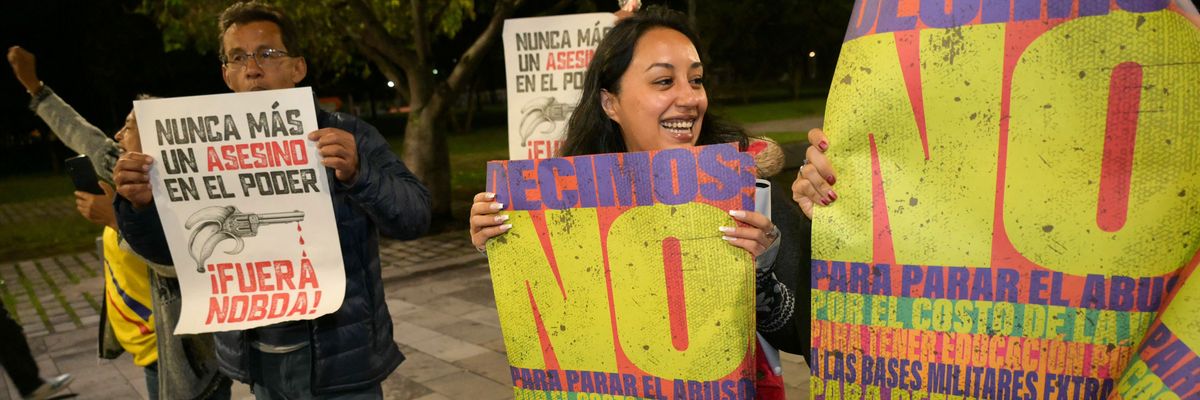
People react following the first results of the referendum vote in Quito, Ecuador on November 16, 2025. (Photo by Rodrigo Buendia/AFP via Getty Images)

“It is, to date, the Noboa government’s biggest electoral defeat.”

Ecuador’s voters on Sunday delivered a major blow to right-wing President Daniel Noboa by decisively rejecting the proposed return of foreign military bases to the South American country’s soil—including installations run by the United States.

Around two-thirds of voters opposed the measure with most ballots tallied, a result that was widely seen as a surprise. Voters also rejected a separate effort to rewrite the country’s progressive 2008 constitution, which enshrined strong labor and environmental rights.

The stinging defeat for Noboa, an ally of US President Donald Trump, comes as the United States carries out an aggressive military buildup and deadly airstrike campaign in the Caribbean and the eastern Pacific—and weighs a direct attack on Venezuela. The BBC reported that the Trump administration “had hoped the referendum would pave the way to opening a military base in Ecuador, 16 years after it was made to close a site on its Pacific coast.”

“The former US military base on Ecuador’s Pacific coast was closed after left-wing President Rafael Correa decided not to renew its lease and pushed for the constitutional ban,” the outlet noted.

Correa celebrated Sunday’s results in a social media post, expressing hope that the vote would mark “the beginning of a definitive constitutional stability for the country.”

“Our constitution is one of the best in the world; we just need to comply with it,” he wrote.

The vote followed a recent trip to Ecuador by US Homeland Security Secretary Kristi Noem, a prominent figure in the Trump administration’s lawless assault in immigrants in the United States. The Trump administration and Noboa’s government have ramped up cooperation efforts in recent months, and both governments have unleashed military forces on their own citizens, illegally repressed protests, and carried out enforced disappearances and other grave human rights violations.

During her visit to Ecuador earlier this month, Noem toured the site of what Noboa’s office described as a potential US military base in the port city of Manta.

The Center for Economic and Policy Research (CEPR) said in a statement late Sunday that “by inviting direct US military involvement and permanent presence in military bases—framed as a partnership to combat drug trafficking and organized crime—Noboa has tied the country’s safety and sovereignty to Washington’s regional ambitions.”

“Today’s ‘no’ vote therefore underscores widespread public unease with that approach and reflects the Ecuadorian people’s skepticism toward the government’s heavy reliance on the Trump administration’s support,” CEPR continued. “More generally, this vote raises questions about the effects and popularity of the last few years of security rapprochement and cooperation between Ecuador and the United States, which include, among other agreements, a Statute of Forces Agreement signed in 2023 that enables the presence of—and grants immunity to—US forces in Ecuador.”

“It is, to date, the Noboa government’s biggest electoral defeat,” the group added.

Original article by Jake Johnson republished form Common Dreams under Creative Commons (CC BY-NC-ND 3.0). 

Continue ReadingEcuador Voters Crush Right-Wing Push to Allow Return of US Military Bases

Ecuador: When legitimate protest becomes ‘terrorism’

Spread the love

Original article by Rose Barboza republished from Open Democracy under a Creative Commons Attribution-NonCommercial 4.0 International licence

Indigenous demonstrators shout slogans during a demonstration at Parque Central Cayambe, Ecuador, as part of the national strike on October 1, 2025
 | Felipe Stanley/Agencia Press South/Getty Images

Taking from Trump’s playbook and reviving colonial trope, President Noboa labelled Indigenous protesters ‘terrorists’

Recent years have seen Western governments extoll their democratic values while leading increasingly harsh crackdowns on dissent, with activists arrested and accused of terrorism.

Now, Ecuador has gone even further. President Daniel Noboa’s far-right government met recent nationwide anti-austerity protests with a brutality that has left two protesters dead, 473 injured, 12 missing, and 206 detained, according to the Alliance of Human Rights Organisations of Ecuador.

A 31-day national strike erupted on 22 September, nine days after Noboa removed fuel subsidies, raising the price of diesel by 55% from $1.80 to $2.80 per gallon. The demonstrations, which disrupted the movement of goods and people across the country as protesters blocked main roads, were led by Ecuador’s largest Indigenous organisation, the Confederation of Indigenous Nationalities, which represents many of the people who will be the hardest hit by the price hikes.

The government responded by imposing a state of emergency and deploying troops to break up protesters, leading to state-inflicted violence that drew criticism from civil rights groups in Ecuador and across the world.

Human Rights Watch reported it had “verified 15 videos” of “soldiers or police officers forcibly dispersing peaceful demonstrations and using tear gas and other ‘less lethal’ weapons recklessly and indiscriminately”, while Amnesty International warned of “excessive use of force against protesters by the security forces, possible arbitrary arrests, as well as the opening of abusive criminal proceedings and freezing of bank accounts belonging to social leaders and protesters”.

The unrest came as Ecuadorian voters prepare to vote on a series of referendums on 16 November. Perhaps the most controversial question they will answer is over whether to accept foreign military bases on Ecuador’s territory.

The ballot does not explicitly refer to the United States, but it may as well do; this week, US homeland security secretary Kristi Noem made her second visit to the Latin American country in four months to scout out locations for new US military bases.

Noboa’s government has long pushed for greater alignment with the US. While Ecuadorian opposition leaders warn that US military bases would threaten Ecuador’s sovereignty, both Noboa and Donald Trump’s administrations argue that they would help to stop transnational crime gangs from using the country to smuggle drugs from South America into the US.

Although polls suggest a slight majority of voters are against the bases, many are still undecided. Regardless of how they vote, Trump’s influence over Noboa’s government is already clear from the reaction to the recent Indigenous-led demonstrations. Taking from the US president’s playbook, ministers accused protesters of carrying out “terrorist acts” – directly echoing language used against activists in the US – and at least 13 people have been charged with terrorism after allegedly attacking the offices of police in Otavalo, a city in northern Ecuador.

This decision to cry terrorism is part of a strategy to turn social discontent into a security threat. Rather than answering the demands of protesters – the majority of whom were the poor people, transport workers and Indigenous peoples who will be hardest hit by fuel price increases – the government has chosen to criminalise dissent and militarise social conflict to protect its austerity measures from popular resistance.

But protest is not terrorism. It is the democratic voice of those who suffer most from inequality.

Unequal sacrifices

In Ecuador, an oil-producing country, the dispute over fuel subsidies is a recurring issue.

The subsidies have kept prices for petrol and diesel artificially low since the 1970s, but consecutive governments have argued they put too much strain on the national budget, costing the state billions, while international financial institutions have criticised them for “distorting” the economy. In 2022, the subsidies were equivalent to around 2% of Ecuador’s GDP, according to a report by the Ministry of Economy and Finance.

But for farmers, truck drivers and informal workers, the subsidies provide indispensable respite from low incomes and rising living costs. Therein lies the clash: what governments see as an easy way to make savings on their balance sheet will mean hunger for many ordinary people.

One key measure of the cost of living in Ecuador is the monthly price of the ‘basic family basket’, a government-defined set of goods needed to sustain a family of four, including food, clothing, medicine, household items and transport costs. In May this year, the price of that basic family basket reached $812, while the monthly minimum wage remained at $470. This disparity will only worsen with the removal of the diesel subsidy, which will make transport, food and the production of goods more expensive.

Previous attempts to scrap the fuel subsidies have caused the social unrest that has marked Ecuadorian politics in recent years. Two previous governments tried to do so in 2019 and 2022. Both instances sparked huge demonstrations that forced ministers into U-turns.

This time, Noboa’s government, which was elected in 2023, does not appear to be backing down. The Confederation of Indigenous Nationalities eventually called off their strike on 23 October in the wake of the state’s brutal repression, having been unable to secure any concessions.

If the government does succeed in removing the subsidies, it will lead to rising costs that will not be borne equally across Ecuador, a plurinational and multi-ethnic country where wealth is concentrated in certain areas and among certain racial groups.

The most recent data finds that 72% of the population self-identifies as mestizo, a term that refers to a person of mixed European and Indigenous American ancestry. The next largest demographic group is the Montubio people (7.4%), a rural ethnic group from coastal Ecuador; followed by Afro-Ecuadorians (7.2%), who also primarily live in the coastal provinces; then Indigenous people (7%) who largely live in the highlands and Amazon; and white people (6.1%), who have historically been based in larger cities.

The Afro-Ecuadorians and Indigenous populations in the country’s Amazon and rural coastal provinces will suffer most from the increases in transport and labour costs. Many of the families who will be affected are already impoverished, with a 40% poverty rate in these areas, far above the national rate of 28%.

Ecuador’s coast is dominated by export-oriented agribusiness and ports; the Andean highlands by public administration, services and manufacturing; while the oil extraction in the Amazonian east accounts for a large part of the country’s national income, without translating into local well-being.

The paradox is evident: the territories that produce wealth also face the greatest inequalities and deficits in health, education and basic services.

Women will also be hit harder by the removal of the fuel subsidies than men. The country’s 3.6% unemployment rate masks key gender inequalities; among women the rate is 4.6%, compared to 2.8% among men. Similarly, only 27% of women have access to adequate employment, with sufficient income and stability, compared to 41% of men, according to official figures.

The greater job insecurity created by rising food and household goods prices will disproportionately affect women. They will be forced to work longer hours to survive, particularly where they are responsible for the care of children or elderly relatives – another burden that disproportionately falls on women.

There is no neutrality in austerity: there is a regressive redistribution that privileges fiscal balance at the expense of the country’s most impoverished.

‘Terrorism’ and state coercion

While protests started in the immediate aftermath of the announcement on 13 September that the subsidies would be scrapped, the coordinated national strike began on 22 September.

Over the following 31 days, news broadcasts were full of images of this resistance across Ecuador: closed roads in Cuenca, pots and pans banging in Quito, women and children fleeing tear gas in San Rafael de la Laguna.

President Noboa imposed a state of emergency in many provinces, a measure that suspends constitutional guarantees such as the freedom of assembly, the inviolability of the home and correspondence, and the freedom of movement due to curfews. Last year, the Constitutional Court issued a warning to the president over the repeated use of this tool, which it said should be applied only in “extraordinary” circumstances.

By also condemning the protesters as “terrorists”, the government aims to delegitimise collective action, depoliticise the dispute over income and enable repression. Labelling Indigenous people as ‘offenders’ revives an old colonial trope of ‘internal enemies’, where racialised bodies are seen as a threat to order.

Noboa’s discourse is also part of a well-known Latin American genealogy: during the years of counterinsurgency, the labels of ‘subversion’ and ‘terrorism’ justified massacres, states of siege and arbitrary detentions. Today, that same language is being revived to shield a neoliberal model that is based not on consensus but on coercion.

For now, the question is not whether Ecuador can sustain fuel subsidies in the long term, but who gets to decide this. Removing subsidies without dialogue or progressive compensation mechanisms is governing against the majority.

A truly democratic policy would require real dialogue with Indigenous, Afro-Ecuadorian and peasant organisations, and including their voices in defining policies on the prices of utilities, including fuel, water and energy.

Wage and labour reform is also needed to link the minimum wage to the cost of the basic basket of goods and reduce gender and ethnic gaps, as well as territorial investment in the Amazon and rural areas to provide health, education and basic services. Finally, the demilitarisation of social conflict and the repeal of laws that criminalise protest.

The Noboa government seems to be choosing another path: shielding austerity with repression. But labelling those who defend life and bread for their families as terrorists does not resolve the conflict: it deepens it.

Protest is the language of those who refuse to be expelled from history by a model that promises order in exchange for inequality and silence.

*Rose Barboza is a Brazilian researcher and doctoral candidate in Social Sciences at the Centre for Social Studies, University of Coimbra, Portugal. She specialises in transitional justice, feminist epistemologies and critical race theory. Her current work explores comparative cases of state repression and social movements across Latin America.

Open Democracy free Daily Email

Get one whole story, direct to your inbox every weekday. Sign up now

Original article by Rose Barboza republished from Open Democracy under a Creative Commons Attribution-NonCommercial 4.0 International licence

Crisis in Ecuador: Days of Mourning and Rage

Ecuador has no winners – both sides will pay for peace

The most dangerous ‘school’ in the UK: Army must end child recruitment

Inside British Army’s child training college where violent abuse is the norm

Continue ReadingEcuador: When legitimate protest becomes ‘terrorism’

Neoliberalism or not? Ecuador heads to the polls on November 16

Spread the love

Original article by Peoples Dispatch republished form peoples dispatch under a Creative Commons Attribution-ShareAlike 4.0 (CC BY-SA) license.

Ecuadorian President Daniel Noboa. Photo: X

Ecuadorians will vote on whether to convene a constituent assembly, accept foreign military bases, stop funding political parties, and reduce the number of legislators. The process has been promoted by President Noboa and seeks to bring the country closer to a neoliberal model.

This Sunday, November 16, Ecuadorians will go to the polls to vote on the so-called “2025 Popular Consultation”. The referendum was called by right-wing President Daniel Noboa, who seeks to change the country’s legal framework to, analysts claim, advance his neoliberal political project.

The government’s need for a new constitution

Without a doubt, the most important question in the referendum concerns the possibility of establishing a Constituent Assembly to draft a new constitution. Ecuador is currently governed by the 2008 Constitution, written during the administration of Rafael Correa, which, while responding to various needs of the former president’s social democratic project at the time, also includes a series of demands that various social movements and left-wing political parties had fought for over decades of struggle.

Among the rights included in the current constitution are the: 

  • prohibition of labor flexibility
  • prohibition of the establishment of foreign military bases
  • progressive strengthening of public health and education 
  • granting of rights to nature (a legal novelty in the world)
  • and many others

In short, it is a constitution that guarantees rights, something that contradicts a series of basic principles of neoliberalism, which has greatly annoyed certain economic elites in the country who are now promoting its radical transformation. To do so, Noboa and his allies have decided to rely on a discourse that mixes uncertainty with political attack.

In a recent interview, when asked what type of constitution he would promote if a constitutional process were to be convened, President Noboa said that he would reveal that information the day after winning the referendum. This has generated a series of criticisms of the executive branch’s secrecy, as this secrecy could be hiding a series of rights eliminations and anti-popular measures that the executive branch is planning.

Read More: Noboa opens door to US military bases

This seems to be the case if we take into account the statements made by some government spokespeople who have talked about introducing hourly work, eliminating free public education at universities, and eliminating the rights of nature. In short, the drafting of a neoliberal constitution.

Noboa has also sought to justify the need for a new constitution because, he claims, the current one protects criminals: “When the YES vote wins, criminals, thieves, and murderers will no longer have anywhere to hide,” he said. However, several analysts and journalists have seen these statements as a manipulation of what the current constitution actually says, in order to justify a massive vote in favor of the government.

Using Correísmo as a scapegoat: Noboa’s repeated strategy

Finally, the executive branch has once again resorted to a strategy that has brought it success in the past: labeling the current constitution as “Correísta” (i.e., belonging to former President Correa’s political party). Although Correísmo is one of the main political forces in the country, its opposition has also generated a kind of unity among various sectors of society that find in their rejection of Correísmo a banner of unity.

For example, in recent days, as the government’s campaign has accelerated on all fronts, photographs were published of former Correísta Vice President Jorge Glas, who was transferred to a maximum-security prison recently inaugurated by the government, where the country’s most dangerous prisoners will be held, according to Noboa.

Glas was convicted for allegedly participating in a corruption scheme, although these convictions have been criticized by former President Correa (who also has several court convictions against him, although he lives abroad) as acts of political persecution.

“Jorge Glas among the most ‘dangerous’ prisoners? Shameless! Everything about you is showmanship, malice, and falsehood … [Noboa] I must admit that you are achieving your goal: to accustom people to showmanship, cruelty, lies, ineptitude, and dishonesty,” Correa posted on X, in response to the news of Glas’s transfer.

Allowing the installation of foreign military bases

Another of the most controversial questions is whether the constitution will be reformed to allow the installation of foreign military bases. The current constitution expressly prohibits this. From the outset, Noboa has sought to remove this sovereign restriction, especially after his clear alignment with Washington’s foreign policy and his declared alliance with Israel.

A few days ago, US Secretary of Homeland Security Kristi Noem visited Ecuador, specifically Manta, where a US military base operated at the beginning of the 21st century until the arrival of the Correa government, which did not renew the agreement. Many have seen this visit as a clear statement of intent regarding the location and purpose of the possible military base.

According to Noboa, the arrival of foreign soldiers would help to halt the most serious crisis of violence in Ecuador’s history, which is part of a territorial dispute between drug trafficking groups and which, in 2025 alone, has left more than 7,000 dead, despite the government’s claims that its “Plan Fénix” (security plan) is yielding positive results.

However, several security experts have questioned whether the real intention behind the installation of military bases has anything to do with the government’s urgency to stop structural violence in the country. Rather, they claim that it is part of a broader geopolitical project by the United States to secure strategic military positions in the face of rivalry with China in the South Pacific Ocean.

Read More: What else is behind the “fight” against drug trafficking in Latin America?

Reduction of legislators and defunding of political parties

The last two questions seek to reform the constitution to reduce the number of assembly members from 151 to 73. According to the government, the large number of national assembly members represents an unnecessary expense for the state coffers, and it argues that a reduction would generally improve the level of public debate among legislators.

However, several voices have spoken out against this proposal because, they claim, it seeks to reduce the representation of political groups in the legislature, promoting a kind of two-party system between ADN (the ruling party) and the Citizen Revolution (Correísmo). In addition, the reduction in the number of assembly members directly impacts provinces with smaller populations, where several assembly members are currently elected, but under Noboa’s reform, they would only have one or two representatives. According to the promoters of the NO vote, this would lead to a reduction in political representation and a deterioration of democracy.

Noboa also proposes that the state stop contributing a certain amount of money to political parties. Currently, the constitution guarantees that political parties that receive a minimum percentage of the popular vote are entitled to public funds to develop, conduct election campaigns, etc. The executive branch argues that this is wasted money.

On the contrary, several voices see the decision as a way to exile political parties that do not have powerful financiers or do not belong to the large economic groups in the democratic game, as is the case with Noboa, son of the richest man in Ecuador and member of one of the country’s oligarchic families. Or, seen from the other side, that political parties allied with or belonging to the wealthiest have an unfair advantage over parties that do not have enormous resources.

Read More: Authoritarianism, austerity, repression, and false narratives: the crisis in Ecuador

This is the opinion of former presidential candidate Andrés Arauz, who said: “[The purpose behind the question] is to make politics unequal. Thus, the ability to get your message across as a candidate depends on whether you are a millionaire, whether you can afford to buy advertising space on television or radio. It does not depend on whether you are poor and have good ideas, in which case your message can still be heard. This is the oligarchization of political debate:”

Two visions for the country: only one is possible

Sunday will be one of the most important elections in the country’s recent history. At stake is something deeper than a presidency or a mayoralty: it is the political definition of the country’s model.

On the one hand, there is the recent past, which, after a complex process of political convergence, managed to produce one of the most progressive constitutions guaranteeing rights in the nearly 200 years of republican history.

On the other hand, the future of a country almost completely aligned with neoliberal doctrine and Washington’s geopolitical project (which are linked) is being projected. Ecuador, unlike its neighbors, has been a curious country that has resisted political projects that seek to neoliberalize its economy, as happened during the governments of the 1990s and early 2000s, when social mobilizations even overthrew presidents who were close to this economic policy.

Likewise, the last three administrations (Lenín Moreno, Guillermo Lasso, and Daniel Noboa) have had a clear neoliberal agenda that has not been able to be fully implemented, partly due to popular mobilizations and citizen response, but also due to a constitution that protects certain rights that would need to be eliminated to pave the way for ultra-liberalism.

Original article by Peoples Dispatch republished form peoples dispatch under a Creative Commons Attribution-ShareAlike 4.0 (CC BY-SA) license.

Continue ReadingNeoliberalism or not? Ecuador heads to the polls on November 16