Trump wants Greenland – but here’s what the people of Greenland want

Spread the love
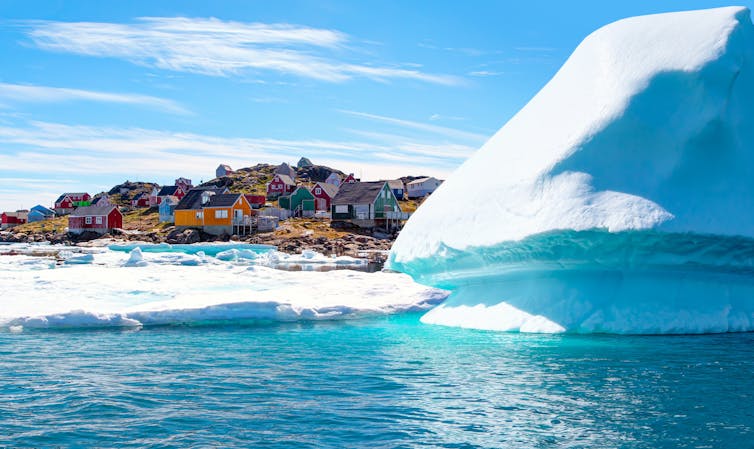
Kulusuk village in East Greenland. Shutterstock/Muratart

Gustav Agneman, Norwegian University of Science and Technology

In 2018, a colleague and I, together with a team of Greenlandic research assistants, conducted one of the most comprehensive surveys to date on public opinion in Greenland. We travelled to 13 randomly selected towns and settlements across the island nation, conducting in-person interviews with a representative sample of adult residents.

The survey explored a wide range of topics. We asked for views on climate change, economic matters – and the prospect of independence from Denmark. Until recently, this was the latest poll on what the people of Greenland thought about this issue.

Greenland, a former Danish colony, is currently an autonomous territory within the Kingdom of Denmark. This political arrangement grants Greenland extensive self-rule, including control over most domestic affairs, as well as its own prime minister and parliament. However, Denmark retains authority over foreign policy, defence and monetary policy.

While our survey results were covered in Greenlandic and Danish media upon their release, they received scant international attention. This changed abruptly on January 15, when newly re-elected US president Donald Trump reposted an old news article about our results. The headline stated that two-thirds of Greenlandic citizens support independence.
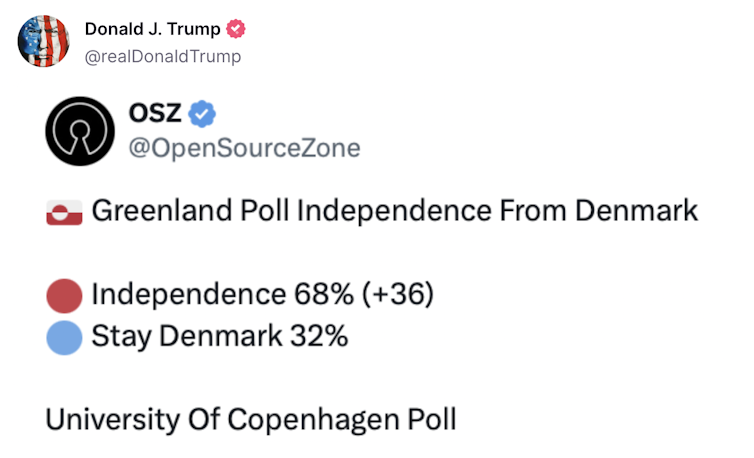
A Truth Social post in which Donald Trump posts a link to a 2018 survey saying Greenlanders want to be independent from Denmark.
Trump posting the 2018 poll in 2025. Truth Social

Trump did not add a comment in the post but the insinuation was clear given his recent statements about annexing Greenland from Denmark: Greenlandic residents want independence from Denmark, and therefore, they might be open to other political or economic arrangements with the US.

“I think we’re going to have it,” Trump recently said after a phone call with the Danish prime minister, Mette Frederiksen, who told him the land was “not for sale”. Trump has in the past spoken of somehow “purchasing” Greenland but has since moved on towards speaking in more assertive terms about taking control of the territory.

Back in 2018, when we conducted the survey, Trump had not yet revealed any plans to annex the island nation. It was a scenario we could hardly even have imagined and therefore did not ask our participants about. As such, regardless of how Trump framed them, the survey results in no way indicated that the population harboured a desire to join the US.

In fact, a recent survey conducted by Sermitsiaq (a Greenlandic newspaper) and Berlingske (a Danish newspaper) directly addressed this question and found that only 6% of respondents wanted Greenland to leave Denmark and instead become part of the US.

In the study I published based on the 2018 data collection, I reported that a majority of the Greenlandic population aspired to independence. Two-thirds of the participants thought that “Greenland should become an independent country at some point in the future”.

Opinions were more divergent regarding the timing of independence. When asked how they would vote in an independence referendum if it were held today, respondents who stated a preference were evenly split between “yes” and “no” to independence.

The Act on Greenland Self-Government, passed in 2009, grants the Greenlandic government the legal authority to unilaterally call a referendum on separating from the political union with Denmark. According to the law, “the decision regarding Greenland’s independence shall be taken by the people of Greenland”.

During the 15 years since its passage, the option to call a referendum has not been exercised. This is likely due to the potential economic consequences of leaving the union with Denmark.

Each year, Denmark sends a block grant that covers approximately half of Greenland’s budget. This supports a welfare system that is more extensive than what is available to most Americans. In addition, Denmark administers many costly including national defence.

This backdrop presents a dilemma for many Greenlanders who aspire to independence, as they weigh welfare concerns against political sovereignty. This was also evident from my study, which revealed that economic considerations influence independence preferences.

For many Greenlanders, the island nation’s rich natural resources present a potential bridge between economic self-sufficiency and full sovereignty. Foreign investments and the associated tax revenues from resource extraction are seen as key to reducing economic dependence on Denmark. Presumably, these natural resources, which include rare earths and other strategic minerals, also help explain Trump’s interest in Greenland.

As Greenland’s future is likely to remain at the centre of a geopolitical power struggle for some time, it is crucial to remember that only Greenlanders have the right to determine their own path. What scarce information is available on their views suggests that while many aspire to independence, it is not driven by a desire to join the US.

Gustav Agneman, Associate Professor, Department of Economics, Norwegian University of Science and Technology

This article is republished from The Conversation under a Creative Commons license. Read the original article.

Continue ReadingTrump wants Greenland – but here’s what the people of Greenland want

There is a green elephant in the room with government’s AI plans

Spread the love
Green Party Co-leader Adrian Ramsay. Wikipedia CC.

Responding to the news that Government plans for AI to be “mainlined into the veins” of the nation, Green Party Co-Leader, Adrian Ramsay MP, said

“The potential for AI is huge and Greens welcome the potential it holds, especially in research and innovation. However, this plan comes almost exclusively from engagement with industry and investors and does not account for the views of the public, or the people working in our public services, about where AI should or should not be used. If AI is to serve our public services, its uses must instead be driven by the voices of those most affected by this technology development and deployment. This of course has to include addressing concerns around privacy and rights over their information”

“In addition, there is a green elephant in the room with neither government nor business truly addressing the environmental impacts of AI. One estimate said AI-related infrastructure may soon consume six times more water than Denmark, a country of 6 million people. And a request made through ChatGPT consumes 10 times the electricity of a Google Search. Yet the action plan does not address these crucial questions of environmental sustainability, let alone the debate about the relative gains from AI versus these obvious harms.”

Continue ReadingThere is a green elephant in the room with government’s AI plans

Sweet like chocolate: Alan Milburn’s new deal

Spread the love

https://morningstaronline.co.uk/article/sweet-like-chocolate-alan-milburns-new-deal

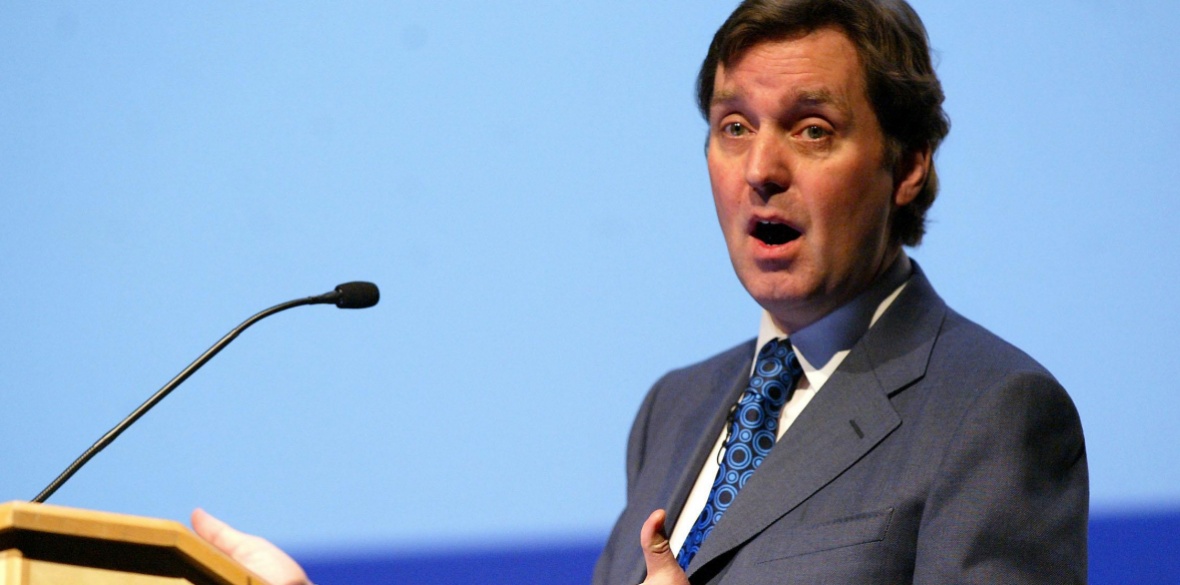
Alan Milburn speaks at the first national conference of the Social Enterprise Coalition, January 25, 2005

Behind a facade of flimsy restrictions, the man who was Tony Blair’s privatisation champion is back in an advisory role, despite the fact he already works for firms that will profit from the selling off of the NHS, writes SOLOMON HUGHES

HEALTH Secretary Wes Streeting says he put Alan Milburn, who was health secretary under Tony Blair, onto the board of the Department of Health “to help government fix health and care.”

But Milburn can’t talk about anything relating “to nutrition, diet, and food, including any work related to the department’s sponsorship of the Food Standards Agency” on that board because he has a part-time job working for Mars Inc.

Appointing someone who works for the firm making Mars Bars to the Department of Health board in the middle of an obesity crisis shows how Streeting values corporate interests above public services.

Milburn was health secretary under Blair from 1999 to 2003. He oversaw the wide-scale privatisation of the NHS. He continued the Margaret Thatcher and John Major governments’ plans to privatise NHS “support services” like cleaning, catering and building management, with the disastrous PFI scheme expanding on his watch.

Milburn also broke new ground by privatising “clinical” services by buying in private operations or giving NHS money to set up privately run clinics. Milburn then cashed in his experience by leaving government and taking on lucrative corporate jobs.

Milburn and his family get around £1-2 million a year from his “advisory” firm, AM Strategy, where all the funds for his “advisory” jobs are collected. Streeting clearly admires both Milburn’s record of privatisation when he was a minister and his highly paid post post-ministerial corporate work.

The Department of Health says Milburn will give up his job as an adviser to Mars Inc at the end of this year, so next year, he will be able to forget all about working for Mars Bars and start discussing obesity.

https://morningstaronline.co.uk/article/sweet-like-chocolate-alan-milburns-new-deal

Continue ReadingSweet like chocolate: Alan Milburn’s new deal

Hunt gambles on tax as services crumble

Spread the love

https://morningstaronline.co.uk/article/hunt-gambles-tax-services-crumble

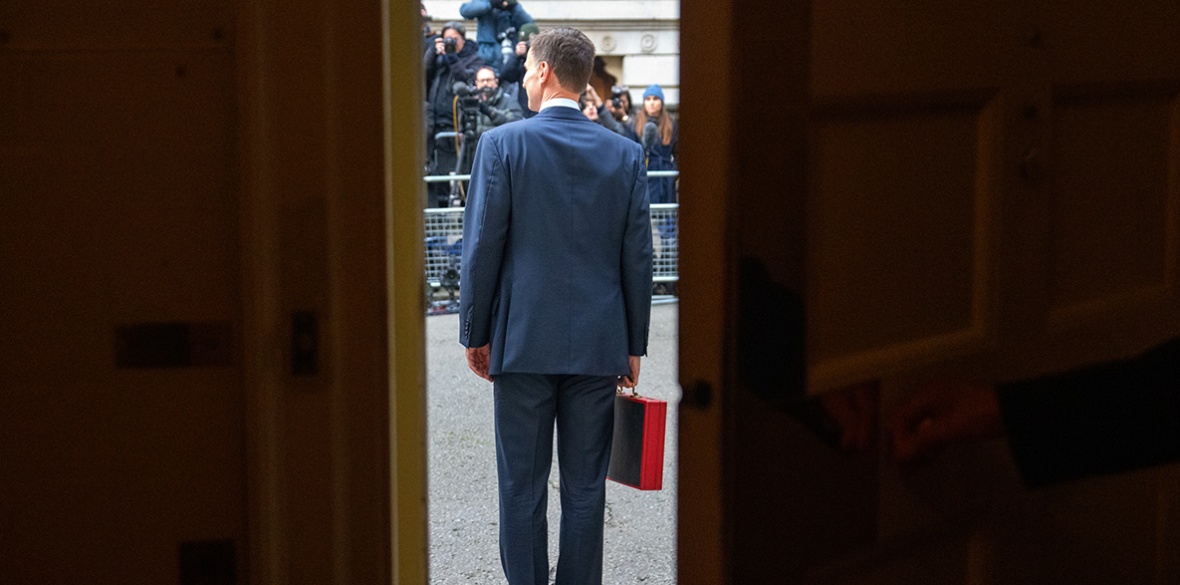
Chancellor of the Exchequer Jeremy Hunt leaves 11 Downing Street, London, with his ministerial box before delivering his Budget in the Houses of Parliament, March 6, 2024.

PUBLIC services are at still greater risk as Chancellor Jeremy Hunt gambled the Tories’ election hopes on a last-ditch tax-cutting Budget.

Mr Hunt announced a 2 per cent cut in National Insurance in a bid to put more money in workers’ pockets before Britain goes to the polls later this year.

But the price will be a major squeeze in public spending in the next parliament, with many department budgets likely to fall in real terms.

The Chancellor also abolished the non-dom tax rule which lets the wealthiest avoid paying taxes on overseas earnings, a key Labour pledge, and brought more families within the scope of child benefit payments.

The Budget therefore leaves Labour more politically denuded than ever — it will either have to find other ways to raise the money it had planned for public services from scrapping the non-dom loophole, or more likely drop residual spending commitments altogether.

Labour leader Sir Keir Starmer told MPs that Labour supported the National Insurance cut too, leaving the parties exchanging rhetorical sound and fury on economic policy but with no significant differences.

https://morningstaronline.co.uk/article/hunt-gambles-tax-services-crumble

Continue ReadingHunt gambles on tax as services crumble

Left Foot Forward

Spread the love

A selection of articles from the excellent Left Foot Forward blog, this blog’s favourite blog ;)

NHS waiting lists increase by 400,000 after Rishi Sunak’s pledge to bring them down

“He can’t pull the wool over people’s eyes by claiming it’s down to strike action. Patients, staff and the public deserve better.”

Voters prefer spending on public services over tax cuts, poll finds

Sadiq Khan perfectly sums up why Brexit has been a failure for London

Environmental campaigners hold protest in Brighton, calling for immediate end to sewage dumping

Crowdfunder urging UK government to halt arms sales to groups actively engaged in warfare gains momentum

More

Continue ReadingLeft Foot Forward