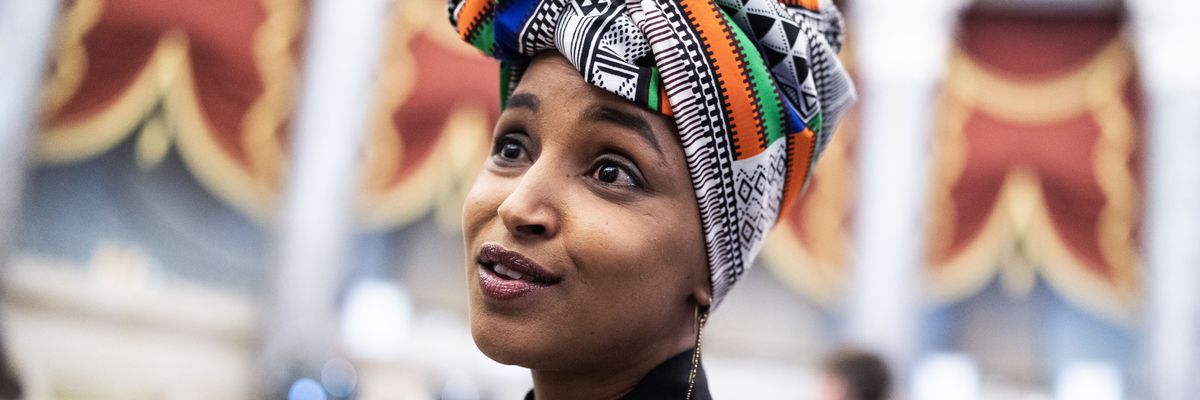
Rep. Ilhan Omar (D-Minn.) is seen before President Donald Trump’s address to a joint session of Congress in the House Chamber of the US Capitol on March 4, 2025. (Photo by Tom Williams/CQ-Roll Call, Inc. via Getty Images)
“His obsession with me is creepy,” said Rep. Ilhan Omar, the first Somali American ever elected to the US Congress.
Rep. Ilhan Omar, the first Somali American ever elected to the US Congress, said Tuesday that she hopes President Donald Trump “gets the help he needs” after he ended a Cabinet meeting with a bigoted tirade against Somali immigrants.
Trump specifically attacked Minnesota’s Somali community—falsely claiming that “they contribute nothing”—and singled out Omar (D-Minn) by name, calling her “garbage” and a “terrible person.”
Omar hit back in a brief social media post, characterizing the president’s remarks as clear evidence that he’s unwell.
Trump’s comments came as his administration prepared to target Somali immigrants with Immigration and Customs Enforcement (ICE) raids in the Minneapolis-St. Paul region. Around 80,000 Somalis live in Minnesota.
The New York Timesreported Tuesday that the directive for ICE raids in Minnesota “came immediately after” Trump used his social media platform to launch an appalling attack on Somalis and others in the wake of the shooting of two National Guard members. The man charged with the shooting is an Afghan national who worked as a member of a CIA-backed “Zero Unit” during the war in Afghanistan before resettling in the US.
Kristi Noem, head of the US Department of Homeland Security, has exploited the shooting to ramp up the administration’s anti-immigrant agenda, proposing what she called “a full travel ban on every damn country that’s been flooding our nation with killers, leeches, and entitlement junkies,” echoing Trump’s white nationalist rhetoric.
Following Trump’s latest attack on Somalis, Minnesota Attorney General Keith Ellisonsaid in a statement that the president’s “disgraceful attacks on Minnesota’s Somali community are injecting more of his poisonous racism into our beloved home state.”
“Hearing him single out our people based solely on their race and country of origin is downright disgusting,” Ellison said. “Minnesotans stand up for our neighbors when they’re under attack. And as Minnesota’s attorney general, I will use every tool I have to protect all our neighbors, including our vibrant Somali community, from these dangerous, racist threats. Our neighbors deserve no less.”
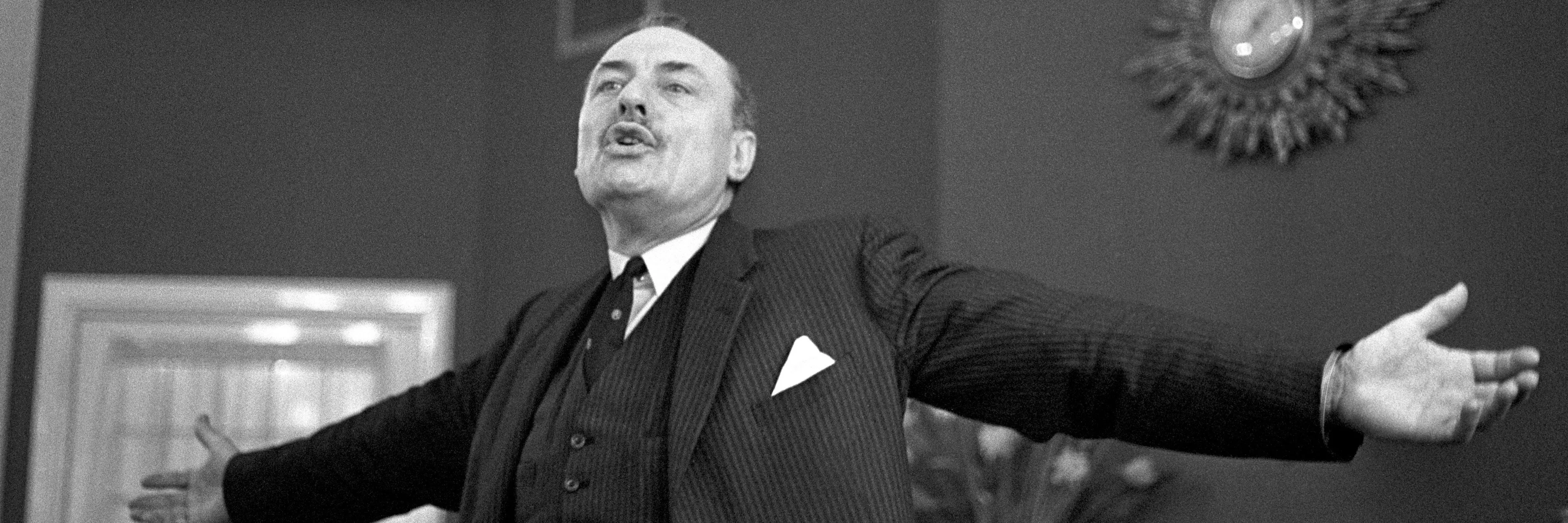
‘We are winning’, claims politician Enoch Powell to students at York University in 1969 following his notorious ‘rivers of blood’ speech. Alamy/PA Images
Prime Minister Keir Starmer thinks that racism is returning to British society. He has accused Nigel Farage’s Reform UK of sowing “toxic division” with its “racist rhetoric”.
Starmer’s comments follow a trend that has seen senior Labour party officials portray their political opponents on the far-right as sowing division with racist rhetoric.
Recently, Wes Streeting, the Labour health secretary, warned that an “ugly” racism is on the rise again, pointing to worrying figures showing an increase of race-based abuse of NHS staff.
And in October, senior Labour officials attacked Farage’s plans to strip millions of legal migrants of their Indefinite Leave to Remain status as a racist policy. Home Secretary Shabana Mahmood said that Farage’s plans sounded like a “very loud dog whistle to every racist in the country”.
Labour officials portray the rise in racist incidents and rhetoric as the return of attitudes that had all but disappeared from British society. Streeting expressed his worry that “1970s, 1980s-style racism has apparently become permissible again in this country”. Starmer similarly stated that “frankly I thought we had dealt with” the problem of racist abuse “decades ago”.
This is an appealing story because it conveys a neat and simple message: racism was defeated decades ago and it is now being revived by racist agitators. But in truth, the history of post-war racism is much more complex.
In my new book, I investigate how ideas of race and racism have changed since the second world war. History shows that racism never disappeared from public life. Rather, it assumed different shapes, some of which are harder to discern than others.
The experience of fascism
The defeat of Nazism in 1945 marked a key moment in the history of racism. Prior to the second world war, ideas of racial difference and even racial hierarchy were firmly entrenched in elite society.
In Victorian Britain, for example, a belief in the racial superiority of Europeans was decisive to maintaining colonial rule across large parts of central and east Asia, Africa, and the Caribbean. This sentiment was famously captured in Rudyard Kipling’s 1899 poem, The White Man’s Burden, which depicted colonial rule as the moral duty of white nations.
The Insights section is committed to high-quality longform journalism. Our editors work with academics from many different backgrounds who are tackling a wide range of societal and scientific challenges.
Likewise, pseudosciences like eugenics and physical anthropology enjoyed significant prestige among British elites well into the 20th century. The British Eugenics Society, dedicated to improving the genetic stock of the British population, flourished in the interwar period. At this time the eugenics movement was an ideological broad church, appealing to progressive as much as conservative elites.
But the second world war irrevocably changed this landscape. The experience of fascism made it clear for all to see just how dangerous the concept of racial superiority was. Ideas of racial purity, racial hierarchy, and eugenics had driven the Nazis to commit genocide. It had led to a world war that many experienced as a straightforward conflict between good and evil.
There was no Nazi atrocity – concentration camps, wholesale maiming and murder, defilement of women or ghastly blasphemy of childhood – which Christian civilization or Europe had not long been practicing against colored folk in all parts of the world in the name of and for the defense of a Superior Race born to rule the world [sic].
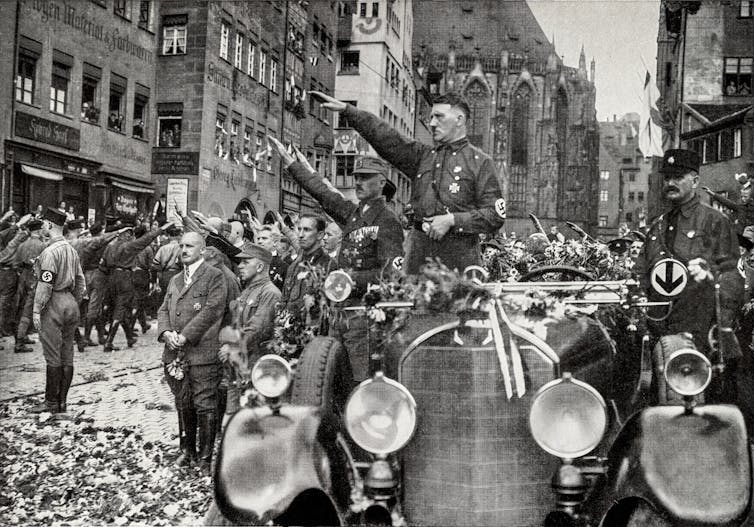
Adolf Hitler on the third day of the Nazi party conference Nuremberg, Germany, in 1929. Shutterstock/Andreas Wolochow
The cumulative effect of these experiences was that ideas of racial superiority came to be seen an unscientific relic of the past.
Squashing ‘scientific racism’
This was exemplified by the United Nations, which in November of 1945 established Unesco (United Nations Educational, Scientific and Cultural Organisation) with the explicit aim of battling racism. Unesco’s constitution, adopted on November 16 of that year, drew a direct connection between racism and the second world war:
The great and terrible war which has now ended was a war made possible by the denial of the democratic principles of the dignity, equality and mutual respect of men, and by the propagation, in their place, through ignorance and prejudice, of the doctrine of the inequality of men and races.
In 1949, Unesco appointed a panel of prominent scientists to formulate a critique of scientific racism. Reporting in 1950, the panel concluded that there is no scientific basis for any claims of racial superiority of one group over another. As the panel wrote, “the likenesses among men are far greater than their differences”.
While a small number of academics remained committed to race science and eugenics, they were forced into the margins of the academic world. The Eugenics Society, though it continued to exist, lost much of its prestige.
Going forward, race science or political appeals to racial superiority were no longer deemed acceptable, even among ruling elites. The language of race lost the scientific legitimacy and political purchase it once had.
This did not mean that racism disappeared, however. Rather, it changed shape.
Immigration and culture
Explicit appeals to race remained politically unacceptable for many decades after the war. This forced intellectuals and politicians on the right, especially those with divisive views about racial and ethnic differences, to develop an alternative language in which to express their ideas.
The backlash against these migration trends was exemplified by Enoch Powell, a Conservative MP and former Minister of Health. In the late 1960s, Powell developed a vocal critique of immigration numbers.
Powell’s rhetoric was inflammatory and racially charged. In his infamous ‘Rivers of Blood’ speech, delivered in 1968 in Birmingham, Powell claimed that unless immigration was restricted, people of colour would soon have “the whip hand over the white man”. In another speech, from 1970, Powell complained that it was no longer politically acceptable to say that “the English are a white nation”.
Powell made no appeal to the idea of biological difference. Instead, his emphasis was on cultural difference. He claimed that migrants and white British people were culturally too dissimilar for assimilation to be possible in large numbers.
Powell’s speeches on immigration cost him his political career. He was dismissed from the Shadow Cabinet following his “Rivers of Blood” comments. Yet his views were soon echoed by other political figures.
In 1976, Ivor Stanbrook, a Conservative MP, said in the House of Commons: “Let there be no beating about the bush. The average coloured immigrant has a different culture, a different religion and a different language. That is what creates the problem.”
And in 1978, Margaret Thatcher said in a TV interview that British “people are really rather afraid that this country might be rather swamped by people with a different culture”. Migration was a threat to Britain’s national identity.
Thatcher added: “We are a British nation with British characteristics. Every country can take some small minorities and in many ways they add to the richness and variety of this country. The moment the minority threatens to become a big one, people get frightened.”
In the 1979 general election, which Thatcher won with a landslide, the Conservative party manifesto pledged to tighten immigration controls and restrict citizenship. This pledge was enacted in 1981.
The denial of racism
The rhetoric of people like Powell, Stanbrook, and Thatcher represented a new kind of racial vocabulary. What is striking about this rhetoric is that it pretended not to concern race at all. Each of them explicitly denied that their rhetoric appealed to racist sentiment.
Powell often distanced his critique of immigration from concerns over race. In a 1970 interview, Powell said:
I’m not talking about race at all. I am talking about those differences, some of which are related to race, between the members of different nations which make the assimilation of the members of one nation into another nation more difficult or less difficult.
Stanbrook also denied that his comments about “coloured immigrants” were racist. In a parliamentary debate, he insisted that to highlight problems with cultural integration “is not racialism, if by that one means, as I do, an active hostility to another race”. This was because, in his view, “a preference for one’s own race is as natural as a preference for one’s own family”. A dislike of immigration, therefore, is not based on racist animosity. “It is simply human nature,” Stanbrook added.
Even Thatcher complained that whenever she tried to address concerns about immigration she was “falsely accused of racial prejudice” by her political opponents. She claimed that because mainstream political parties were not willing to talk about immigration, voters were instead turning to the far-right National Front. “If we do not want people to go to extremes, and I do not, we ourselves must talk about this problem and we must show that we are prepared to deal with it,” she said.
These denials of racism indicate that during this period, the language of race itself remained socially unacceptable. Powell, Stanbrook and Thatcher all felt the need to distance themselves from it.
This helps to explain why they preferred to focus on ideas of cultural difference and national identity. These ideas did not carry the same negative connotations as race, yet could be used to convey a similar message – namely that some groups did not belong in Britain.
The rise of inflammatory rhetoric surrounding immigration in the 1960s and 70s had an immediate impact on policy. During this period, successive governments responded to the growing clamour over immigration by selectively tightening migration controls and nationality legislation.
However, this rhetoric has also had a more gradual, long-term effect on racism’s place in society. Powell’s and Thatcher’s views on immigration have been echoed again and again, often framed in the same vocabulary. This continues to this day.
Last month, Katie Lam, the shadow home office minister, appeared to argue that Ukrainian and Gazan refugees should be treated differently because the former are better able to assimilate to British culture, as well as being more likely to go back to rebuild their country of origin.
And earlier this month, nationalist writer and academic Matthew Goodwin, who is formally linked to Reform, wrote in his personal newsletter that the “cultures that our hapless politicians are now importing into our country at speed are not just radically different and incompatible to our own; they are inferior, primitive, stuck in cultural codes and practices we moved on from centuries ago”.
The gradual normalisation of this kind of rhetoric has allowed it to re-enter mainstream public discourse. This has caused the erosion of the anti-racist norms established in the wake of the second world war. For many years after the war, these social norms meant that public figures who expressed views that were considered racist paid a high social or professional cost. Powell’s dismissal from the shadow cabinet following his Rivers of Blood speech is a forceful example of this.
Today, these anti-racist norms are under increasing pressure. To be sure, they have not fully disappeared. In recent years, anti-racist movements like the Black Lives Matter have enjoyed broad popular support in Britain and elsewhere.
Likewise, officials who express inflammatory rhetoric can still expect to be challenged. Politicians including Starmer, Robert Jenrick and Katie Lam have recently been met with criticism for divisive comments or policies on race, migration, and culture.
Starmer, for instance, was criticised for saying that migration numbers are turning Britain into an “island of strangers”. This comment was likened to Powell’s rhetoric on immigration, who also said that immigration left Britons feeling like “strangers in their own country”. When confronted with criticism, Starmer said he deeply regretted using that phrase.
Meanwhile, Farage has faced pressure to distance himself from racist comments he is alleged to have made in the past – allegations which he has strongly denied.
Yet, the prospect of a politician being dismissed from a cabinet role for racially inflammatory comments is very remote today. Neither Jenrick nor Lam has been dismissed from the shadow cabinet for their comments, with Conservative Party leader Kemi Badenoch expressly defending Jenrick.
Various forms of racism persist. Today, cultural racism is the most widespread and politically consequential kind. Derogatory and stereotyped views on cultural differences and national identity are now an everyday feature of public discourse, especially in debates over immigration.
Yet cultural racism remains poorly understood. In most media reporting and political discourse, the term “racism” continues to refer primarily to individual prejudice based on outward appearance or group belonging. When Streeting talks about “1970s, 1980s-style racism” he specifically means “abuse based on people’s skin colour”.
While it is undeniably a good thing that racist abuse is being vocally challenged by politicians, this narrow definition of racism obscures as much as it reveals. It fails to challenge forms of racism that do not appeal to physical traits but to cultural traditions. And it gives political agitators intent on sowing division on themes like immigration the opportunity to deflect criticism by denying that their ideas are racist.
At the structural level, racism causes certain individuals or communities to be more vulnerable to violence, exclusion, marginalisation, poverty, and other harmful outcomes on the basis of their membership of a particular racial, cultural, or religious group. Rhetoric that intensifies this vulnerability feeds racism, even when it is not expressed in the language of “race” or when there is no prejudicial intent.
So long as these structural factors are not taken into consideration, more subtle forms of racism will continue to hide in plain sight and exert a corrosive influence on the health and wellbeing of those it targets.
To hear about new Insights articles, join the hundreds of thousands of people who value The Conversation’s evidence-based news. Subscribe to our newsletter.
Elon Musk urges you to be a Fascist like him, says that you can ignore facts and reality then.A parody ‘Tesla – The Swasticar’ advert posted at a London bus stop. Photograph: People vs ElonKeir Starmer refuses to be outcnuted by Nigel Farage’s chasing the racist bigot vote.
dizzy: I tend to regard racism and misogyny as inherent and necessary to Capitalism, part of the divide and rule strategy providing an implied differentiation and continuum of perceived statuses. “No dogs, blacks or Irish”. It’s so ridiculously stupid and obviously transparent really.
I sometimes experience racism as a Welshman in England and as a perceived Englishman in Wales. It must be strange when I say the odd Welsh phrase “Diolch yn fawr” (most Welsh people will recognise and understand that). FM,(*1) an Englishman who’s learned Welsh, what’s the World coming to?
Strange hypocrisy that these Labour politicians can so readily condemn racism while supporting the explicitly racist and genocidal Israel apartheid regime …
*1
Orcas discuss the formation of UK’s new Socialist party and ask if the killer apes have finally come to their senses.
People attending the People’s Assembly Against Austerity protest in central London, June 7, 2025
BRITAIN’S Communists meet tomorrow in Yorkshire for their 58th Congress. They will debate the urgent challenges faced by the left across the nations of Britain and more widely across the world.
Reactionary nationalism and racism, accelerated militarism and the abandonment of commitments on global warming all demand a new level of unity, a united front, not just as a slogan, but as a unifying solidarity across our communities and the organised labour movement.
How to secure that unity is a question that both unites but also sometimes divides the wider left. It is certainly not one that will be currently resolved by thinking purely in terms of political parties.
Keir Starmer says that the Labour Party under his leadership is intensely relaxed about assaulting those least able to defend themselves – the very poorest and most vulnerable.Nigel Farage urges you to ignore facts and reality and be a climate science denier like him and his Deputy Richard Tice. He says that Reform UK has received £Millions and £Millions from the fossil fuel industry to promote climate denial and destroy the planet.Nigel Farage explains the politics of Reform UK: Racism, Fake anti-establishmentism, Deregulation, Corporatism, Climate Change Denial, Mysogyny and Transphobia.
Then prime minister David Cameron (left) welcomes then newly-elected Newark MP Robert Jenrick to the Houses of Parliament in London, June 11, 2014
SOLOMON HUGHES finds one-time Cameron-centrist EU fans now promote vicious anti-migrant rhetoric in their bid to get attention for their ailing party
Robert Jenrick’s complaints about “not seeing another white face” in Birmingham’s Handsworth show the Tories will push racism to try to grab votes.
Jenrick’s hard right turn is creepy because this formerly “Liberal” Tory, who was so blandly Cameron-centrist-pro-EU that he was called “Robert Generic,” now uses the language of the National Front.
At Tory conference anti-migrant, anti-asylum-seeker, prejudiced and racist language was ubiquitous: Mirroring Jenrick’s manoeuvre, it spread to supposedly “liberal” Tories.
I went to a conference meeting of Tory group Bright Blue. Founded when David Cameron was leader, Bright Blue see themselves as a socially conscious liberal Tory group.
Their slogan is “Our work is about defending and improving liberal society.” Their “advisory board” has Labour figures — former ministers Margaret Hodge and John Denham and former Blair adviser John McTernan — alongside a dozen leading Tories.
This supposed liberalism evaporated over migration. They had a debate on “How Conservatism can be popular and effective again.”
Shadow home secretary Chris Philp was on the panel. Philp is pushing his anti-migrant message hard: he attacks asylum-seekers as criminals. He also attacks the much greater numbers of “legal” migrants, claiming “mass migration has certainly damaged social cohesion.”
But what Philp said for the “Bright Blue” crowd was instructive: Bright Blue wrote a list of 10 Tory objectives. Philp said this wouldn’t work, because “it is hard to get attention” for the Tories, so any list had to be reduced to two: immigration and the economy. Philp was making clear the Tories are going hard on immigration mostly to get “attention.”
Philp was joined on the panel by Jesse Norman MP, a “Bright Blue” favourite, seen as a Tory liberal. In 2022 Jesse Norman wrote a “no-confidence” letter to then PM Boris Johnson, complaining “the Rwanda policy is ugly, likely to be counterproductive and of doubtful legality.”
So did Norman object to Philp and the Tories’ plan to reinstate their policy of deporting all asylum-seekers to Rwanda, or his “ugly“ language?
No. Norman argued pushing against “immigration” was essential, saying “it’s almost a threshold condition for seriousness” for would-be Tory voters.
This is the current Tory position, across the board, from former “liberals” like Jenrick to supposedly current “liberals” like Norman — they want to hammer the anti-immigrant button, because they can’t see any other way to beat Reform.
The Tory conference was quite direct about this manoeuvre: the conference slogan was “Stronger Economy. Stronger Borders.”
They want to have a “stronger economy” — which for the Tories means more privatisation, deregulation and lower taxes, and will use their “stronger borders” message — meaning their newly supercharged anti-migrant and racist prejudices — to get it.
Those cynically adopting this hard anti-migrant persona are more sinister in some ways than lifelong bigots. They are willing to play with prejudice without principle.
If the Conservatives end up in coalition with Farage — a distinct possibility — we can’t expect the Tories to blunt Reform’s prejudices in government. Quite the opposite, they might lean into them more, and deliver them with more efficiency.
Morning Star copyright to this article is recognised.
UK Conservative Party leader Kemi ‘not a genocide’ Badenoch explains her reality that the Earth is flat, the Moon is made of cheese and that she was born from
Unicorn horn dust
Keir Starmer objects to criticism of the IDF. He asks how could anyone object to them starving people to death, forced marches like the Nazis did, bombing Gaza’s hospitals and universities, mass-murdering journalists, healthworkers and starving people queuing for food, killing and raping prisoners and murdering children. He calls for people to stop obstructing his genocide for Israel.
dizzy: This is a small excerpt (the closing paragraphs) of a long Guardian article by journalist Owen Jones. The whole article is recommended. Will these new laws lead to widespread challenges just as the proscription of Palestine Action has done? Is it too much to expect the arrogant Zionist Labour government to learn from it’s mistakes?
…
On the same day as the synagogue attack, the Israeli army killed at least 57 Palestinians in Gaza – another hideous tally in two years of daily atrocities that have left tens of thousands dead. British politicians and media outlets have barely concealed the lack of value they attach to Palestinian life. It is among the most brazen expressions of racism of our time. One wonders how history will judge this moment: politicians are accusing people who are protesting against genocide of inciting hatred, while they are supporting those who are committing genocide.
Our government has already crossed a dangerous threshold by proscribing Palestine Action, a non-violent, anti-genocide direct action group. More than 2,000 British protesters have been arrested, mostly for holding placards opposing genocide and supporting the banned organisation. Many of them are pensioners; one is a retired priest, another the daughter of a Holocaust survivor. When the state begins calling movements “terrorism” when they are nothing of the sort, it is attacking democracy itself.
It’s not hard to see where this all leads. In the US, Democrats helped to demonise pro-Palestinian protests: the former house speaker Nancy Pelosi suggested that some were “connected to Russia”, while Joe Biden called such protests antisemitic. In doing so, they only helped to legitimise the authoritarian crackdown on such protests – and on freedom of expression in general – under Donald Trump. If Nigel Farage becomes prime minister, a hard-right government would be granted sweeping powers to control dissent. What do you think a Reform government would do with this repressive toolkit? Our ancestors struggled, suffered and died to secure our freedoms. We will come to rue how casually we let them go.
UK Foreign Minister David Lammy confirms that UK government and military are active participants in Israel’s genocides and that the F-35 parts that they suspended from supplying to Israel are instead simply diverted via the United States. He says see https://youtu.be/QILgUHrdWREPalestine Action joke that appeared in the UK satirical magazine ‘Private Eye’.Orcas discuss Genocide-supporting and complicit Zionists. Donald Trump, Keith Starmer, David Lammy, Rachel Reeves, Angela Rayner and Wes Streeting are acknowledged as evil genocide-complicit and supporting cnuts.



 People attending the People’s Assembly Against Austerity protest in central London, June 7, 2025


