Watchdogs Say World’s Richest Man Elon Musk Has ‘Declared War on Social Security’

Spread the love

Original article by Jake Johnson republished from Common Dreams under Creative Commons (CC BY-NC-ND 3.0). 
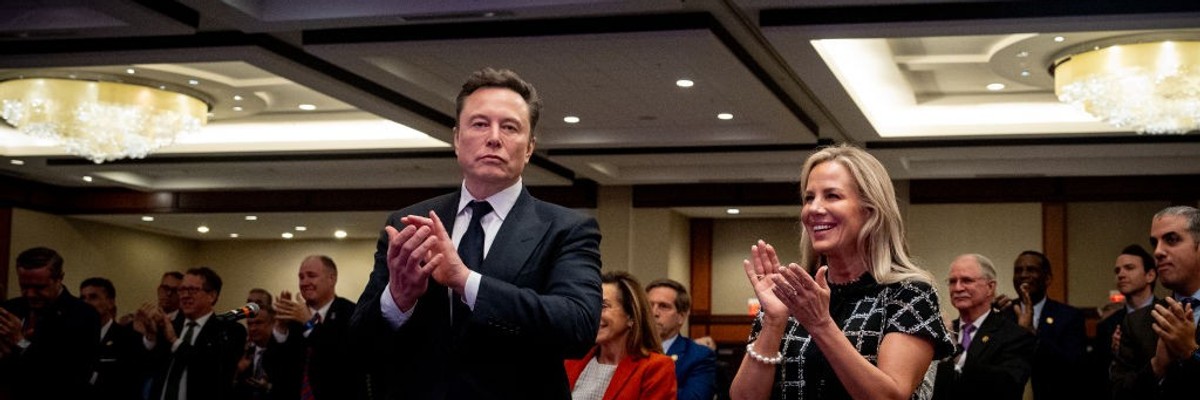
Elon Musk applauds alongside the wife of House Speaker Mike Johnson (R-La.) during a House Republican Conference meeting on November 13, 2024. (Photo: Andrew Harnik/Getty Images)

“Elon Musk’s commission is a plot to destroy our Social Security by giving it to Wall Street executives—so that you get nothing and they get everything,” warned one advocate.

A lengthy series of X posts attacking Social Security as a “nightmare” caught the attention of the platform’s mega-billionaire owner, Elon Musk, who could soon take aim at the beloved New Deal program as co-chair of an advisory commission tasked with identifying federal spending to slash.

“Interesting thread,” Musk, the world’s richest man, wrote late Monday in response to the posts by Sen. Mike Lee (R-Utah), who once said he hopes to pull Social Security “up by the roots and get rid of it,” along with Medicare and Medicaid.

In his new thread, Lee characterized Social Security—which lifts more Americans above the poverty line than any other federal program—as a “tax plan” insidiously disguised as a retirement plan and condemned the Social Security Act of 1935 as one of many “deceptive sales techniques the U.S. government has used on the American people.”

Max Richtman, president and CEO of the National Committee to Preserve Social Security and Medicare (NCPSSM), replied Tuesday that Lee’s posts amount to “a misrepresentation of Social Security’s history and how the program works.”

“There is nothing deceptive about Social Security. The social insurance program has been working just fine for nearly 90 years and has never missed a payment,” said Richtman. “The kind of propaganda Sen. Lee posted undermines public support for Social Security, making it easier to cut or privatize the program. It is perhaps no coincidence that Sen. Lee’s second-biggest campaign contributor by industry is the securities and investment sector.”

“The money is ours, Mike Lee, Elon Musk, and Donald Trump. You’re not going to get a penny of it.”

Lee also claimed the federal government “routinely raids” the Social Security Trust Fund—a longstanding and misleading right-wing talking point.

Social Security Works (SSW), a progressive advocacy group, said Tuesday that by amplifying Lee’s thread to his hundreds of millions of followers, Musk “just declared war on Social Security.”

“For 89 years, through war and peace, boom time and bust, health and pandemics, Social Security has never missed a single payment,” said Alex Lawson, SSW’s executive director. “Compared to the risky alternatives on Wall Street, Social Security is a rock of retirement security. If billionaires like Elon Musk paid into Social Security at the same rate as the rest of us on all of their income, we could expand benefits for everyone and pay them in full forever.”

“This is a declaration of war against seniors, people with disabilities, and the American public,” Lawson said. “The Republicans are coming for your Social Security, which they call a ‘nightmare.’ Elon Musk’s commission is a plot to destroy our Social Security by giving it to Wall Street executives—so that you get nothing and they get everything.”

“We’ve seen this play again and again,” he added. “When Republicans destroyed defined-benefit pension plans, they claimed that the market would be able to create amazing returns for everybody. Instead, workers got pennies, while Wall Street managers got billions. That is always the plan. We will defeat this Republican effort to steal our earned benefits. The money is ours, Mike Lee, Elon Musk, and Donald Trump. You’re not going to get a penny of it.”

https://twitter.com/SSWorks/status/1863959338055823536?ref_src=twsrc%5Etfw%7Ctwcamp%5Etweetembed%7Ctwterm%5E1863959338055823536%7Ctwgr%5E3dc7071fc8e883d1662f930797a349982566c241%7Ctwcon%5Es1_c10&ref_url=https%3A%2F%2Fwww.commondreams.org%2Fnews%2Felon-musk-social-security

Sorry, this content could not be embedded.
X

Richard Fiesta, executive director of the Alliance for Retired Americans, similarly denounced Lee’s thread and Musk’s promotion of it, saying both “should enrage and concern every single American who has contributed to Social Security.”

“Sen. Mike Lee has dreamed about ‘phasing out Social Security’ and the benefits generations of Americans have earned for more than a decade. His bad ideas have been rightfully ignored but last night he got a big assist from Elon Musk, who amplified Lee’s wrongheaded views about Social Security on X.”

“Social Security is a solemn promise between the American people and the government,” Fiesta continued. “We pay for Social Security’s guaranteed benefits with every paycheck and expect them to be there when we retire, lose a spouse or parent, or become disabled. No one voted to phase out Social Security or let Wall Street gamble with their earned benefits. Older Americans will rightly punish any politician who tries to cut their benefits or gut the system that has worked for generations.”

On the campaign trail, President-elect Donald Trump pledged to defend Social Security while simultaneously pushing proposals that would wreck the program’s finances.

Many Republican lawmakers, who are soon to be in the majority in both chambers of Congress, have called for raising the Social Security retirement age—a change that would cut benefits across the board. On Tuesday, Rep. Rich McCormick (R-Ga.) toldFox Business Network that “we’re going to have to have some hard decisions” on Social Security, Medicaid, and Medicare—a euphemism for benefit cuts.

Richtman of NCPSSM said that the kind of attack advanced by Lee and other Republicans “conflicts with President Trump’s promise not to tamper with Americans’ earned benefits.”

“It signals where Trump’s MAGA allies in Congress are heading—toward privatization and benefit cuts, something the majority of Americans across party lines say they do not want,” Richtman added.

Original article by Jake Johnson republished from Common Dreams under Creative Commons (CC BY-NC-ND 3.0). 

Continue ReadingWatchdogs Say World’s Richest Man Elon Musk Has ‘Declared War on Social Security’

Movement leaders in the US say Trump’s agenda will be met with a strong fightback

Spread the love

Original article republished from peoples dispatch under a Creative Commons Attribution-ShareAlike 4.0 (CC BY-SA) license.

Claudia De la Cruz speaks at “What is to be done?” panel on November 8 (Photo: Wyatt Souers)

US-based movement leaders take up the task of answering the burning question: “What is to be done?”

Just two days after Donald Trump’s landslide victory against Vice President Kamala Harris, US socialists and movement leaders took up the task of answering the burning question: What is to be done following Trump’s win?

Hundreds of people gathered at the People’s Forum in New York City on November 8 for a panel discussion which featured the presidential candidate of the Party for Socialism and Liberation, Claudia De la Cruz, who ran against both Trump and Harris in a explicitly socialist campaign, Brian Becker, executive director of the anti-war organization the ANSWER Coalition, Eugene Puryear, journalist with BreakThrough News, Jorge Torres, part of the National Day Laborer Organizing Network with extensive experience organizing undocumented immigrant workers, and Miriam Osman, leader in the Palestinian Youth Movement, which has played a central role in the Palestine solidarity movement across North America.

Layan Fuleihan, Education Director of the People’s Forum, opened up the discussion. “We, the workers, the social movements, the immigrant families, the young people, the anti-war movement, the working class as a whole, we are faced with many urgent questions,” she said. 

“How will we confront this continual rise of the right? Will we be driven by fear and apathy or pessimism? Will we stay home? Or will we organize our forces and chart our own path forward? Will we follow the lead of the Democratic Party and mourn their loss? Or will we assert that we reject the billionaire agenda no matter which party is executing its orders?”

Speakers put the blame for Trump’s win not on a shift to the right by working class people, but on the failures of the Democratic Party. Claudia De la Cruz spoke to what she called the “scapegoating of working class sectors” by the Democrats. 

“They are saying we have to blame Black men, that we have to blame Latino men, that we have to blame immigrant communities, that we have to place judgment on those who didn’t go out and vote,” she said. 

In reality, according to De la Cruz, “it is the spinelessness of the Democratic Party that has brought us here.” 

“While Trump won this election, we cannot pretend that the Democrats have not allowed and conducted attacks against the working class people for decades,” De la Cruz said. “If we think about the last 16 years, the Democratic Party had power for 12 of those years, and they didn’t do anything. Not a single thing to protect or expand our rights. In fact, they sat back and watched how our rights were placed on a chopping block and said, we can’t do anything about it.” 

Torres, who himself comes from a migrant background and was undocumented, spoke not only of the fear that exists within immigrant communities of Trump’s anti-migrant policy promises, but also the resolve to fight back. According to Torres, for the past few months, immigrant day laborers within the NDLON network were very scared of what would happen in the event of a Trump win. Trump has promised to deport between 15 to 20 million people in the largest mass deportation in US history, a policy which could result in family separations affecting up to 1 in 3 Latinos in the country. 

But this did not paralyze these communities, who instead came together in a renewed resolve to “start organizing for real,” Torres described. Communities began to ask one another, “What does that mean when we say the people save the people?”

“We made a decision that it was about time to organize local communities in popular committees across the country,” Torres said. “We decided to organize popular assemblies across the country. In around one month we organize almost 25 assemblies across the country. And now we have almost 45+ committees led by workers, led by undocumented people, led by people that really are directly impacted.” Torres also mentioned that NDLON is working closely with the Landless Rural Workers’ Movement (MST) in Brazil, speaking to deep ties of international solidarity.

According to Torres, “most of the committees have lost their belief and hope and the Democratic Party or the Republican Party.” 

“By now it is time to organize, and we just have us, and we don’t have no one else,” Torres asserted. 

According to Eugene Puryear, Trump’s policy promises to round up migrant workers should be a call to action for a mass movement to defend immigrant communities. This movement can find inspiration from the history of the movement for the abolition of slavery in the United States. Puryear recalled the history of the Fugitive Slave Act, which imposed harsh punishments on those who sheltered runaway slaves. But this certainly did not stop abolitionists and anti-slavery activists from protecting slaves anyway. 

“Whether or not the law said one thing, there was a higher law: that they had to fight against slavery no matter the risk,” Puryear described. 

“So [abolitionists] formed things called vigilance committees, all across the country, that said that when a fugitive slave is brought before the bar into the courthouse, we will go to the courthouse and we will physically resist the imposition of returning them back. That we will physically remove them from the courthouse if we have to, and put them on the Underground Railroad and send them to Canada. And maybe we won’t succeed. Maybe we’ll be beaten. In many cases, these were serious tussles. People were pulling out guns. Maybe we’ll even be killed. But we would rather risk our lives than allow our formerly enslaved brothers and sisters to be taken back.”

There are parallels between the Fugitive Slave Act of 1850 and Trump’s promise to remove tens of millions of migrants from the country by force, Puryear argued. And the historic tasks of the mass movement, therefore, are similar to those shortly before slavery was abolished. “You can say it’s scary, and it is scary. You can say it’s odious, it is odious. But when they start bringing the trucks around to round people up, you can also say, I’m going to step outside of my door and I’m going to link arms with my neighbors. And if you’re going to throw them out, you better throw me out with them because we’re standing together no matter what,” Puryear said.

Brian Becker also echoed this same militant fighting spirit, rooted in the lessons of past movements. Becker drew attention in particular to the movement that arose after 2016 in opposition to Trump’s first election. 

“There’s another side to the question of what is to be done, and that is what is to not be done,” Becker said. “Let’s learn the lesson of the first Trump administration when Trump came into office. So many people went to the airports because he said, we’re going to ban Muslims from coming into the country. Massive protests on Inauguration Day. We outnumbered Trump supporters. This was the anti-Trump resistance,” he described.

“But what happened? The Democratic Party completely co-opted that movement, completely took over that movement, because they said you have to resist Trump, the person, which meant that the best and practical way to do it, is to get rid of Trump by electing the Democrats.”

This co-optation marked the end of this mass movement, which because merely a “tail to the Democratic Party,” Becker described. 

According to Becker, “the problem isn’t just Trump. The problem is the capitalist system and the ruling class parties. The Democrats and the Republicans are not an opposition to capitalism. They are the voice of capitalism.”

Becker spoke to the need to “build a political program” independent of the two establishment parties, which speaks to the needs of the masses of people. 

Miriam Osman of the Palestinian Youth Movement spoke to the way that the movement in solidarity with Palestine has given people in the US renewed political clarity regarding the similarities between both major parties. “Our task is to draw more and more people into our struggle against the shared enemy, the shared enemy of the Palestinian people, the shared enemy of the working people of the world, and the shared enemy of working people in the United States,” which is the US ruling class, Osman articulated. “Our task is to build power. Our task is to unify our efforts, because this is the only thing that’s going to give us the force to transform this system.”

Original article republished from peoples dispatch under a Creative Commons Attribution-ShareAlike 4.0 (CC BY-SA) license.

Continue ReadingMovement leaders in the US say Trump’s agenda will be met with a strong fightback

Neoliberal Fascism Is Now the Dominant Ideology in the United States of America

Spread the love

Original article by C.J. Polychroniou republished from Common Dreams under Creative Commons (CC BY-NC-ND 3.0). 

Republican presidential nominee, former President Donald Trump speaks during a campaign rally at Van Andel Arena on November 05, 2024 in Grand Rapids, Michigan. (Photo by Chip Somodevilla/Getty Images)

The formation of a united front against this far-right realignment is more important and urgent than ever before.

It’s official. Neoliberal fascism has become mainstream in the United States. This is the only rational conclusion that one can draw from Trump’s decisive victory in the 2024 election. Indeed, Trump’s historic victory (which includes leading the GOP to a much larger-than-expected Senate majority and potentially in control of the House) has changed the nature of the Republican Party and shifted the center of gravity in U.S. politics in such earth-shattering fashion that it has led to the actual collapse of the Democratic Party.

Neoliberal fascism is now the dominant politico-ideological orientation in the United States and its dire consequences will undoubtedly be felt for years to come both inside the country and across the world. In this context, the formation of a united front against fascism is more important and urgent than ever before.

Under the leadership of Donald Trump, a political movement has been born that encompasses different major coalitions (working-class voters, women [whose share of support for Trump, ironically enough, went up by 2 percentage points from the last election], Christian fundamentalists, minorities [Black, Hispanic, Asian voters] and youth [though largely white and conservative], and the ultra-wealthy) all of whom have been drawn to the “America First” slogan.

As such, the followers of Trump’s movement are apparently enthused by the idea of witnessing the radical restructuring of the federal government (the shrinking of government agencies accompanied by the expansion of the powers of the presidency) and retribution for the great leader’s political enemies; they are apparently in favor of rolling back civil and human rights and in approval of “law and order” politics which includes, among other things, militarizing the police and carrying out a militarist plan to deport millions of undocumented immigrants and banning sanctuary cities; they are apparently in support of a political agenda that targets climate change and curtails measures that protect the environment; and they are apparently in approval of massive tariffs on all imports as a tool of economic competition and tax cuts to benefit the rich.

The GOP is now Trump’s party, and it is fascistic. It was a fallacy all along on the part of many Democrats to think that MAGA Republicans were a minority within the GOP. Kamala Harris exhibited anything but political savviness by going after wavering Republicans, flip flopping on key issues, and ignoring the needs of working-class people. Thus, as Bernie Sanders aptly put it, “It should come as no great surprise that a Democratic Party which has abandoned working class people would find that the working class has abandoned them.”

The Democrats should have learned from the mistakes of Social Democratic parties in Europe, which abandoned working class people and subsequently opened the door to authoritarian populist leaders who promised voters fed up with neoliberal policies a return to a “golden age” of economic independence, national identity and traditional social values. But they didn’t because Democrats have become the party of Wall Street and jet-setting celebrities.

The question now facing progressive and radical forces in the US is what to do next. Questions over political identity, vision and strategy ought to dominate public discussions in the weeks and months ahead. A united front against Trump must be formed in order to curtail the scope of his neoliberal fascist plans. As things stand, there are virtually no checks on Trump in his second term. And he cones into office armed with a Supreme Court ruling that grants the president immunity from prosecution for criminal acts committed while in office.

Dark times lie ahead. Many of those who voted for Trump will come to regret their choice, but that’s of little consolation now to the rest of society. Now it’s up to the rest of us to become more involved ever more passionately in pedagogical projects and political struggles that would build walls of resistance against a fascist takeover in the US. The fascist threat is real, and the Democratic Party bears much responsibility for democracy’s imminent demise.

The country needs a new vision and new politics. A powerful popular mass political response is urgently needed. It can happen. It must happen. The time to get organized in a much more serious and effective way is now.

Original article by C.J. Polychroniou republished from Common Dreams under Creative Commons (CC BY-NC-ND 3.0). 

Continue ReadingNeoliberal Fascism Is Now the Dominant Ideology in the United States of America

Murdoch to Musk: how global media power has shifted from the moguls to the big tech bros

Spread the love
The Conversation, Mary Altaffer/AAP, Frederic Legrand/Shutterstock

Matthew Ricketson, Deakin University and Andrew Dodd, The University of Melbourne

Until recently, Elon Musk was just a wildly successful electric car tycoon and space pioneer. Sure, he was erratic and outspoken, but his global influence was contained and seemingly under control.

But add the ownership of just one media platform, in the form of Twitter – now X – and the maverick has become a mogul, and the baton of the world’s biggest media bully has passed to a new player.

What we can gauge from watching Musk’s stewardship of X is that he’s unlike former media moguls, making him potentially even more dangerous. He operates under his own rules, often beyond the reach of regulators. He has demonstrated he has no regard for those who try to rein him in.

Under the old regime, press barons, from William Randolph Hearst to Rupert Murdoch, at least pretended they were committed to truth-telling journalism. Never mind that they were simultaneously deploying intimidation and bullying to achieve their commercial and political ends.

Musk has no need, or desire, for such pretence because he’s not required to cloak anything he says in even a wafer-thin veil of journalism. Instead, his driving rationale is free speech, which is often code for don’t dare get in my way.

This means we are in new territory, but it doesn’t mean what went before it is irrelevant.

A big bucket of the proverbial

If you want a comprehensive, up-to-date primer on the behaviour of media moguls over the past century-plus, Eric Beecher has just provided it in his book The Men Who Killed the News.

Alongside accounts of people like Hearst in the United States and Lord Northcliffe in the United Kingdom, Beecher quotes the notorious example of what happened to John Major, the UK prime minister between 1990 and 1997, who baulked at following Murdoch’s resistance to strengthening ties with the European Union.

In a conversation between Major and Kelvin MacKenzie, editor of Murdoch’s best-selling English tabloid newspaper, The Sun, the prime minister was bluntly told: “Well John, let me put it this way. I’ve got a large bucket of shit lying on my desk and tomorrow morning I’m going to pour it all over your head.”

MacKenzie might have thought he was speaking truth to power, but in reality he was doing Murdoch’s bidding, and actually using his master’s voice, as Beecher confirms by recounting an anecdote from early in Murdoch’s career in Australia.

In the 1960s, when Murdoch owned The Sunday Times in Perth, he met Lang Hancock (father of Gina Rinehart) to discuss potentially buying some mineral prospects together in Western Australia. The state government was opposed to the planned deal.

Beecher cites Hancock’s biographer, Robert Duffield, who claimed Murdoch asked the mining magnate, “If I can get a certain politician to negotiate, will you sell me a piece of the cake?” Hancock said yes. Later that night, Murdoch called again to say the deal had been done. How, asked an incredulous Hancock. Murdoch replied: “Simple […] I told him: look you can have a headline a day or a bucket of shit every day. What’s it to be?”

Between Murdoch in the 1960s and MacKenzie in the 1990s came Mario Puzo’s The Godfather with Don Corleone, aided by Luca Brasi holding a gun to a rival’s head, saying “either his brains or his signature would be on the contract”.

Former British Prime Minister John Major fell foul of Rupert Murdoch – and paid the price. Lynne Sladky/AP/AAP

Changing the rules of the game

Media moguls use metaphorical bullets. Those relatively few people who do resist them, like Major, get the proverbial poured over their government. Headlines in The Sun following the Conservatives’ win in the 1992 election included: “Pigmy PM”, “Not up to the job” and “1,001 reasons why you are such a plonker John”.

If media moguls since Hearst and Northcliffe have tap-danced between producing journalism and pursuing their commercial and political aims, they have at least done the former, and some of it has been very good.

The leaders of the social media behemoths, by contrast, don’t claim any fourth estate role. If anything, they seem to hold journalism with tongs as far from their face as possible.

They do possess enormous wealth though. Apple, Microsoft, Google and Meta, formerly known as Facebook, are in the top ten companies globally by market capitalisation. By comparison, News Corporation’s market capitalisation now ranks at 1,173 in the world.

Regulating the online environment may be difficult, as Australia discovered this year when it tried, and failed, to stop X hosting footage of the Wakeley Church stabbing attacks. But limiting transnational media platforms can be done, according to Robert Reich, a former Secretary of Labor in Bill Clinton’s government.

Despite some early wins through Australia’s News Media Bargaining Code, big tech companies habitually resist regulation. They have used their substantial influence to stymie it wherever and whenever nation-states have sought to introduce it.

Meta’s founder and chief executive, Mark Zuckerberg, has been known to go rogue, as he demonstrated in February 2021 when he protested against the bargaining code by unilaterally closing Facebook sites that carried news. Generally, though, his strategy has been to deploy standard public relations and lobbying methods.

But his rival Musk uses his social media platform, X, like a wrecking ball.

Musk is just about the first thing the average X user sees in their feed, whether they want to or not. He gives everyone the benefit of his thoughts, not to mention his thought bubbles. He proclaims himself a free-speech absolutist, but most of his pronouncements lean hard to the right, providing little space for alternative views.

Some of his tweets have been inflammatory, such as him linking to an article promoting a conspiracy theory about the savage attack on Paul Pelosi, husband of the former US Speaker, Nancy Pelosi, or his tweet that “Civil war is inevitable” following riots that erupted recently in the UK.

As the BBC reported, the riots occurred after the fatal stabbing of three girls in Southport. “The subsequent unrest in towns and cities across England and in parts of Northern Ireland has been fuelled by misinformation online, the far-right and anti-immigration sentiment.”

Nor does Musk bother with niceties when people disagree with him. Late last year, advertisers considered boycotting X because they believed some of Musk’s posts were anti-Semitic. He told them during a live interview to “Go fuck yourself”.

He has welcomed Donald Trump, the Republican Party’s presidential nominee, back onto X after Trump’s account was frozen over his comments surrounding the January 6 2021 attack on the capitol. Since then both men have floated the idea of governing together if Trump wins a second term.

Is the world better off with tech bros like Musk who demand unlimited freedom and assert their influence brazenly, or old-style media moguls who spin fine-sounding rhetoric about freedom of the press and exert influence under the cover of journalism?

That’s a question for our times that we should probably begin grappling with.

Matthew Ricketson, Professor of Communication, Deakin University and Andrew Dodd, Director of the Centre for Advancing Journalism, The University of Melbourne

This article is republished from The Conversation under a Creative Commons license. Read the original article.

Continue ReadingMurdoch to Musk: how global media power has shifted from the moguls to the big tech bros

Why Bernie Sanders Is Thanking Elon Musk

Spread the love

Original article by JAKE JOHNSON republished from Common Dreams under Creative Commons (CC BY-NC-ND 3.0).

Elon Musk speaks at an event on November 29, 2023 in New York City.  (Photo: Slaven Vlasic/Getty Images for The New York Times)

The Vermont senator said Musk has done “an exceptional job of demonstrating a point that we have made for years—and that is the fact we live in an oligarchic society.”

U.S. Sen. Bernie Sanders on Tuesday took the unusual step of applauding Elon Musk—but not for reasons that the Tesla CEO and world’s richest man would likely find flattering.

In the wake of reports indicating that Musk plans to inject $45 million per month into a new super PAC supporting former President Donald Trump’s bid for another four years in the White House, Sanders (I-Vt.) thanked Musk for doing “an exceptional job of demonstrating a point that we have made for years—and that is the fact we live in an oligarchic society in which billionaires dominate not only our economic life and the information we consume, but our politics as well.”

“And let me be clear. While the size of Musk’s financial contribution is particularly egregious, he is not alone in attempting to buy this election to further his own needs,” Sanders continued. “Other billionaires are also playing a significant role—in both political parties. Oh, I know… here goes Bernie Sanders again about Citizens United and the role of money in politics. I have no shortage of critics who accuse me of being boring and of hammering away at the same themes year after year after year.”

“They’re probably right. I am repetitious, but that’s because the problems we care about are only getting worse,” he added. “Let’s be clear. It has never made sense to me, then or now, that a tiny clique of people should have incredible wealth and power while most people have none.”

“While people like Elon Musk try to buy elections for Donald Trump, people who work for low wages, have no health insurance, can’t afford prescription drugs, and can’t find affordable housing are giving up on politics.”

Citing unnamed sources, The Wall Street Journal and Bloomberg reported earlier this week that Musk has pledged to donate $45 million per month to America PAC, whose founding donors include ultra-rich tech investors who are part of Musk’s social circle. The New York Timesseparately reported that “one leader of America PAC told a friend that the group expected to have a major donor who would make donations in four batches, adding up to as much as $160 million over the course of the campaign.”

The Journal and Bloomberg stories—which Musk denied with a meme that included the words “fake gnus”—followed reports that Musk had already given the super PAC a substantial sum of money despite his March declaration that he is “not donating money to either candidate for U.S. president.”

Musk formally endorsed Trump on X—the social media platform Musk owns—following an assassination attempt against the former president this past weekend in Pennsylvania. Conspiracy theories about the attempt on Trump’s life proliferated rapidly on X, with the help of Musk himself.

The Tesla CEO’s name did not appear on America PAC’s disclosure filings for June, which could mean that he donated to the PAC earlier this month.

Musk, who is worth over $250 billion, is one of more than a dozen billionaires supporting Trump and his newly chosen running mate, Sen. JD Vance (R-Ohio). Axios and the Times reported Tuesday that Musk personally lobbied Trump to make Vance his vice presidential pick.

Musk and other U.S. billionaires got $1 trillion richer during Trump’s first four years in office, gains fueled by massive tax cuts he signed into law in 2017.

Sanders wrote in his email Tuesday that Musk’s influence on the 2024 election could be particularly pronounced given his ownership of X, the social media platform formerly known as Twitter.

Musk, Sanders wrote, has used the platform “to amplify the voices of conspiracy theorists who deny the results of the last election and spread the dangerous idea that Democrats want to allow mass, undocumented migration to the country to replace, electorally, the votes of white people.”

“The reality is that while people like Elon Musk try to buy elections for Donald Trump, people who work for low wages, have no health insurance, can’t afford prescription drugs, and can’t find affordable housing are giving up on politics,” the senator continued. “They see the rich getting richer as they use their wealth to buy influence, and wonder whether anyone in Washington even knows what is going on in their lives.”

Sanders argued that to end the pernicious political influence of Musk and other billionaires, it is essential to elect candidates who support overturning Citizens United v. Federal Election Commission, the 2010 Supreme Court decision that spawned the super PACs now playing a massive role in the nation’s elections.

“It is an issue that should concern all Americans—regardless of their political point of view—who wish to live under a government that represents all of the people and not just a handful of powerful special interests,” Sanders wrote. “Taking action is not just good politics, it is also good policy. Because the truth is, campaign finance reform is the most important issue facing us today, because it impacts all the others.”

Original article by JAKE JOHNSON republished from Common Dreams under Creative Commons (CC BY-NC-ND 3.0).

World’s Richest Man, Other Billionaires Rally Around Trump After Assassination Attempt ›

Continue ReadingWhy Bernie Sanders Is Thanking Elon Musk