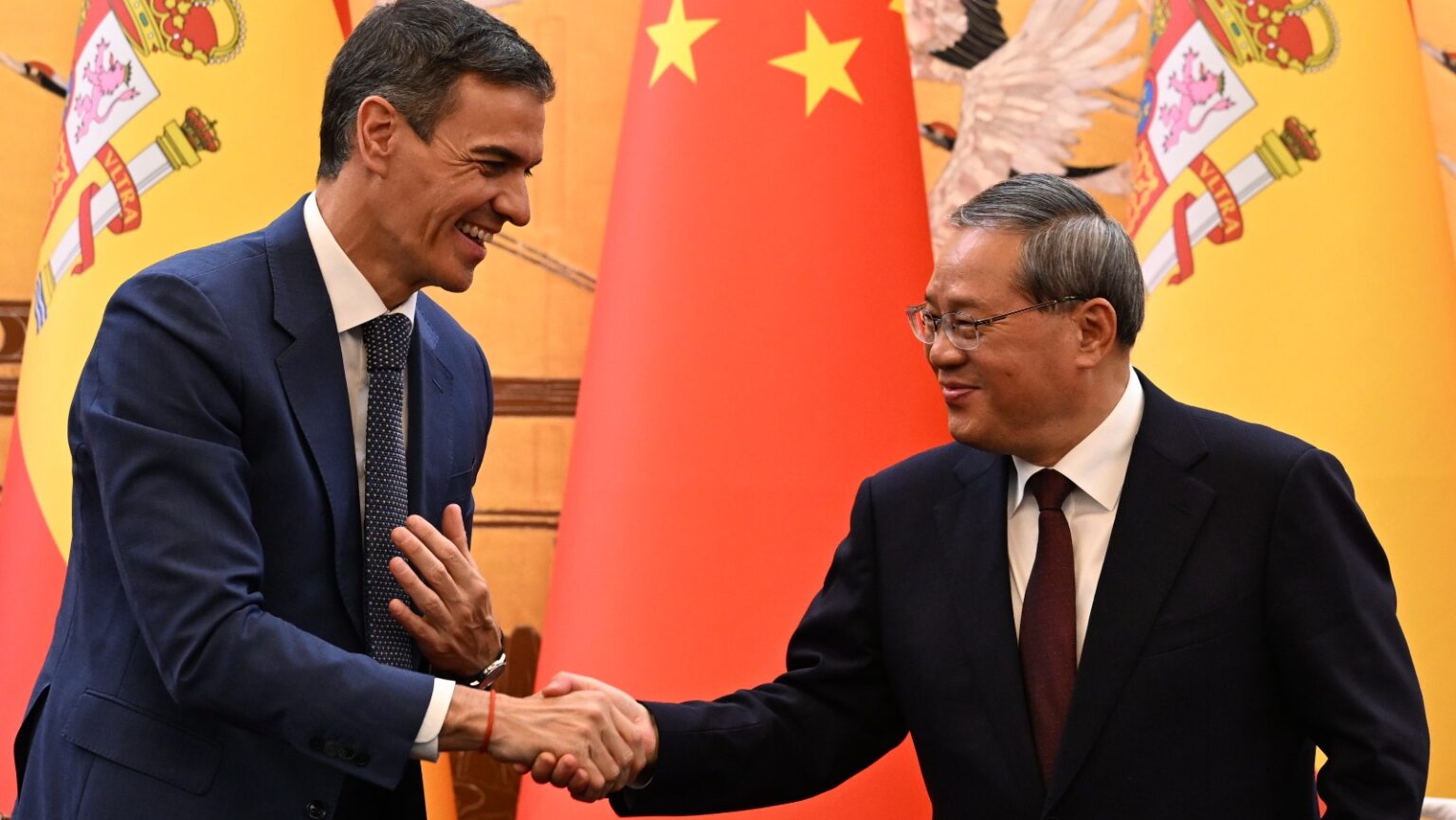
Spanish Prime Minister Pedro Sánchez with Chinese counterpart Li Qiang, April 2026. Source: La Moncloa/X
Spanish Prime Minister Pedro Sánchez completed his fourth visit to China in four years, marked by cooperation agreements and focus on multilateralism and peace.
While European Union officials have largely maintained frosty ties with China, Spanish Prime Minister Pedro Sánchez completed his fourth visit in four years to the Asian country – announcing agreements spanning trade, science, agriculture, food, and other sectors. Between April 11-15, Sánchez met Chinese President Xi Jinping, Prime Minister Li Qiang, and Chairman of the Standing Committee of the National People’s Congress Zhao Leji, signaling an alternative path to other EU member states.
The meetings emphasized cooperation between China and Spain in global affairs, particularly concerning international law and multilateral institutions. “China and Spain are both countries that value principle and justice, and both opt for the right side of history,” Chinese Foreign Ministry Spokesperson Guo Jiakun reported on these exchanges, conveying President Xi’s observations. “The two countries need to jointly uphold true multilateralism, and reject any backslide into the law of the jungle.”
Discussions on multilateralism and diplomacy occurred amid ongoing assaults on several countries in West Asia and Latin America led by the United States and Israel. Throughout these attacks, Chinese and Spanish officials have called for an end to the violence, with the Sánchez administration being the only EU government to stand up to Donald Trump in the early phases of the illegal war he launched on Iran alongside Israeli PM Benjamin Netanyahu.
During a speech at Tsinghua University in Beijing, Sánchez again emphasized the need for countries to work together for peace and counter those who view multilateralism as outdated. “Because a multipolar world without rules leads to rivalry, and rivalry only gives rise to wars, trade conflicts, and ruin,” he stated.
Instead, the Spanish Prime Minister suggested existing institutions, including the United Nations, should be strengthened in a way to provide fairer representation of Global South countries and others outside the West.
“In my opinion, what is happening today is not a shift in hegemony,” he said. “It is a proliferation of poles – not just of power, but also of prosperity. And this is great news for Europe. Because for the first time in contemporary history, progress is taking root simultaneously in many parts of the world – places that do not resemble one another and do not share the same culture. Nor do they share the same political system or the same social conditions. And they don’t need anyone’s permission to grow.”
Unlike many other Western nations, Sánchez stated, Spain embraces this change. “We do so out of realism, out of pragmatism, and, without a doubt, out of a sense of responsibility,” he said. “But I would also like to emphasize that we do so out of hope.”
While adopting a more constructive approach than other European interactions with China, the Spanish Prime Minister’s visit also raised concerns about equitable trade relations, praising recent EU agreements with various countries – agreements that have raised concerns about likely impacts on local economies and rights – and proposed acting as a bridge in discussions to maintain economic cooperation between China and the European bloc.
Matthew Chattle/Future Publishing via Getty Images
The UK’s broken justice system is locking young activists like me away – and we’ll all suffer the consequences
My name’s Ella. I am a fairly average 22-year-old from Birmingham, central England. I have friends, a supportive family, and hopes and dreams for after graduation. I’m also facing up to ten years in prison.
On 5 August last year, I was arrested along with three others on a side street in Gatley, near Manchester, just after 4am. We had been planning to enter Manchester Airport’s airfield – provided it was safe to do so – to block the taxiway by glueing our hands to the tarmac.
We didn’t get near the airport, but I have been held in HMP Styal, a women’s prison just outside Manchester, ever since. I was charged with conspiracy to cause a public nuisance and spent six months in prison awaiting trial. I was found guilty in February and will have served three months by the time I am sentenced at the end of this month.
So what drives a young person like me to take nonviolent action as drastic as this? You may have realised that I am a member of Just Stop Oil. At the time of my arrest, I was carrying boltcutters, glue, a hi-vis jacket, and a banner reading ‘sign the treaty’ in all caps.
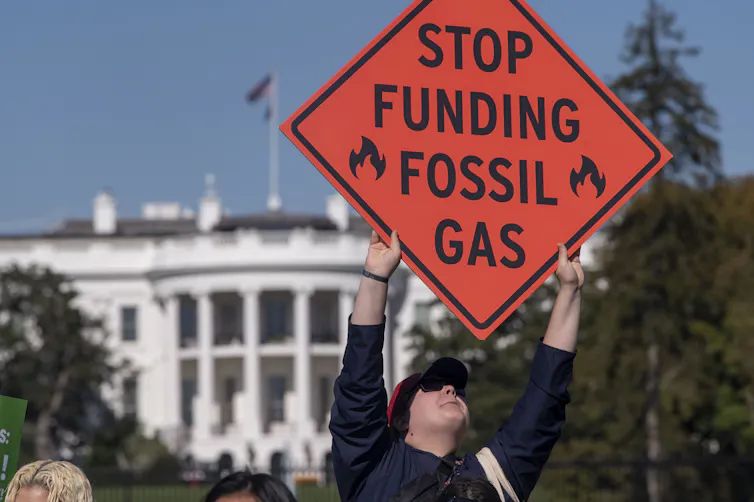
It was the summer of 2024, the hottest year ever recorded. We were trying to send a message to the British government: it must sign the Fossil Fuel Non-Proliferation Treaty and make an immediate plan to transition away from oil, gas and coal to prevent further global heating, climate breakdown, and eventual societal collapse.
We wanted to go to an airport – a symbol of the carbon economy – to make clear that the UK’s ‘business as usual’ approach is sending humanity over a cliff edge into destruction, displacement, and massive loss of life.
Our protest may have seemed drastic, but as I tried to explain to the judge and the jury, it was proportionate to the scale of the crisis we are facing. We all stand to lose everything.
Until my arrest, I was a final-year environmental science student at the University of Leeds. As I told the court, the science is clear: burning and extracting fossil fuels is heating the planet and leading to mass crop failure, with food insecurity and starvation for large parts of the world and drastic price hikes on staples for the rest of us. Crop failure on this scale will kill millions and displace many more. A billion people could be on the move within 25 years. The impacts will be felt everywhere, by everyone.
I spoke about my university lecturers, who are prominent climate scientists and are fearful for their children’s lives. They feel they aren’t being listened to, that the government is implementing policies contrary to science. I said that the knowledge I had gained from studying gave me a responsibility to act.
Court trials like mine are remarkably technical – you must submit a legal defence if you want the judge to allow jurors to consider your motivation, or the context of your actions. I did not have a lawyer and, like my co-defendants, put forward a defence of ‘self-defence’ and ‘necessity’.
I argued that I acted not only to protect the lives of the millions already living on the frontline of climate breakdown, but in defence of myself and young people globally. I told the court how I am afraid for my own future, the future of my brother, my friends, my cousins, and all young people everywhere.
The judge dismissed this, saying the climate crisis does not pose an ‘immediate threat to life’. He told jurors to ignore the context around our actions and focus only on whether we had planned to commit a ‘crime’, saying that anything they’d heard about climate change during the hearing was irrelevant as it was a political or philosophical belief.
But the climate crisis is not a belief, it is science, and science doesn’t care about legal defences, judges’ rulings or prison sentences. It will continue to worsen and take more lives until governments work together to stop burning fossil fuels.
Conservative ministers loudly championed free speech – right up until they outlawed it. Now, we’re all at risk
Over the past six months in prison, this truth has become clearer and clearer. Climate breakdown is no longer something I read about in textbooks, study in lectures, or write about in exams. I’m seeing it through the bars of my cell window.
On New Year’s Day, a state of emergency was declared as Greater Manchester was hit by heavy rains. Over a thousand people were evacuated from flooded homes – HMP Styal’s prison officers among them – their possessions ruined, and huge disruption caused.
The rising waters cut off the roads leading to the prison, causing a staffing crisis that compromised our safety, with no one allowed to leave their wings or houses. The prison’s library and workplaces were flooded, ruining books and leaving some prisoners with no work or activities even after the regime returned to normal.
Such extreme weather is being seen everywhere. On the penultimate day of my hearing, 14 people were killed in floods in the US state of Kentucky, including a seven-year-old girl and her mother, who were washed away in their car. I used my closing speech to tell jurors about this, about how upset it made me. How many people will die before we open our eyes?
The judge ruled it irrelevant.
Having been barred from considering almost everything we’d said, the jury had little choice but to find us guilty. I am grateful to all twelve of them, though, for listening to what we had to say for three weeks and making the only decision they could within the constraints given.
Despite the guilty verdict, being in prison and my impending sentencing, I am at peace. I should have had my whole life ahead of me, and my future now hangs in the balance, but I know that I acted in line with my conscience and moral convictions and, above all, nonviolently: without violence and actively against violence.
Being on trial at a crown court in my early twenties was the scariest thing I’ve ever done. But what choice did I have? At university, I studied the truth, and now I have to act on it.
Orcas discuss Donald Trump and the killer apes’ concept of democracy. Front Orca warns that Trump is crashing his country’s economy and that everything he does he does for the fantastically wealthy.Neo-Fascist Climate Science Denier Donald Trump says Burn, Baby, Burn.Elon Musk urges you to be a Fascist like him, says that you can ignore facts and reality then.
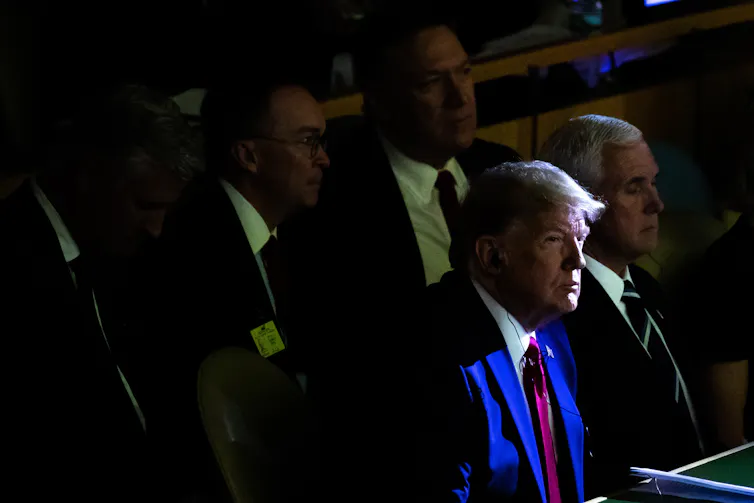
If you care about saving Earth from catastrophe, you might be feeling a little down about the re-election of Donald Trump as United States president. Undeniably, his return to the White House is a real setback for climate action.
But beyond Trump and his circle, there remains deep concern about climate change, especially among younger people. Support for climate policy remains high in the US and around the world. And studies based on data from 60,000 people in more than 60 countries suggest individuals’ concern about climate change is widely underestimated.
So now is a good time to remember that efforts to tackle the climate crisis – both in Australia and globally – are much bigger than one man. Here are ten reasons to remain hopeful.
Beyond Trump and his circle, there remains deep concern about climate change around the world. HAYOUNG JEON/EPA
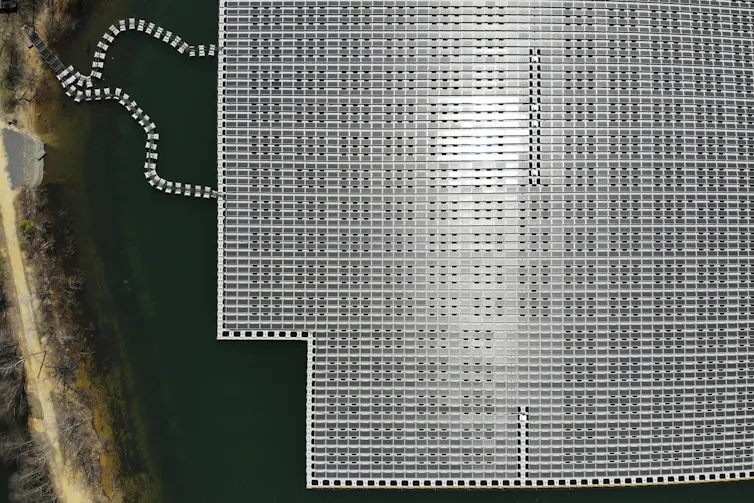
1. The global clean energy transition can’t be halted
4. The federal government is not everything in the US
When Trump was last in power, he withdrew the US from some climate commitments, such as the Paris Agreement. But many state and local governments powered ahead with climate policy, and that will happen this time around, too. For example, California – the world’s fifth largest economy – plans to eliminate its greenhouse gas footprint by 2045. Even Texas, a Republican heartland, is leading a shift toward wind and solar power.
5. The US climate movement will be more energised than ever
During Trump’s first presidency, the US climate movement developed policy proposals for a “Green New Deal”. Many of these proposals were later implemented by the Biden administration. Initial reactions to Trump’s re-election suggest we can expect similar policy advocacy this time around.
Efforts to tackle the climate crisis are much bigger than one man in the White House. Kevin Wolf/AP
6. Global climate cooperation is bigger than Trump
If Trump makes good on his promise to leave the Paris Agreement (again), he will only be leaving the room where the world’s future is being shaped. The US has walked away from global climate agreements before – for example, refusing to join the Kyoto Protocol in 2001. But other nations rallied for global action, and will do so again.
7. The rules-based global order will remain
When a nation walks away from rules that have been agreed after decades of negotiation, responsible countries must work together to bolster global cooperation. This applies to trade and security – and climate is no different.
As our Foreign Minister Penny Wong recently explained, Australia, as a middle power on the world stage, wants:
a world where disputes are resolved by engagement, negotiation and by reference to rules [and] norms […] We don’t want a world in which disputes are resolved by power alone.
8. Australian diplomacy matters
Australia is seeking to co-host the United Nations climate talks with Pacific island countries in 2026, and is emerging as the favourite. Hosting the conference, known as COP31, would be a chance for Australia to help broker a new era of international climate action, even if the US opts out under Trump.
Hosting the talks would also help cement Australia’s place in the Pacific and assist our Pacific neighbours to deal with the climate threat.
Co-hosting COP31 would help assist our Pacific neighbours to deal with the climate threat. Mick Tsikas/AAP
9. Australia’s clean energy shift is accelerating
About 40% of Australia’s main national electricity grid is poweredby renewables and this is set to rise to 80% by 2030. Some states are surging ahead – for example, South Australia is aiming for 100% renewables by 2027.
Australians love clean energy at home, too. One in three households have rooftop solar installed, making us a world-leader in the technology’s uptake. Trump’s occupation of the Oval Office cannot stop this momentum.
10. Trump cannot change the science of climate change
The science is clear – burning coal, oil and gas fuels climate change and increases the risk of disasters that are harming communities right now. In Australia, we need look no further than the Black Summer bushfires in 2019-20 and unprecedented Lismore floods in 2022.
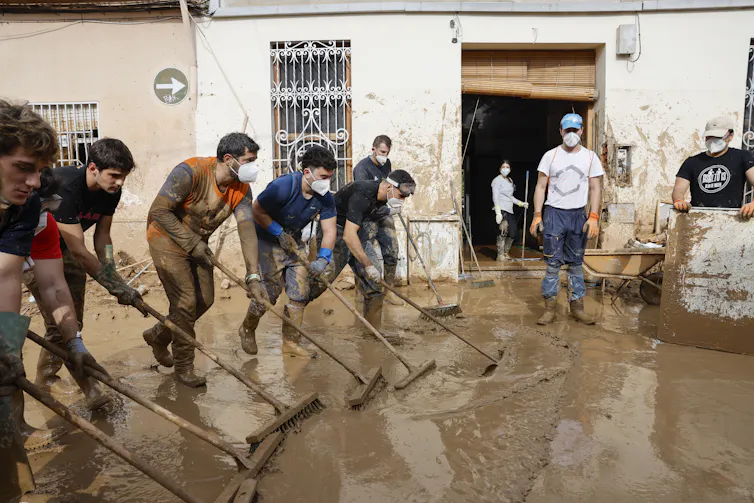
The devastating floods in Spain remind us that climate change has arrived. ANA ESCOBAR/EPA
On gloomy days – like, say, the election of a climate denier to the White House – it might feel humanity won’t rise to Earth’s biggest existential challenge. But there are many reasons for hope. The vast majority of us support policies to tackle climate change, and in many cases, the momentum is virtually unstoppable.
Wesley Morgan, Research Associate, Institute for Climate Risk and Response, UNSW Sydney and Ben Newell, Professor of Cognitive Psychology and Director of the UNSW Institute for Climate Risk and Response, UNSW Sydney
Reassuring report based on long-debunked climate contrarian
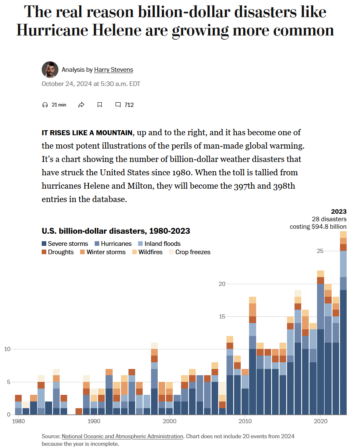
The Washington Post (10/24/24) claims that “the rise in billion-dollar disasters, while alarming, is not so much an indicator of climate change as a reflection of societal growth and risky development.”
As the country begins to vote in an election that will be hugely consequential for the climate crisis, the central task of news outlets’ climate beats should be informing potential voters of those consequences. Instead, the Washington Post‘s “Climate Lab” seems to be working hard to cast doubt on whether climate change is really causing weather disasters to be more expensive.
In a lengthy piece (10/24/24) headlined “The Real Reason Billion-Dollar Disasters Like Hurricane Helene Are Growing More Common,” Post Climate Lab columnist Harry Stevens highlighted a NOAA chart depicting a notable increase in billion-dollar weather disasters hitting the US that he says is widely used by government reports and officials “to help make the case for climate policies.” But, in fact, Stevens tells readers:
The truth lies elsewhere: Over time, migration to hazard-prone areas has increased, putting more people and property in harm’s way. Disasters are more expensive because there is more to destroy.
The takeaway is clear: The (Democratic) government is lying to you about the supposedly devastating impacts of climate change.
Distorting with cherry-picked data
The problem is, it’s Stevens’ story that’s doing the misleading. It relies heavily on the work of one source, Roger Pielke Jr., a longtime climate contrarian beloved by climate denial right-wingers, who cherry-picks data to distort the truth.
What’s worse, from a media critic’s perspective, is that it’s not even a new story; it’s been debunked multiple times over the years. Pielke—a political scientist, not a climate scientist, which Stevens never makes clear—has been promoting this tale since 1998, when he first published a journal article that purported to show that, as Stevens describes, “after adjusting damage to account for the growth in people and property, the trend [of increasing economic costs from weather disasters] disappears.”
A review of Roger Pielke’s book The Climate Fix in the journal Science (11/26/10) accused him of writing “a diatribe against the IPCC and other scientists that is based on highly selective and distorted figures and his own studies.”
When Pielke published the argument in his 2010 book, the journal Science (11/26/10) published a withering response, describing the chapter as “a diatribe against the IPCC and other scientists that is based on highly selective and distorted figures and his own studies.” It detailed the multiple methodological problems with Pielke’s argument:
He makes “corrections” for some things (notably, more people putting themselves in harm’s way) but not others. Some adjustments, such as for hurricane losses for the early 20th century, in which the dollar value goes up several hundred–fold, are highly flawed. But he then uses this record to suggest that the resulting absence of trends in damage costs represents the lack of evidence of a climate component. His record fails to consider all tropical storms and instead focuses only on the rare land-falling ones, which cause highly variable damage depending on where they hit. He completely ignores the benefits from improvements in hurricane warning times, changes in building codes, and other factors that have been important in reducing losses. Nor does he give any consideration to our understanding of the physics of hurricanes and evidence for changes such as the 2005 season, which broke records in so many ways.
Similarly, in discussing floods, Pielke fails to acknowledge that many governing bodies (especially local councils) and government agencies (such as the US Army Corps of Engineers) have tackled the mission of preventing floods by building infrastructure. Thus even though heavy rains have increased disproportionately in many places around the world (thereby increasing the risk of floods), the inundations may have been avoided. In developing countries, however, such flooding has been realized, as seen for instance this year in Pakistan, China and India. Other tenuous claims abound, and Pielke cherry-picks points to fit his arguments.
That year, climate expert Joe Romm (Climate Progress, 2/28/10) called Pielke “the single most disputed and debunked person in the entire realm of people who publish regularly on disasters and climate change.”
Debunked a decade ago
In response to Pielke, climate scientist Kerry Emanuel (538, 3/31/14) pointed out that it’s not necessarily appropriate to normalize damages by gross domestic product (GDP) if the intent is to detect an underlying climate trend,” since “GDP increase does not translate in any obvious way to damage increase,” as “wealthier countries can better afford to build stronger structures and to protect assets.”
Pielke peddled the story in 538 (3/19/14) four years later—and lost his briefly held job as a contributor for it, after the scientific community spokeoutagainst it in droves, as not being supported by the evidence.
The backlash led 538 to give MIT climate scientist Kerry Emanuel (3/31/14) a column to rebut Pielke, in which she explained that while it’s of course true that “changing demographics” have impacted the economic costs of weather disasters, Pielke’s data didn’t support his assertion “that climate change has played no role in the observed increase in damages.” She pointed to the same kinds of methodological flaws that Science did, noting that her own research with Yale economist Robert Mendelsohn projected that through the year 2100, “global hurricane damage will about double owing to demographic trends, and double again because of climate change.”
That all happened ten years ago. So why is Pielke’s same old ax-grinding getting a platform at the Washington Post shortly before Election Day?
Stevens does tell readers—quite far down in the article—that Pielke has “clashed with other scientists, journalists and government officials” over his research—though Stevens doesn’t give any details about those clashes, or about Pielke’s reputation among climate scientists more generally.
Stevens also briefly notes that Pielke was recently hired by the American Enterprise Institute, which Stevens characterizes as “center-right,” but more helpfully might have characterized as “taking millions from ExxonMobil since 1998.” But in the same paragraph, Stevens also takes pains to point out that Pielke says he’s planning to vote for Harris, as if to burnish Pielke’s climate-believer bonafides.
Pielke agrees with Pielke
Roger Pielke “agrees with studies that agree with Pielke” (Environmental Hazards, 10/12/20).
Stevens tells Post readers that the science is firmly on Pielke’s side:
Similar studies have failed to find global warming’s fingerprint in economic damage from hurricanes, floods, tornadoes and crop losses. Of 53 peer-reviewed studies that assess economic damage from weather events, 52 could not attribute damage trends to global warming, according to Pielke’s 2020 review of the literature, the most recent and comprehensive.
You’ll notice Stevens just used Pielke’s own review to bolster Pielke’s argument. But the journal that published that review (Environmental Hazards, 8/5/20) immediately followed up with the publication of a critique (10/12/20) from researchers who came to the opposite conclusion in their study on US hurricanes. They explained that there are “fundamental shortcomings in this literature,” which comes from a disaster research “field that is currently dominated by a small group of authors” who mostly use the same methodology—adjusting historical economic losses based strictly on “growth in wealth and population”—that Pielke does.
The authors, who wrote a study that actually accounted for this problem and did find that economic losses from hurricanes increased over time after accounting for increases in wealth and population, point out that Pielke dismissed their study and two others that didn’t agree with his own results essentially because they didn’t come to the same conclusions. As the authors of the critique write drily: “Pielke agrees with studies that agree with Pielke.”
A phony ‘consensus’
Stevens includes in his article an obligatory line that experts say
disputing whether global warming’s influence can be found in the disaster data is not the same as questioning whether climate change is real or whether society should switch from fossil fuels.
He also adds that
many scientists say that global warming has intensified hurricanes, wildfires, droughts and other extreme weather, which must be leading to greater economic losses.
Note that he frames it as only “many,” and suggests they are only using (faulty, simplistic) logic, not science. But of course, climate change is intensifying extreme weather, as even Stevens has reported as fact recently (in the link he provides in that passage). In contrast, Stevens writes that
the consensus among disaster researchers is that the rise in billion-dollar disasters, while alarming, is not so much an indicator of climate change as a reflection of societal growth and risky development.
But in fact, as mentioned above, there’s not consensus even among disaster researchers (who are primarily economists). And the “many scientists” who disagree with Pielke aren’t the scientists the Post chooses to focus on. While Stevens quotes a number of different experts, including some who disagree with Pielke, they are not given anywhere near the space—or credence—Pielke and his arguments are. (Pielke’s name appears 15 times across the article and its captions.)
When he does get around to quoting some of the scientists, like MIT’s Emanuel, whose research shows that extreme weather events are intensifying, Stevens presents the conflicting conclusions as a back-and-forth of claims and counterclaims, giving the last word in that debate to a disaster researcher whose goal is to refocus blame for disasters on political decisions—like supporting building in vulnerable locations—rather than climate change.
Changes in our built environment, and governments’ impact on those changes, are certainly an important subject when it comes to accounting for and preventing billion-dollar disasters—which virtually no one disputes. (Indeed, the four government reports Stevens links to in his second paragraph as supposedly misusing the NOAA data explicitly name some variation of “increased building and population growth” as a contributing factor to growing costs.) It’s simply not an either/or question, as the Post‘s teaser framed it: “Many blame global warming. Others say disasters are more expensive because there is more to destroy.” So it’s bizarre and frankly dangerous that ten years after climate scientists debunked Pielke’s claim that there’s no evidence climate change is increasing extreme weather costs, Stevens would take, as the “urgent” question of the moment, “Is global warming to blame” for the growing billion-dollar disaster tally?
By giving the impression that the whole thing is basically a government scam to justify climate policies, Stevens’ direct implication is that even if climate change is indisputable, it doesn’t really matter. And it feeds into climate deniers’ claims that the climate change-believing government is lying about climate change and its impacts, at a time when a large number of those deniers are seeking office.
The paper is expected to reignite criticism of the UK’s Conservative government, which has promised hundreds of oil and gas exploration licenses to boost the North Sea industry. Photograph: Russ Bishop/Alamy
Researchers say world has enough fossil fuel projects planned to meet demand forecasts to 2050 if net zero is reached
The world has enough fossil fuel projects planned to meet global energy demand forecasts to 2050 and governments should stop issuing new oil, gas and coal licences, according to a large study aimed at political leaders.
If governments deliver the changes promised in order to keep the world from breaching its climate targets no new fossil fuel projects will be needed, researchers at University College London and the International Institute for Sustainable Development (IISD) said on Thursday.
The data offered what they said was “a rigorous scientific basis” for global governments to ban new fossil fuel projects and begin a managed decline of the fossil fuel industry, while encouraging investment in clean energy alternatives.
By establishing a “clear and immediate demand” political leaders would be able to set a new norm around the future of fossil fuels, against which the industry could be held “immediately accountable”, the researchers said.
Published in the journal Science, the paper analysed global energy demand forecasts for oil and gas, as well as coal- and gas-fired electricity, using a broad range of scenarios compiled for the UN Intergovernmental Panel on Climate Change that limited global heating to within 1.5C above pre-industrial levels.
It found that in addition to not needing new fossil fuel extraction, no new coal- and gas-fired power generation was needed in a net zero future.
The paper is expected to reignite criticism of the UK’s Conservative government, which has promised to offer hundreds of oil and gas exploration licenses to boost the North Sea industry, a policy that has emerged as a key dividing line with the opposition Labour party before the 4 July general election.
Labour has vowed to put an end to new North Sea licences if it comes to power, and also plans to increase taxes on the profits made by existing oil and gas fields to help fund investments in green energy projects through a new government-owned company, Great British Energy.