As reported by the New York Times, the court has agreed to hear arguments related to a petition filed by ExxonMobil and Canadian energy firm Suncor related to a 2018 lawsuit by the city of Boulder, Colorado that seeks financial damages from the companies for their role in causing global climate change.
The Times report noted that dozens of similar lawsuits have been filed by states and municipalities over the last decade, and they generally seek money from energy firms to help mitigate or repair damage done by extreme weather exacerbated by the climate crisis.
According to the Associated Press, attorneys for the energy companies are petitioning to have the case moved from state courts to federal courts that have in the past dismissed similar complaints.
“The use of state law to address global climate change represents a serious threat to one of our nation’s most critical sectors,” the attorneys claimed.
The Supreme Court’s decision to hear the case comes months after the Colorado Supreme Court ruled that Boulder’s lawsuit could initiate the discovery process and move toward a trial.
In an interview with the Colorado Sun, Boulder County Commissioner Ashley Stolzmann said that the city wasn’t backing down from its efforts make the fossil fuel industry pay for the damage it’s done.
“The oil companies have tried every avenue to delay our climate accountability case or move it to an out-of-state court system,” said Stolzmann. “As everyone continues to face rising costs that put budgets under pressure, we must hold oil companies accountable for the significant harm they’ve caused our communities.”
Richard Wiles, president of the Center for Climate Integrity, said that the merits of the Boulder lawsuit are clear, regardless of the Supreme Court’s intervention.
“Big Oil’s climate lies are the most consequential and harmful corporate deception campaign in history,” Wiles said, “and the communities paying the price for that deception deserve to put these companies on trial. Exxon’s desperation to escape accountability does not change the evidence of their wrongdoing or the law that lower courts agree is on Boulder’s side.”
Alyssa Johl, vice president of legal and general counsel at the Center for Climate Integrity, said the Supreme Court should simply affirm lower court rulings stating that “communities like Boulder have the right to seek accountability in their state courts when corporations have knowingly caused local harms.”
Donald Fuhrump says that Amerikkka doesn’t bother with crimes or charges anymore, not being 100% Amerikkkan and opposing his real estate intentions is enough.Orcas discuss Donald Trump and the killer apes’ concept of democracy. Front Orca warns that Trump is crashing his country’s economy and that everything he does he does for the fantastically wealthy.Elon Musk urges you to be a Fascist like him, says that you can ignore facts and reality then.
Federal subsidies to the oil and gas sector totalled $74.6 billion over five years, Environmental Defence found. Credit: David Niddrie / Flickr (CC BY NC 2.0)
Amid trade war talk of expanding Canadian energy infrastructure, a new report reveals that direct Canadian subsidies to the fossil fuel and petrochemical sectors reached nearly $30 billion in 2024.
For comparison’s sake, Canada spent between $38 billion and $39 billion on defense in 2024.
“Oil and gas companies – emboldened by their influence over President Trump – are exploiting the current economic uncertainty to call on governments to double down on fossil fuels,” Julia Levin, associate director of national climate with nonprofit group Environmental Defence, which put out the report, said in a statement.
Levin notes that oil and gas companies have been vocal in their demand that politicians work to expand pipelines and related projects, and seek new export markets for Canadian fossil fuels. Meanwhile, Canadian taxpayers, who fund the companies’ subsidies, face the expensive consequences of climate change and related disasters.
In recent weeks, the chief executives of Canada’s major oil and gas companies — including Suncor, Cenovus, Enbridge, and Imperial — signed an open letter to the leaders of four of Canada’s major political parties. In it, they demand federal party leaders to eliminate regulations, emissions caps, tanker bans on the West Coast, and carbon levees on major emitters.
The open letter was endorsed by prominent Canadian conservatives, including Conservative Party leader Pierre Poilievre. Alberta Premier Danielle Smith recently repeated many of the same industry talking points in defending her taxpayer-funded trip to attend a controversial PragerU fundraiser where she shared a stage with far-right influencer Ben Shapiro.
Last month, Liberal leader Mark Carney indicated his interest in building new east-west pipelines, ostensibly to reduce dependence on foreign imports and develop new trade opportunities.
“This push ignores the fact that fossil fuels come at a high price — not just at the pump, but through rising costs of groceries, worsening health outcomes, damage to property and huge government handouts,” said Levin in the statement.
“It also ignores the rapid energy transition towards renewable energy that is happening globally.”
Among Environmental Defence’s principal findings is that the Canadian government spent $29.6 billion on the fossil fuel sector in 2024, which is nearly $6 billion more than what it would cost to build interprovincial grid connection infrastructure. Recent research from the International Institute for Sustainable Development suggests that a national electrical grid could lower electricity costs nationwide, create hundreds of thousands of new clean tech jobs, stabilize electricity costs, improve Canadians’ health, and provide Canada with the energy security currently threatened by the Trump trade war.
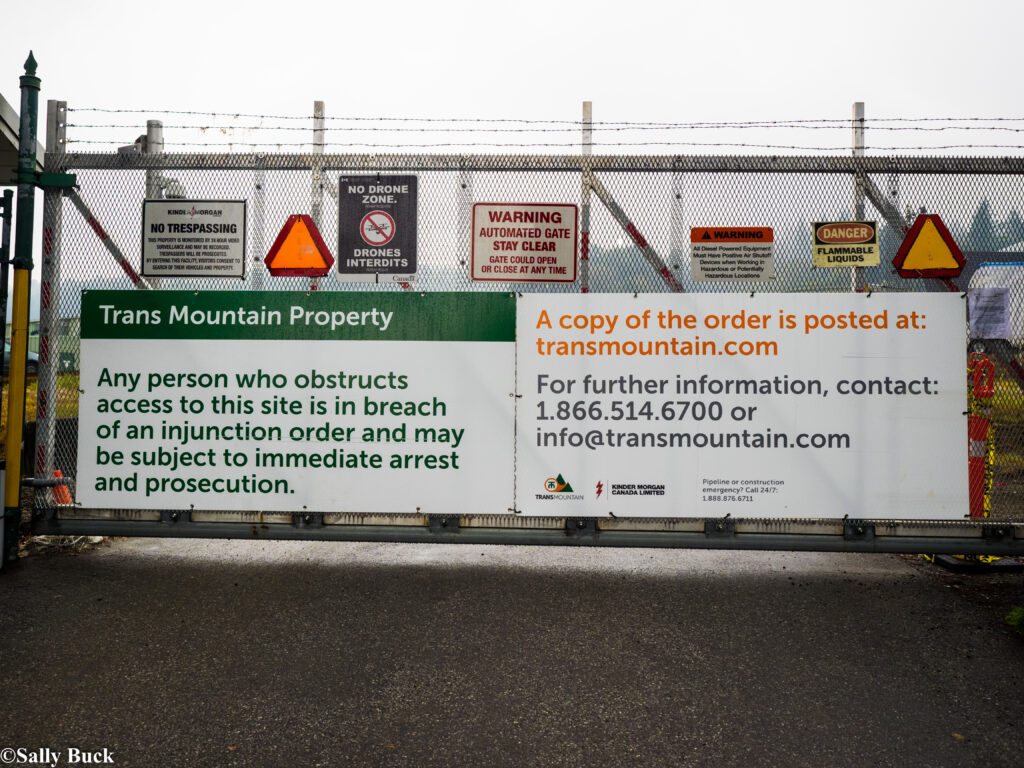
The Trans Mountain project has received $21 billion in government financing. Credit: Sally T. Buck / Flickr (CC BC NC ND 2.0)
Canada’s direct subsidies includes approximately $21 billion in financing for the Trans Mountain Pipeline, $7.5 billion from Export Development Canada (which included money for LNG and carbon capture, and financing for Canadian companies and companies and governments seeking to buy Canadian products), and another $700 million for LNG infrastructure.
Big Oil regularly promotes LNG and carbon capture as potential solutions for the climate crisis, though these arguments have been thoroughly debunked. LNG advocates in Canada often characterize it as a “bridge fuel” that could be used to help developing nations transition away from coal. Recent research indicates that the world’s two largest coal users — India and China — are in fact transitioning directly to renewable energy systems like solar and wind.
Moreover, LNG is a deadly fossil fuel that also happens to be resource intensive to produce, and often results in large volumes of methane emissions. Methane is estimated to be 80 times more potent a greenhouse gas than carbon dioxide. As for carbon capture, recent research from the Institute for Energy Economics and Financial Analysis poured cold water on Canada’s premier industry-driven carbon capture project — Pathways Alliance — determining that it is not financially viable and is unlikely to provide any environmental benefit. This determination is consistent with expert analyses of other carbon capture projects, both in Canada and globally.
Canada Has Given Away $74.6 Billion in Subsidies
Environmental Defence estimates Canada spent $2.4 billion on carbon capture projects in 2024, more than in previous years.
The group’s report also determined that federal subsidies to the oil and gas sector over the last five years amounted to $74.6 billion. Their analysis of what constitutes federal fossil fuel funding includes direct grants, tax breaks, loans, and loan guarantees from the government of Canada and some federal agencies (such as Export Development Canada).
Despite oil industry claims that fossil fuel companies are investing in climate solutions (claims that have led the federal government to introduce anti-greenwashing legislation), Environmental Defence found that none of Canada’s four largest industry companies reported investments in climate initiatives or emissions reductions as part of their capital spending.
The report has also reveals that pollution created by oil and gas companies reached an estimated $53 billion in 2024. This includes increased health costs, property damage from extreme weather events, as well as decreased agricultural productivity, a consequence of changing weather patterns.
“The calls for a new oil pipeline pose real risks to Canadian taxpayers,” said Levin in an email to DeSmog, noting not only that global demand for oil is set to peak in the next four years and then significantly decline, but that oil demand is already showing signs of plateauing in major energy markets like China.
“No company is willing to bet its own money on what is guaranteed to quickly become a massive stranded asset,” said Levin. “Instead, oil and gas companies want taxpayers to pay the price for new fossil fuel infrastructure as their wealthy shareholders reap the rewards.”
Levin is particularly critical of the under reported fact that federal subsidies to the fossil fuel sector have deepened Canada’s economic vulnerability.
“The Canadian public is already on the hook for the new Trans Mountain Pipeline — to the tune of somewhere around $30 to $40 billion and rising. And the project has done nothing to reduce our dependence on the United States, with nearly half its oil still flowing south of the border,” she said.
Business leader says government tax credit for oil and gas ‘extends the life of Canada’s largest industrial sector.’
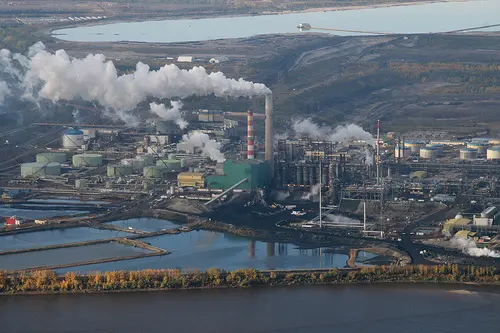
The government of Alberta, home to the tar sands pictured here, has announced taxpayer funding in the range of $3.5 billion to $5.3 billion for CCS projects. Credit: (CC BY-NC-ND 2.0)
As world leaders meet in Dubai for the COP28 climate negotiations, federal and provincial governments in Canada are preparing to give an estimated $15.3 billion in new subsidies to oil and gas companies, and other heavy emitters, for expanding the production of fossil fuels, according to climate experts.
Those subsidies are taking the form of massive new tax credits for carbon capture and storage (CCS), which is a technology that companies use to grow their extraction of oil and gas while burying a fraction of their greenhouse gas emissions underground.
“I completely agree that Canada’s tax credit for carbon capture and storage is a subsidy to the oil and gas industry,” Jason MacLean, an adjunct professor who studies climate policy at the University of Saskatchewan, told DeSmog in an email.
The federal Canadian government is close to announcing details on a tax credit that will go to top oil and gas companies like Suncor, Cenovus, and Imperial Oil, along with other major industrial polluters. Policymakers previously estimated the value of these investment tax credits to be $10 billion. The government of Alberta, home to the tar sands, has meanwhile announced taxpayer funding in the range of $3.5 billion to $5.3 billion for CCS projects.
The Pathways Alliance, an industry lobbying and marketing group representing 95 percent of tar sands production, says these tax credits are essential for oil and gas producers to lower their emissions in line with achieving “net-zero emissions” by 2050. Reaching “net-zero” entails stabilizing global temperature rise at 1.5 degrees Celsius, a level beyond which scientists warn the impacts to humankind could be catastrophic.
Yet, in submissions to the federal government, the Pathways Alliance explained that lowering a portion of oil sands emissions via carbon capture will create opportunities for the industry to expand globally — even as other countries move away from fossil fuels. “We believe Canada should seek to increase its market share for responsibly produced, lower emissions energy, even if global market demand, as a whole, begins to decline,” the group said in one submission.
“We need to keep in mind that this is about reducing emissions and not reducing production,” the organization said last year in a separate submission, as revealed by DeSmog.
Representatives of the Pathways Alliance are among the 35 people with ties to the fossil fuel sector who are part of Canada’s official delegation to COP28 this year. At the climate talks, they are pushing for policies supporting global deployment of carbon capture, which will allow companies to keep producing oil as countries get stricter about regulating emissions.
“It is really important for the energy industry in Canada because it extends the life of Canada’s largest industrial sector and maintains our competitiveness over the long term,” Scott Crockatt of the Business Council of Alberta told the Calgary Herald last month.
However, tax credits supporting carbon capture risk accelerating already dangerous levels of global temperature rise, MacLean argues. Even if the technology can fully capture emissions from the production of oil and gas in Canada — which is an expensive and uncertain proposition — the vast majority of climate impacts occur when fossil fuels are burned in places like car and truck engines and house furnaces.
“No possible innovation or improvement to [carbon capture technology] can change the fact that it applies only to the direct and upstream greenhouse gas emissions arising from the production of oil and gas, not the downstream emissions resulting from the combustion of oil and gas, which represent approximately 85 percent of the total emissions,” MacLean told DeSmog.
Allowing oil and gas to expand while relying on carbon capture could result in the release of 86 billion additional tonnes of greenhouse gas emissions worldwide between 2020 and 2050, according to a new analysis from the organization Climate Analytics. This “86 billion tonne carbon bomb” could derail efforts to keep global warming from exceeding dangerous thresholds, the group argues.
The Canadian government earlier this year unveiled detailed plans to remove “inefficient” oil and gas subsidies, with Environment and Climate Minister Steven Guilbeault saying at the time that “the simple reality is that it’s no longer free to pollute in Canada.”
But climate campaigners say that promise risks being completely undermined by the new carbon capture tax credits.