Independent Exclusive: Energy minister Miatta Fahnbulleh confirmed her department has assessed the impact the policy change will have on pensioners living in fuel poverty, but said only that it will be published ‘in due course’
The government has assessed the number of people who will be pushed into fuel poverty by its winter fuel payment cuts, but will not publish the figures until after MPs vote on the measure, The Independent can reveal.
But, asked by Mr McDonnell and The Independent, the Department for Energy Security and Net Zero refused to say when the document would be published, only promising that it would be “in due course”.
Her answer suggests that while the department has carried out the analysis, it will not be published until after MPs have voted on the measure. Mr McDonnell said “it is no way to implement policy” and he is “fearful of the impact on those who will be put at serious risk”.
The left-wing MP told Lewis Goodall on LBC that he will not vote for the changes if there is no adjustment before they are put before Parliament.
Mr McDonnell said: “I will vote against it. We’ve had 14 years of austerity I don’t think my community can cope with it anymore.
“My fear is, as a result of this, there will be more deaths.”
On the policy, Mr McDonnell added: “It’s the wrong route to go down – it will disillusion people. This is not what a Labour government should be doing I’m afraid.
“My fear is there may be other austerity measures coming down the track”.
Take the Labour Government’s decision to means-test winter fuel payments. Over nine million pensioners, including many on just £12,000 a year, will lose help as we head into the cold months. Some will be forced to turn down the heating. Cold homes are linked to higher rates of strokes, heart attacks and respiratory diseases, so this policy could have fatal consequences.
That harm is entirely avoidable. These are not “tough choices” for politicians, but for those forced to choose between heating their homes and eating. Maintaining universal winter fuel payments costs £1.4 billion. Meanwhile, a modest two per cent wealth tax on assets over £10 million could raise £24 billion, more than enough to fund winter fuel payments, scrap the two-child benefit cap and support public sector workers whose wages have stagnated for over a decade.
The false narrative that resources are too limited to support both the elderly and the young pits us against each other. Within a few weeks in office, the new Labour Government has already denied help to all children with more than one sibling, and now to older people too. The Prime Minister talks about growth, but the only thing that is growing so far is avoidable poverty. No child should be born into poverty due to an arbitrary limit on family support, just as no pensioner should freeze because of arbitrary means-testing. There is still time to change course and not go ahead with this.
Introducing a wealth tax would indicate this is a progressive government. But that seems unlikely
Taking as his theme the need to “fix the foundations” after “14 years of rot” under Tory rule, new Labour prime minister Keir Starmer this week delivered a message that should bring discomfort to everyone in the months and perhaps years to come.
Those “14 years of rot” are of no surprise to voters; indeed, they helped ensure a landslide Labour victory in the election in July. But Starmer’s plans to resolve them appear likely to be far harsher than many voters expected.
The chancellor of the Exchequer, Rachel Reeve, has made numerous hints that hard times are ahead. Her October budget will be uncompromising in its commitment to raising revenue to help fill a fiscal hole reckoned to be around £20bn – but much of this money seems likely to be taken from the poorer sections of society, not the rich.
Labour will retain unpopular policies introduced by the Conservatives – the ‘bedroom tax’ and limiting child benefit allowances to the first two children, for example – while introducing its own cost-cutting measures, such as reducing the winter fuel allowances for many pensioners.
These actions contribute to a growing sense that the Starmer government will prove to be decidedly right-of-centre in a country beset with deep divisions of wealth and poverty. Some areas may see an improvement, such as labour rights, but even there, it is a matter of the devil in the detail.
One area where the government does apparently have cash to spash, though, is military spending, which is set to be substantially increased despite the manifest failures in Afghanistan, Iraq and Libya, and the deeply unpopular Israeli wars on Gaza and the West Bank.
Labour’s attitude to Israel is certainly unlikely to change, with the Department for Business and Trade reporting on efforts to strike a new trade deal with the country, saying: “Our teams will be entering negotiating rooms as soon as possible, laser-focused on creating new opportunities for UK firms.” An official from the British Embassy in Israel also recently wrote of the “tremendous opportunity for collaboration between Israeli and British companies”.
A full-scale Strategic Defence Review is also underway, and there are few if any indications that it will start by addressing the grievous failures of the past two decades. If previous experience is anything to go by, it will likely also omit the main challenge to international security: climate breakdown. Without that, the review will not be worth the paper it is written on. Net zero secretary Ed Miliband may be doing his best to maintain the idea of a green transition but the issue would be sidelined by any major increase in government spending.
On the domestic front, less than two months into the new Labour government the contrast between Food Bank Britain and the ludicrous levels of runaway wealth is apparent. It was coincidentally yet powerfully illustrated just four days before Starmer’s pre-budget speech, by a full-page property advertisement from Sotheby’s in the Financial Times.
Of the seven properties on sale, one was a relatively modest three-bedroom apartment in Chelsea, on sale for a mere £5m, while the others included a six-bedroom house in Belgravia offered at £18m and a nine-bedroom/five-bathroom place near Regent’s Park for £20m. Another Regent’s Park number was on sale for £25m million, which at least had 7 bathrooms for the 6 bedrooms. Trumping all was a triplex number in Knightsbridge – £50m with exclusive access to Hans Place Gardens.
While we have to wait for the October budget announcements, we can be reasonably sure that there will be some attempts to raise modest amounts from the wealthier sectors of society, possibly involving changes in capital gains and inheritance taxes. But the best indicator of a changed government would be one willing to bring in wealth taxes, especially those directed at the super-rich.
Onee of Britain’s largest trade unions, Unite, recently proposed a 1% per annum tax on those with net assets of over £4m, which would include property, shares and bank holdings but not mortgaged property. That is estimated to yield £25bn a year but would be bitterly opposed, with the Daily Mail informing us that: “Millionaires are looking to flee the UK in their droves to escape Labour’s tax raids – with a record number of wealthy Britons tipped to leave the country this year.”
As things stand, the budget is expected to include substantial cuts in public spending that could be at least partly avoided by such a wealth tax, and it is worth noting that some European countries such as Switzerland and Spain have already introduced them. At least Britain’s wealthy won’t be fleeing “in their droves” to those countries.
If adopted in October, in even a modest form, a wealth tax would be a reasonable marker for a progressive government. If not, then an opportunity will be missed for placing Labour in a more progressive place in the political spectrum than currently seems at all likely.
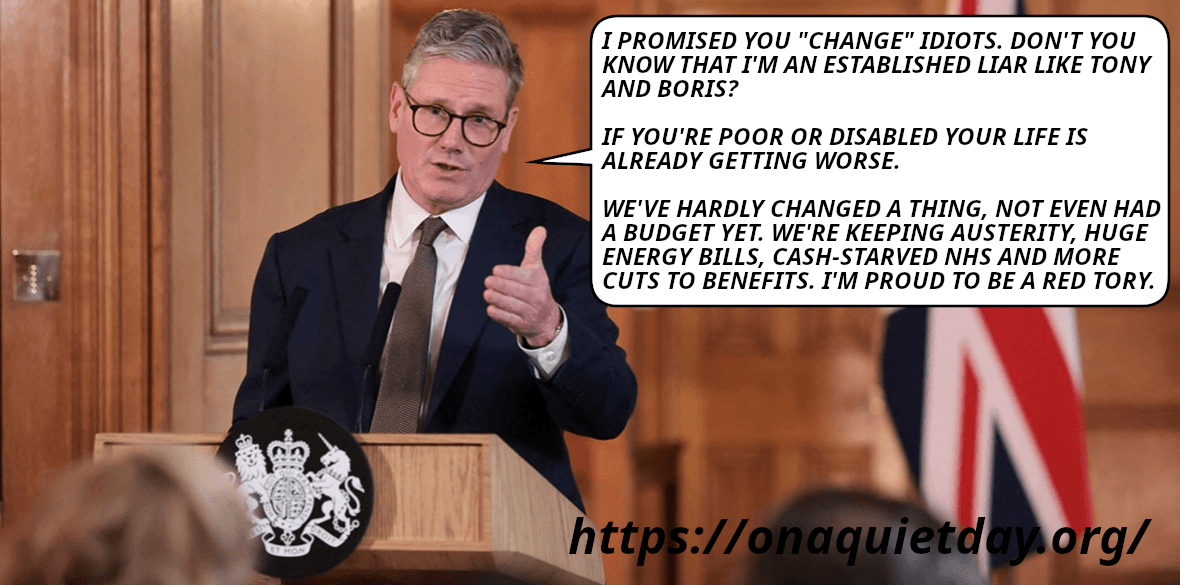
Keir Starmer confirms that he is continuing Tory policies and that he’s proud to be a red Tory.Keir Starmer says pensioners can freeze to death and poor children can starve and be condemned to failure and misery all their lives.