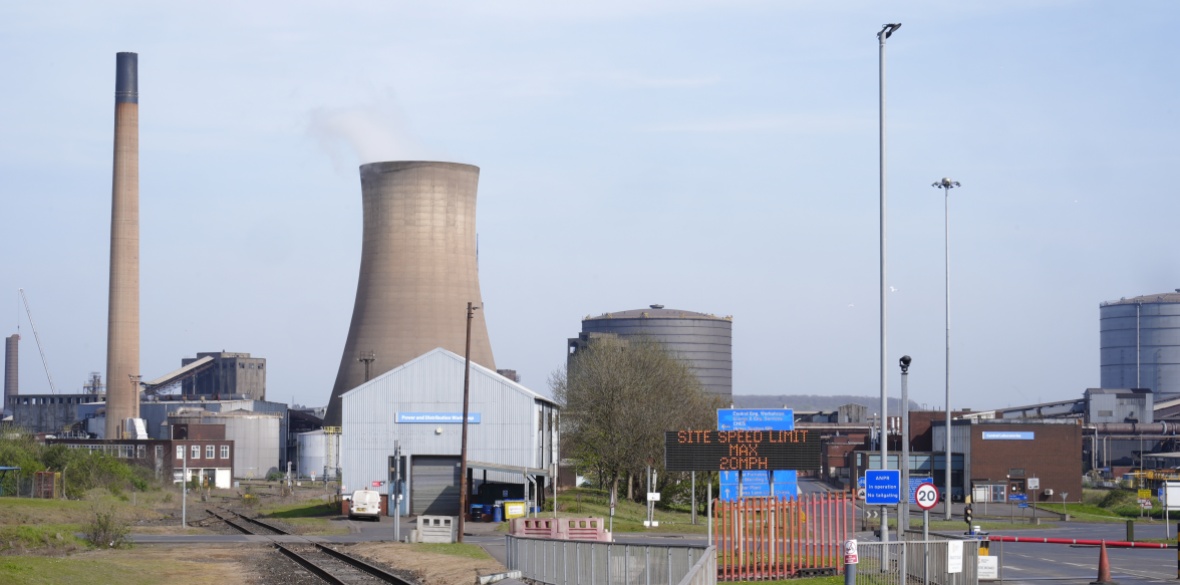
Campaigners demand full nationalisation of British Steel after government seizes control of Scunthorpe plant

Spread the love

https://morningstaronline.co.uk/article/campaigners-demand-full-nationalisation-british-steel-after-government-seizes-control

A general view of British Steel in Scunthorpe, Lincolnshire, April 12, 2025

LABOUR has been urged to catch up with public support for nationalising services “just as strategically important” as British Steel.

Campaigners and unions have continued to call for the full nationalisation of the company after the government passed an emergency law on Saturday to seize control of its Scunthorpe plant.

The legislation was passed in a single day, empowering ministers to save the last plant making “virgin steel” direct from raw materials from imminent closure, as well as thousands of jobs.

But Labour’s action was likened to an expensive public bailout today amid growing calls for the government to stop the private sector from running other services into the ground.

We Own It founder and director Cat Hobbs said: “The government has sprung into action to protect British Steel as a strategically important industry, with nationalisation on the table.

“In 2020, Keir Starmer promised public ownership of rail, mail, energy and water — as well as ending outsourcing in our NHS and local government.

“These public services are just as strategically important as steel, as drivers of economic and social development.

“Since Thatcher’s sell off, many of our key public services have been handed over to foreign states, offshore funds and billionaires.

“If Starmer is looking to take back control of our economy, this would be a good place to start.

“The UK public overwhelmingly supports public ownership and it’s high time our government caught up.”

Article continues at https://morningstaronline.co.uk/article/campaigners-demand-full-nationalisation-british-steel-after-government-seizes-control

Continue ReadingCampaigners demand full nationalisation of British Steel after government seizes control of Scunthorpe plant

Labour’s rush to Thatcherism: what’s going on?

Spread the love

https://morningstaronline.co.uk/article/labours-rush-thatcherism-whats-going

Chancellor of the Exchequer Rachel Reeves during a visit to Premier Modular in Driffield, Humberside, January 30, 2025

SOLOMON HUGHES examines how Labour has gone from blaming Tory deregulation for our economic woes to betting the nation’s future on more of it

WHEN Keir Starmer finally got his prime ministerial phone call with President Trump on Sunday, according to Number 10 the two “discussed trade and the economy, with the Prime Minister setting out how we are deregulating to boost growth.”

Which is odd, because the word “deregulation” isn’t in the Labour manifesto. In fact, before the election Business Secretary Jonathan Reynolds argued deregulation was a Tory sin that didn’t bring growth.

Starmer was telling Trump the truth — Labour are pressing regulators to let business do what it wants in the desperate hope they will get some “growth” to drag up their low polling. But why does Keir tell Trump the truth before British voters?

Perhaps aware that they had stumbled into openly admitting they are a “deregulation” government, despite previous promises, Starmer finally decided to lay this out by writing in The Times, making a Tory argument in the Tory press.

In his Times article Starmer admitted: “This may seem like an unusual goal for Labour politicians. But deregulation is now essential for realising Labour ambitions in this era.”

He referred admiringly to Thatcher’s deregulation and launched into purple prose about the need to hack at “thickets of red tape” to “clear out the regulatory weeds and allow a new era of British growth to bloom” and “curb regulator overreach.”

https://morningstaronline.co.uk/article/labours-rush-thatcherism-whats-going

Keir Starmer, Angela Rayner and Rachel Reeves wear the uniform of the rich and powerful. They have all had clothes bought for them by multi-millionaire Labour donor Lord Alli. CORRECTION: It appears that Rachel Reeves clothing was provided by Juliet Rosenfeld.
Continue ReadingLabour’s rush to Thatcherism: what’s going on?

Morning Star: The Tories have wrecked the NHS – but that doesn’t mean Labour will rescue it

Spread the love

https://morningstaronline.co.uk/article/tories-have-wrecked-nhs-doesnt-mean-labour-will-rescue-it

The NHS overtook the economy as voters’ biggest concern in February, according to polling by Ipsos. Small wonder when waiting lists have hit 7.5 million: there can hardly be a person in the country who doesn’t have a friend or relative who has been affected.

And the Conservatives bear a heavy responsibility.

In the decade up to the pandemic, real-terms healthcare spending per head rose on average by just 0.4 per cent a year — in four years it actually fell, despite rising pressures on the service.

That compares very poorly to the record of the last Labour government, which raised spending by 5.7 per cent a year on average from 1997-2010. It even compares badly to that of the Thatcher and Major Conservative governments, which averaged a 2.1 per cent annual increase.

But we should be more cautious than Poulter about endorsing Keir Starmer’s solution.

Starmer and shadow health secretary Wes Streeting have pointedly refused to offer the increases in NHS budgets that the Tony Blair and Gordon Brown governments delivered. Streeting is emphatic that he will not “pour money into a 20th-century model,” instead demanding reforms which, in increasing reliance on the private sector, both mimic existing Conservative policy and are unlikely to make a difference to waiting lists (because private healthcare in Britain recruits from the NHS, so overall capacity will not grow).

Britain’s public services are collapsing under the strain of decades of neoliberal policy. In the NHS, hospitals have been undermined through outsourcing services to the private sector as well as by the cost of PFI debt — both issues with their origins in the Blair years.

To restore our NHS to health, we need a reversal of privatisation and outsourcing and a forced end to all PFI contracts, as well as a significant increase in overall funding to bring us closer to healthcare spending levels in France or Germany.

https://morningstaronline.co.uk/article/tories-have-wrecked-nhs-doesnt-mean-labour-will-rescue-it

Continue ReadingMorning Star: The Tories have wrecked the NHS – but that doesn’t mean Labour will rescue it

Business as usual as Starmer proves his loyalty with every rightward move

Spread the love
Image of Keir Starmer sucking up to the rich and powerful at the World Economic Forum, Davos

https://www.counterfire.org/article/business-as-usual-as-starmer-proves-his-loyalty-with-every-rightward-move-weekly-briefing/

Lindsey German on … [Keith Starmer] , the establishment’s friend …

The fate of Thames Water should be the end of the privatisation model pioneered by Thatcher in the 1980s. The major utilities and public companies were sold off at undervalued prices, their shares rapidly snapped up by big corporations and investors, prices for consumers rose rapidly, and profits went to shareholders, not to investment. That’s why today the common refrain about most parts of public life in Britain is that nothing works. And it is epitomised by Thames Water drowning in debt and likely to be taken back into public ownership temporarily.

But any form of nationalisation is going to be resisted to the bitter end, not just by the greedy privatised companies themselves, but by the Tories and the increasingly right-wing Labour Party under Keir Starmer. The cheek of the privatised companies was illustrated when the head of another, Severn Trent, convened a meeting of all the water firms to explicitly discuss ways of resisting nationalisation. And it’s no use going to the supposed regulators for help. As the Observer reported, ‘27 former Ofwat directors, managers and consultants [are] working in the industry they helped to regulate, with about half in senior posts.’ So a number of those regulating the industry have moved over to take lucrative positions in…. the privatised water companies.

While investors take the money and run, working class people are left with dire and expensive services that fail frequently because there is no investment. The water companies are publicly disgraced because of their dumping of sewage in rivers and seas, rather than invest in new treatment plants. But in London (and no doubt elsewhere) there have been several burst water mains, risking lives as they cause disruption sometimes for months, because of lack of investment. In the southeast of England, drinking water supplies have failed ‘because of the hot weather’, in what must be the lamest excuse from a company supposed to provide just that.

The answer from government and industry alike is that future investment will have to be paid for by us, through much higher bills and higher taxes. Already gas and electricity is beyond affordable for millions. But the energy companies will set the benchmark for other industries as profits are protected. No wonder nearly 13 million adults struggle to pay bills.

https://www.counterfire.org/article/business-as-usual-as-starmer-proves-his-loyalty-with-every-rightward-move-weekly-briefing/

dizzy: Under Capitalism failing companies would normally go bankrupt so that the companies’ debts would be transferred to it’s creditors. This is not the case with the banks in the banking crisis of 2008, the energy companies failures of recent years and it looks like failing water companies now. Instead of the companies creditors shouldering the debt as part of the normal process, the poor public is instead burdened with it. This is great for the banks of course because it means that they can borrow without any risk of default, knowing that they will profiteer from the public regardless.

Dianne Abbott: The idea of renationalisation refuses to die

Take Thames Water into public ownership petition amasses tens of thousands of signatures

Continue ReadingBusiness as usual as Starmer proves his loyalty with every rightward move

The state of UK’s water industry

Spread the love

The Guardian has a series of articles looking at UK’s water industry. Looks like it’s a cash cow for foreign investors with prices to consumers inflated to service debt and excessive payments to shareholders. Well worth a look (and tofu-eating is not mandatory ;) …

England’s water: the world’s piggy bank

England is one of the few countries in the world where water is fully owned by private companies. These companies answer to investors based thousands of miles away from their customers.

“What we have here is just a crazy system,” said Kate Bayliss, from the department of economics at SOAS University of London and author of several papers on England’s privatised water. “We are managing our water in the interests of offshore investors.”

These offshore investors include private and state-owned international funds, banks, multinationals and billionaires headquartered outside the UK, and they control at least 72% of English water, new Guardian research has found.

Here’s how England’s profitable water system has been sold off around the world:

Revealed: more than 70% of English water industry is in foreign ownership

Foreign investment firms, private equity, pension funds and businesses lodged in tax havens own more than 70% of the water industry in England, according to research by the Guardian.

The complex web of ownership is revealed as the public and some politicians increasingly call for the industry to be held to account for sewage dumping, leaks and water shortages. Six water companies are under investigation for potentially illegal activities as pressure grows on the industry to put more money into replacing and restoring crumbling infrastructure to protect both the environment and public health.

More than three decades after the sector was sold off with a promise to the public they would become individual small shareholders or “H2Owners”, control of the water industry has become dominated by overseas investment vehicles, the super-rich, companies in tax havens and pension fund investors. The ownership structure is such that transparency and accountability are limited, according to Dr Kate Bayliss, a research associate with the department of economics at Soas University of London.

Down the drain: how billions of pounds are sucked out of England’s water system

In the 30 years since England’s water was privatised by Margaret Thatcher, water companies have set up a system in which billions of pounds leave the network in an average year.

It’s money that could have gone towards building a more resilient water system, say academics. Among them, Dieter Helm, an Oxford professor of economic policy specialising in utilities, went as far as saying in 2021 that England’s water system was “a scandal of financial engineering”.

So where is the money going?

Continue ReadingThe state of UK’s water industry