As Trump Targets Chicago, Mayor Fights His ‘Tyranny’ With Executive Order

Spread the love

Original article by Jessica Corbett republished form Common Dreams under Creative Commons (CC BY-NC-ND 3.0). 
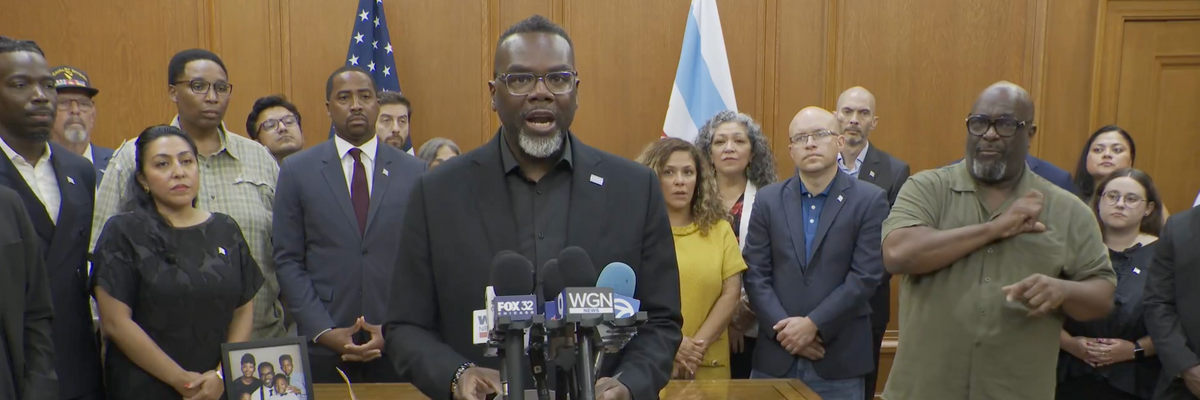
Chicago Mayor Brandon Johnson signed an executive order responding to US President Donald Trump’s threat to send immigration agents and potentially troops to the Illinois city on August 30, 2025. (Photo: screenshot/City of Chicago/X)

“We will protect our Constitution, we will protect our city, and we will protect our people,” Mayor Brandon Johnson declared. “We do not want to see tanks in our streets. We do not want to see families ripped apart.”

Continuing the battle against US President Donald Trump’s “erratic and petulant behavior,” Democratic Chicago Mayor Brandon Johnson on Saturday signed an executive order responding to the Republican’s threats to deploy federal immigration agents and potentially National Guard and active-duty troops to Illinois’ biggest city.

Just before signing the order, Johnson told journalists that he would have preferred to work with City Council to pass legislation, “but unfortunately we do not have the luxury of time,” given “credible reports that we have days, not weeks, before our city sees some type of militarized activity by the federal government.”

Asked about which specific reports he was referring to, the mayor just said that the deployment could occur as soon as Friday, so he had to take “immediate, drastic action to protect our people from federal overreach.”

“We will protect our Constitution, we will protect our city, and we will protect our people,” he declared. “We do not want to see tanks in our streets. We do not want to see families ripped apart. We do not want grandmothers thrown into the back of unmarked vans. We don’t want to see homeless Chicagoans harassed or disappeared by federal agents. We don’t want to see Chicagoans arrested for sitting on their porch. That’s not who we are as a city, and that’s not who we are as a nation.”

A spokesperson for the suburban Naval Station Great Lakes confirmed to Military Times earlier this week that the US Department of Homeland Security (DHS) has contacted the base about possibly using it for immigration enforcement activities.

The Chicago Sun-Times obtained an email in which the station’s commanding officer, Navy Cpt. Stephen Yargosz, told his leadership team: “These operations are similar to what occurred in Los Angeles earlier this summer. Same DHS team.”

According to the newspaper, Yargosz added in his Monday email that “this morning I received a call that there is the potential also to support National Guard units. Not many details on this right now. Mainly a lot of concerns and questions.”

In addition to targeting California’s largest city, Trump has recently federalized Washington, DC’s police force and deployed the National Guard there—and he has threatened to similarly target other Democrat-led cities, despite their falling crime rates.

As the Sun-Times reported Saturday:

White House officials have distinctly said the operation in Chicago would mirror Los Angeles more than DC, which saw thousands of National Guard troops and hundreds of active-duty Marines—some of whom are stationed there through November—activated to quell protests against immigration raids.

“If these Democrats focused on fixing crime in their own cities instead of doing publicity stunts to criticize the president, their communities would be much safer,” wrote White House spokesperson Abigail Jackson. “[Democrats] should listen to fellow Democrat Mayor Muriel Bowser who recently celebrated the Trump administration’s success in driving down violent crime in Washington, DC.”

Johnson’s order against Trump’s “tyranny” states that the mayor demands the president “and any agents acting under his authority stand down from any attempts to deploy the US armed forces—including the National Guard—in Chicago.”

“The city will pursue all available legal and legislative avenues to counter coordinated efforts from the federal government that violate the rights of the city and its residents, including the constitutional rights to peacefully assemble and protest, and the right to due process,” the document warns.

The order also establishes the Protecting Chicago Initiative, which will include making information regarding residents’ rights and federal government action available; coordinating efforts to identify and address community needs; and regularly submitting public records requests to DHS, including Immigration and Customs Enforcement as well as Customs and Border Protection.

The document states that the Chicago Police Department “shall remain a locally controlled law enforcement agency” under the authority of the city and the mayor, no CPD personnel shall participate in civil immigration enforcement, and all officers, “when engaged in any law enforcement, crowd management, or public safety operations, will wear department-authorized uniforms.”

It further says that “CPD officers are prohibited from intentionally disguising or concealing their identities from the public by wearing any mask, covering, or disguise while performing their official duties,” and “all other law enforcement officers, including federal agents, as well as members of the military operating in Chicago, are urged to adhere to these requirements to protect public safety and promote accountability.”

Under Trump, federal immigration officials have often donned masks—which has led to people targeted for arrest questioning whether they are encountering real agents, as well as criminals impersonating agents.

During Saturday’s signing event, Johnson said that his office has communicated with Illinois Gov. JB Pritzker, Cook County Board President Toni Preckwinkle, and the state’s congressional delegation, and “we are in complete alignment.”

The mayor’s move won praise from the Chicago Teachers Union, which said in a statement that CTU “stands in firm opposition to the president’s threat to occupy our city with federal forces and terrorize our communities. As educators working and living in every one of Chicago’s 77 neighborhoods, we know that safety does not come from federal forces invading our city. Real safety comes from the types of community investments that Mayor Johnson has made into public health, public education, summer youth jobs, affordable housing, small business development, and mental health care.”

Noting Trump’s recent attacks on Medicaid and the Supplemental Nutrition Assistance Program, the union said that “if Trump wants to spend a million dollars a day in Chicago, he can send it for crossing guards to help our children move safely across this city, for Safe Passage to make sure that our children have a friendly face to see on their journey back and forth to home, for SNAP benefits to make sure our children have the nutrition they need to thrive and flourish, for special education and dual language supports for our students, and for healthcare so their families can afford the medicine and care they need.”

“The CTU applauds Mayor Johnson for taking steps to protect the rights of Chicagoans, and to not be conscripted into Trump’s threatened occupation of our city,” the union continued. “We stand in solidarity with all of our fellow Chicagoans, as we say no to occupation and demand that our federal tax dollars be used to provide the services our communities actually need: healthcare, SNAP, and fully funded schools to our communities, not to send federal troops to terrorize them.”

“This is why we will join tens of thousands of Chicagoans on Monday at 11:00 am, for the Workers Over Billionaires march and rally,” the CTU added. “This Labor Day, we will be in the streets of our city, marching peacefully, to say NO to Trump, his occupation, and the billionaire takeover of our country.”

Original article by Jessica Corbett republished form Common Dreams under Creative Commons (CC BY-NC-ND 3.0). 

Orcas discuss how Trump was re-elected and him being an insane, xenophobic Fascist.
Donald Trump urges you to be a Climate Science denier like him. He says that he makes millions and millions for destroying the planet, Burn, Baby, Burn and Flood, Baby, Flood.
Elon Musk urges you to be a Fascist like him, says that you can ignore facts and reality then.
Continue ReadingAs Trump Targets Chicago, Mayor Fights His ‘Tyranny’ With Executive Order

Trump’s Venezuela Drug War Gambit and the Militarization Playbook at Home

Spread the love

This article by Michelle Ellner republished from Common Dreams under Creative Commons (CC BY-NC-ND 3.0).

National Guard troops are deployed to the Washington Monument as part of US President Donald Trump’s mobilization of law enforcement on August 12, 2025 in Washington, DC. (Photo by Andrew Leyden/Getty Images)

Whether it’s a wall in the desert or barricades in front of the White House, the message is the same: Perceived threats, real or manufactured, are met with troops, not talks.

US President Donald Trump has quietly authorized the Pentagon to carry out military operations against what his administration calls “narco-terrorist” networks in Latin America. On paper, it’s a counter-narcotics policy. In practice, it serves as a green light for open-ended US military action abroad, bypassing congressional approval, sidestepping international law, and stretching the definition of “national security” until it becomes a catchall justification for the use of force.

The directive allows the US to target groups unilaterally labeled as both criminal and terrorist. Once that designation is made, the military can operate without the consent of the targeted country, a move that violates international law. In a region with a long history of US-backed coups, covert wars, and destabilization campaigns, the risk of abuse isn’t hypothetical; it’s inevitable.

While the order applies across Latin America, Venezuela stands at the top of the list. The Trump administration has accused President Nicolás Maduro’s government of working with transnational cartels, and has doubled the bounty on him to $50 million (double the bounty for Osama bin Laden). It’s a lawfare tactic designed to criminalize a head of state and invite mercenaries and covert operatives to participate in regime change. The accusations fueling this escalation have grown increasingly far-fetched casting Maduro in turn as a partner of Colombia’s FARC, the head of the “Cartel de los Soles,” a patron of Venezuela’s Tren de Aragua, and now, as an ally of Mexico’s Sinaloa Cartel. a charge even Mexico’s own president says has no evidence, revealing how politicized and unfounded this allegation is.

The core premise of the accusation is that Maduro is involved in a cocaine trafficking network of Venezuelan military and political figures called Cartel de los Soles. The Venezuelan government denies the cartel’s existence, calling it a fabrication to justify sanctions and regime change efforts. Multiple independent investigations have shown no hard evidence exists and that this narrative thrives in a media-intelligence echo chamber. Reports from outlets like Insight Crime cite anonymous US sources; those media stories are then cited by policymakers and think tanks, and the cycle repeats until speculation becomes policy.

The communities in Caracas and Los Angeles, in the Venezuelan plains, and in the US-Mexico border may seem worlds apart, but they are facing the same war machine.

Fulton Armstrong, a professor at American University and a former longtime US intelligence officer, has stated that he knows no one in the intelligence community, apart from those currently in government, who believes in the existence of the Cartel de los Soles.

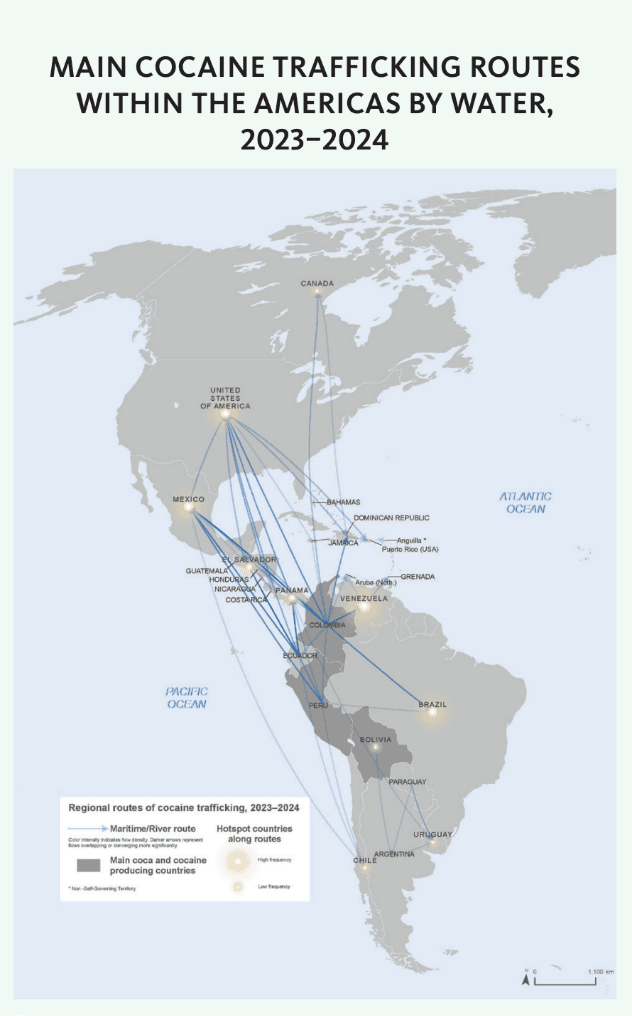
Drug monitoring data also contradict this narrative. The Washington Office on Latin America (WOLA) reports that only about 7% of US-bound cocaine transits through the Eastern Caribbean via Venezuela, while approximately 90% takes Western Caribbean and Eastern Pacific routes. The United Nations Office on Drugs and Crime’s 2025 World Drug Report likewise confirms that trafficking remains concentrated in major Andean corridors, not through Venezuela. Yet Venezuela is targeted anyway, not for its actual role in the drug trade, but because neutralizing its government has become a pillar of US foreign policy, seen in Washington as a step toward reshaping the country’s political system and prying open its economy to foreign control.

The “narco-terror” label put on Venezuela also attempts to rope Venezuela into the US fentanyl crisis, despite the absence of evidence that the country plays any role in fentanyl trafficking. Even US drug enforcement assessments make no mention of Venezuela as a source or transit point.

This link exists only in political rhetoric, a way to fold Venezuela into a domestic public health crisis and recycle the same logic used to brand it a “national security threat.” That accusation dates back to 2015 when then-President Barack Obama created the legal and political scaffolding for an open-ended campaign of coercion. Once the “narco-terror” framework is in place, Washington can sustain and escalate military measures over time, regardless of the immediate pretext.

This framing turns a political standoff into a declared security imperative. It broadens the range of permissible military tools, from ISR (intelligence, surveillance, reconnaissance) to direct action.

The pattern is familiar. In Panama (1989), Colombia (2000s), and Honduras (2010s), US militarized antidrug campaigns failed to dismantle supply chains or reduce trafficking volumes. What they did accomplish was shifting routes, militarizing criminal actors, and destabilizing governments, and left societies more fragile—costing lives and destroying communities in the process.

The Mirror at Home: Militarization and Communities of Color

The same militarized logic driving US policy in Venezuela is being applied inside the United States. In August 2025, President Trump signed an executive order placing the DC Metropolitan Police Department under federal control and deployed the National Guard, citing a public safety “emergency,” despite official data showing violent crime at multiyear lows. Even US law enforcement statistics contradict the White House narrative, but the administration dismissed them, casting the city as overrun by “roving mobs,” “wild youth,” and “drugged-out maniacs.”

DC is only one example. The same militarized logic has sent thousands of troops to the US-Mexico border, converted military bases into detention centers from Texas to New Jersey, and stationed soldiers inside Immigration and Customs Enforcement detention facilities in over 20 states. In Los Angeles, Marines and National Guard units patrolled immigrant neighborhoods in a show of force, a deployment beaten back only by mass community resistance and the threat of labor action.

Whether it’s a wall in the desert or barricades in front of the White House, the message is the same: Perceived threats, real or manufactured, are met with troops, not talks. The playbook never changes: In Venezuela, the “threat” is cast as narco-terrorism; in the US, it’s a “border surge” or a manufactured public safety emergency built on racially coded depictions of Black and brown communities. In both cases, the logic is identical: Treat political disputes and social crises as security emergencies, sideline diplomacy and community solutions, usurp greater executive powers, and make military force a routine tool of governance.

The Real Threat

Trump’s “narco-terror” authorization uses the language of fighting drugs and crime to mask a deeper project: expanding the military’s role in governance and normalizing its use as a tool of political control both at home and abroad.

In Latin America, that means more interventions against governments the US wants to topple. At home, it means embedding the military deeper into civilian life, particularly in Black and brown neighborhoods.

The communities in Caracas and Los Angeles, in the Venezuelan plains, and in the US-Mexico border may seem worlds apart, but they are facing the same war machine. Until we reject militarization in all its forms, the targets will keep shifting, but the people under the gun will look the same.

This article by Michelle Ellner republished from Common Dreams under Creative Commons (CC BY-NC-ND 3.0).

Continue ReadingTrump’s Venezuela Drug War Gambit and the Militarization Playbook at Home

Israel says it plans to keep its troops in parts of the occupied West Bank

Spread the love

https://morningstaronline.co.uk/article/israel-says-it-plans-keep-its-troops-parts-occupied-west-bank

Israeli tanks gather outside of the occupied West Bank near Jenin, Sunday, Feb. 23, 2025

ISRAEL’S defence minister said today troops would remain “for the coming year” in parts of the occupied West Bank.

This follows complaints by Hamas over the decision by Tel Aviv to halt the release of detainees promised under the ceasefire deal.

The Israelis have deepened their crackdown on the Palestinian territory since launching their military offensive on the northern West Bank on January 21 — two days after the ceasefire that paused the war in Gaza took hold. They then expanded it to include other nearby areas.

Israel says it is determined to stamp out resistance in the territory, but Palestinians view such raids as part of an effort to cement Israeli control over the territory, where three million Palestinians live under military rule.

The deadly raids have devastated urban areas and displaced tens of thousands.

Article continues at https://morningstaronline.co.uk/article/israel-says-it-plans-keep-its-troops-parts-occupied-west-bank

Continue ReadingIsrael says it plans to keep its troops in parts of the occupied West Bank