A Donald Trump coin is pictured alongside Bitcoin and various other cryptocurrencies in this photo illustration in Brussels, Belgium, on August 5, 2025. (Photo by Jonathan Raa/NurPhoto via Getty Images)
Buying Trump’s meme coin is like investing in “a pet rock, except you don’t even get a rock” out of the deal, said economist Steve Rattner.
Since returning to office a little more than a year ago, President Donald Trump has nearly tripled his net worth, driven in large part by investments in his family’s cryptocurrency ventures.
Appearing on MS NOW on Friday morning, economist Steve Rattner broke down how Trump’s net worth has exploded from $2.34 billion in 2024 to an estimated $6.5 billion in 2026.
“So where did the money come from? He had $4 billion, he and his family, of profits,” Rattner said. “$3 billion of it came from crypto, and I will tell you, there are so many transactions here, so many structures, that made my head hurt trying to understand it.
In addition to the crypto ventures, Rattner pointed to Trump son-in-law Jared Kushner raising money from investors in the Middle East through his investment firm Affinity Partners; increased revenue that came from raising admission fees to his Mar-a-Lago resort; and money he’d obtained from lawsuits against assorted media companies.
Rattner then explained the finances of the Trump meme coin, which he described as investing in “a pet rock, except you don’t even get a rock” out of the deal.
“He sold them initially at $7, it went up to $45, not surprisingly it crashed,” Rattner said.
However, Rattner said that early investors in the cryptocurrency, whom he described as “whale wallets,” managed to profit handsomely from the venture by buying up large numbers of Trump coins and then selling them to retail investors, who were left holding the bag when the coin’s value fell precipitously shortly after its launch.
“Let me just emphasize, it’s not like [the retail investors] got anything,” he added. “All they got, in effect, was like a little note, a little email or something, saying, ‘Congratulations, you own 10 Trump meme coins.’ But there’s nothing they can do with it. They were buying nothing, they were buying air.”
The economist did note that Trump made $600 million in trading fees that investors paid to carry out transactions of the coin.
After his appearance on MS NOW, Rattner posted a photo on social media of a graph he made to document the rise in Trump’s wealth over the last two years.
Trump’s net worth has nearly tripled in his second term, reaching $6.5 billion.
His administration is the most brazenly self-enriching in American history.
Climate science denier Donald Trump confirms that he knows nothing about democracy and that more liquid gold is being secured according to his policy of global privateering.
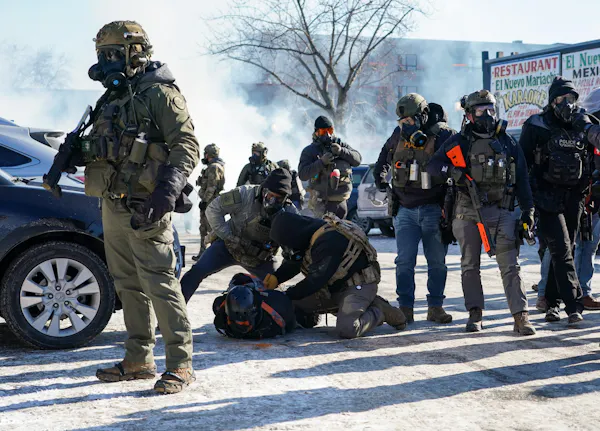
Federal immigration agents in the city of Minneapolis are accused of having wrestled a 37-year-old intensive care nurse called Alex Pretti to the ground and then shooting him dead. The killing took place just over a mile from where another American citizen, Renee Good, was allegedly fatally shot by federal agents weeks earlier.
The latest incident prompted angry protests from people in Minneapolis who want the immigration enforcement operation in their city to end. We spoke to Mark Shanahan, an associate professor of political engagement at the University of Surrey, to address several key issues.
Why has sending in federal immigration agents caused such trouble in Minnesota?
Since returning to the White House in January 2025, the national guard has been deployed to several US cities to quell what have generally been Donald Trump-inflated crises, with illegal migration among the most prominent. However, in December, the Supreme Court ruled that Trump did not have authority for such deployments.
So, since then we have seen federal agents with US Customs and Border Protection and Immigration and Customs Enforcement taking the battle largely to minorities in cities with Democratic party leadership as part of the president’s violent attack on illegal immigration, a situation he has described as “the greatest invasion in history”.
Minneapolis is a Democrat-run city in a Democrat-led state. The governor is Tim Walz who ran for vice-president on the Kamala Harris ticket against Trump in the 2024 election. Walz has faced allegations, which he denies, of overlooking alleged widespread fraud in the financing of public safety net programmes, supposedly involving segments of the Somali-American community.
While most of these allegations have been refuted, they gave Trump reason to send in federal agents. This has ramped up tensions between state officials and the administration, causing brutal and unnecessary deaths in the community and pitting ordinary Minnesotans against federal government officials.
How does the situation in Minnesota reflect the second amendment right to bear arms?
It’s a reversal of virtually all of the second amendment debates that have been seen in recent years. The second amendment was introduced to the US constitution in 1791 through the Bill of Rights due to a deep mistrust of centralised military power and a desire to ensure that the newly formed federal government could not disarm the populace.
The founding fathers envisaged a “natural right of resistance and self-preservation”. Trump’s actions in sending in armed federal agents to conduct enforcement operations in various states appear to fulfil the founding fathers’ concerns.
The agents are trampling all over not only citizens’ second amendment right to bear arms (officials seemingly connected Pretti’s killing to him carrying a weapon) but also their first amendment right to freedom of assembly.
Federal officers detain a protester in Minneapolis, Minnesota, on January 24. Craig Lassig
How have the fatal shootings affected Trump’s popularity?
Trump’s popularity is on the decline. His failure to deliver on the economic promises outlined in his election campaign, scatter-gun approach to international relations and the widening gulf between rhetoric and achievement have all damaged his standing in the polls.
In a CNN poll published on January 16, almost six in ten respondents described Trump’s first year back in office as a failure with the president focused on the wrong priorities.
And what support he does have is ebbing rapidly as federal immigration agents appear out of control, targeting many more documented citizens than illegal migrants, spreading fear and operating as if they are above the law.
With what looks like high levels of gaslighting coming from Homeland Security officials, voters are turning against the increasing autocracy of this administration, believing in the evidence widespread across the media rather than highly contentious statements from Trump’s lieutenants.
Is it unusual for former presidents to speak out the way Barack Obama and Bill Clinton have?
It certainly is. There is a longstanding tradition in the US of, and implicit agreement among, former presidents to avoid public criticism of the incumbent. Such reticence to speak is generally a sign of respect for the office and an acknowledgement of the unique and difficult challenges of the presidency.
But Trump 2.0 is no normal presidency. The 47th president’s style is both combative and retributive, and there seems to be an increasing feeling of it being out of step with the desires and best interest of the country he leads.
Trump’s march to autocracy creates crises where he regards himself as the hero the country needs to overcome its ills. His predecessors take a different view.
Whether it’s Obama calling out the assault on core American values or Clinton’s condemnation of the “horrible scenes” in Minneapolis as “unacceptable” and avoidable, Democrat past presidents have not held back. Notably, the only living previous Republican president, George W. Bush, has so far kept his own counsel.
What can be done to prevent further violence?
Most simply, Trump could end the deployment of federal immigration agents to Minneapolis and refrain from similar actions in the future. He is clearly looking for an off-ramp and sending his “border czar”, Tom Homan, to Minneapolis to direct operations could be the first step to de-escalation. But Trump abhors being called out as wrong and, at least beyond Minneapolis, is far more likely to double down on the immigration enforcement activities.
Realistically, the most likely de-escalator is Congress showing some teeth and refusing to fund further federal immigration enforcement activity. Democrats could force another government shutdown over the issue, and need just a handful of Republicans to flip in order to refuse to sanction a 2026 budget for the Department of Homeland Security.
At a public level, the greater the scrutiny of immigration enforcement agencies, the closer the fact-checking of official statements and the more cohesive the opposition to Trump’s deportation policy, the greater the chance of effectively opposing it.
It is midterm year – and the greater the public pressure, the more likely Republican legislators are to cleave away from the Trump line. While he currently controls the levers of power, that control remains fragile. Even Trump may soon realise that overt, violent, coercive autocracy is not a vote winner.
Elon Musk urges you to be a Fascist like him, says that you can ignore facts and reality then.Donald Fuhrump says that Amerikkka doesn’t bother with crimes or charges anymore, not being 100% Amerikkkan and opposing his real estate intentions is enough.Orcas discuss how Trump was re-elected and him being an obviously insane, xenophobic Fascist.