The UK government has been urged to go further on sanctions against Israeli settlements in the West Bank, with senior lawyers warning that current measures “fall far short” of Britain’s obligations under international law.
Foreign secretary Ed Miliband last week announced a ban on the trade of goods with illegal Israeli settlements in the occupied West Bank, a move seen as a major shift in UK-Israel relations. Canada and France announced similar actions the same day.
But 130 top lawyers and legal academics have written to prime minister Andy Burnham to say the measures do not meet the UK’s legal obligations, including those set out in a 2024 ruling by the International Court of Justice.
…
They said they welcomed the new measures but that the UK must now extend sanctions to more sectors of Israel’s economy, prevent public bodies investing in settlements and enforce a full arms embargo.
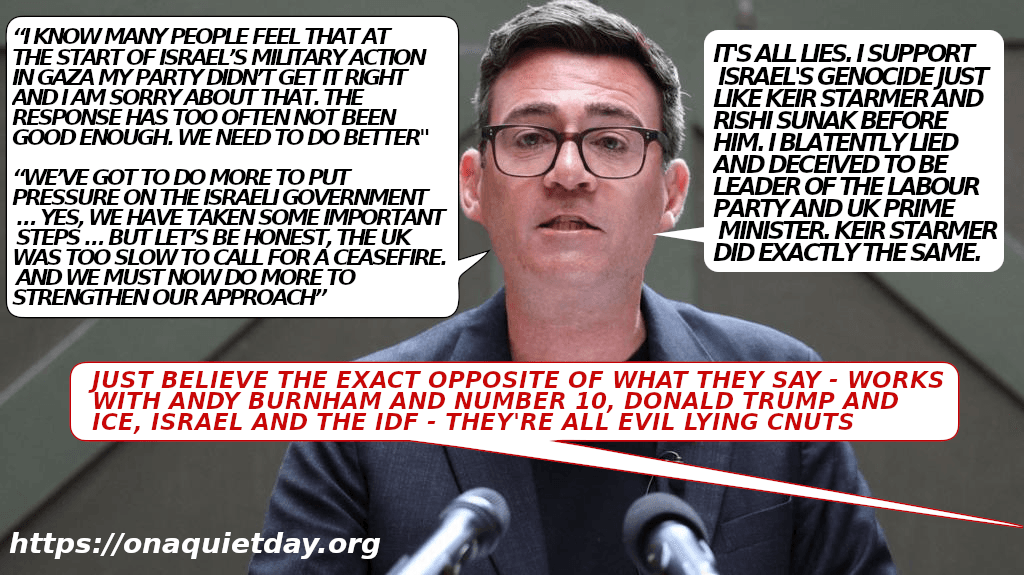
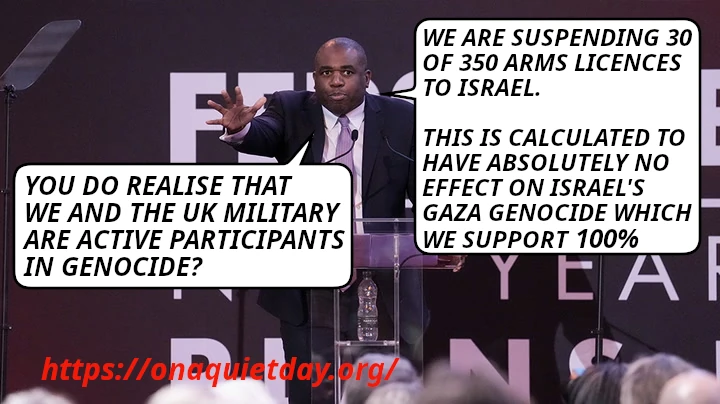
UK Prime Minister Andy Burnham admits to blatently lying and engaging in deception to become leader of the UK Labour Party and Prime Minister.Genocide denying [former] UK Foreign Secretary David Lammy says that UK is suspending 30 of 350 arms licences to Israel. He also confirms the UK government’s support for Israel’s Gaza genocide and the UK government and military’s active participation in genocide.Orcas discuss Genocide-supporting and complicit Zionists. Donald Trump, Keith Starmer, David Lammy, Rachel Reeves, Angela Rayner and Wes Streeting are acknowledged as evil genocide-complicit and supporting cnuts.
This work by Middle East Monitor is licensed under a Creative Commons Attribution-NonCommercial-ShareAlike 4.0 International License.
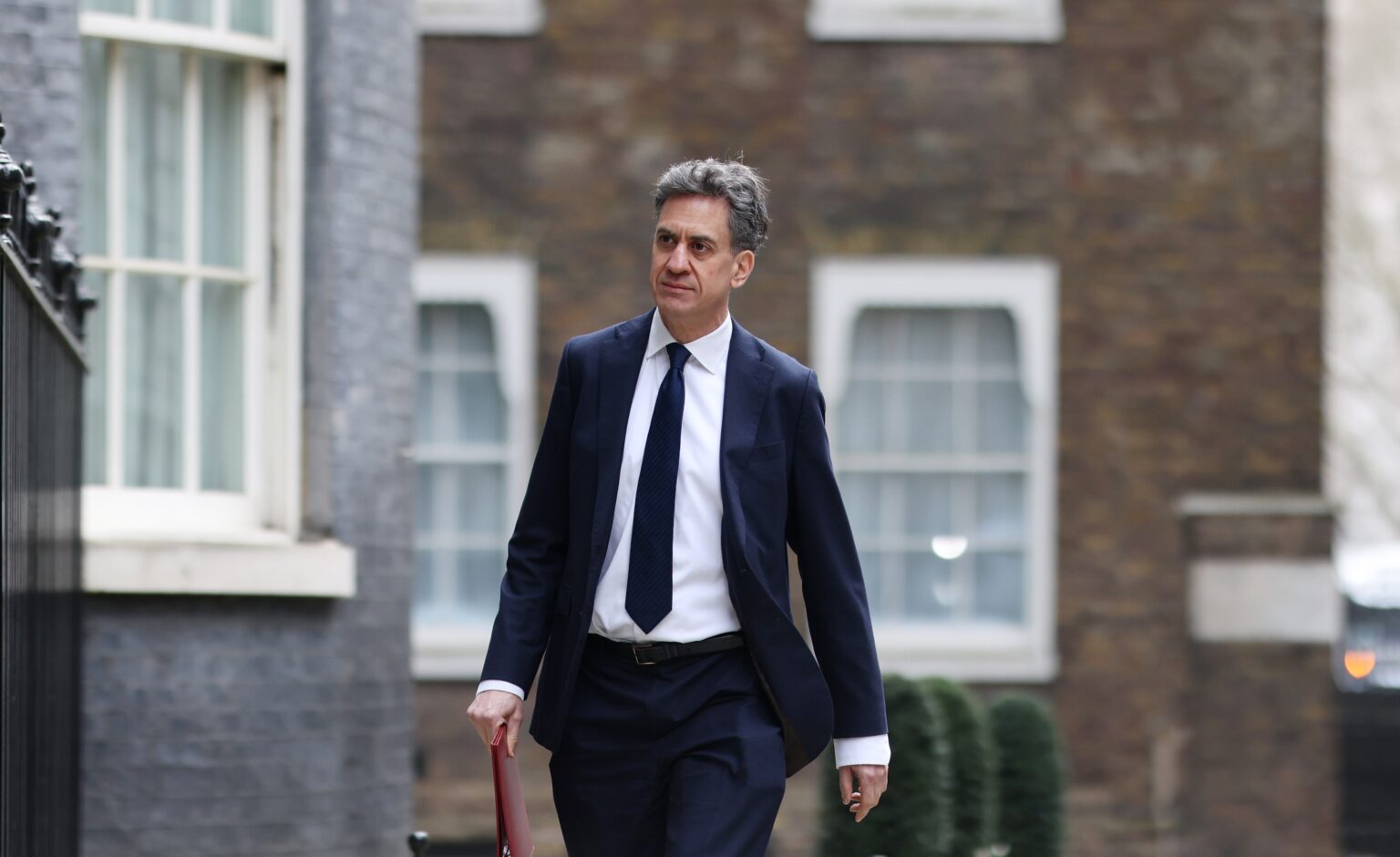
Ed Miliband, Secretary of State for Foreign, Commonwealth and Development Affairs, arrives at 10 Downing Street to attend the weekly Cabinet meeting in London, United Kingdom on July 21, 2026. [Zeynep Demir – Anadolu Agency]
In a rare display of opposition, the UK Government on Wednesday issued a strongly worded statement condemning Israel’s publication of a tender for the E1 settlement, describing the project is an unacceptable and destructive act.
Foreign Secretary Ed Miliband said: “E1 would cut across the heart of Palestine and risks separating the West Bank from East Jerusalem, which would endanger the viability of a two-state solution.
“The UK has been clear privately and publicly in our opposition to E1 and our support for a two-state solution as the only way to ensure long-term security and peace for both Palestinians and Israelis. All settlements damage that prospect and are a flagrant breach of international law.
“Today, I made clear to the Israeli Foreign Minister Gideon Sa’ar that the Israeli Government must halt E1 plans immediately, retract the tender and stop all settlement expansion.
“In addition, the Israeli Chargé d’Affaires has been summoned to the Foreign, Commonwealth and Development Office, where we set out the UK’s profound objection to this move by the Netanyahu government and demanded an immediate reversal.
“The impact of settler violence and terrorism has been catastrophic for Palestinian communities. Settlement expansion and attempts to create irreversible divisions on the ground threaten peace, security and the prospects for a viable Palestinian state.
“Britain will not stand back and accept the destruction of the Two-State Solution.
“In the coming weeks we will set out a comprehensive set of measures to respond to Israeli government policies, protect the viability of the Palestinian state, target sanctions at those who participate in illegal settlement expansion and support a just and lasting peace for Israelis and Palestinians.”
Climate science denier Donald Trump confirms that he knows nothing about democracy and that more liquid gold is being secured according to his policy of global privateering.Orcas discuss Donald Trump and the killer apes’ concept of democracy. Front Orca warns that Trump is crashing his country’s economy and that everything he does he does for the fantastically wealthy.
This work by Middle East Monitor is licensed under a Creative Commons Attribution-NonCommercial-ShareAlike 4.0 International License.
People stage a pro-Palestinian demonstration and call on Labour Party leader Andy Burnham, who is preparing to take office as prime minister, to impose comprehensive sanctions on Israel, in London, United Kingdom on July 18, 2026. [Raşid Necati Aslım – Anadolu Agency
Britain’s new government has rejected calls from 80 MPs and peers to recognise Israel’s genocide in Gaza, impose a full arms embargo and introduce comprehensive sanctions against the occupation state.
The decision has intensified criticism of Prime Minister Andy Burnham and Foreign Secretary Ed Miliband, whose first statements in office raised expectations of a break with the policies of former Prime Minister Keir Starmer but have so far produced little substantive change.
In a cross-party letter led by Labour MP Kim Johnson, members of the House of Commons and House of Lords urged Burnham to recognise the findings of the UN Independent International Commission of Inquiry, which concluded that Israel had committed genocide against Palestinians in Gaza.
I'm one of 80 MPs & Peers calling on the PM to:
– Recognise the UN’s findings on genocide & implement the ICJ ruling in full – Impose sanctions including a full arms embargo – Ban trade that supports Israel’s illegal settlements
The parliamentarians called on the government to “fundamentally change its position” by supporting Palestinian rights and taking steps to prevent further Israeli violations of international law.
They also urged ministers to implement the International Court of Justice’s ruling on Israel’s illegal occupation, impose comprehensive sanctions, introduce a complete arms embargo and prohibit trade in goods and services linked to illegal Israeli settlements in the Occupied Palestinian Territory.
However, the Foreign, Commonwealth and Development Office declined to endorse any of the demands.
The rejection follows criticism of Miliband’s first statement as foreign secretary, in which he referred explicitly to “Russia’s illegal war in Ukraine” but described Israel’s assault on Gaza only as “conflict in the Middle East”.
British governments and senior ministers have repeatedly made legal and political judgements about Russia’s conduct without waiting for a final international court ruling. The UK described Russia’s invasion as illegal from its outset and accused Russian forces of committing war crimes.
In June 2026, the Commission reported that Israeli authorities and forces continued to commit genocide and other atrocity crimes, including through the deliberate targeting of Palestinian children.
The UN findings are part of a much broader body of expert assessments.
Amnesty International concluded in December 2024 that Israel had committed and was continuing to commit genocide against Palestinians in Gaza. Israeli human rights organisation B’Tselem reached the same conclusion in its July 2025 report, Our Genocide. The International Association of Genocide Scholars later declared that Israel’s policies and actions met the legal definition of genocide under the Genocide Convention.
Despite these findings, the British government has maintained that only a court can make a genocide determination.
During a House of Lords debate following the UN Commission’s September 2025 report, ministers insisted that the government would not describe Israel’s actions as genocide until a competent national or international court had ruled on the issue.
Burnham had sought to distance himself from Starmer’s record before entering Downing Street. He acknowledged that Labour “got it wrong” in its initial response to Gaza and admitted that Britain had been too slow to call for a ceasefire.
However, he stopped short of recognising genocide, arguing that the matter should be left to international courts. Green Party deputy leader Mothin Ali accused Burnham of hiding behind the courts when discussing Israel while showing no similar hesitation in condemning Russia.
Ali warned that the duty under the Genocide Convention is to prevent genocide rather than wait until the destruction has been completed and formally adjudicated. Recognising the evidence, he argued, would also raise questions about Britain’s arms exports, surveillance cooperation and wider support for Israel.
This work by Middle East Monitor is licensed under a Creative Commons Attribution-NonCommercial-ShareAlike 4.0 International License.
Members of the Islamic Revolutionary Guard Corps (IRGC) participate in a military exercise aimed at “increasing combat capabilities” in Tehran province, Iran, on May 12, 2026. [Islamic Revolutionary Guard Corps – Anadolu Agency]
The UK government listed Iran’s Islamic Revolutionary Guard Corps (IRGC) as a terror group on Monday, using new powers introduced under the National Security (State Threats) Act, according to media reports, Anadolu reports.
In a written statement to parliament, Security Minister Angela Eagle said the government had “identified activity linked to the IRGC involving threats to life and intimidation on UK soil,” Sky News reported.
The government also designated the Islamic Movement of Companions of the Right (IMCR), which Sky News described as being linked to Iran.
The decision followed the fast-tracking of the National Security (State Threats) Act, as promised by Prime Minister Keir Starmer in April.
Following the designation, it is now a criminal offense to invite support for or express support for the groups, assist them in carrying out UK-related activities, engage in conduct likely to materially assist them, or accept or retain material benefits provided by or on their behalf, according to the report.
Keir Starmer explains that UK is actively supporting Israel’s genocidal expansion and repeats his previous quotation that he supports Zionism “without qualification”. Keir Starmer said “I said it loud and clear – and meant it – that I support Zionism without qualification.” here: https://www.jewishnews.co.uk/keir-starmer-interview-i-will-work-to-eradicate-antisemitism-from-day-one/Orcas discuss how Trump was re-elected and him being an obviously insane, xenophobic Fascist.
“Netanyahu’s directive to expand Israeli military control over 70% of the Gaza Strip is horrifying, constituting a grave breach of the ceasefire if carried out and a blatant disregard for the rights and lives of Palestinian civilians already enduring unimaginable suffering.
“This plan will not serve to strengthen the path to security or peace in the region. It will only drive yet more families from their homes, further restrict the delivery of aid, and deepen a humanitarian crisis in a territory already devastated by war, famine, and genocide. The people of Gaza cannot be squeezed into an ever-smaller space and expected to survive without proper access to food, water, shelter, and medical care.
“The UK Government must act immediately: unequivocally condemn any attempt to seize more territory or ethnically cleanse Gaza, insist on full compliance with the ceasefire and international law, and demand unimpeded humanitarian access to Gaza at scale. It must also halt all arms sales to and military cooperation with the Israeli Government, drive independent investigations into war crimes, and impose sanctions on government officials responsible for breaches of international law.
“The continued expansion of military control and the forced displacement of Palestinians cannot be allowed to become normalised. The UK must stand up for international law, human rights, and the protection of civilians – not further impunity for perpetrators of war crimes.”