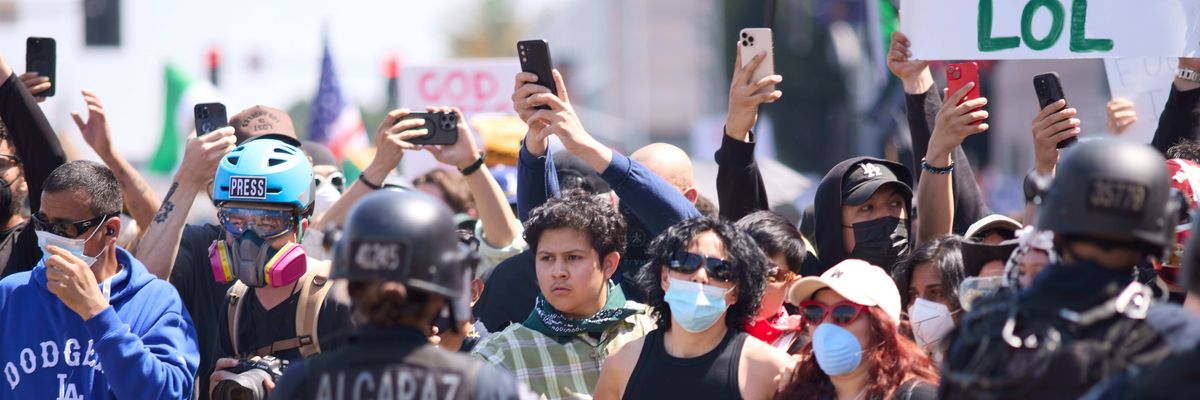
Women chant slogans during a protest marking International Women’s Day in Istanbul, Turkey, March 8, 2025
WOMEN took to the streets of cities across Europe, Africa, South America and elsewhere to mark International Women’s Day with demands for ending inequality and gender-based violence.
On the Asian side of Istanbul, Turkey’s biggest city, a rally in Kadikoy saw members of dozens of women’s groups listen to speeches, dance and sing in the spring sunshine.
The colourful protest was overseen by a large police presence, including officers in riot gear and a water cannon truck.
Protesters pushed back against the idea of women’s role being confined to marriage and motherhood, carrying banners reading “Family will not bind us to life” and “We will not be sacrificed to the family.”
…
From Athens to Madrid, Paris, Munich, Zurich and Belgrade and in many more cities across the continent, women marched to demand an end to treatment as second-class citizens in society, politics, family and at work.
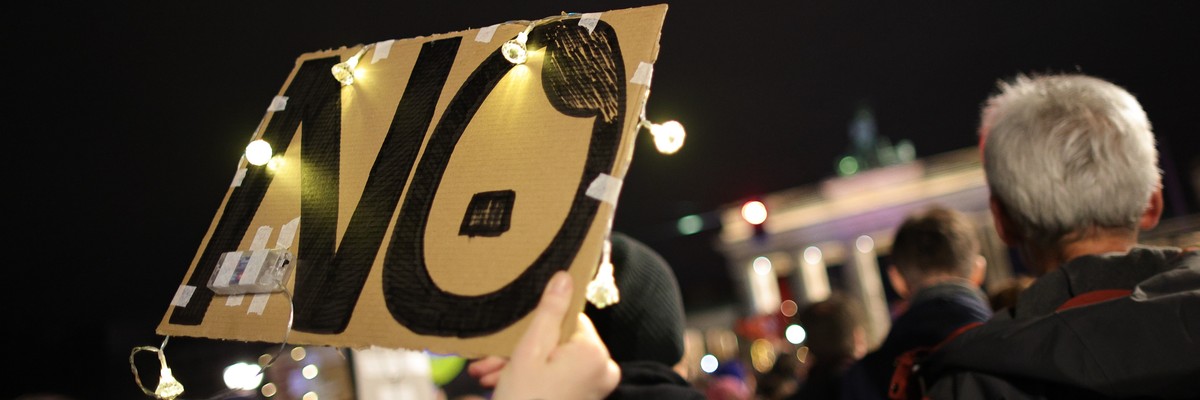
Protesters hold up a banner reading “NO” with the O shaped like an Adolf Hitler caricature during a demonstration against right-wing extremism, U.S. President Donald Trump, and right-wing billionaire Elon Musk on January 25, 2025 in Berlin, Germany. (Photo: Omer Messinger/Getty Images)
“We must not forget the tragic lesson of our past,” said Polish Prime Minister Donald Tusk. “Evil, violence and contempt cannot triumph anew.”
Billionaire enterpreneur Elon Muskinsisted at a far-right rally in Germany over the weekend that the European country must move “beyond the past” and leave behind the memory of one of the deadliest genocides in history—but as leaders on the continent marked the 80th anniversary of the Auschwitz concentration camp liberation on Monday, several made clear that Musk’s advice was not welcome.
Musk’s comments on “‘the need to forget German guilt for Nazi crimes’ sounded all too familiar and ominous,” said Polish Prime Minister Donald Tusk on Sunday. “Especially only hours before the anniversary of the liberation of Auschwitz.”
German Chancellor Olaf Scholz said on the social media platform X, “I couldn’t agree more.”
The country’s ambassador to Israel said that while Musk claimed German children are treated as “guilty of the sins” of the Nazis during World War II, the government simply wants “them to grow up informed and responsible and to apply the lessons of Germany’s past.”
As Common Dreams reported, the Tesla CEO and key adviser to U.S. President Donald Trump made the remarks at a rally for Alternative for Germany (AfD) on Saturday, five weeks before Germans are set to vote in federal elections.
AfD is currently polling at 19%, trailing the center-right Christian Democratic Union (CDU), which is in first place at 28%. But leaders across Europe, including Spanish Prime Minister Pedro Sánchez, French President Emmanuel Macron, and Scholz have warned that Musk appears to be angling for the spread of far-right ideologies—including neo-Nazism—in European countries.
The AfD has been designated a “suspected extremist” group by Germany’s domestic intelligence agency, and one of its candidates for public office last year said that “not all” Nazis who worked for Adolf Hitler’s government were criminals.
The party has been ostracized in Germany, with other political groups including the CDU ruling out the formation of a coalition government with the AfD, but last week CDU leader Friedrich Merz said he would push for tougher anti-immigration proposals even if they were submitted by the AfD.
Scholz, who represents the Social Democrats, toldStuttgarter Zeitung in response to Merz’s comments that “the firewall to the AfD must not crumble.”
As Tusk oversaw the liberation of Auschwitz anniversary on Monday, International Holocaust Remembrance Day, he alluded to Musk’s comments at the AfD rally.
“We must not forget the tragic lesson of our past,” he said on X, which is owned by Musk. “Evil, violence, and contempt cannot triumph anew.”
Musk’s comments came days after he appeared to flash a Nazi salute twice at an event for Trump’s inauguration.
In the U.S. on Sunday, Illinois Gov. JB Pritzker addressed Musk’s remarks at the AfD rally on CNN, asking why Trump hadn’t spoken out against them.
“President Trump ought to be calling that out,” said the Democratic governor. “If he doesn’t agree with Elon Musk, if he doesn’t agree with two Sieg Heils at his own rally, and backing a party that backs Nazis, then he ought to say so. Why isn’t Donald Trump speaking out?”
I’ve held off from commenting of the violence in Amsterdam because it’s difficult to know what happened without being. This report appears comprehensive.
Over 2,000 people took to the streets of Naples against soaring military spending in Europe and increased repression of dissent as G7 defense ministers convened for high-level talks
Thousands of people took to the streets of Naples on October 19, demonstrating against the G7 military agenda and Italy’s proposed reforms that would limit the freedom to dissent. Protesters, representing a host of organizations including student associations, trade unions, and community centers, rallied against Prime Minister Giorgia Meloni’s government’s policies, demanding a shift in priorities toward social needs instead of military spending. Side by side with the protest in Naples, demonstrations were held in dozens of cities across Italy, as reported by the left political party, Power to the People (Potere al Popolo).
Protesters carrying a banner reading “Cut the weapons, raise the wages!”. Source: Ex OPG occupato – Je so’ pazzo/Facebook
The protest was organized to counter a G7 defense ministers’ meeting that took place in Naples from October 18 to 20, with a focus on global military goals. The meeting was seen by protesters as yet another example of Western countries deepening their involvement in wars, including the ongoing genocide in Gaza and the war in Ukraine, instead of pursuing agendas of social justice and peace. In the lead-up to the meeting, local activists voiced their opposition, stating that “lords of war” were not welcome in their city.
“Never has so much been spent on war, and as a result, war is rampant everywhere,” the associations organizing the march asserted during the preparations. “We refuse to host a meeting in our city that supports the war economy our government has chosen to follow.”
Two central issues dominated the protest in Naples: the West’s support for Israel as it continues to exterminate the people of Gaza and the increasing repression of dissent at home, embodied in Meloni’s proposed security bill. Many protesters pointed out the link between military aggression abroad and domestic policies that seek to criminalize dissent. European countries continue to actively repress solidarity with Palestine and others, like Italy, are doing so while attempting to silence voices against their policies.
The new security bill seeks to impose severe restrictions on protests, including strikes and environmental activism. Progressive associations argue that this is a blatant attempt to stifle opposition and consolidate power, and some of them saw Saturday’s protest as a test run for the government’s strategy of suppressing future mobilizations. Days before the protest, authorities tried to restrict the march route, forcing organizers to end the demonstration a kilometer away from the G7 meeting site.
Despite these attempts, protesters refused to be stopped. They briefly broke through the set course of the rally, marching in areas originally declared off-limits by the authorities. In response, police deployed tear gas and used other forms of violence against them. Naples’ historic center has systematically been blocked off to popular protests, and things are set to get worse if the new bill is passed, protesters said. Because of that, community groups including Ex OPG – Je so’ pazzo called upon people to continue resisting.
“We believe this repressive project must be stopped, and more importantly, we see it as a reflection of the Meloni government’s fear of what might still be burning beneath the surface of the seeming calm in the country,” they said.
Saturday’s protest marked an important moment of resistance against the shrinking of democratic space in Italy, as well as to the strengthening of the armament agenda in Europe. Demonstrators announced they were ready to continue fighting against the security bill and expressed determination to challenge Meloni’s government over announced cuts to social support.
“Today, this square is sending a loud message: if the government thinks it can ignore social needs, public healthcare, workers’ rights, and housing in favor of pouring billions into military spending, it’s headed in the wrong direction,” said Chiara Capretti from Power to the People.
The fuse may have been set alight by online disinformation and secretive social media channels, but this explosion of far-right violence has been decades in the making. And while Stephen Yaxley-Lennon (AKA Tommy Robinson) and his mob of far-right agitators are its immediate instigators, much of Britain’s political and media class is complicit in laying the groundwork for this eruption of hate.
This truth of how we reached this point flips the normal classist narrative about racism in Britain. The reality is that racism isn’t a bottom-up expression of popular discontent, but a top-down project propagated by people in positions of power.
Or think how Conservative politicians normalise far-right rhetoric, dehumanising people and spreading hate. From “one nation” Conservatives such as David Cameron who as prime minister described migrants as a “swarm”, to the likes of Suella Braverman who as home secretary said there was a migrant “invasion”. Rishi Sunak’s “Stop the boats” slogan is now a far-right chant andjust this week the Tory party leadership hopeful Robert Jenrick said the police should “immediately arrest” people shouting “Allahu Akbar” on the street, the Arabic phrase meaning “God is great” – the equivalent of a Christian saying “hallelujah”.
This rhetoric was propagated further by the privately educated, former City trader Nigel Farage, who claims to be a man of the people. In the general election campaign, he said many Muslims didn’t share “British values” and this week promoted the “two-tier policing” conspiracy.
But it’s not just rightwing politicians, pundits and publications at fault. So-called centrists too often refuse to push back against this hate as well, sometimes peddling the same dangerous tropes or dismissing the concerns of those subject to this hatred.
I was confronted by this painful reality just this week. On Monday morning I was invited on to ITV’s Good Morning Britain to talk about the recent racist riots, only to be interrogated – and it did feel like an interrogation – about why I, a Muslim MP, thought it was important to call the recent racist violence Islamophobic. “Why is it important to use that specific word?” Kate Garraway repeatedly questioned me.
Almost before I could answer, and behaving with the same sneering condescension he did throughout the segment, the former Labour shadow chancellor and now broadcaster Ed Balls repeatedly interrupted me, seemingly incredulous that I thought this hate should be called by its proper name. The show has now been hit with more than 8,200 Ofcom complaints about that morning’s episode, many of them about his handling of my interview.