Analysis Reveals Wall Street Titans Behind Big Oil Profiteering Push in Venezuela

Spread the love

Original article by Stephen Prager republished from Common Dreams under Creative Commons (CC BY-NC-ND 3.0).
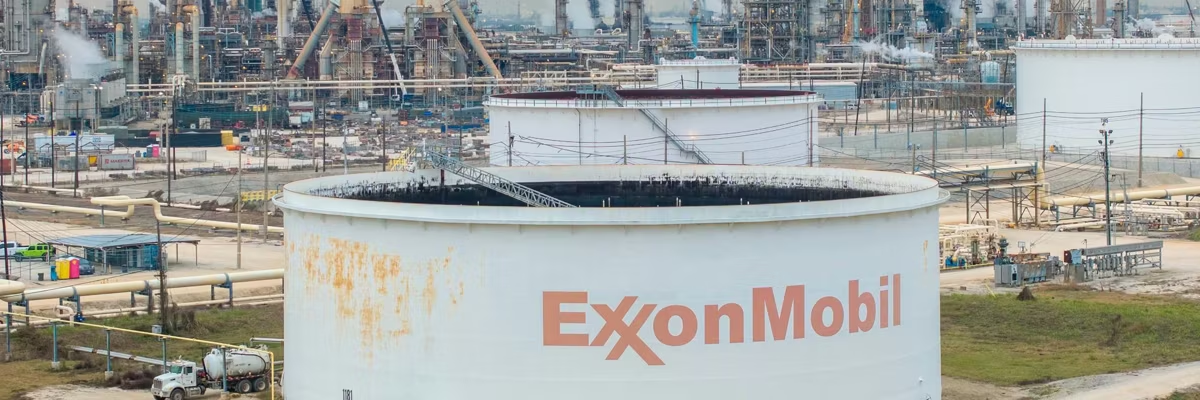
In an aerial view, the ExxonMobil Baytown Refinery is seen on January 13, 2026, in Baytown, Texas. (Photo by Brandon Bell/Getty Images)

Since 2021, top Wall Street banks have committed more than $124 billion in investments to the nine companies set to profit most from the toppling of Venezuela’s government.

As oil industry giants are being set up to profit from President Donald Trump’s invasion of Venezuela, a new analysis shows the ample backing those companies have received from Wall Street’s top financial institutions.

Last week, Bloomberg reported that stock traders and tycoons were “pouncing” after Trump’s kidnapping of President Nicolás Maduro earlier this month, after having pressured the Trump administration to “create a more favorable business environment in Venezuela.”

RECOMMENDED…

VENEZUELA-US-CONFLICT-CRISIS-OIL

Democrats Launch Probe to Learn What Trump Told Oil Giants About Venezuela Attack—and When
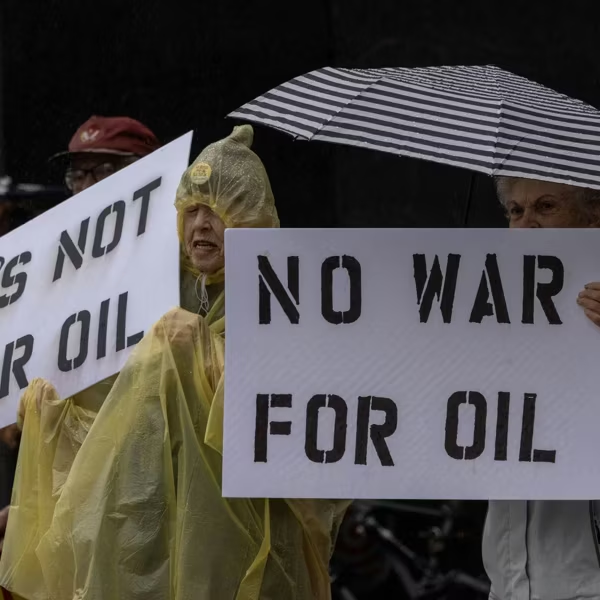
People participate in a “No War on Venezuela” protest

Trump Meeting With Big Oil Underscores Venezuela Agenda: Enriching ‘Himself and His Fossil Fuel Donors’

dataset compiled by the international environmental advocacy group Stand.earth shows the extent to which these interests are intertwined.

Stand.earth found that since 2021, banks—including JPMorgan Chase, HSBC, TD, RBC, CitigroupWells Fargo, and Bank of America—have committed more than $124 billion in investments to the nine companies set to profit most from the toppling of Venezuela’s government.

More than a third of that financing, $42 billion, came in 2025 alone, when Trump launched his aggressive campaign against Venezuela.
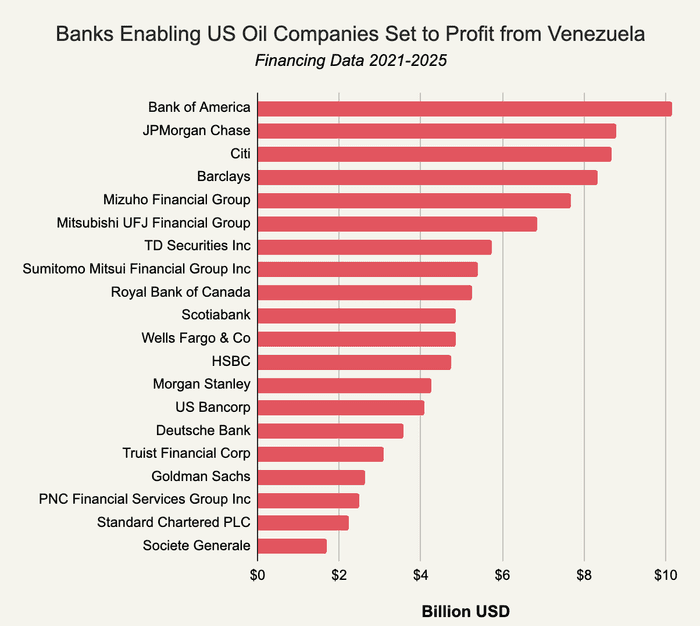
(Graphic from Stand.earth)

Among the companies expected to profit most immediately are refiners like Valero, PBF Energy, Citgo, and Phillips 66, which have large operations on the Gulf Coast that can process the heavy crude Venezuela is known to produce. These four companies have received $41 billion from major banks over the past five years.

Chevron, which also operates many heavy-crude facilities, benefits from being the only US company that operated in Venezuela under the Maduro regime, where it exported more than 140,000 barrels of oil per day last quarter.

At a White House gathering with top oil executives on Friday, the company’s vice chair, Mark Nelson, told Trump the company could double its exports “effective immediately.”

According to Jason Gabelman, an analyst at TD Cowen, the company could increase its annual cash flow by $400 million to $700 million as a result of Trump’s takeover of Venezuelan oil resources.

Chevron was also by far the number-one recipient of investments in 2025, with more than $11 billion in total coming from the banks listed in the report—including $1.78 billion from Barclays, another $1.78 billion from Bank of America, and $1.32 billion from Citigroup.

According to Bloomberg, just weeks before Maduro’s removal, analysts at Citigroup predicted 60% gains on the nation’s more than $60 billion in bonds if he were replaced.

Even ExxonMobil, whose CEO Darren Woods dumped cold water on Trump’s calls to set up operations in Venezuela on Friday, calling the nation “uninvestable,” potentially has something major to gain from Maduro’s overthrow.

Exxon and ConocoPhillips each have outstanding arbitration cases against Venezuela over the government’s 2007 nationalization of oil assets, which could award them $20 billion and $12 billion, respectively.

The report found that in 2025, ExxonMobil and ConocoPhillips received a combined total of more than $12.8 billion in investment from major financial institutions, which vastly exceeded that from previous years.

Data on these staggering investments comes as oil companies face increased scrutiny surrounding possible foreknowledge of Trump’s attack on Venezuela.

Last week, US Senate Democrats launched a formal investigation into “communications between major US oil and oilfield services companies and the Trump administration surrounding last week’s military action in Venezuela and efforts to exploit Venezuelan oil resources.”

Richard Brooks, Stand.earth’s climate finance director, said the role of the financial institutions underwriting those oil companies should not be overlooked either.

“Without financial support from big banks and investors, the likes of Chevron, Exxon, ConocoPhillips, and Valero would not have the power that they do to start wars, overthrow governments, or slow the pace of climate action,” he said. “Banks and investors need to choose if they are on the side of peace, or of warmongering oil companies.”

Original article by Stephen Prager republished from Common Dreams under Creative Commons (CC BY-NC-ND 3.0).

Elon Musk urges you to be a Fascist like him, says that you can ignore facts and reality then.
Donald Fuhrump says that Amerikkka doesn't bother with crimes or charges anymore, not being 100% Amerikkkan and opposing his real estate intentions is enough.
Donald Fuhrump says that Amerikkka doesn’t bother with crimes or charges anymore, not being 100% Amerikkkan and opposing his real estate intentions is enough.
Orcas discuss how Trump was re-elected and him being an obviously insane, xenophobic Fascist.

Continue ReadingAnalysis Reveals Wall Street Titans Behind Big Oil Profiteering Push in Venezuela

114 Climate Defenders Arrested While Blocking Entry to NY Federal Reserve

Spread the love

Original article by Brett Wilkins republished from Common Dreams under Creative Commons (CC BY-NC-ND 3.0).

A protester is led away by a New York City police officer during a September 18, 2023 climate protest in Lower Manhattan. (Photo: Spencer Platt/Getty Images)

The activist group Climate Defiance asked: “Why are we getting handcuffed while people who literally torch the planet get celebrated for their ‘civility’ and their ‘moderation’?”

A day after tens of thousands of climate activists marched through Manhattan’s Upper East Side demanding an end to oil, gas, and coal production, thousands more demonstrators hit the streets of Lower Manhattan Monday, where more than 100 people were arrested while surrounding the Federal Reserve Bank of New York to protest fossil fuel financing.

Protesters chanted slogans like “No oil, no gas, fossil fuels can kiss my ass” and “We need clean air, not another billionaire” as they marched from Zuccotti Park—ground zero of the 2011 Occupy Wall Street movement—to pre-selected sites in the Financial District. Witnesses said many of the activists attempted to reach the New York Stock Exchange but were blocked by police.

“We’re here to wake up the regulators who are asleep at the wheel as they continue to let Wall Street lead us into ANOTHER financial crash with their fossil fuel financing,” the Stop the Money Pipeline coalition explained on social media.

Local and national media reported New York Police Department (NYPD) officers arrested 114 protesters and charged them with civil disobedience Monday after they blocked entrances to the Fed building. Most of those arrested were expected to be booked and released.

“I’m being arrested for exercising my First Amendment right to protest because Joe Manchin is putting a 300-mile-long pipeline through my home state of West Virginia and President [Joe] Biden allowed him to do it for nothing in return,” explained Climate Defiance organizer Rylee Haught on social media, referring to the right-wing Democratic senator and the Mountain Valley Pipeline.

As she was led away by an NYPD officer, a tearful Haught said Biden “sold us out.”

“He promised to end drilling on federal lands, and he’s selling out Appalachia’s future for profit,” she added.

Responding to the “block-long” line of arrestees, Climate Defiance asked: “Why are we getting handcuffed while people who literally torch the planet get celebrated for their ‘civility’ and their ‘moderation’?”

Alicé Nascimento of New York Communities for Change toldWABC that the protests—which are part of Climate Week and are timed to coincide with this week’s United Nations Climate Ambition Summit—are “our last resort.”

“We’re bringing the crisis to their doorstep and this is what it looks like,” said Nascimento.

As they have at similar demonstrations, protesters called on Biden to stop approving new fossil fuel projects and declare a climate emergency. Some had a message for the president and his administration.

“We hold the power of the people, the power you need to win this election,” 17-year-old Brooklynite Emma Buretta of the youth-led protest group Fridays for Future told WABC. “If you want to win in 2024, if you do not want the blood of my generation to be on your hands, end fossil fuels.”

Original article by Brett Wilkins republished from Common Dreams under Creative Commons (CC BY-NC-ND 3.0).
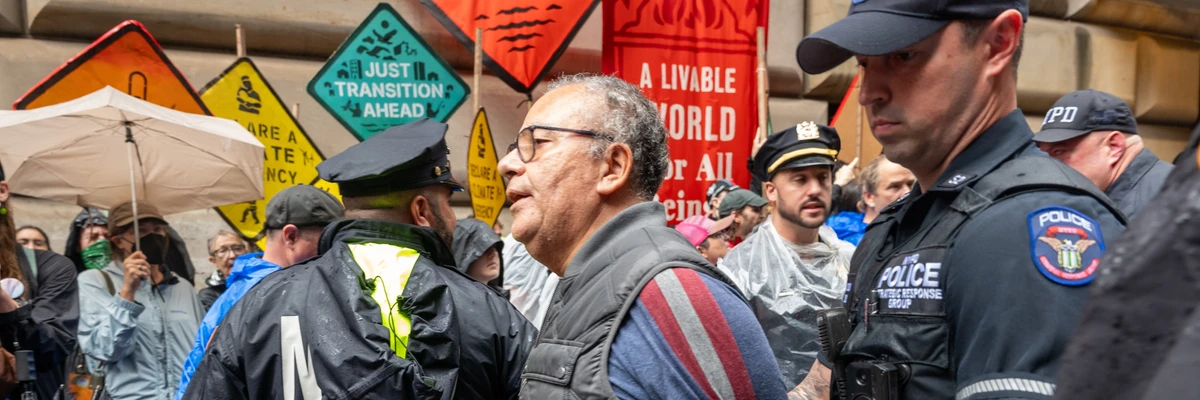
Climate activists block Federal Reserve bank, calling for end to fossil fuel funding

Continue Reading114 Climate Defenders Arrested While Blocking Entry to NY Federal Reserve

Faith Leaders, Zombies, Moms and Kids Agree: It’s Time for Wall Street to Stop Funding Fossil Fuels

Spread the love

Activists are not slowing down: it’s clear that Wall Street holds an outsized responsibility for the death, destruction, and chaos caused by the climate crisis.

Reposted from Common Dreams, licensed under Creative Commons (CC BY-NC-ND 3.0). Feel free to republish and share widely.

Arielle Swernoff November 18, 2022

Over the past few months, activists around the country and the world have laid the blame for climate disasters at Wall Street’s feet. In a wave of escalated actions under the name “Blame Wall Street,” dozens of groups have called out the financial industry for their financing of fossil fuels and complicity in the climate crisis.

Around the country, people took on elevated amounts of risk in order to increase pressure on the dirty banks, insurance companies, and asset managers financing the climate crisis.

Activists pummeled the banks with actions and protests for months. Over 40 groups across the country held over 50 actions and protests.

In New York City, a week of action targeting Citi began with moms and kids birddogging the bank’s chief sustainability officer, Val Smith, over Citi’s continued funding of Russian oil and gas interests. Later that week, activists infiltrated Citi’s Taste of Tennis gala and interrupted the event with a large banner accusing the bank of funding Russia’s war crimes.

Citi, the US’s largest funder of coal, faced additional protests at greenwashing PR events and at branches in Phoenix, Brooklyn, and other locations. Activists interrupted the speech of Citi’s Chief Sustainability Officer at a sustainable banking conference, and protested Citi, Wells Fargo, and Chase leadership at a Women in Banking event.

Chase emerged from its fall PR events similarly beleaguered. Activists crashed the Chase-sponsored US open, passing out fans to sweaty attendees accusing Chase of funding climate chaos. Later in the month, nine different affinity groups created a circus out of the San Francisco Chase Corporate Challenge, with activists taking over every part of the road race, which hundreds of Chase employees participate in, from the course to the finish line to the after party to protesting in kayaks along the route.

As the world’s largest funder of fossil fuels, it’s no surprise that Chase was protested again and again: Leavenworth, Washington; Worcester, Watertown, and Boston, Massachusetts; Madison, Wisconsin; Fort Lauderdale, Florida; Chicago, Illinois; Providence, Rhode Island; Silver Spring, Maryland; Sacramento, California; New Orleans, Louisiana; and New York City all saw protests at Chase branches or headquarters.

Another major target was asset manager BlackRock, one of the world’s top investors in fossil fuels and climate destruction. BlackRock saw protest after protest at their headquarters, with regular actions from September through November. People sang outside their building, came in costume, held prayer and faith actions, and stormed the headquarters with pitchforks and dumped coal on their escalators. BlackRock is on notice: time to stop financing fossil fuels.

Global climate strike protests also included demands on Wall Street and an end to fossil fuel financing, with activists in Los Angeles, Chicago, New York, and Maryland partnering with youth leaders to demand a safe and livable future. Climate strikers weren’t the youngest activists: in Los Angeles and New York, people protested the greed of the fossil fuel industry alongside their infants and toddlers.

Actions were creative, including art, music, and costumes. In Albany, New York, the red rebel brigade joined a protest outside of TD Bank. In Brooklyn, activists dressed up as Mr. Moneybags and brought bagpipes to branch locations of Citi, Chase, and Bank of America. In Sacramento, Denver, and New Orleans, activists staged Halloween actions, dressing up as endangered species or zombie bankers.

Faith leaders exercised their moral authority in calling on banks and asset managers to stop funding climate disaster. Near Philadelphia, Quaker activists held a prayer vigil outside of the Vanguard HQ, calling on the asset manager to stop financing fossil fuels. In Washington, DC, faith leaders called on the IMF and World Bank to do the same. Faith activists also held protests outside of the Bank of America headquarters in Charlotte, and a Bank of America branch in Springfield, Illinois. Leaders from different faith communities protested multiple times outside of BlackRock’s corporate headquarters in New York City—at one protest, 27 faith leaders were arrested.

Around the country, people took on elevated amounts of risk in order to increase pressure on the dirty banks, insurance companies, and asset managers financing the climate crisis. Dozens of people were arrested this fall—from San Francisco to New York to Pennsylvania to Rhode Island. These activists went to jail in order to show the world the greed of dirty Wall Street actors.

Activists innovated by taking repeated action at financial targets. Instead of one protest, people showed up week after week, increasing the pressure on banks and asset managers. In Phoenix, Arizona, Sacramento, California, Madison, Wisconsin, and Leavenworth, Washington, local actions happened again and again.

People targeted other financial actors, as well. Insurance companies received their fair share of pressure, with actions on Traveller’s, Hartford, and Chubb. One action saw a huge oil derrick parked outside of the home of Chubb CEO, Evan Greenberg. Groups protested the Federal Reserve in Jackson Hole, Wyoming and in Washington, DC, activists protested TIAA’s support for deforestation, there was an action outside of the shareholder meeting of Proctor & Gamble, and a noise protest outside of the homes of the CEOs of the private equity firms KKR and Blackstone. In Sierra Leone, youth activists protested the Central Bank’s support of fossil fuel expansion.

Activists are not slowing down: it’s clear that Wall Street holds an outsized responsibility for the death, destruction, and chaos caused by the climate crisis. With shareholder meetings coming up this spring, banks, insurance companies, asset managers, and pension funds should be ready for increased pressure. Banks are expected to see more shareholder resolutions calling on them to walk the talk on climate than ever before, and the grassroots movement to stop the flow of money to fossil fuels is only growing in energy and momentum. 

On December 14, we are hosting a call to share what’s next in the fight to stop the money pipeline to climate chaos. We hope you will join us.


Reposted from Common Dreams, licensed under Creative Commons (CC BY-NC-ND 3.0). Feel free to republish and share widely.

Arielle Swernoff

Arielle Swernoff

Arielle Swernoff is an organizer, strategist, and facilitator based in New York City. She is the Stop the Money Pipeline US Banks Campaign Manager.

Continue ReadingFaith Leaders, Zombies, Moms and Kids Agree: It’s Time for Wall Street to Stop Funding Fossil Fuels