Israel economy shrinks 3.3% due to war with Iran

Spread the love

This work by Middle East Monitor is licensed under a Creative Commons Attribution-NonCommercial-ShareAlike 4.0 International License.

Hundreds of Israelis gather at Habima Square to protest against Prime Minister Benjamin Netanyahu and the Israeli government in Tel Aviv, Israel on January 17, 2026. [Mostafa Alkharouf – Anadolu Agency]

Official Israeli data revealed that the Israeli economy contracted by 3.3 percent year-on-year during the first quarter of 2026, impacted by the repercussions of the ongoing war with Iran.

According to a report published Sunday by the Israeli economic website Globes, the Israeli Central Bureau of Statistics stated that the Israeli economy experienced a 3.3 percent annual contraction during the first quarter of this year.

The website explained that this sharp decline ended a period of growth that had lasted for two consecutive quarters, indicating that the war with Iran was the primary cause of the recorded economic downturn.

The data showed that the GDP per capita decreased by 4.5 percent annually compared to the last quarter of 2025, which the website described as the most realistic indicator for measuring the standard of living in Israel. The report indicated that the Israeli economy had recorded annual growth of 2.9 percent during the last quarter of 2025, before declining significantly at the beginning of this year.

The Central Bureau of Statistics stated that private consumption expenditure fell by 4.7 percent year-on-year, following a similar decline of 4.6 percent in the last quarter of last year.

Conversely, the report explained that security spending rose by 9 percent year-on-year, amid ongoing military operations.

Israel imposes strict censorship and a broad blackout on its economic and human losses resulting from the wars it is waging in the region, and it prohibits the dissemination of images and videos related to these losses.

READ: Netanyahu says Israeli army nearing completion of Gaza mission, signals readiness for all Iran scenarios

This work by Middle East Monitor is licensed under a Creative Commons Attribution-NonCommercial-ShareAlike 4.0 International License.

Keir Starmer explains that UK is actively supporting Israel's genocidal expansion and repeats his previous quotation that he supports Zionism "without qualification". Keir Starmer said “I said it loud and clear – and meant it – that I support Zionism without qualification.” here: https://www.jewishnews.co.uk/keir-starmer-interview-i-will-work-to-eradicate-antisemitism-from-day-one/
Keir Starmer explains that UK is actively supporting Israel’s genocidal expansion and repeats his previous quotation that he supports Zionism “without qualification”. Keir Starmer said “I said it loud and clear – and meant it – that I support Zionism without qualification.” here: https://www.jewishnews.co.uk/keir-starmer-interview-i-will-work-to-eradicate-antisemitism-from-day-one/
Donald Trump sings and dances, says that it's fun to kill everyone ...
Donald Trump sings and dances, says that it’s fun to kill everyone …
Orcas discuss Donald Trump and the killer apes' concept of democracy. Front Orca warns that Trump is crashing his country's economy and that everything he does he does for the fantastically wealthy.
Orcas discuss Donald Trump and the killer apes’ concept of democracy. Front Orca warns that Trump is crashing his country’s economy and that everything he does he does for the fantastically wealthy.

Continue ReadingIsrael economy shrinks 3.3% due to war with Iran

Trump Says US Fighting Iran War ‘To Help Israel… Saudi Arabia… Qatar… UAE… Kuwait’—China Too

Spread the love

Article by Stephen Prager republished form Common Dreams under Creative Commons (CC BY-NC-ND 3.0). 

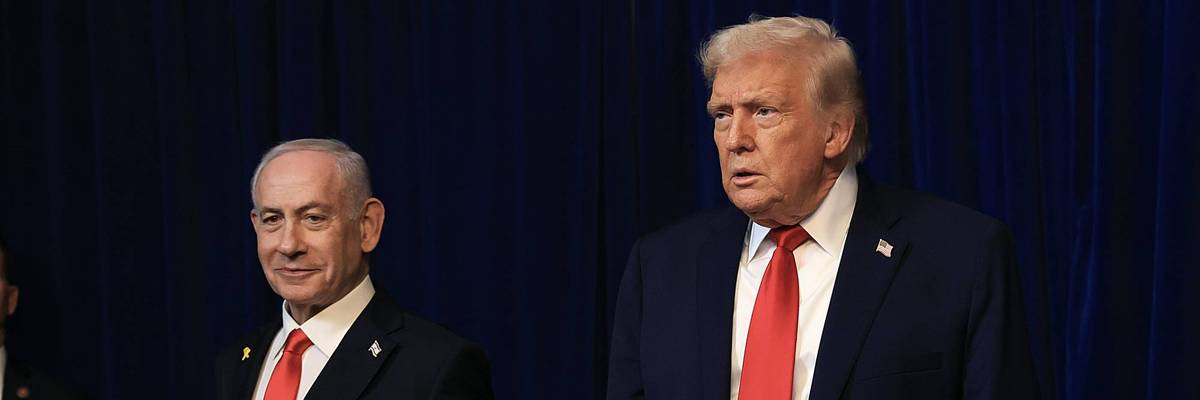
US President Donald Trump holds a press conference with Israeli Prime Minister Benjamin Netanyahu at his Mar-a-Lago club on December 29, 2025, in Palm Beach, Florida. (Photo by Joe Raedle/Getty Images)

“Trump again says the quiet part out loud—America entered the Iran war to support a genocidal ethno-state and brutal absolute autocracies, all of whom are his political and commercial financiers.”

During his campaign for reelection, one of President Donald Trump’s central pitches was that the US needed to stay out of foreign wars in order to prioritize “America first.”

But his decision to join Israel and launch a massive war with Iran, which has caused turmoil across the American economy, has left many voters rather skeptical of these motivations, believing the war benefits other nations—particularly Israel—more than the US.

RECOMMENDED…

'We Can Tell': Trump Confesses He Doesn't 'Think About Americans' Financial Situation' When It Comes to Iran War

‘We Can Tell’: Trump Confesses He Doesn’t ‘Think About Americans’ Financial Situation’ When It Comes to Iran War

Pete Hegseth

Trump Cries ‘Virtual Treason’ as US News Outlets Detail Iran War Intel Assessments

That perception has not been assuaged by statements from officials like Secretary of State Marco Rubio, who acknowledged in the early days of the war that a so-called “imminent threat” to the US only existed because Israel had planned to attack, or by the president’s recent comment that he doesn’t “think about Americans’ financial situation” regarding the war.

In an interview with Sean Hannity on Fox News on Thursday, Trump appeared to further affirm that the Iran invasion’s impact on his own country is far from top-of-mind.

Trump was asked by Hannity about his weekslong effort to reopen the Strait of Hormuz, which Iran closed in response to the war’s launch, causing a spike in global oil prices that has hit the US. Reopening the strait has become one of Trump’s main demands as he pushes for a deal with Iran, even though it was open before the war began.

But Trump said on Thursday that other countries “need the strait more than we need it open.” He cited his administration’s aggressive expansion of oil drilling, which he has claimed would make the US more resilient to the oil shock, although it hasn’t been enough to stop gas prices from soaring above $4.50/gallon on average.

“We don’t need it at all,” Trump said, to which Hannity responded incredulously, “We don’t need it at all?”

“We don’t need it at all,” Trump reiterated. “I mean, you could make the case, you know, like why are we even, we’re doing it to help Israel, and to help Saudi Arabia, and to help Qatar and [the United Arab Emirates] and, you know, Kuwait and other countries, Bahrain—”

Hannity interjected: “It also helps China.”

Speaking of his summit this week with Chinese leaders, including President Xi Jinping, Trump said: “Actually, I told him today, I said, ‘You know, we’re helping you, and we’re helping you in another way,’ because I don’t think they want, I don’t think China wants Iran to have a nuclear weapon either.’”

Trump’s director of national intelligence, Tulsi Gabbardtestified in a written statement to Congress in March that Iran had not tried to rebuild its nuclear enrichment capability after earlier US and Israeli attacks last June, which undercut one of the administration’s primary rationales for war.

Trump’s former National Counterterrorism Center director, Joe Kent, said last week that the US intelligence community agreed in the days leading up to the war that “Iran wasn’t developing a nuclear weapon,” but said that these assessments were undermined by persuasion from “a foreign government—Israel,” which “won the argument and forced us into this war.”

Many of the US’s Persian Gulf allies have publicly tried to distance themselves from the war, especially in the face of retaliation from Iran. But The Associated Press has reported that countries like the UAE, Saudi Arabia, Kuwait, and Bahrain have pushed Trump behind the scenes to continue escalating the war in an effort to weaken Iran militarily and force more permanent changes to the regime.

Some have noted the Trump family’s close personal ties to the Gulf regimes—from his family’s cryptocurrency venture which is buoyed by a $500 million investment from a powerful member of Abu Dhabi’s ruling family; to his son in law Jared Kushner’s private equity firm, which has received $2 billion from Saudi Arabia’s public investment fund; to his real estate empire which has lucrative Trump-branded properties popping up across the region.

Independent journalist Borzou Daragahi said that with his latest comments, “Trump again says the quiet part out loud—America entered the Iran war to support a genocidal ethno-state and brutal absolute autocracies, all of whom are his political and commercial financiers.”

Article by Stephen Prager republished form Common Dreams under Creative Commons (CC BY-NC-ND 3.0). 

Continue ReadingTrump Says US Fighting Iran War ‘To Help Israel… Saudi Arabia… Qatar… UAE… Kuwait’—China Too

Another Oil War, Another Perfect Reason to Stop Burning It

Spread the love

Original article by Kyle Schmidlin republished form Common Dreams under Creative Commons (CC BY-NC-ND 3.0). 

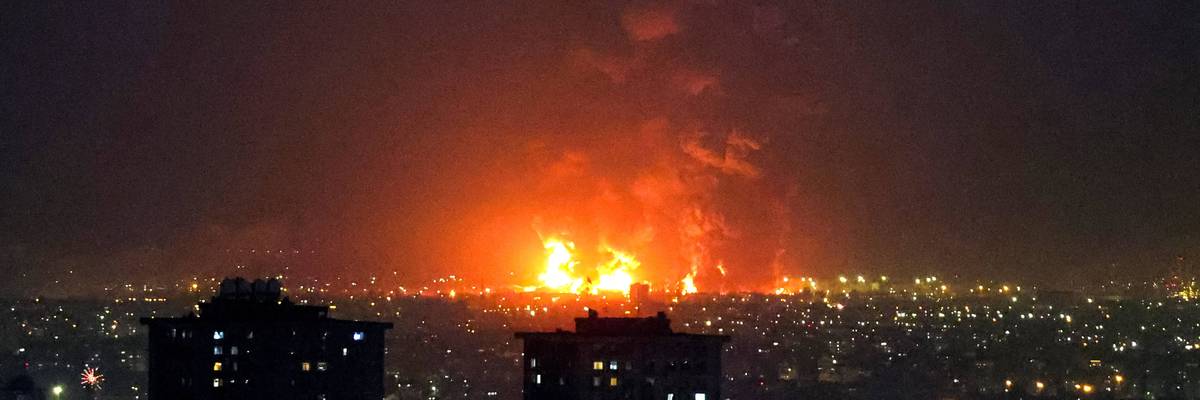
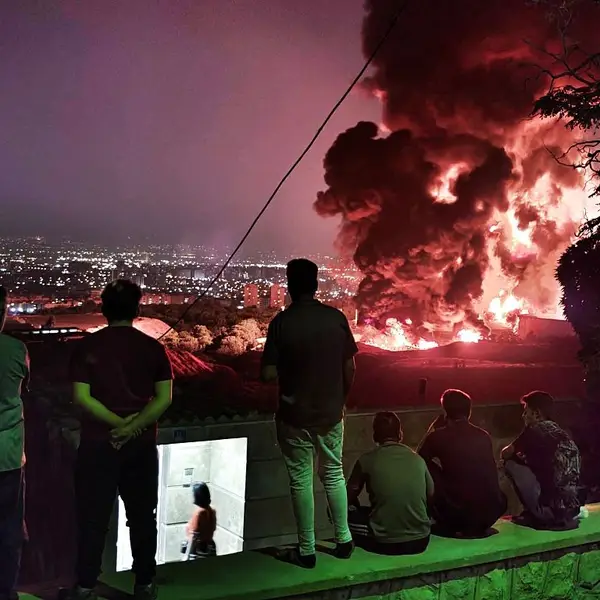
Explosions erupt following strikes at Tehran Oil Refinery in Tehran on March 7, 2026. (Photo by Atta Kenare/ AFP via Getty Images)

It’s a dirty business that’s ruining the planet and jeopardizing our futures in countless ways, of which this despicable war in Iran is just the latest and highest profile.

On February 28, President Donald Trump and Israeli Prime Minister Benjamin Netanyahu started a war with Iran. Since then, violence has spread throughout the Middle East. On the first day of bombing, the US bombed an elementary school, killing more than 100 children. Iran struck back, hitting Israel and US bases in the region. Israel expanded into Syria and Lebanon, bombing apartment buildings in Beirut. A few weeks ago Israel bombed oil depots in Tehran, engulfing the sky in flames and raining toxic oil on a population bigger than New York City.

But all Americans can think of, naturally, is the price of gas.

RECOMMENDED…

Iran Calls Israeli Strikes 'Declaration Of War' As Region Braces For Escalation

As Another Oil-Fueled War Erupts, Study Reveals Planet Heating at Unprecedented Rate

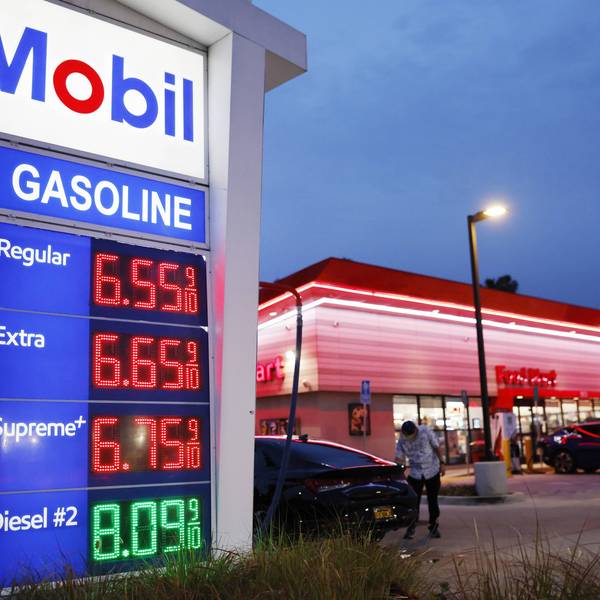
Gas prices are displayed at a Mobil gas station

As G7 Weighs Measures to Confront Growing Energy Crisis, Officials Urged to Tackle ‘Fossil Fuel Profiteering’

Oil is both a major driver of this war and, for now at least, the primary way Americans are feeling its effects. The war drives home the grim reality that we are hostage to this toxic ooze that burns dirty, poisons wildlifecauses cancer, and accelerates climate change. The necessity to wean ourselves off of it, as quickly and completely as possible, has never been more apparent.

An Oil Crisis of Trump’s Own Making

Even Trump is subservient to the whims and demands of the oil economy. Since he started the war, he’s tried desperately to control the chaotic effect his bombing campaign has had on global oil markets. Trump may not be bright, but he understands one very basic political reality: He can cover up the Epstein files, get away with all manner of fraud and graft, and even commit war crimes—but he cannot let the price of gas get too high.

Oil makes all our lives dirtier and less safe. Fighting wars so we can dig it up until it’s all gone—or until we are—is as stupid, reckless, and self-destructive a thing as any animal has ever done.

From a strategic perspective, then, the focal point of the war quickly became the Strait of Hormuz, a narrow passageway out of the Persian Gulf that pinches down between southern Iran and the Omani Musandam Peninsula. The strait is an essential shipping lane for 20% of the world’s liquefied natural gas (LNG), as well as a third of the global fertilizer trade. With essentially uncontested control of the strait, Iran has closed it to “enemy-linked” ships. Iran insists that non-hostile ships pay a toll in Chinese yuan, which is an attempt to undermine the supremacy of the petrodollar.

The crisis at the Strait of Hormuz is entirely of Trump’s own making, and has triggered an erratic series of threats, pleas, lies, and bargaining from him as he tries to keep his stupid war from grinding the global economy to a halt. Trump has even threatened to deploy the US Navy to escort ships through the strait. One has to wonder how sailors feel about being offered up as bodyguards for Qatari tankers, thrown into a situation where they would be wide open for Iranian drone and missile attacks.

Trump the Oil Imperialist

Trump sees this war almost entirely through the lens of oil. As part of alleged ceasefire negotiations, Trump claimed Iran “gave us a present… worth a tremendous amount of money… it was oil-and-gas related.” That turned out to be Iran allowing 10 oil ships through the Strait of Hormuz. Trump also implied that those high gas prices causing so many people pain at the pump are actually good for the country. Because the US is a net exporter of oil, Trump said, “When oil prices go up, we make a lot of money”—perhaps forgetting that most Americans do not own oil companies.

Compare Trump’s constant talk of oil with the Bush administration’s 2003 invasion of Iraq. In 2003-06, calling Iraq a war for oil was considered a conspiracy theory. Dissidents and war critics were driven out of polite conversations for even bringing it up. Insinuating that the troops would ever be deployed for such an ignoble purpose was treated as beyond the pale, if not treasonous, by Fox News and the Bush White House.

This time, there’s next to no pretense of nobility in Trump’s war. While lots of motivations, with varying degrees of believability and logic, have been given—ranging from halting Iran’s nuclear capabilities to ushering in Armageddon—the Trump administration is perfectly open about the centrality of oil to their war mission. In a way, it’s almost refreshing to hear a politician speak so forwardly about their imperialist intent, even if it does lay bare the villainy of the US empire.

In addition to the Strait of Hormuz, Trump is focused on Kharg Island, a small island in the Persian Gulf that handles up to 90% of Iran’s crude oil exports. Sen. Lindsey Graham (R-SC), who is among the most bloodthirsty war hawks on the planet, encouraged Trump to seize Kharg Island (and compared such an operation to Iwo Jima, in which 7,000 Marines died—no skin off Lindsey Graham’s back). Trump himself then said, while discussing his military options, “My favorite thing is to take the oil in Iran.”

Trump has long openly fantasized about using the military to conquer oil fields. In 2013, before his political career really started, he tweeted, “I still can’t believe we left Iraq without the oil,” and he repeated this urge to plunder Iraq’s oil during the 2016 election. To Trump, this is just how the world works: If your guns and bombs make bigger holes and explosions, you get to just take whatever you want, anywhere in the world. There is no right, no wrong, no law.

This also tracks with how Trump has handled the oil industry in Venezuela. Last year, Trump started claiming that Venezuela had stolen, or “unilaterally seized and sold American oil.” This claim was a reference to Venezuela nationalizing their oil industry and evicting American oil companies. Then, in January, the US military abducted Venezuelan President Nicolás Maduro, an astonishing breach of international norms. With Maduro gone, Trump began shadily directing Venezuelan oil revenue into an offshore Qatari account.

The Need to Wean Ourselves off of Oil

Such oil imperialism long predates Trump. Just ask other offenders of the US oil monopoly, like Muammar Gaddafi or Saddam Hussein. Oil is the locus of US foreign policy. The US military itself is the single largest institutional polluter and user of fossil fuels. It’s a dirty business that’s ruining the planet and jeopardizing our futures in countless ways, of which this despicable war in Iran is just the latest and highest profile.

The simple answer to all this madness is to wean ourselves off of oil. It won’t be easy, and we’ll probably never be fully rid of it, but we aren’t even trying. There are a million ways we could start cutting back, a million investments we could make toward a future that is as oil free as possible. But Trump is doing everything he can to keep us addicted to it, including starting an unpopular and illegal war.

Trump has always been particularly pro-fossil fuel. He loves the nonsensical phrase “beautiful clean coal.” He calls green energy a “scam” and has repeatedly made the utterly deranged claim that windmills cause cancer. His administration displays a psychotic obsession with destroying green energy initiatives, most recently paying a French energy company $1 billion to cancel a wind farm and instead invest in oil and gas.

Oil makes all our lives dirtier and less safe. Fighting wars so we can dig it up until it’s all gone—or until we are—is as stupid, reckless, and self-destructive a thing as any animal has ever done. With a little bit of will and some leadership, we could control our greed and addiction. If we were able to do that, we might not find ourselves charging into the Middle East on such a regular basis, burning through American lives and treasure, killing countless men and women and children, and making the rest of the world hate us.

Original article by Kyle Schmidlin republished form Common Dreams under Creative Commons (CC BY-NC-ND 3.0). 

Climate science denier Donald Trump confirms that he knows nothing about democracy and that more liquid gold is being secured according to his policy of global privateering.
Donald Trump urges you to be a Climate Science denier like him. He says that he makes millions and millions for destroying the planet, Burn, Baby, Burn and Flood, Baby, Flood.
Orcas comment on killer apes destroying the planet by continuing to burn fossil fuels.

Continue ReadingAnother Oil War, Another Perfect Reason to Stop Burning It

Warnings of Iran Invasion Grow as US to Send Up to 5,000 Marines, Sailors to Middle East

Spread the love

Original article by Stephen Prager republished from Common Dreams under Creative Commons (CC BY-NC-ND 3.0). 

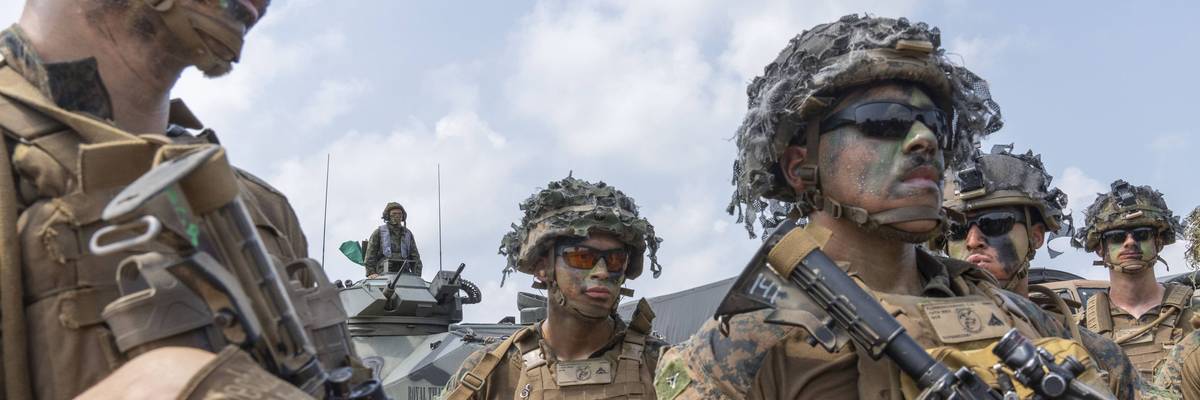
US marines stand on a beach in Sattahip, Thailand after taking part in the 46th Cobra Gold multinational military exercises co-hosted by the Royal Thai Armed Force and the US Indo-Pacific command on February 26, 2026. (Photo by Adryel Talamantes/Anadolu via Getty Images)

“Bringing this war to an end,” said one former US intelligence analyst, “requires recognizing it can still get much, much worse.”

In what has been described as a potential “major escalation” of the Trump administration’s war with Iran, Defense Secretary Pete Hegseth has reportedly approved a request from US Central Command to move more warships and thousands of Marines to the Middle East following Iran’s attacks on vessels in the Strait of Hormuz.

Citing three US officials, The Wall Street Journal reported on Friday that the US was sending “an element of an amphibious ready group and attached Marine expeditionary unit, typically consisting of several warships and 5,000 Marines and sailors.”

RECOMMENDED…

image shoes US military planes headed to the midde east

‘The Tankers Just Keep Coming’: US Military Movements Spike Fears of Imminent Attack on Iran

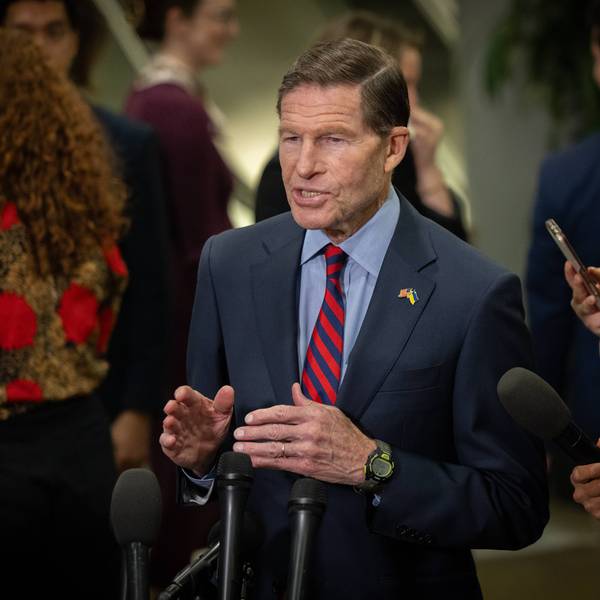
Sen. Richard Blumenthal speaks to reporters

After Secret Briefing, Dem Senators Warn Trump ‘On a Path’ to Ground Invasion of Iran

According to the Journal, the Japan-based USS Tripoli and its attached Marines are already headed to the Middle East.

While the Journal did not explicitly report that the operation was tied to the volatile situation in the Strait of Hormuz, it noted that “the move comes as Iran’s attacks on the strait have paralyzed traffic through the strategic waterway, disrupting the global economy, driving up gas prices and posing a major military and political challenge for President [Donald] Trump.”

In his first address on Thursday, delivered by a news anchor on Iranian state TV, the country’s new supreme leader, Mojtaba Khamenei, said that “the lever of blocking the Strait of Hormuz must definitely be used” to heighten economic pressure on the US.

Iran’s Islamic Revolutionary Guard Corps (IRGC) has declared that “not a liter of oil” shall pass through the strait, and vowed to attack any ship linked to the US and Israel that may attempt to make the journey.

Iran has reportedly attacked at least six commercial ships in the area since Wednesday, including one marked with a Thai flag that still has three crew members missing. US intelligence sources have also accused Iran of laying mines in the Strait, which Iran has neither confirmed nor denied.

The blockage of the strait, through which about one-fifth of global oil shipments pass each year, has sent the global market into chaos. Prices of Brent crude have surged from under $70 less than a month ago to more than $100 per barrel on the global market, and US gas prices have leaped to $3.63 per gallon on average, up from $2.94 a month ago.

Prices have continued to climb even after the International Energy Agency (IEA) announced its largest-ever coordinated release of oil from nations’ strategic reserves on Wednesday to combat what it called “the largest supply disruption in the history of the global oil market.”

Shashank Joshi, the defense editor at The Economist and a visiting fellow at the Department of War Studies at King’s College London, said that a deployment of such a large Marine force seems to be “a key indicator of a potential ground operation” in Iran.

Trump said earlier this week that he was “nowhere near” sending troops into Iran even as it ramped up threats to block the strait. But privately, he has reportedly been mulling plans to put “boots on the ground” within Iranian territory to accomplish a number of objectives, though officials have characterized them as limited special-operations missions.

Administration officials have reportedly suggested a commando raid on Iran’s nuclear sites to confiscate or sabotage its supply of uranium, according to Axios. They’ve also considered a plan to occupy Kharg Island, which sits 15 miles off Iran’s coast and handles about 90% of its oil exports, serving as an economic “lifeline” for the battered nation.

But Trump has also said that if Iran blocks the strait, “the US Navy and its partners will escort tankers through the strait, if needed.” Chairman of the Joint Chiefs, Gen. Dan Caine, has said the Pentagon is looking at “a range of options” to do this.

In an analysis published Tuesday by Zeteo, Harrison Mann, a former US Army major and executive officer of the Defense Intelligence Agency’s Middle East/Africa Regional Center, suggested that the US may pursue an ambitious plan to “clear Iran’s coastline around the strait” to get tankers moving again.

Mann, who worked under the Biden administration but resigned in protest of its support for the genocide in Gaza, said this plan would require “an indefinite occupation–otherwise missile trucks could just get in position after US forces leave.” Doing this, he added, would require “a full-fledged invasion, possibly beyond even the 10,000 or so rapid-response forces at Trump’s disposal.”

“All of these ground operations risk high casualties while failing to accomplish their missions,” Mann said. “That’s a feature, not a bug. Even if one of these operations met its objectives, troops in peril behind enemy lines demand resupply, evacuation, and revenge, which puts more troops in peril behind enemy lines, and so on.”

The movement of more troops comes as the US public expresses strong disapproval of Trump’s war with Iran. In a Quinnipiac poll published this week, 53% of registered voters said they opposed US military action against Iran, while just 40% approved.

About 74% said they feared that the war would cause oil and gas prices to rise, and 71% feared that the war would last “months” or longer.

Trump’s former chief strategist, Steve Bannon, who remains one of his top allies in media, said on his War Room podcast that deploying such a large military force “sends a signal to Iran, but it also sends a signal to the American people: This is a major escalation.”

Mann said that putting troops on the ground in Iran will only “ensure that Trump can’t back out easily, which is exactly what [Israeli Prime Minister Benjamin] Netanyahu, [US Sen.] Lindsey Graham (R-SC), and their ilk need to fracture Iran.

“Bringing this war to an end,” Mann said, “requires recognizing it can still get much, much worse, refusing to fall for the promise of ‘small special ops raids,’ and calling these courses of action what they are: a prelude to forever war.”

Original article by Stephen Prager republished from Common Dreams under Creative Commons (CC BY-NC-ND 3.0). 

Climate science denier Donald Trump says that more liquid gold is being secured according to his policy of global privateering
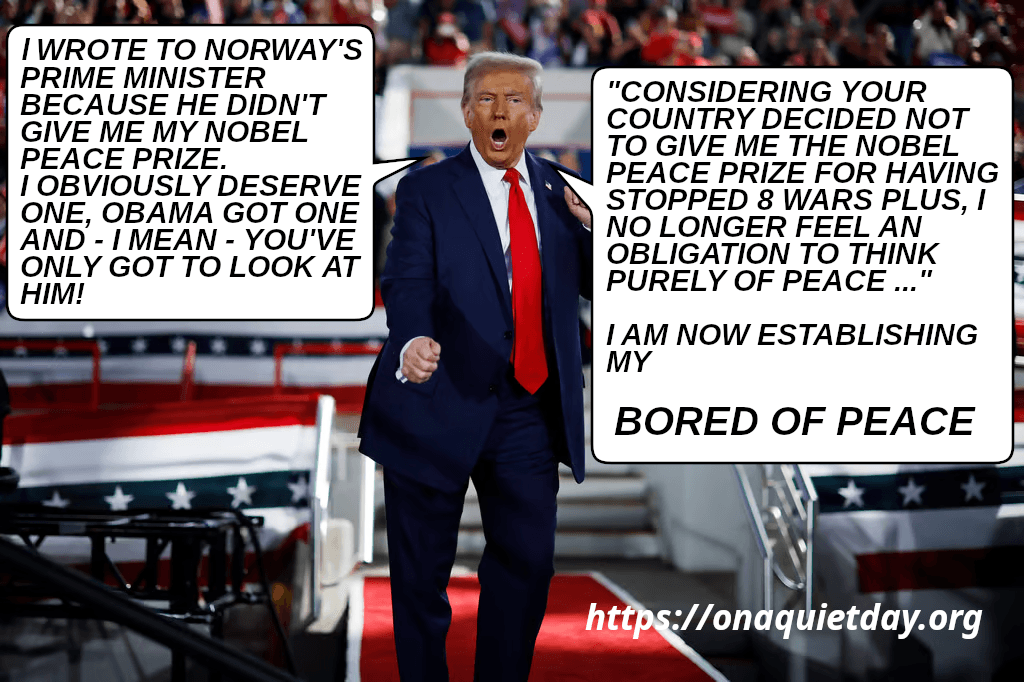
Donald Trump explains why he established his Bored of Peace
Orcas discuss rotting brain. Front Orca says "Wish someone would lock him up".
Orcas discuss rotting brain. Front Orca says “Wish someone would lock him up”.

Continue ReadingWarnings of Iran Invasion Grow as US to Send Up to 5,000 Marines, Sailors to Middle East

Netanyahu to Press for ‘Another Round of War With Iran’ in Meeting With Trump This Week

Spread the love

Original article by Stephen Prager republished from Common Dreams under Creative Commons (CC BY-NC-ND 3.0). 

Israeli Prime Minister Benjamin Netanyahu, accompanied by US President Donald Trump speaks during a dinner in the Blue Room of the White House on July 7, 2025 in Washington, DC. (Photo by Andrew Harnik/Getty Images)

Amid a growing rift between Israel and the White House, one foreign policy analyst says the meeting “will signal whether Washington is prepared to continue underwriting open-ended escalation.”

As Israeli Prime Minister Benjamin Netanyahu heads to Mar-a-Lago to meet with US President Donald Trump on Monday, amid a growing rift with the president and his advisers, reports say he’ll seek to push the US back toward war with Iran.

Last week, NBC News reported that at the meeting, “Netanyahu is expected to make the case to Trump that Iran’s expansion of its ballistic missile program poses a threat that could necessitate swift action” and that “the Israeli leader is expected to present Trump with options for the US to join or assist in any new military operations.”

RECOMMENDED…

Walmart CEO Doug McMillon

As Wage Growth Slows and Unemployment Rises, Trump Tax Cuts Deliver Big for Mega-Rich Retail CEOs

Investigation Shows How Decades of Corporate Consolidation Have Devastated US Cattle Ranchers

Investigation Shows How Decades of Corporate Consolidation Have Devastated US Cattle Ranchers

“Netanyahu plans to press Donald Trump for US backing for another round of war with Iran, now framed around Iran’s ballistic missile program,” said Sina Toossi, a senior fellow at the Center for International Policy. “Netanyahu’s pivot to missiles should therefore be read not as the discovery of a new threat, but as an effort to manufacture a replacement casus belli after the nuclear argument collapsed.”

He noted criticisms levied against Netanyahu by Yair Golan, chair of the Democrats, a center-left party in Israel, earlier this week: “How is it possible that last June, at the end of the war with Iran, Benjamin Netanyahu solemnly declared that ‘Israel had eliminated Iran’s nuclear threat and severely damaged its missile array’; and that this was a ‘historic victory’—and today, less than six months later, he is running to the president of the United States to beg for permission to attack Iran again?” Golan said.

Iran is just one of several areas the two will likely discuss on Monday. According to Israeli officials who spoke to the Washington Post, Netanyahu also reportedly wants Trump to “take a tougher stance on Gaza and require that Hamas disarm before Israeli troops further withdraw as part of the second phase of Trump’s 20-point peace plan.”

The chief of Israel’s armed forces suggested earlier this week that its occupation of more than half of Gaza would be permanent, but walked those comments back after reported behind-the-scenes outrage in the White House. Meanwhile, Trump—invested in his image as a peacemaker—has reportedly balked at Israel’s routine violations of the ceasefire agreement he helped to broker in October.

Near-daily strikes have resulted in the death of at least 418 Palestinians, according to the Gaza Media Office. Meanwhile, Israel’s continued blockade of humanitarian aid has left hundreds of thousands of people—displaced from homes destroyed by Israeli bombing—to languish in the cold without tents. Desperately needed fuel, food, and medicine have entered the strip at far lower numbers than the ceasefire agreement required.

As Axios reported on Friday, Trump’s advisers increasingly fear that Netanyahu is intentionally slow-walking and undermining the peace process in hopes of resuming the war.

Netanyahu also seeks Trump’s continued backing of Israel’s territorial expansion in Syria. Earlier this month, the Israel Defense Forces (IDF) pushed through a UN-monitored demilitarized zone between Israeli and Syrian-held positions in the Golan Heights, which Israel illegally occupies.

This push into southern Syria went against the wishes of the Trump administration, which feared it could destabilize the Western-backed government that rules in Damascus following the ouster of former President Bashar al-Assad.

Israel has also routinely struck Lebanon in violation of the US-brokered ceasefire it signed with Hezbollah in late 2024, with bombings becoming a near-daily occurrence in December. Last month, the UN reported that at least 127 civilians, including children, had been killed in Israeli strikes since the ceasefire began.

“Netanyahu’s visit unfolds against a backdrop of unresolved fronts, with widening disputes with Washington over the second phase of the Gaza ceasefire, including postwar governance, reconstruction, and Turkish involvement,” Toossi said. “At the same time, Israel is seeking greater latitude to escalate again against Hezbollah in Lebanon, an end to US accommodation of Syria’s new leadership, and firm assurances on expanded military aid.”

“Taken together, Netanyahu’s visit is less about resolving any single crisis than about postponing strategic reckoning,” he continued. “The outcome will signal whether Washington is prepared to continue underwriting open-ended escalation, or whether this meeting marks the beginning of clearer limits on Israel’s regional strategy.”

Original article by Stephen Prager republished from Common Dreams under Creative Commons (CC BY-NC-ND 3.0). 

Continue ReadingNetanyahu to Press for ‘Another Round of War With Iran’ in Meeting With Trump This Week