This work by Middle East Monitor is licensed under a Creative Commons Attribution-NonCommercial-ShareAlike 4.0 International License
Displaced Palestinians, staying in makeshift tents, struggle to survive under harsh conditions as rain and severe storms affect the Nuseirat Refugee Camp of Deir al-Balah, Gaza on December 27, 2025. [Moiz Salhi – Anadolu Agency]
At least 235,000 people have been affected by a “man-made” crisis in Gaza after low-pressure weather systems hit the war-ravaged enclave, the head of the UN agency for Palestinian refugees (UNRWA) said Monday, Anadolu reports.
“Months of war and displacement forced people in Gaza to live amid collapsing ruins in makeshift shelters or in flimsy tents,” UNRWA Commissioner-General Philippe Lazzarini said on the US social media company X.
“While Storm Byron that struck Gaza on December 10 was a natural hazard, its consequences are man-made,” Lazzarini stressed.
Heavy rains and strong winds triggered by low-pressure weather systems caused the collapse of 17 buildings and the full or partial damage of more than 42,000 tents or makeshift shelters and affected at least 235,000 people between Dec. 10 and 17, Lazzarini said, citing data by the Shelter Cluster in Gaza.
A new wave of weather depression has been battering Gaza since the weekend, causing the death of two people and the uprooting of tens of thousands of tents, according to civil defense.
Weather conditions pose great danger to displaced Palestinians who are living in worn-out tents or severely damaged high-risk buildings, which have been under repeated Israeli strikes since October 2023.
The Israeli army has killed more than 71,200 people, mostly women and children, and injured over 171,200 others since October 2023 in Gaza in a brutal assault that also left the enclave in ruins.
Despite a ceasefire that took effect in Gaza on Oct. 10, Israel still closes the territory’s crossings and prevents the entry of mobile homes and reconstruction materials, worsening the plight of nearly 2.4 million people in the enclave.
Keir Starmer objects to criticism of the IDF. He asks how could anyone object to them starving people to death, forced marches like the Nazis did, bombing Gaza’s hospitals and universities, mass-murdering journalists, healthworkers and starving people queuing for food, killing and raping prisoners and murdering children. He calls for people to stop obstructing his genocide for Israel.Orcas discuss Genocide-supporting and complicit Zionists. Donald Trump, Keith Starmer, David Lammy, Rachel Reeves, Angela Rayner and Wes Streeting are acknowledged as evil genocide-complicit and supporting cnuts.Donald Fuhrump says that Amerikkka doesn’t bother with crimes or charges anymore, not being 100% Amerikkkan and opposing his real estate intentions is enough.
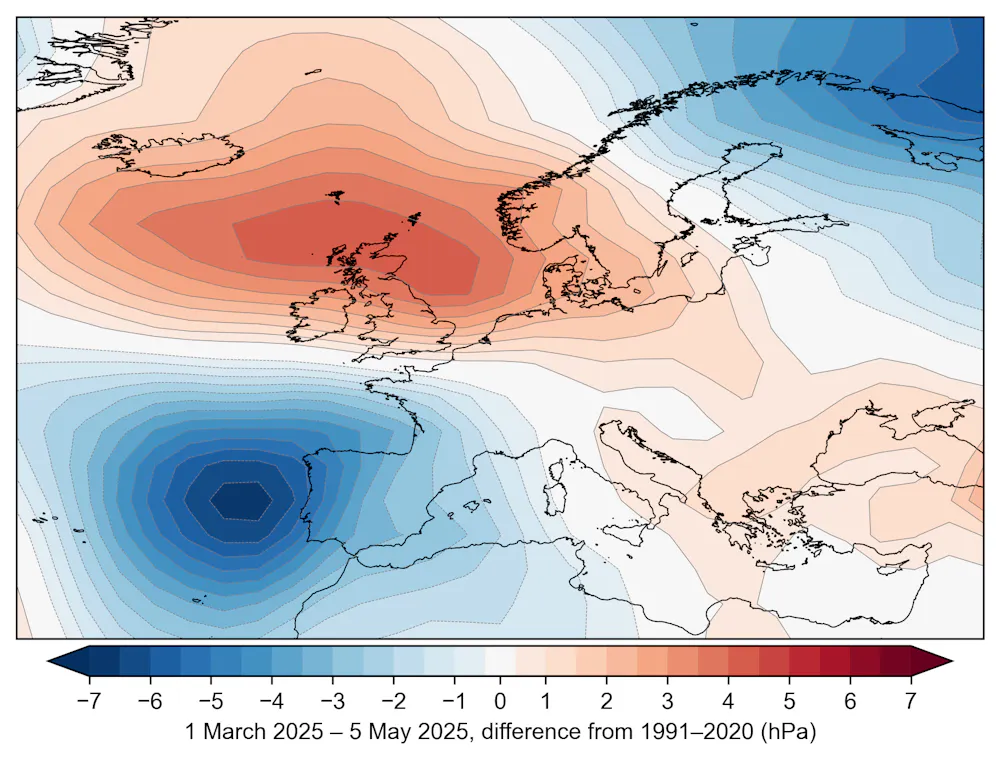
A “blocking” weather system lingering high above the UK has produced one of the driest, warmest and brightest starts to spring on record.
April 2025 was the sunniest since records began in 1910. This followed the third-sunniest March, and both months saw temperatures well above average nationwide. On May 1, the temperature reached 29.3°C in Kew Gardens in London – a new record for the date.
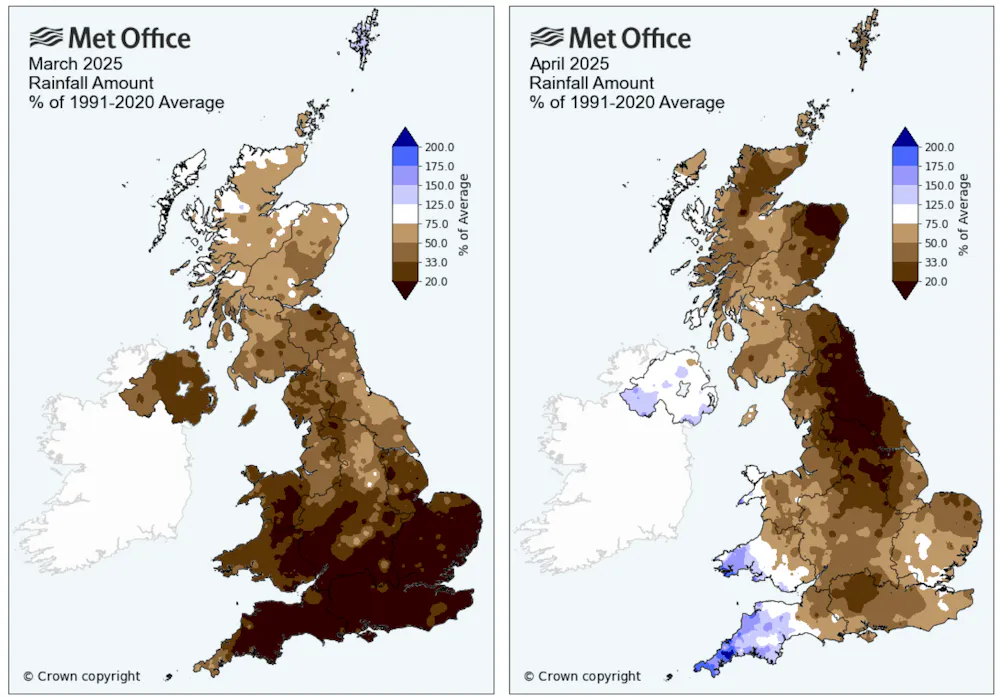
Meteorologists are warning of the potential for a summer drought, as the UK has seen roughly half its usual amount of rainfall for March and April. While farmers fret about this year’s harvest, some water companies are urging customers to help reservoir levels recover by limiting water use.
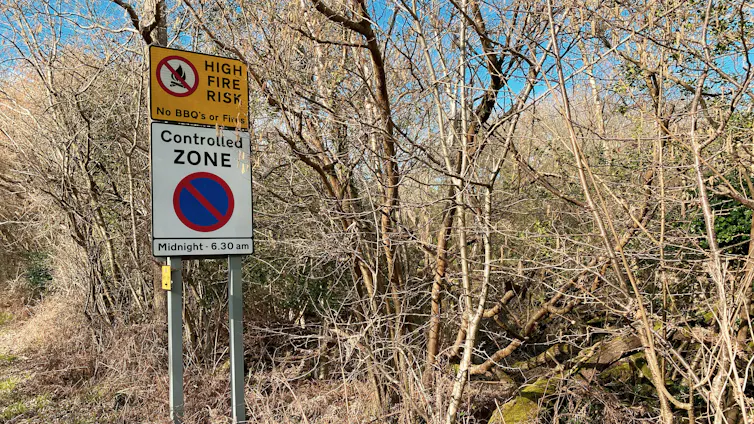
Meanwhile, wildfires have engulfed forest and moorland in areas of Scotland, Wales and England.
Most of the UK has experienced a record-dry spring so far. Met Office
For several weeks, a stubborn area of high pressure over the UK has diverted the usual flow of mild, moist air from the North Atlantic like a boulder in a river. This is known as a blocking weather system.
Within it, air descends, warms and dries, which is why this weather pattern tends to be linked to heatwaves and drought. Blocking is usually persistent, making it seem like the weather is stuck.
Here’s how climate change may have played a role in setting up this unusual spring.
The warming climate means that unusually warm weather is occurring more often and becoming more intense. At the same time, we can expect more periods of both severe drought and extreme rainfall. Sudden changes from drought to deluge, termed “weather whiplash”, are due to the intensification of the water cycle in a warmer atmosphere that can hold more water vapour.
However, certain weather patterns are necessary to produce extreme weather. More blocking events in future could increase the chance of heatwaves or drought. But are blocking weather patterns becoming more common?
It’s difficult to determine how weather patterns will change as a result of the rising concentration of greenhouse gases in the atmosphere, which is predominantly caused by the burning of fossil fuels.
Part of the difficulty arises from the fact that weather patterns vary year to year. Several years in a row with more blocking events than usual could make it seem like blocking is increasing due to climate change, but it could simply be down to chance.
As a result, it is difficult to detect the fingerprint of human activity from weather observations alone. For example, blocking weather patterns over Greenland during summer have happened more often in recent decades, which can enhance the melting of the ice sheet. But it isn’t clear that this trend is the result of human-induced climate change.
Climate models do suggest future changes in the occurrence of blocking, however. These computer simulations, consisting of equations that describe the fundamental physics of the atmosphere, are the main tool scientists use to perform experiments that parse how the climate will behave in future.
When scientists run climate model simulations with increased greenhouse gas concentrations the results consistently show a decrease in blocking events. But blocking generally happens more often in real life than model simulations, which reduces the confidence scientists have in future projections.
Keeping track of the jet stream
The movement of weather systems in Earth’s mid-latitudes – including over the UK – is linked to the jet stream, which is a fast-flowing river of air driven by the contrast in temperature between the poles and mid-latitudes.
Some researchers have suggested that, because the Arctic is warming faster than the tropics, the jet stream may weaken and become more “wavy”, increasing the occurrence of blocking events, contrary to what most climate models show.
Outside of the scientific community, this idea has become popular. However, the hypothesis remains controversial among scientists, and observational evidence has weakened in recent years.
In fact, around ten kilometres above the Earth’s surface, near commercial aircraft cruising altitudes, the opposite trends are occurring: the temperature difference between the Arctic and mid-latitudes is increasing, acting to increase the strength of the jet stream.
There are considerable challenges with understanding how climate change is affecting the large-scale atmospheric patterns which drive the weather we experience. These include large natural variability and imperfect climate models. Models mostly suggest a decline in blocking events with climate change, though this remains relatively uncertain compared with other aspects of the science.
Overall, we can be confident that climate change is bringing warmer conditions in all seasons. Scientists also have strong evidence to suggest that drought conditions will become more common. These changes are already affecting food production, energy generation and water availability and these impacts will continue to worsen with climate change.