Western Media Manufactured Consent for Israel’s Murder of Palestinian Journalists
Original article by Emma Lucia Llano republished from FAIR under a Creative Commons Attribution-NonCommercial-NoDerivs 3.0 Unported License.
Israel’s targeted assassination of six Palestinian media members in the Gaza Strip on August 10 sent shockwaves through the journalism community. Though the murder of journalists has been a common tool of the Israeli’s government’s suppression of information coming out of Gaza, the loss of Al Jazeera‘s Anas al-Sharif was particularly harrowing.
Many of us had been moved by al-Sharif’s heart-wrenching coverage, from watching him remove his press vest in relief when a ceasefire was announced (1/19/25), to seeing a languid al-Sharif reporting on the famine (7/21/25) as people fainted around him. “Keep going, Anas, don’t stop,” said a voice off-camera. “You are our voice.”
Three of the victims were al-Sharif’s colleagues at Al Jazeera, one of the few media outlets that was able to keep journalists reporting in Gaza despite Israel’s blockade. As millions around the world grieved not just for al-Sharif but for his colleagues Mohammed Qreiqeh, Mohammed Noufal and Ibrahim Zaher, and freelancers Moamen Aliwa and Mohammad al-Khaldi, we were also gravely concerned about the vacuum their murders created of on-the-ground coverage of the genocide.
Establishment media, however, used these courageous journalists’ murders as an opportunity to continue parroting the same Zionist talking points that contributed to manufacturing consent for their killings. FAIR looked at 15 different news outlets’ initial coverage of the murders: the New York Times, Los Angeles Times, Washington Post, Wall Street Journal, Financial Times, ABC, CBS, NBC, CNN, Fox, BBC, Politico, Newsweek, Associated Press and Reuters.
We found that they overwhelmingly centered Israel’s narrative, attempted to delegitimize pro-Palestinian sources, and failed to contextualize the killings within the larger context of the genocide.
Prioritizing Israel’s pretext
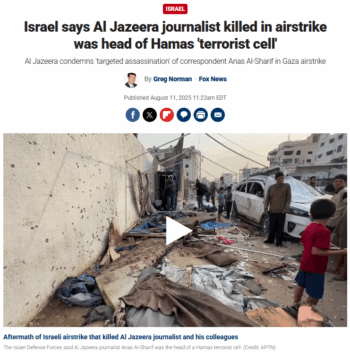
Fox News (8/11/25) went farthest in embracing Israel’s “terrorist” narrative.
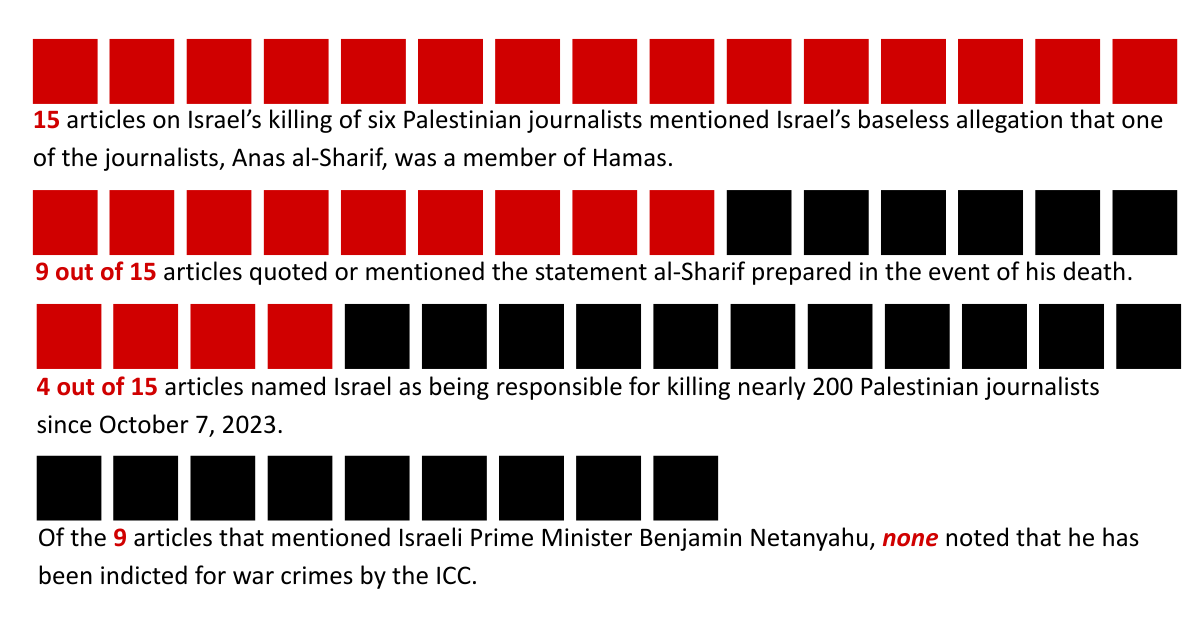
All of the articles mentioned Israel’s allegation that al-Sharif was a member of Hamas posing as a journalist, a claim that the Committee to Protect Journalists (CPJ), the Foreign Press Association and the United Nations have all found to be baseless.
Four of the 15 articles (New York Times, 8/10/25; NBC, 8/10/25; Fox, 8/11/25; Wall Street Journal, 8/11/25) mentioned the allegations in either the headline or subhead. “Israel Kills Al Jazeera Journalists in Airstrike, Claiming One Worked for Hamas,” was NBC‘s headline, with Israel’s smear that al-Sharif “posed as a journalist” in the subhead. Fox offered “Israel Says Al Jazeera Journalist Killed in Airstrike Was Head of Hamas ‘Terrorist Cell.’”
Reuters’ original headline (8/11/25) was “Israel Kills Al Jazeera Journalist It Says Was Hamas Leader,” only later changed to “Israel Strike Kills Al Jazeera Journalists in Gaza.”
Al-Sharif had been targeted and smeared by the Israeli Defense Forces for months prior to his murder, and had written a statement in anticipation of his killing. “If these words reach you, know that Israel has succeeded in killing me and silencing my voice,” he wrote. He asked the world to continue fighting for justice in Palestine: “Do not forget Gaza.”
Six of the articles (ABC, 8/11/25; BBC, 8/11/25; New York Times, 8/10/25; NBC, 8/10/25; Fox, 8/11/25; Wall Street Journal, 8/11/25) completely omitted references to or quotes from al-Sharif’s final statement. Of those six articles, the New York Times, BBC, NBC and Fox did include quotes from Israeli government representatives—perplexingly choosing to prioritize the voices of al-Sharif’s killers over his own.
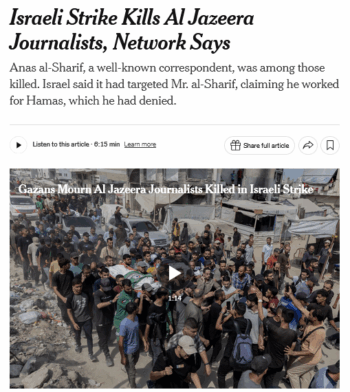
The New York Times (8/10/25) gave the Israeli government ample space to smear one of the journalists it had just killed, claiming he was “the head of a terrorist cell” who was “responsible for advancing rocket attacks against Israeli civilians.”
Coverage by the Wall Street Journal and New York Times devoted the most space to advancing Israel’s pretext for the killings. The Journal’s Anat Peled dedicated the first three paragraphs of her article to detailing al-Sharif’s supposed Hamas affiliation. Ephrat Livni of the Times also spent three paragraphs on the bogus allegations, allowing only one paragraph for a rebuttal from Al Jazeera and CPJ.
Every article except the ones from the New York Times (8/10/25) and Fox (8/11/25) cited the historically high number of Palestinian journalists that have been killed since October 7, 2023. The death toll currently stands at 192, according to the CPJ. However, only four articles (ABC, 8/11/25; CNN, 8/10/25; Politico, 8/11/25; Wall Street Journal, 8/11/25) listed Israel as the primary perpetrator of these murders. More typically, the AP (8/11/25) wrote that “at least 192 journalists have been killed since Israel’s war in Gaza began,” leaving the identities of both these journalists and their killers unmentioned.
Six (ABC, 8/11/25; BBC, 8/11/25; Newsweek, 8/10/25; Fox, 8/11/25; CBS, 8/11/25; Wall Street Journal, 8/11/25; LA Times, 8/11/25) of the 15 articles failed to mention Prime Minister Benjamin Netanyahu, and none mentioned the International Criminal Court’s arrest warrant against him for war crimes and crimes against humanity, including murder and intentionally directing attacks against a civilian population.
Critically, only two articles (Wall Street Journal, 8/11/25; Washington Post, 8/11/25) even noted the fact that the other five slain journalists had not been accused of belonging to Hamas. With this omission, the other outlets accepted and transmitted to audiences Israel’s premise that any number of bystanders can legitimately be killed in order to target a supposed Hamas member.
Unnecessary qualifiers
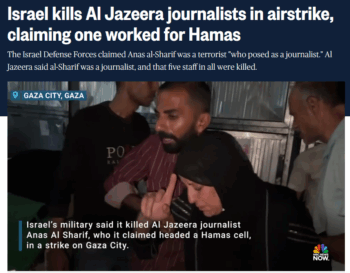
Including the October 7, 2023, breakout as background for the killing of journalists, NBC (8/10/25) specified that “many of the targets of those attacks were civilians, including people attending a music festival.” Palestinians killed subsequently by Israel, by contrast, were just described as “people…in the Hamas-run enclave.”
A common practice for Western media has been the use of unnecessary qualifiers to delegitimize information that comes from Palestinian sources. The coverage of al-Sharif’s assassination was no exception.
The BBC (8/11/25) wrote, “More than 61,000 people have been killed in Gaza since the Israeli military operation began, according to the territory’s Hamas-run health ministry.” Western media have taken it upon themselves to seemingly rename the Gaza Health Ministry (GHM) in order to cast doubt on the extent of Israel’s atrocities. They rarely note that a Lancet study (2/8/25) has found that the death toll could be up to 40% higher than what the GHM is reporting. The New York Times (8/10/25) and Reuters (8/11/25) also utilized “Hamas-run” to describe figures from the Gazan government.
These outlets also showed a clear bias as to how they characterize casualties. The New York Times (8/10/25), when reporting on the death toll in Gaza, wrote that the GHM doesn’t “distinguish between civilians and combatants.” Later on, the Times reported on Israeli deaths—and failed to distinguish between Israeli civilian and combatant deaths.
The implication is that some Palestinian deaths might be considered to be of lesser importance, or even justified, based on victims’ potential “combatant” status. Israeli deaths, meanwhile, are to be counted simply as human beings. The Washington Post (8/11/25) exhibited the same double standard in its reporting.
NBC (8/10/25) wrote, “Many of the targets of [the October 7] attacks were civilians, including people attending a music festival.” When reporting Palestinian deaths, NBC made no mention that over half of those killed by Israel have been women, children and the elderly. A more recent investigation found that civilians make up 83% of deaths, according to the IDF’s own data. The report also didn’t describe what Palestinian victims might have been doing when they were killed, such as the almost 1,400 who have been shot while seeking aid.
In addition to the usual rhetoric, eight of the 15 articles cast doubt on Al Jazeera by repeatedly mentioning its ownership by the Qatari government. (Qatar, like Israel, is one of 20 countries worldwide officially designated as a “major non-NATO ally” by the United States.) Three of the articles (New York Times, 8/10/25; Wall Street Journal, 8/11/25; LA Times, 8/11/25) mention the Israeli government’s adversarial relationship with Al Jazeera, with the New York Times and the Journal dedicating several paragraphs to the outlet’s alleged ties to Hamas as the presumed basis for the conflict, rather than Al Jazeera‘s critical coverage of Israeli actions.
False equivalences
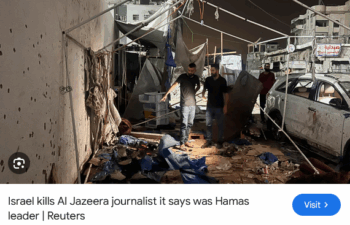
Reuters‘ original headline (8/11/25) was written from the point of view of al-Sharif’s killers.
Only three of the articles use the word “famine” (Financial Times, 8/10/25; CNN, 8/10/25; Newsweek, 8/10/25), and only the Financial Times mentions the word outside of quotes. Reuters (8/11/25) and the Wall Street Journal (8/11/25) called the situation “a hunger crisis” and “a humanitarian crisis that has pushed many Palestinians toward starvation,” respectively.
Media outlets continue to push the narrative that this so-called conflict began less than two years ago, as when NBC (8/10/25) wrote, “Israel launched the offensive in Gaza, targeting Hamas, after the Hamas-led terror attacks against Israel on October 7, 2023.”
Though the rate of killing greatly escalated after the October 7 operation, Israeli violence against Palestinians goes back to before the founding of the state, as many historians have carefully explained. In the decades immediately prior to the Hamas operation, the Israeli human rights group B’tselem counts more than 10,000 Palestinians killed by Israeli forces between September 2000 and September 2023—most of them noncombatants, over 2,400 of them children under 18. (Over the same period, some 1,300 Israelis—civilians and military—were killed by Palestinians.)
The Financial Times (8/10/25) described the ongoing genocide as “triggered” by the October 7 attacks, as if the al-Aqsa Flood operation were a random act of violence unrelated to the apartheid system that Israel imposes on Palestinians. The BBC (8/11/25) described Israeli violence as a “response to the Hamas-led attack,” completely erasing Israel’s history of occupation and ethnic cleansing of Palestinians that long precedes the existence of Hamas. Obscuring this sort of context is part of the motivation for Israel’s systematic murder of Palestinian journalists, including al-Sharif and his colleagues.
Original article by Emma Lucia Llano republished from FAIR under a Creative Commons Attribution-NonCommercial-NoDerivs 3.0 Unported License.