Trucks line up at the Egyptian side of the Rafah border crossing between Egypt and the Gaza Strip after Israel blocked the entry of aid trucks into Gaza, March 2, 2025
THE United Nations food agency only has enough supplies in the Gaza Strip to keep public kitchens and bakeries open for less than two weeks, the body said today.
Israel has imposed another blockade on Gaza to pressure Hamas into accepting an alternative ceasefire arrangement, six weeks into their fragile truce.
Israel allowed a surge of humanitarian aid during the first six weeks of the ceasefire. But the World Food Programme said on Wednesday that its stocks are low because it prioritised delivering food to the population.
The UN agency also warned that its fuel stocks would only last for a few weeks.
Palestinians said prices spiked as people rushed to markets to stock up on supplies after Israel announced the tightening of its blockade.
After more than 16 months of war, Gaza’s population is entirely dependent on deliveries of food and other aid. Most are displaced from their homes, and many need shelter.
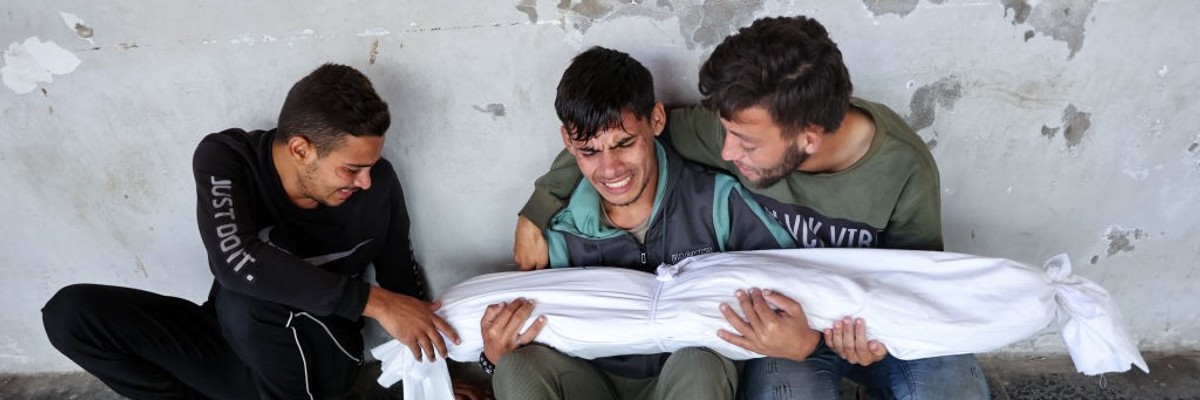
A Palestinian man mourns after an Israeli attack killed members of this family on October 12, 2024. (Photo: Omar al-Qattaa/AFP via Getty Images)
Israeli Prime Minister Benjamin Netanyahu is reportedly “examining a plan to seal off humanitarian aid to northern Gaza,” which could starve hundreds of thousands of Palestinians.
Palestine’s deputy permanent observer to the United Nations said Saturday that “what is happening in northern Gaza now is a genocide within the genocide” as Israeli forces continued to bombard the region and terrorize the hundreds of thousands of people who remain trapped there, in increasingly desperate need of food and other necessities.
Palestinian Ambassador Majed Bamya’s message came after the World Food Program (WFP) warned that Israel’s latest offensive in northern Gaza “is having a disastrous impact on food security for thousands of Palestinian families.”
“Food distribution points, as well as kitchens and bakeries in North Gaza, have been forced to shut down due to airstrikes, military ground operations, and evacuation orders,” the U.N. body said in a statement. “The only functioning bakery in North Gaza, supported by WFP, caught fire after being hit by an explosive munition.”
Antoine Renard, WFP’s country director for Palestine, said that the northern part of the enclave “is basically cut off and we’re not able to operate there.”
“WFP has been on the ground since the onset of the crisis,” said Renard. “We are committed to delivering lifesaving food every day despite the mounting challenges, but without safe and sustained access, it is virtually impossible to reach the people in need.”
What is happening in northern Gaza now is a genocide within the genocide
No shipments of food, water, or medicine have been able to enter northern Gaza in at least two weeks due to Israel’s assault, which has trapped around 400,000 people and killed dozens. Residents have reported witnessing Israeli drones and quadcopters fire on people attempting to flee the famine-stricken area.
Israel’s military said Saturday that even shelters for displaced people in northern Gaza are considered part of a “dangerous combat zone,” further underscoring that there is no safe place in the besieged enclave.
” Israel is exterminating northern Gaza right now,” said Middle East historian and analyst Assal Rad. “There are 400,000 Palestinians there being deliberately starved, with nowhere to go, trapped inside a killing field. There’s no outrage or wall-to-wall media coverage because Israel is the one doing it and the victims are Arab.”
On Sunday, The Associated Press reported that Israeli Prime Minister Benjamin Netanyahu is “examining a plan to seal off humanitarian aid to northern Gaza in an attempt to starve out Hamas militants, a plan that, if implemented, could trap without food or water hundreds of thousands of Palestinians unwilling or unable to leave their homes.”
According to AP, the plan was proposed to Netanyahu and the Israeli parliament by “a group of retired generals.” It would give the hundreds of thousands of Palestinians who remain in the northern third of Gaza a week to leave before the area is declared a “closed military zone.”
“Those who remain would be considered combatants—meaning military regulations would allow troops to kill them—and denied food, water, medicine, and fuel,” AP added. “The plan calls for Israel to maintain control over the north for an indefinite period to attempt to create a new administration without Hamas, splitting the Gaza Strip in two.”
While the Netanyahu government has not yet decided whether to “fully carry out” the plan, the outlet observed, “one official with knowledge of the matter said parts of the plan are already being implemented, without specifying which parts.”
Citing senior defense officials, the Israeli newspaper Haaretz reported Sunday that the Netanyahu government “is not seeking to revive hostage talks and the political leadership is pushing for the gradual annexation of large parts of the Gaza Strip.”
“Army commanders in the field who spoke with Haaretz say the recent decision to launch operations in northern Gaza was taken without any in-depth discussion. They said it appeared that the operations were aimed principally at pressuring local residents, who were again told to evacuate the area for the coast as winter is approaching,” the newspaper continued. “It is possible that the operation is laying the groundwork for a decision by the government to put into effect the so-called surrender or starve plan of Maj. Gen. (ret.) Giora Eiland.”
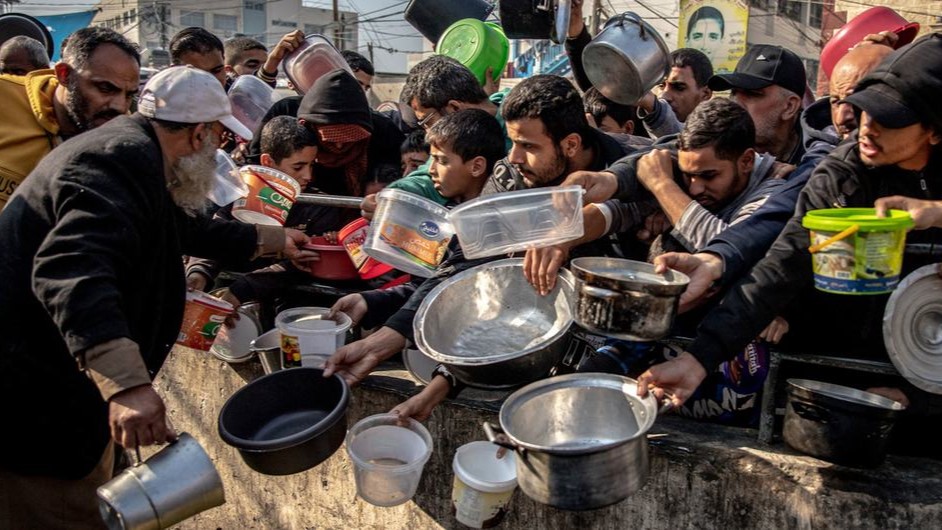
Displaced Palestinians wait for food at Al-Shaboura camp, in Rafah. Photo: WHO via UN Photo
A new report found that that over 15% of children under the age of 2 in northern Gaza are acutely malnourished, with 3% of them suffering from wasting. The World Food Programme has warned that without a ceasefire, a famine may ravage Gaza by May
Nutrition indicators among children in Gaza have been declining at an unprecedented rate since the beginning of Israeli attacks on October 7, 2023. Without a ceasefire, there will be a famine ravaging through the region by May, warned the World Food Programme (WFP).
In a new report based on data collected by the World Health Organization (WHO) and UNICEF, the Global Nutrition Cluster found that over 15% of children under the age of 2 in northern Gaza are acutely malnourished, with 3% of them suffering from wasting.
The numbers in the southern regions, including Rafah, where most of Gaza’s population has been displaced to, are somewhat lower, yet still represent a massive increase compared to the situation before October 7. The report indicates that by January, 5% of under-2-year-olds in Rafah were acutely malnourished. Previously, less than 1% of children younger than 5 experienced such circumstances across the entire Strip.
The extent of malnourishment is creating the perfect conditions for the spread of communicable diseases, which could drive the devastating number of children killed by Israeli attacks even higher. As most children can only consume food of low variety, their bodies become more vulnerable to the effects of otherwise treatable conditions, like diarrhea. Additionally, the lack of clean potable water, affecting all households in Gaza, further decreases the chances of treating these conditions.
Children are not the only group affected by the lack of food. Their parents, including pregnant mothers, are choosing to forgo meals to feed their children. Approximately 95% of pregnant and breastfeeding women in Gaza are not getting enough to eat. If they have access to food, it is of low nutritional value, adding to the pre-existing burden of anemia and undermining maternal health.
The WFP has documented much of this situation but stopped delivering aid to northern Gaza as the occupying forces did not ensure conditions for safe delivery. The aid entering southern regions of Gaza remains only a small fraction of what is needed, and the effects of malnutrition are exacerbated by the destruction of the health infrastructure.
No hospital or health center is spared in this process, and attacks have also been noted against civilian infrastructure where health workers and their families are seeking shelter. In one of the most recent attacks of this kind, the Israeli Occupying Forces (IOF) targeted a house where 64 Doctors Without Borders (MSF) staff members and their families were staying. The building was clearly marked with an MSF flag, and the IOF were informed of their presence, yet they attacked the house, killing several people inside.
According to MSF, the IOF’s action “shows a complete disregard for human life and a lack of respect for the medical mission. This makes it almost impossible to sustain medical humanitarian activities in Gaza.”
As the IOF persists in its attacks on hospitals, not only the shelling but also the evacuation orders and sieges further jeopardize the health of people who are already sick or wounded. Commenting on recent cases of hospital evacuation in Gaza, Guillemette Thomas from MSF pointed out that patients were forced to leave on foot, in wheelchairs, or even rolled in hospital beds, despite being in no condition to be moved.
Their treatment increases the risk of infection and lowers the chances of recovery, Thomas stated. “This can be extremely dangerous for them. When someone with a severely fractured leg starts to walk, it compromises their possibility to regain mobility and can have life-threatening consequences.”
Even after most patients, medical staff, and forcibly displaced people are evacuated from the hospitals, Israeli forces continue to besiege them. On February 22, after a full month of besieging and targeting Al-Amal Hospital in Khan Younis, the IOF damaged the hospital’s communication devices, which are used by the Palestine Red Crescent Society (PRCS) for locating and dispatching teams. This is only one in a series of IOF attacks that hit the PRCS, following the kidnapping of several staff members, destroying ambulance vehicles dispatched to rescue children, and raids on Al-Amal, which left behind damaged medical equipment and vehicles.
The situation is far from better in Nasser Hospital. While the WHO and other organizations were finally able to reach the complex to evacuate one part of the patients who had stayed behind following a violent incursion into the buildings by the IOF, over 100 patients who cannot move and about a dozen medical staff providing them care still remain behind.
The UN health agency was granted permission to enter Nasser Hospital only earlier this week, after several attempts were blocked by the Israeli forces. “Prior to the missions, WHO received two consecutive denials to access the hospital for medical assessment, causing delays in urgently needed patient referral. Reportedly, at least five patients died in the Intensive Care Unit before any missions or transfers were possible,” the organization said in a statement.
Upon their return from Nasser, WHO staff said the destruction was indescribable. “Gaza has become a death zone,” said WHO Director-General Tedros Adhanom Ghebreyesus.