The broadcaster lost a major defamation case earlier this year after Mr Adams took them to court over a 2016 episode of its Spotlight programme
Former Sinn Fein president Gerry Adams (Brian Lawless/PA)
Gerry Adams has said he has made donations to “good causes” after the BBC paid the former Sinn Fein president 100,000 euro (£84,000) in defamation damages.
The broadcaster lost a defamation case earlier this year after Mr Adams took them to court over a 2016 episode of its Spotlight programme and an accompanying online story.
They contained an allegation that Mr Adams sanctioned the killing of former Sinn Fein official Denis Donaldson.
…
[D]onations have been made to “Unicef for the children of Gaza”, local GAA organisations, a support group for republican prisoners and their families called An Cumman Cabhrach, to the Irish language sector, to the “homeless and Belfast based-youth, mental health and suicide prevention projects” and others. …
A protester holds a placard outside of the Pennsylvania Capitol during a #50501 protest on Wednesday, February 5, 2025. (Photo by Paul Weaver/SOPA Images/LightRocket via Getty Images)
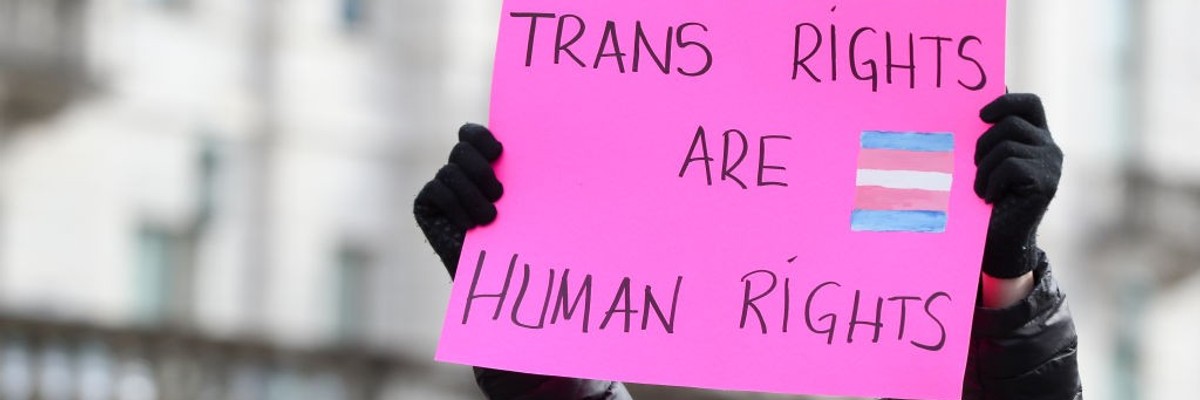
If anyone celebrating this attack against transgender people were to spend time with the parents, children, and doctors affected, their feelings might change.
President Donald Trump’s executive order prohibiting any hospital that receives federal funds from practicing gender-affirming care callously disregards the needs of children who are both gender and neurodiverse, putting them and their families at risk. If anyone celebrating this order were to spend time with the parents, children, and doctors affected, their feelings might change. They should meet Pearl who before receiving treatment was failing out of high school, contemplating suicide, and rarely left the house, and is now attending community college, teaching herself another language, and has developed deep friendships. Or the mathematically-gifted Ellen who after two deep depressive episodes in the last three years, finds safety, companionship, and stability in her gender support group. Or Jacob, a role model to all that meet him, who is attending college out of state and just performed in a concert on campus.
For three years my husband and I have been part of a support group with the parents of these children, who range in age from 14 to 25. Many are now scrambling for information to determine how far the order extends; where one can continue to receive care; what care, if any, the doctors they’ve trusted, relied on, and put faith in for years can still provide. Parents are counting prescription refills, checking if pharmacies will still honor them, searching for providers not impacted by the order, and compiling a list of states they could afford to travel to if other options don’t materialize. Some fear the order will destroy their children’s delicate mental health. Others fear it is a death sentence.
Our “community” includes some of the most thoughtful and loving caregivers I have ever known. Our children, who all have autism spectrum disorder (ASD), see and experience the world through a different yet remarkable lens. While some focus on their deficits, we see their creativity, honesty, strong sense of justice, loyalty, and enhanced focus as superpowers. But none of us deny that what makes them unique also presents challenges, including struggling with social interactions, poor executive functioning skills, or developmental delays. One challenge they all share is dealing with their gender diversity.
These are parents not boogeymen. These children are lovingly cared for and listened to, not abused.
Those with ASD are three to six times more likely than the general population to be gender diverse1—the umbrella term that includes non-binary and transgender. On top of their social, developmental, or communication issues, the added stress of feeling uncomfortable in their own bodies deeply impacts their well-being. We often talk about their “dark periods” when they’ve experienced debilitating depression, suicidal ideation, and elevated anxiety. Like any good parent, we sought advice from trusted medical professionals who provide the standard of care supported by leading medical organizations, including the American Medical Association and the American Academy of Pediatrics.
Our children see a multidisciplinary team of fully licensed, board-certified, highly trained pediatric specialists at a world-renowned hospital. These neuropsychologists, psychiatrists, gynecologists, and social workers coordinate care plans tailored to each child, considering their unique developmental, mental, and emotional health needs. Every child is evaluated regularly over extended periods of time. The medical care they receive may include mental health treatment, executive functioning courses, and in-person or online groups where they play games like D&D and socialize with like-minded youth. Some children who are past puberty receive hormone therapy after an extensive evaluation process. No child under the age of 18 is provided with gender-affirming surgery.
Parents in our group run the gamut. Some struggled to accept their child’s gender diversity or ASD diagnosis. Some oppose using hormone therapy, despite their child’s repeated demands, because they believe their child couldn’t handle the responsibility. Some have once needed to hospitalize their suicidal children, but have watched them flourish since starting them on hormone therapy. All struggling and questioning. But no care decisions are made without extensive consultation with their doctors, whose paramount concern is that our children are happy, healthy, productive, and thriving.
My child does not receive hormone therapy or other treatments outlined in the order. I do not, cannot, fully understand the magnitude of their pain. All I can do is stand witness to this action’s cruelty. These are parents not boogeymen. These children are lovingly cared for and listened to, not abused. These doctors have dedicated their lives to improving the mental and physical health of some of the most vulnerable among us. They are saving them, not experimenting on them. We are all good, intelligent, informed, and, now, scared people, whose greatest concern is the welfare of our children.
Editor’s Note: To protect privacy all names and identifying details of those mentioned in this piece have been changed.
Donald Trump decrees forbidden terms denying sexual diversityElon Musk urges you to be a Fascist like him, says that you can ignore facts and reality then.
dizzy: I have somehow managed to post this to the non-current version of this site. There are 2 versions atm because I have changed my web host and DNS needs to propogate so that it all points to my new web host.
March for Palestine | Mark Kerrison/In Pictures via Getty Images
A new generation across the UK is demanding political representation. But this unstoppable force is meeting an immovable object, the Labour Party
A new generation across the UK is demanding political representation. Yet, this unstoppable force is now meeting an immovable object, the Labour Party.
On one hand, despite its failure to leave behind much grassroots organisation, Jeremy Corbyn’s leadership galvanised millions. This generation now knows what it’s like to have a voice in the political mainstream. It won’t tolerate being shut out of the political process indefinitely. The success of Green and independent candidates at this year’s general election was in part driven by this fact.
Meanwhile, the realities of climate breakdown, renewed austerity and a genocide in Gaza continue to alienate many. The British public backs the renationalisation of energy by a margin of four to one, the introduction of a wealth tax by a margin of eight to one, and a ban on arms exports to Israel by about three to one.
On the other hand, the Labour Party is a fortress. Many advisors and politicians of the Labour right regarded the party’s defeat under Corbyn in 2019 as a lucky escape, and remain terrorised by the prospect of losing their careers to an insurgent political force. Starmerism is a relentless campaign on behalf of this professional political class, which is determined to shut the left out. Their hubris is an existential threat not just to Labour’s role as a political home for the left, but to the party itself.
Both wings of the Labour Party are being blindsided by this process. The Labour right, and the commentariat that lives in its orbit, likes to think in terms of historical cycles and playbooks. The crushing of the post-Corbynite left was a repeat of Kinnock’s expulsion of the Militant Tendency. 2024 was just 1997 with TikTok.
Starmer’s first act in government – blaming the outgoing administration for an economic mess and indicating a shift towards austerity – was both a conscious mimicry of Tory George Osborne and an homage to New Labour’s fiscal hawkishness.
The Labour left’s attachment to the past is more nostalgic. Its leaders – Aneurin Bevan, Tony Benn, Corbyn – are stripped of their failings and revered. Its heroic defeats – the 1981 Deputy Leadership campaign, the Greater London Council’s fight for survival, Corbyn’s general elections – are endowed with their own folklore.
Life on the outside is unthinkable and futile, as illustrated by every past attempt (the Socialist Labour Party, the Socialist Alliance, Respect, the Trade Union and Socialist Coalition, Left Unity) to build an alternative. “It is the Labour Party or it is nothing”, as Bevan once wrote, chiding members of the Independent Labour Party when they split in 1932.
Both wings of Labour are good at producing a sense of collective memory that reinforces the party’s standing as immutable, and which relates new events to past ones. Neither are good at understanding when reality diverges from the historical script.
In 2015, the left challenged for power, and in doing so broke the old system. Tony Blair did not bother to get rid of Tony Benn. Yet Starmer almost immediately expelled Corbyn and changed Labour’s rule to ensure that no one like him could lead the party again. He has already suspended seven MPs for voting to abolish the two-child benefit cap. It is only a matter of time until more feel forced to rebel.
A politics from below
The real politics happens outside parliament. We’ve already witnessed huge protests take shape against the massacre in Gaza, and the coming years could see mass movements and industrial unrest over cuts and living standards. Having lived through the Corbyn years, the participants of these movements are unlikely to be satiated by the prospect of a soft left Labour leader some time in the 2030s.
Labour’s initial plans will provide some relief. The Employment Rights Bill is likely to be the most significant improvement in workers’ rights in decades. The renationalisation of the railways will also prove popular. But what happens once these progressive measures have been exhausted?
The Green Party came second behind Labour in 39 seats. Pro-Palestinian Independent candidates have made inroads into safe Labour areas. For this to have happened while Labour was in opposition is unprecedented. Unless the new government rapidly shifts its approach on public spending, redistribution and green investment, it will face an earthquake.
“Unless the new government shifts its approach on public spending, redistribution and green investment, it will face an earthquake”
To have any success, the post-Corbynite left will have to ditch its obsession with icons and celebrities. Despite its roots in social movements, Corbynism became a tightly centralised project, in which activists were given little, if any, role in determining policy and strategy. Even now, discussion of the left’s future beyond Labour seems to centre on the intentions of Corbyn, his former advisors, prominent commentators, or MPs.
Building a serious political project is about representing a solid base in society. This task flows from organising, and having roots in social and industrial struggle, not how many Twitter followers you have.
The green surge
Much of the left will also have to get over its age-old sectarianism towards the Greens, who have emerged as by far the most serious organised force to Labour’s left.
If you listen to many old Labour left activists, or read many socialist newspapers, you will be presented with a critique of the Greens that is at least two decades old. They are portrayed as ‘Tories on bikes’ and alternative medicine enthusiasts. Their ability to win seats in North Herefordshire and Waveney is said to be the product of triangulation towards right-wing rural voters. The compromises of Green parties in France and Germany are held up as the inevitable destiny of the UK Greens.
On the contrary, the Greens have become a major force precisely by occupying a space to the left of their sister parties in continental Europe. Since the turn of the millennium, their membership has risen twelve-fold to around 60,000. Waves of new members – from the ‘green surge’ of 2014 to today’s recruits – comprise its activist base.
Many joined on a radical environmental basis, but just as many did so to oppose austerity, champion freedom of movement, or fight for Palestinian rights. There might be a case that their time would be better spent in Labour, or that party affiliation often operates more like a consumer identity than a political strategy. But the existence of a genuinely left-wing, and increasingly successful, Green Party in Britain is simply a fact. Any attempt to rebuild the left as an electoral force – from within Labour or outside – must take account of this.
The landscape of the British left following the fall of Corbynism is still emerging. The only people who are definitely wrong are those who claim to know exactly what will happen. Perhaps Starmer will move back to the centre-left. Perhaps the social and industrial movements won’t materialise. There are many socialists – including me – who remain in Labour and will keep chipping away.
One thing we can be certain of is that things will never go back to the way they were before the Corbyn moment. The late 2010s unleashed forces that are only beginning to shape our politics. The left must adapt if it is to survive.