NHS news review
NHS news: Cuts and huge increases in waiting times under the UK Con-Dem – Conservative and Liberal-Democrat – coalition government. There appears to be a growing acceptance that the changes are intended to destroy the NHS.
There’s an interesting article by Hospital Dr that suggests that contrary to claims to the opposite, the Con-Dem coalition has been very effective in communicating it’s ‘message’ of NHS ‘reform’ – concentrating on the core soundbite that GPs will have a huge proportion of NHS budget to do commissioning while other far more important details are obscured.
The Guardian has some very useful articles providing background information.
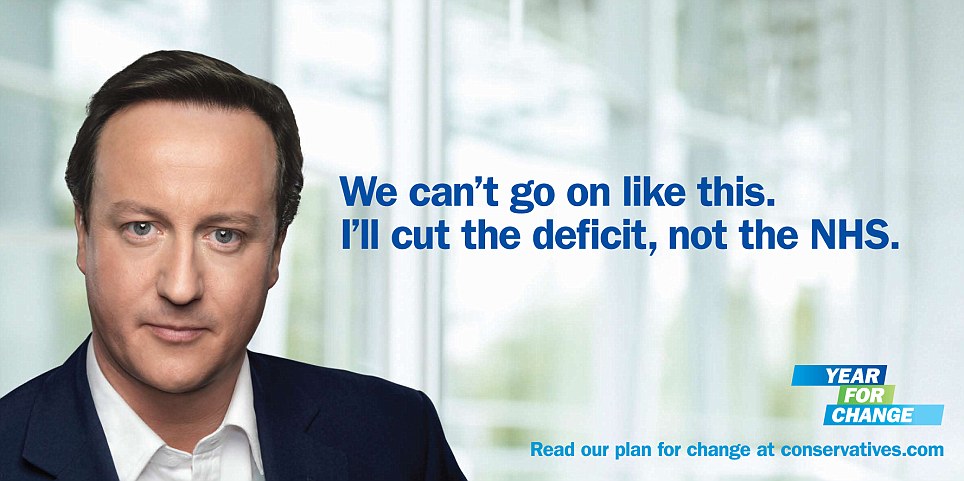
- Conservative election poster 2010
A few recent news articles concerning the UK’s Conservative and Liberal-Democrat coalition government – the ConDem’s – brutal attack on the National Health Service.
NHS faces ‘perfect storm’ – Channel 4 News
Hospital waiting times are at a three year high and the percentage of patients waiting longer than four hours in accident and emergency rose sharply at the end of 2010, reports Victoria Macdonald.
The King’s Fund reports says: “Over the next few years the NHS faces two unprecedented challenges: coping with the tightest funding settlement for decades and implementing top-to-bottom reforms of the system.”
The panel of finance directors reported that they had “limited” confidence in meeting theirproductivity targets over the following years. Many of the panel also reported the difficulty they were having in trying to “manage increased demand for care with reduced capacity and the need to continue to meet targets and maintain quality while keeping within reduced budgets”.
When asked how they would meet their productivity target, the majority mentioned reducing beds or services.
…
The end of the NHS as we know it? – Channel 4 News
After warnings of the coming of a “perfect storm”, health expert Professor Colin Leys speak to Channel 4 News about the future of the NHS in a climate of cuts and reform.
…
Professor Leys pointed out that because NHS funding is no longer pooled, there is a “very uneven spread” of resources: “Some foundation trusts in surplus and others with huge debt.” He compared the current situation with shops closing on the high street: “Cutting,” he said, “is due to breaking the NHS into various parts – the story of the last 11 years… The point of converting it into a market is that each provider is independent, but now they have put the break on, there are problems.”
…
So, does the NHS have a future? “I don’t think any government will abolish funding for health treatment. The question is how much health funding is available in a uniform and complete way.
“The universality of the NHS whereby everyone will have access, rich or poor. That is bound to go.
“The redistributive and egalitarian system will go; since the consortia will have the power to decide what is appropriate, and will be acting within budget constraints, they will be forced to make decisions, and there will be pressure to go for cheaper providers.”
Professor Leys said the idea, presented by finance directors in The King’s Fund report, that productivity could be maintained alongside cuts, was problematic and argued that since health care is “inter-personal”, its effectiveness is lessened if there is a reduction in “the ratio of skill to patients”.
Kings Fund report: ‘Ready ammunition for service closure’ – Channel 4 News
“Services do not need to close; that always has been and remains a political decision,” writes health expert Professor Allyson Pollock for Channel 4 News.
The UK government is proceeding with its plans to abolish the NHS and is implementing its new system in advance of the highly controversial Health and Social Care Bill becoming law. This is profoundly undemocratic and combined with demands for £20bn worth of efficiency savings represents a looming catastrophe for public health care.
The efficiency targets are without precedent, according to the House of Commons health select committee. No country in the world has acheived a real terms decrease of £20bn in its health budget in just five years. Nevertheless, the government is allowing chief executives and finance director to press on with a policy of service, ward and hospital closure.
It is also continuing a policy of hollowing out the NHS as the Government allows CEOs to use the excuse of deficits to offload services on to the private sector and risks of not being treated onto patients. Hinchingbrooke Foundation Trust Hospital has been contracted out to Circle, private patient bed numbers increased in Maidstone, Kent, and US health care company, United, allowed to run primary care trust commissioning along with other companies.
NHS chiefs predict ward closures and job cuts | Society | guardian.co.uk
NHS finance directors predict ward closures, job cuts and other reductions as they struggle to make ends meet and prepare for the reorganisation of England’s health system, according to the King’s Fund thinktank.
With some hospital waiting times the worst for three years, A&E departments overstretched, and surgeons warning that patients are being denied key treatments, the first in a series of planned quarterly monitoring reports highlights “significant concern” among some of those responsible for contributing to £20bn of “efficiency savings” in the NHS over four years and for ensuring that new bodies taking over services in the next three years do not start with deficits. Most say they are unlikely to meet productivity targets this year.
The challenging picture painted by the report, from a respected independent analyst of the health service, comes during the government’s two-month “pause ” in trying to push through its controversial legislation. It has promised to listen and make “substantive” changes to its plans, although NHS staff have been told by the chief executive, David Nicholson, to “maintain momentum on the ground”.
…
NHS reforms: what are the key issues? | Society | guardian.co.uk
The government’s proposed health reforms have proven so controversial that the health minister has announced a two-month ‘pause’ in the health bill to review concerns. According to NHS Future Forum, the body set up to lead the so-called ‘listening exercise’, there are four key themes to the reforms that they will be reviewing. We have tried to decode them for you below
…
NHS reforms: glossary of key terms | Society | guardian.co.uk
Rowenna Davis explains the jargon used in the debate over the coalition’s controversial plans for the NHS
…
NHS reforms: who are the key players? | Society | guardian.co.uk
…
NHS reform: changes need to be made to health bill, admits Cameron | Politics | guardian.co.uk
PM rejects claim government is moving too fast with plans to ‘reform and modernise’ NHS but accepts elements of original plan will have to change
David Cameron has said “changes need to be made” to the health and social care bill in recognition of the need to get more “full-throated support” for reforms from NHS staff.
The prime minister denied the government had moved too fast with its plans to “reform and modernise” the NHS in the face of an ageing population and more expensive drugs and treatment, but accepted that elements of the original plan would have to change.
Speaking as he prepared to conduct another NHS “listening exercise” alongside the health secretary, Andrew Lansley, Cameron said key planks of the reforms – such as giving hospitals greater independence, a payment by result system and GPs having a greater role in commissioning services – must go ahead.
But he insisted on the BBC Radio 4 Today programme that “substantive and serious changes” would be examined.
…
Lansley’s claims tell only half the story of NHS reforms | Society | The Guardian
Critics who claim the government’s NHS marketisation reforms lack democratic legitimacy have invariably provoked a robust, if partial, response from the beleaguered health secretary, Andrew Lansley.
He maintains town halls are being offered unprecedented powers to integrate health and social care commissioning through statutory health and wellbeing boards – thus giving councillors, potentially, a stronger role in the oversight of the NHS. Or not, as the case may be.
Councils have few friends in the Department for Communities and Local Government, but even the (Liberal Democrat) care services minister, Paul Burstow, managed to praise authorities last week for having an in-depth understanding of the public health needs of their populations.
But Burstow and Lansley have not made clear how health and wellbeing boards are expected to align with stand-alone GP commissioning consortia, which lack accountability and are said to cover, in “pathfinder” form, nearly 90% of patients in England through 220 groups of GP practices.
The boards give a vaguely “localist” gloss to the health and social care bill, which is “paused” for a two-month rethink, as Cameron privately blames the messenger (Lansley) rather than the message. However, leading Lib Dems clearly see moves over wider NHS “democratisation” as the key concession to be dragged from the PM. But not, it seems, much else.
…
NHS: Back to the dark days of waiting / Britain / Home – Morning Star
Waiting times for NHS treatment are spiralling out of control as finance directors seek ways to make £20 billion in budget cuts by 2015.
Health charity The King’s Fund published shocking figures today showing that NHS waiting times are at their highest in three years, with nearly 15 per cent of hospital inpatients waiting more than 18 weeks for treatment in February.
The figures have been steadily increasing ever since the coalition government relaxed the 18-week waiting target for hospital treatement almost as soon as it came to power in June last year, the charity warned.
King’s Fund chief economist professor John Appleby said: “With hospital waiting times rising, the NHS faces a considerable challenge in maintaining performance as the financial squeeze begins to bite.
“The trouble is it’s hard to see what the mechanisms are to keep that target low.
“I think the issue is how far they will continue to rise and at what point does the public start to notice.”
He warned that the problem was escalating as hospitals now only have “a vague commitment” to meet targets.
…
Struggling in their hands / Comment / Home – Morning Star
Well, it’s goodbye to any illusion that the NHS is either safe in Tory hands or that the coalition’s efforts to “reform” the service would be accomplished without affecting front-line services.
Health charity The King’s Fund disposed of those twin delusions very effectively indeed yesterday, without any political spin or even party-political angle.
It reported that NHS waiting times are at their highest level for three years, with nearly 15 per cent of hospital inpatients waiting more than 18 weeks for treatment in February this year.
In addition, waiting times in accident and emergency departments also rose steadily with the proportion of patients waiting more than four hours climbing through the roof.
…
Health Bill is not just about GP commissioning » Hospital Dr
Andrew Lansley has apologised. Not for being the architect of a Bill that has met with near-universal concern in the healthcare world, but because what he is “setting out to do, hasn’t communicated itself”.
The irony is that, in some senses, the government has been very clever in its communications, keeping the elements of the Health Bill it wants to talk about centre stage. Almost every newspaper article that discusses the Bill includes the neat phrase, “the plans, which would hand the £80 billion NHS budget over to GPs”, as if the changes were only about who controls the purse strings.
The fact that the Health and Social Care Bill is, in the public ’s mind at least, assumed to be purely about GP commissioning works very much to the government‘s advantage. It’s hard to argue against the principle of devolving power to doctors, whom patients know and trust. The BMA, as you’d expect, has always been very keen on the idea of doctors having a genuine say in the shaping of services (though it has a number of significant concerns about how the current plans would work in practice).
But the reality is that doctors could have been empowered without any legislation at all, and without the £2-3 billion cost of the top-down reorganisation. The Bill as it is currently written is actually more about fundamentally altering the character of NHS service provision than it is about putting in place a new process of commissioning.
…