Just Stop Oil to restart London actions
Just Stop Oil say “From November 28th, Just Stop Oil will bring disruption back into London by marching, temporarily blocking and holding inner city roundabouts. Disruption will continue over three weeks with both arrestable and non-arrestable roles needed to send our message loud and clear this winter.”
Fossil Fuel-Linked Companies Dominate Sponsorship of COP27
From software giants to soft drinks makers, the vast majority of partners at climate talks in Egypt are enmeshed with the oil and gas industry, researchers find.
Republished from DeSmog according to their republishing guidelines.

onNov 16, 2022 @ 09:05 PST
Series: COP27 COVERAGE
Eighteen of the 20 companies sponsoring U.N. climate talks in the Egyptian resort of Sharm El-Sheikh either directly support or partner with oil and gas companies, according to a new analysis shared with DeSmog.
The findings underscore concerns over the role of the fossil fuel industry at the negotiations, known as COP27, which have become a focal point for deals to exploit African natural gas.
“These findings underline the extent to which this COP has never been about the climate: It’s been about rehabilitating the gas industry and making sure that fossil fuels are on the agenda,” said Pascoe Sabido of Brussels-based Corporate Europe Observatory, which co-produced the analysis with Corporate Accountability, a nonprofit headquartered in Boston.
“These talks are supposed to be about moving us away from fossil fuels, phasing them out,” Sabido told DeSmog.
A previous analysis by the two organisations and research and advocacy group Global Witness identified at least 636 fossil lobbyists who have been granted access to COP27 – an increase of more than 25 percent compared to the previous COP26 talks held in Glasgow a year ago; and twice the number of delegates from a U.N. body representing indigenous peoples.
“This is part of the bigger problem which is linked to the overall corporate capture of the U.N. climate talks,” Sabido said. “We need to kick big polluters out.”
Social license
As documented in the latest edition of DeSmog’s Gaslit column, fossil fuel sponsorship of COP27 represents an extension of a decades-long effort by oil and gas companies to buy social legitimacy by bankrolling sports, arts, and education around the world.
COP27 partner Hassan Allam Holding, one of the largest privately owned corporations in Egypt, has announced plans to invest $17.1 billion to turn North Africa into a regional natural gas hub, and $830 million in oil projects over the next two years, the analysis found.
Sponsors also include Cairo-based Afreximbank, which plans to finance new oil and gas projects through the creation of a multi-billion dollar “energy bank”, and Mashreq, the oldest private bank in the United Arab Emirates, which refinances oil and gas projects.
Microsoft, which uses cloud-based artificial intelligence to help companies such as Chevron optimize oil and gas extraction, is a partner at COP27, along with rival Google.
Google says it has cracked down on climate misinformation on its platforms. But the company is still taking money from oil and gas companies to place adverts in search results that present their industry as environmentally friendly, a report found.
German engineering company Siemens, another COP27 sponsor, services firms such as Cairo-based Orascom Construction, which built one of the world’s biggest gas power plants in Egypt in 2018. IBM, also a sponsor, works with pesticide and fertiliser companies to promote “carbon farming” – a carbon offsetting technique that generates carbon credits for storing carbon in soils. Many climate groups believe such practices will provide an excuse for big companies to continue polluting.
Conflict of interest
The predominance of fossil fuel sponsorship at COP27 cuts a stark contrast with demands from countries facing an existential threat from climate change for urgent action to cut emissions.
Last week, the island states of Vanuatu and Tuvalu became the first countries to back calls to cut greenhouse gas emissions at source by developing a treaty modeled on Cold War-era nuclear arms control agreements to wind down oil, gas and coal production.
Advocates of the campaign for such a Fossil Fuel Non-Proliferation Treaty, including a growing number of cities and municipalities, also want to ban fossil fuel advertising and sponsorship.
“We’ve got numerous countries calling for a Fossil Fuel Non-Proliferation Treaty and yet COP27 is sponsored by the same companies either directly funding them [fossil fuels], facilitating the extraction of oil and gas, or using their products,” Sabido said.
The Boston Consulting Group, an American consulting firm and one of the main COP27 partners, works with Anglo-Dutch oil major Shell. COP27 lead partner Coca-Cola, which relies on plastic bottles derived from hydrocarbons, was named the world’s top plastic polluter for five years in a row by the Break Free From Plastic movement in its annual brand audit. The oil industry is banking on expanding production of plastics and other petrochemicals for its future growth.
Only two out of the 20 COP27 sponsors, renewable energy provider Infinity Power and real estate developer Sodic, have no strong ties to the fossil fuel industry, the analysis found.
Corporate Europe Observatory and Corporate Accountability are calling for the U.N. body that organises the annual climate negotiations to adopt a conflict of interest policy that would exclude fossil fuel companies and their partners from attending or sponsoring the events.
More than 450 organizations have already supported a campaign to Kick Big Polluters Out of COP27.
“What we need to do is end big polluter sponsorships of the talks, they shouldn’t be allowed to bankroll this process,” Sabido said. “They shouldn’t be allowed to greenwash their image through their presence at COPs.”
Republished from DeSmog according to their republishing guidelines.
‘Abdication of Responsibility’: Fury as COP27 Draft Omits Oil and Gas Phase-Out
Republished from Common Dreams under Creative Commons (CC BY-NC-ND 3.0). Feel free to republish and share widely.
“At a COP shaped by more than 600 fossil-fuel lobbyists roaming the halls, parties fighting for progress must push back against weak language that allows the fossil fuel industry to continue its deadly expansion,” said one campaigner.

Julia Conley November 17, 2022
Climate action groups were outraged Thursday as global policymakers released a draft agreement making clear that dire warnings from energy experts and scientists regarding fossil fuel extraction have not gotten through to them, with the document failing to endorse a phase-out of oil and gas use.
The draft agreement was published as the 2022 United Nations Climate Change Conference (COP27) comes to a close in Sharm el-Sheikh, Egypt, and is expected to be heavily revised in the coming days.
“As climate impacts and injustice accelerate, lives, livelihoods, cultures, and even whole countries are lost, the latest draft cover note from the COP27 presidency pushes the pedal to the metal on the highway to climate hell.”
The absence of crucial language regarding oil and gas left campaigners concerned that the conference, where hundreds of fossil fuel lobbyists were present, will ultimately fail to produce an agreement that treats the climate crisis with the urgency needed.
“We came to Sharm el-Sheikh to demand real action on meeting and exceeding climate finance and adaptation commitments, a phase-out of all fossil fuels and for rich countries to pay for the loss and damage done to the most vulnerable communities within developing countries by agreeing a Loss and Damage Finance Fund,” said Yeb Saño, Greenpeace International’s head of delegation at the summit. “None of that is on offer in this draft. Climate justice will not be served if this sets the bar for a COP27 outcome.”
The draft agreement “encourages the continued efforts to accelerate measures towards the phase-down of unabated coal power and phase out and rationalize inefficient fossil fuel subsidies.”
It also echoes the call in last year’s document out of COP26 to emphasize “the importance of exerting all efforts at all levels to achieve the Paris agreement temperature goal of holding the increase in the global average temperature to well below 2°C above pre-industrial levels and pursuing efforts to limit the temperature increase to 1.5°C above pre-industrial levels.”
But the omission of a phase-out of all fossil fuel extraction, which delegates from India have lobbied for at COP27 and which the U.S., U.K., and European Union expressed conditional support for in recent days, denotes a draft document that “ignores the science of 1.5°C” even as it pledges to limit the temperature increase, said Tzeporah Berman, chair of the Fossil Fuel Non-Proliferation Treaty Initiative.
“Acknowledging only the need to phase down coal while ignoring oil and gas is hugely problematic. This predatory delay is out of line with the science and with 1.5 degrees,” Collin Rees, campaign manager at Oil Change International, told Bloomberg. “At a COP shaped by more than 600 fossil-fuel lobbyists roaming the halls, parties fighting for progress must push back against weak language that allows the fossil fuel industry to continue its deadly expansion.”
The draft is the first agreement out of an annual U.N. climate conference to address “loss and damage”—the harms already suffered by countries in the Global South due to the climate crisis and the need for wealthy governments to help finance their recovery.
The document does not provide details about how a loss and damage fund would operate, saying only that it “welcomes” the inclusion of the issue in the final agreement.
“More than 40 million people in the Horn of Africa are currently experiencing climate-induced hunger crisis,” said Nafkote Dabi, climate change policy lead for Oxfam, on Wednesday. “Pakistan is faced with $30 billion worth of loss and damage from the recent mass floods that left a third of the country under water. It is crucial that developing countries can access a formal fund to pay for the damages and losses they are already suffering today.”
Rich countries must meet their $100 billion annual goal for climate finance in addition to establishing a new Loss and Damage fund that is fit for purpose, accessible and gender responsive,” Dabi added. “Rich countries must heed the urgent call and deliver a loss and damage fund at COP27.”
Related Content
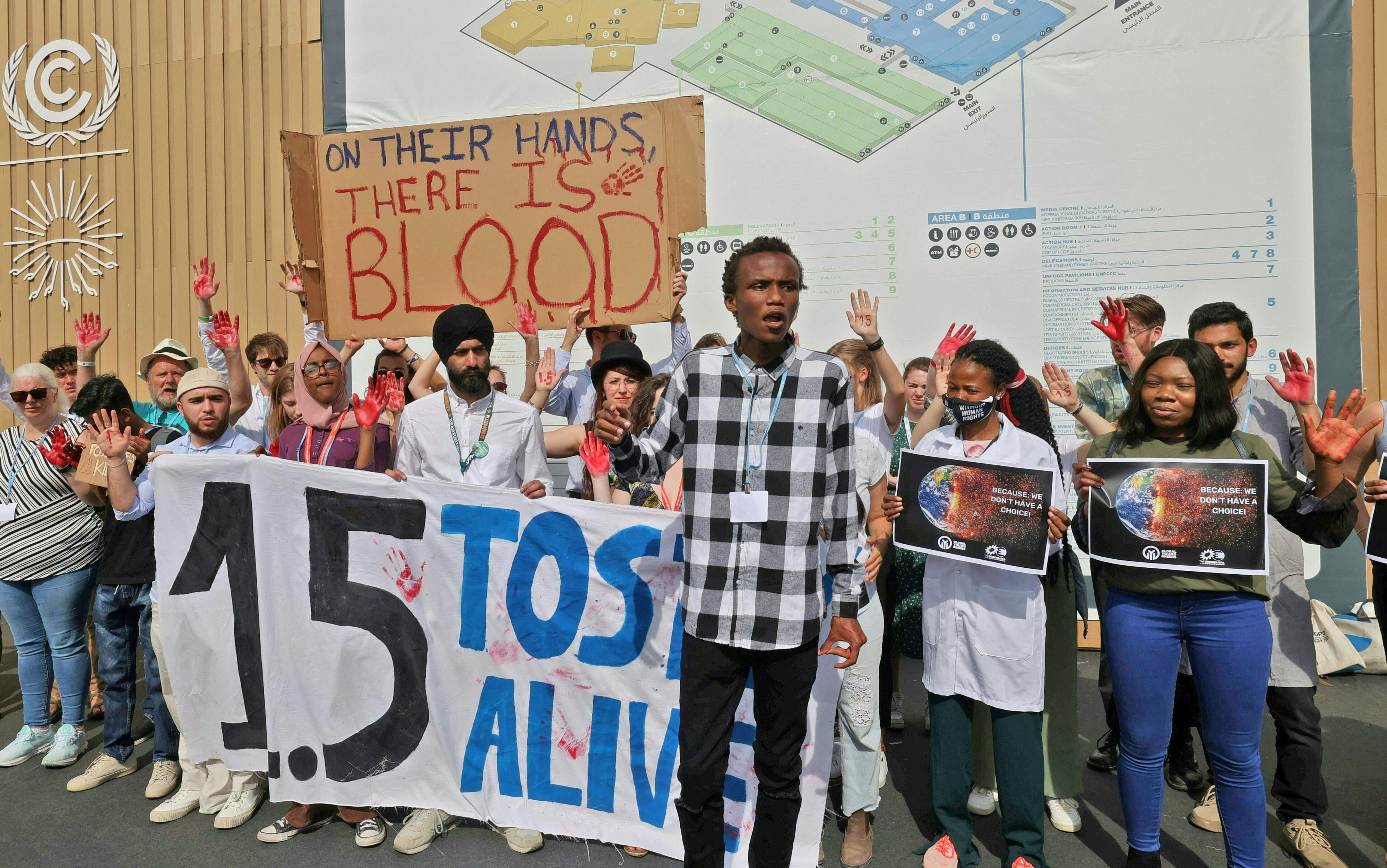
As COP27 Failure Looms, Climate Movement Demands: ‘Phase Out All Fossil Fuels’
The document includes some areas of improvement over the agreement written at COP26 last year, such as a call for multilateral development banks to scale up climate finance “without exacerbating debt burdens” for countries in the Global South, but leaves out details on how wealthy countries must strengthen their emissions-slashing targets.
“There should be a clear road map by those who are emitting a lot to start reducing their emissions,” Collins Nzovu, Zambia’s environment minister, told Bloomberg. “We are headed completely in the wrong direction—driving very, very fast into a ditch.”
Saño condemned the draft as “an abdication of responsibility to capture the urgency expressed by many countries to see all oil and gas added to coal for at least a phase-down.”
“As climate impacts and injustice accelerate, lives, livelihoods, cultures, and even whole countries are lost,” he added, “the latest draft cover note from the COP27 presidency pushes the pedal to the metal on the highway to climate hell.”
Republished from Common Dreams under Creative Commons (CC BY-NC-ND 3.0). Feel free to republish and share widely.
Is COP27 Already Too Lost and Too Damaged?
Republished from Common Dreams under Creative Commons Attribution-Noncommercial-No Derivative Works 3.0 United States License.
To date, the world’s wealthy countries have so far refused to pay for “loss and damage,” that is, to admit that they’ve massively polluted the atmosphere with carbon dioxide, methane and other greenhouse gasses.


Amy Goodman, Denis Moynihan November 17, 2022 by Democracy Now!
The United Nations Climate Change Conference has convened here in Sharm el-Sheikh, Egypt. It’s called COP27, the 27th Conference of Parties to the UN’s Framework Convention on Climate Change (UNFCCC), the ever-evolving, never-quite-fully-negotiated treaty that, it is hoped, will someday ensure all countries rapidly reduce greenhouse gas emissions to forestall catastrophic climate change. An estimated 30,000 people from around the world have descended on this Red Sea resort on the southern tip of the Sinai Peninsula. The summit is hosted by Egypt, a dictatorship propped up by billions of dollars annually in military aid from the United States. This has been dubbed “The Africa COP,” to highlight the continent’s plight as one of the world’s poorest regions, already suffering dire impacts of the climate crisis.
The phrase “Loss and Damage” denotes the devastating climate impacts millions are already experiencing in poor frontline nations—those that have contributed the least to global warming.
“This is not an African COP. Africa is not here,” Nnimmo Bassey, renowned Nigerian environmentalist, said on the Democracy Now! news hour. “The poor people who are suffering floods, droughts and all kinds of adverse situations, they are not here. They can’t afford to get here. They wouldn’t get accreditation. They can’t afford the accommodation in this city that is mostly for tourists…The other COPs were exclusive, but this is super exclusive. We are all cordoned into a peninsula, cut off from even the country in which we are supposed to be.” Bassey concluded, calling the UN climate process itself “lost and damaged.”
While Bassey has been coming to COPs for many years, members of the growing youth climate movement joined more recently. Vanessa Nakate founded the first climate strike in Uganda. “Fridays for Future” grew out of a solo protest by teenager Greta Thunberg in front of the Swedish parliament in August 2018 and blossomed into a global movement involving more than 14 million young people. Students take a school day off to strike, typically on Friday, demanding that the older people in charge take urgent action on the climate emergency.
In December, 2019, at COP25 in Madrid, Vanessa Nakate described her early days as a climate striker in Kampala, Uganda: “People found it very weird that I was on the streets. Some of them threw some negative comments, like I was wasting my time, and the government will not listen to anything that I have to say. But I just kept going.”
One month later, at the World Economic Forum in Davos, Switzerland, Vanessa was photographed with Greta and other youth activists. The Associated Press published an edited version of the photo, cropping Vanessa out of a group of five. The four remaining in the photo were white. The AP apologized and restored the image.
“Being cropped out of that photo changed me. I became bolder and more direct in how I talk about the climate crisis and racism,” Vanessa later wrote in her book, A Bigger Picture: My Fight to Bring a New African Voice to the Climate Crisis.
Here at COP27, Vanessa said on Democracy Now!, “We have more than 600 fossil fuel lobbyists at this COP, and yet so many communities and activists from the frontlines of the climate crisis weren’t able to make it here…The climate crisis is pushing so many communities beyond adaptation. You cannot adapt to starvation. You can’t adapt to extinction.”
She continued, “What will make it an African COP is ensuring that there is an establishment of a Loss and Damage Finance Facility…supporting a just transition to renewable energy while addressing the energy poverty on the African continent.”
The phrase “Loss and Damage” denotes the devastating climate impacts millions are already experiencing in poor frontline nations—those that have contributed the least to global warming. These developing countries are demanding that rich, historically high-polluting countries meet their pledges made at COP21 in Paris, in 2015, to contribute $100 billion per year to a fund “for mitigation and adaptation.” “Mitigation” refers to investments that lower emissions, like building renewable energy installations. and “adaptation” to building infrastructure and capacity to deal with the impacts of climate change—for example, building seawalls to cope with rising sea levels.
To date, the world’s wealthy countries have so far refused to pay for “loss and damage,” that is, to admit that they’ve massively polluted the atmosphere with carbon dioxide, methane and other greenhouse gasses—in the case of the United States and most of Europe, since the beginning of the Industrial Revolution—and thus must pay climate reparations for the impacts of their pollution.
But those who have been fighting for a just climate transition aren’t giving up hope. Hundreds packed into a People’s Plenary here as COP27 neared it close. Asad Rehman, lead spokesperson for the Climate Justice Coalition, offered his assessment of the entrenched fossil fuel interests as he rallied those gathered for the struggles ahead:
“The word they fear the most: solidarity.”
Republished from Common Dreams under Creative Commons Attribution-Noncommercial-No Derivative Works 3.0 United States License.