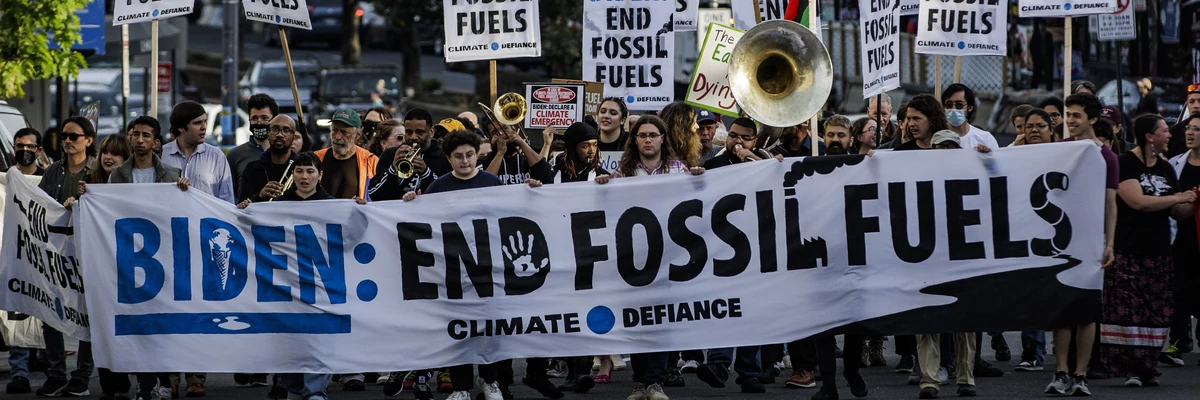
Activists at Scotland’s climate camp said they do not want to disturb the general public and have issued an invitation to anyone who wishes to visit.
Climate activists who have set up one of Scotland’s largest protest camps in a decade have said they do not wish to cause a disturbance to the general public.
Climate Camp Scotland officially opened their camp near the Grangemouth oil refinery on Wednesday evening, with speaker Leonidas Iza of Ecuador’s biggest indigenous organisation. There were about 100 people in attendance.
Campaigner Quan Nguyen told the PA news agency the group wanted the space in Kinneil Park in Bo’ness, near Falkirk, to be open and welcoming for people to discuss the climate emergency, even if they disagreed.
He said: “It’s really open and really supportive, we invite everyone to come in.
“We don’t want to take the space away, we want it to be a space where we can have an open discussion.
Police officers and security personnel stand on the airfield and try to detach activists of the group Last Generation who have stuck themselves to the asphalt in the airport area, in Duesseldorf, Germany, July 13, 2023
CLIMATE activists blocked a runway at Hamburg airport early today, causing numerous flights to be cancelled on the first day of the school holidays in the north German city.
The group Last Generation said several of its members entered the grounds of Hamburg airport in the early morning and glued themselves to the runway.
…
Members of the group also cut through a security fence at Dusseldorf airport and blocked an access route to the runway.
In a statement, the group accused the German government of lacking a strategy to tackle the climate crisis and called for immediate measures to cut emissions in the transport sector, including ending tax exemptions for airline kerosene.
Keir Starmer’s Labour Party are positioning themselves as the new red Tories and have committed to continuing whatever the Tories do about energy. Labour have adopted the Tories energy policy exctly, there is no difference between them.
Labour and the country value the contribution of all those working in energy, including oil and gas, to powering the UK now and into the future. That is why, as part of our approach, Labour will ensure a phased and responsible transition in the North Sea, partnering with business and workers to manage our existing fields for the entirety of their lifespan. As the North Sea Transition Authority (NTSA) itself indicates, oil and gas production in the North Sea will be with us for decades to come. The charts below show that the significant majority of proven gas in the North Sea lies in existing fields. In the case of oil, there are more potential new fields, but 80 per cent of our oil production is exported abroad.
Under Labour’s plans, North Sea oil and gas will continue for decades to come.We will not revoke licences. But we will also build alternative opportunities for workers that transition out of oil and gas, in decommissioning, carbon capture and storage, hydrogen, and renewables like offshore wind. Labour has committed to not handout new licences to explore new oil and gas fields, which we believe would not offer the right answer for the economy or the environment. We will act to ensure continued investment in our offshore infrastructure and workforce as the North Sea becomes home to new forms of energy production. Labour will work with offshore communities and trade unions to avoid a repeat of the mistakes of the past. As oil and gas workers consider the future of their industry, they should be in no doubt about Labour’s commitment to prevent a transition akin to the Tories’ closure of the coal mines of the 1980s. We will not let that happen again.
…
This is Grant Shapps bonkers policy. Bonkers, insane, mad because there can be no new oil or gas without trashing the planet.
Limiting global warming will require major transitions in the energy sector. This will involve a substantial reduction in fossil fuel use, widespread electrification, improved energy efficiency, and use of alternative fuels (such as hydrogen).
“Having the right policies, infrastructure and technology in place to enable changes to our lifestyles and behaviour can result in a 40-70% reduction in greenhouse gas emissions by 2050. This offers significant untapped potential,” said IPCC Working Group III Co-Chair Priyadarshi Shukla. “The evidence also shows that these lifestyle changes can improve our health and wellbeing.”