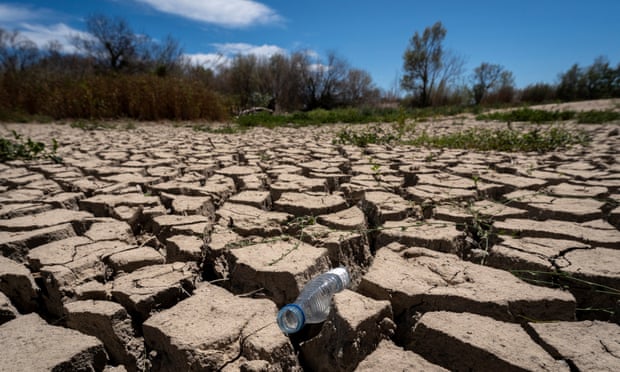
A dried-up part of the Muga riverbed in northern Spain. Photograph: David Borrat/EPA
Water scarcity threatening agriculture faster than expected, warns Cop15 desertification president
The world is likely to face major disruption to food supplies well before temperatures rise by the 1.5C target, the president of the UN’s desertification conference has warned, as the impacts of the climate crisis combine with water scarcity and poor farming practices to threaten global agriculture.
Alain-Richard Donwahi, a former Ivory Coast defence minister who led last year’s UN Cop15 summit on desertification, said the effects of drought were taking hold more rapidly than expected.
“Climate change is a pandemic that we need to fight quickly. See how fast the degradation of the climate is going – I think it’s going even faster than we predicted,” he said. “Everyone is fixated on 1.5C [above pre-industrial levels], and it’s a very important target. But actually, some very bad things could happen, in terms of soil degradation, water scarcity and desertification, way before 1.5C.”
The problems of rising temperatures, heatwaves and more intense droughts and floods, were endangering food security in many regions, Donwahi said. “[Look at] the effects of droughts on food security, the effects of droughts on migration of population, the effect of droughts on inflation. We could have an acceleration of negative effects, other than temperature,” he said.
This is obvious. We’ve seen huge droughts, floods, heatwaves, heatdomes, etc already with temperature increases at 1.1/1.2. Agriculture is already precarious.
“Fossil fuel interests see a clear benefit in promoting direct air capture as a means to preserve the dominance of dirty fossil fuels,” said one advocate.
Campaigners demand far-reaching climate action at a rally. (Photo: michael_swan/flickr/cc)
Climate action groups on Friday said the U.S. Department of Energy’s newly announced $1.2 billion in grants for two carbon capture projects are far from the climate action that scientists and advocates have demanded for years—despite the Biden administration’s claim that the “next-generation technologies” must be used alongside renewable energy sources to draw down carbon emissions.
The department said it will invest $1.2 billion to build the nation’s first commercial plants that will conduct “direct air capture,” in which “giant vacuums… can suck decades of old carbon pollution straight out of the sky,” as Energy Secretary Jennifer Granholm told reporters on Thursday.
The unproven technology has been a key focus of oil and gas lobbyists, who argue that fossil fuel companies can continue their planet-heating extraction activities if plants are built to remove the pollution they cause.
Advocacy group Food & Water Watch noted that one oil company, Occidental, stands to benefit directly from the grants because its wholly owned subsidiary, 1Point5, was selected by the Energy Department as one of the recipients.
“Direct air capture is expensive, unproven, and will ultimately make almost no difference in reducing climate pollution… Capturing just a quarter of our annual carbon emissions would require all of the power currently generated in the country.”
“Fossil fuel interests see a clear benefit in promoting direct air capture as a means to preserve the dominance of dirty fossil fuels,” said Jim Walsh, the group’s policy director. “The federal government is handing them hundreds of millions of dollars in subsidies, when it should be pursuing policies to end the era of fossil fuels.”
Occidental plans to build one of the plants in Kleberg County, Texas, while nonprofit research firm Battelle will build another in Calcasieu Parish, Louisiana—one of the state’s air pollution hotspots, according to New Orleans Public Radio.
“Frontline communities that have borne the brunt of environmental racism and climate change for generations say, ‘Enough!'” said Marion Gee, co-executive director of the national grassroots coalition Climate Justice Alliance. “In an effort to move quickly and carelessly to balance a ‘carbon budget,’ the backyards that he’s talking about building in won’t be [White House Deputy Chief of Staff John] Podesta’s, President [Joe] Biden’s, or their neighbors. It’ll be Black folks, Indigenous communities, and poor BIPOC neighbors—sacrificed, yet again, in the name of protecting corporate interests.”
Critics note that carbon capture is expensive and requires a huge amount of energy to run the “capturing” mechanisms, increasing the very emissions companies aim to remove from the atmosphere.
Former Vice President Al Gore said in a TED Talk last month that turning to carbon capture—as the Biden administration did when it included $3.5 billion to fund a total of four direct air capture plants in the 2021 bipartisan infrastructure law—is a “moral hazard” that will give fossil fuel giants “an excuse for not ever stopping oil.”
“That gives them a license to continue producing more and more oil and gas,” he said.
Basav Sen, climate justice policy director at the Institute of Policy Studies, accused the Biden administration of playing “cynical political game of squandering public funds on unproven, expensive, and potentially dangerous schemes such as direct air capture, purportedly to gain credibility for backing climate solutions, while doubling down on expanding fossil fuels.”
The grants were announced days after President Joe Biden angered campaigners by claiming that “practically speaking,” he has already declared a climate emergency, despite his approval earlier this year of a massive oil drilling project in Alaska and his recent proposal to update rules for—but not end—fossil fuel leasing on public lands.
As Common Dreams reported in May, Food & Water Watch recently unveiled an interactive online website titled Carbon Capture Scam to expose the “false narratives” being pushed by the fossil fuel industry and lawmakers to promote a “dangerous distraction from the pressing need to move off oil and gas.”
“Direct air capture is expensive, unproven, and will ultimately make almost no difference in reducing climate pollution,” said Walsh on Friday. “Capturing just a quarter of our annual carbon emissions would require all of the power currently generated in the country.”
“Even if the technology was effective, there are still serious questions about whether there is a safe and effective way to store the captured carbon dioxide,” he added. “A more practical and effective approach would be to invest money in wind and solar energy—which would be far more effective in actually reducing climate pollution.”
JUNIOR doctors walking out for a fifth time this weekend are blamed by Tory ministers for the NHS’s record-breaking waiting lists.
Their pay restoration demands are billed as greedy, though the case they make is straightforward, as the British Medical Association’s junior doctors committee co-chair Dr Robert Laurenson points out: “Over the last 15 years, the government has cut our pay by 31.7 per cent so we’re looking to restore that pay back to what it was like in 2008.”
Rishi Sunak declines even to discuss this — maintaining that the current offer is “fair and final,” on the grounds it has been recommended by an “independent” (by which he means government-appointed) pay review body.
…
Labour backs the Tory policy for reducing waiting lists, which is to increase NHS use of private-sector providers.
This cannot possibly work, since the private sector is parasitical on the NHS and poaches NHS staff. Commissioning more private-sector work actively worsens the NHS staffing crisis.
Our demand ultimately needs to be for more resources for the NHS. It needs more staff, it needs to pay them more and it needs to treat them better.
The Westminster consensus against raising spending needs to be challenged. It’s therefore disappointing that Scottish Labour simply carped at the Scottish National Party after research it commissioned exposed the huge funding gap between the NHS and European healthcare systems — with Germany and Norway spending a full third more per head on healthcare than we do.
RISHI SUNAK’S five key promises, made shortly after becoming Prime Minister in January, have turned into five failures according to figures showing ministers’ lack of progress since then.
…
Taking his pledges in turn, inflation remains the highest in the G7 –with RPI still at an eye-watering 10.7 per cent in June.
NHS waiting lists in England this week hit a new record high of 7.6 million.
And Britain’s debt pile was bigger than its economic output in June – the first time this has happened in more than 60 years.
Today’s 0.2 per cent growth in Q2 GDP was hailed as an unexpected win for Britain’s spluttering economy, which the Bank of England says will remain sluggish for years to come.
And dangerous refugee crossings not only set a new record for the month of June, but fresh arrivals on Thursday saw the total number of people risking their lives to cross the English Channel on small boats reach 100,000 for the first time since 2018.
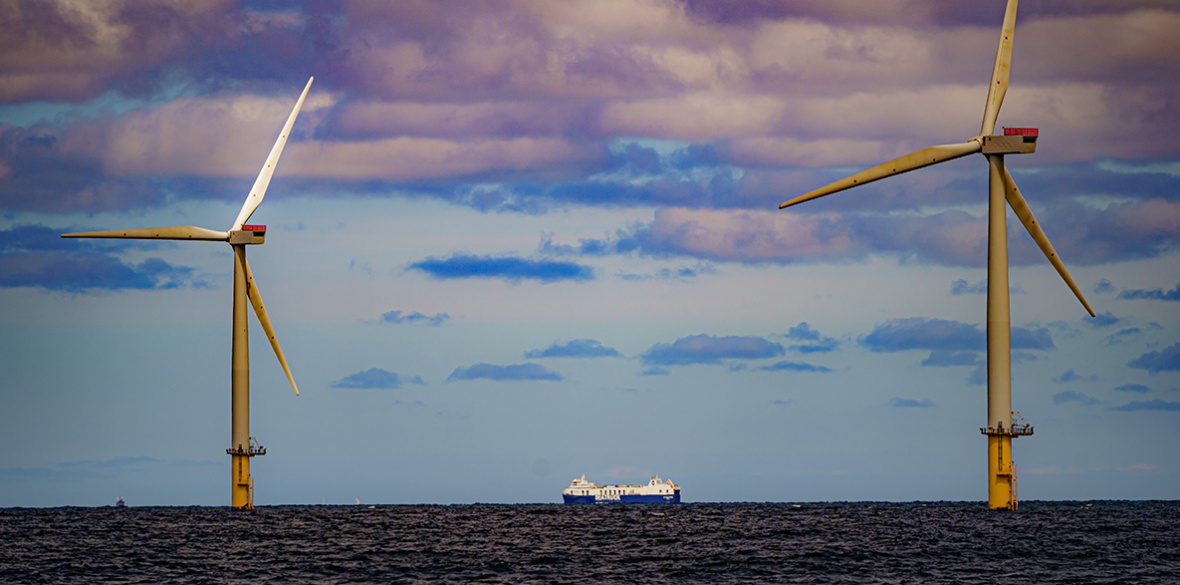
A ship passes wind turbines at RWE’s Gwynt y Mor, the world’s 2nd largest offshore wind farm located eight miles offshore in Liverpool Bay, off the coast of North Wales, July 26, 2022
NATIONALISED energy firms could make a whopping £140 billion for the British economy by 2040, according to a TUC analysis published today.
The union body argued investment in a publicly owned clean power company could generate £3 for every £1 put in, or £5,000 per household.
The strategy would lower record-high gas and electricity bills, make the country richer, create good clean jobs and cut carbon emissions, it said.
…
Oslo has raked in more than £300bn from North Sea oil in the last 40 years by investing in publicly owned energy firms, noted the TUC, which slammed Westminster for choosing to privatise oil fields and put “corporate profits over the public purse.”
The union body’s general secretary, Paul Nowak, said: “Publicly owned energy companies work – across Europe they are lowering household bills and delivering good jobs.