Congressional Dems Request DOJ Investigation into Big Oil’s Climate Deception

Spread the love

Original article by Dana Drugmand republished from DeSmog.
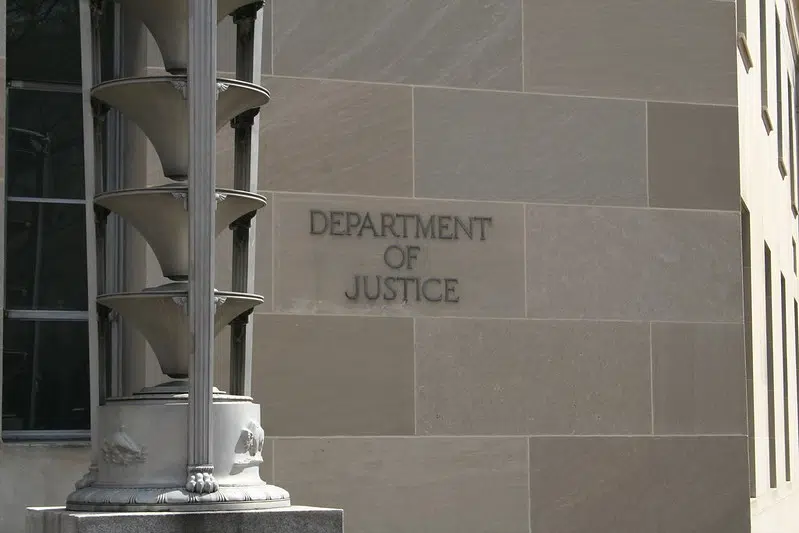
U.S. Department of Justice in Washington DC. Credit: Scott (CC BY-SA 2.0)

Citing “new evidence” of Big Oil firms’ advanced knowledge of climate risks and their actions to publicly conceal these risks, Democratic members of Congress are renewing calls for the U.S. Department of Justice to investigate carbon majors for potential violations of federal law.

In a letter sent to Attorney General Merrick Garland on Tuesday, the 20 congressional signatories, led by Sen. Richard Blumenthal (D-Conn.) and Rep. Ted Lieu (D-Calif.), compare Big Oil’s deceptive conduct to that of Big Tobacco. In 2006, major tobacco firms were convicted of violating the Racketeer Influenced and Corrupt Organizations (RICO) Act in litigation brought by the DOJ. The letter requests that the DOJ now open an investigation into ExxonMobil, Shell, and other oil majors to “determine whether they violated RICO, consumer protection, truth in advertising, public health, or other laws.”

The call for a federal investigation into the fossil fuel industry’s alleged climate deception follows new revelations further showing that Big Oil knew about the climate consequences of its products, yet actively worked to disseminate climate denial and block policy responses to protect profits.

As DeSmog reported in an investigation published March 31, oil major Shell sponsored climate research in the 1970s — years earlier than previously thought. Despite the stark warnings for society issued in internal reports, the company backed a series of industry publications that downplayed climate risks, emphasized uncertainties in climate science, and called for more fossil fuel use, particularly coal. The investigation was based on more than 200 documents uncovered and compiled by Dutch scholar and activist Vatan Hüzeir.   

One of those documents, an internal 1989 Shell scenarios report, discussed the potential for an unprecedented climate refugee crisis with global temperatures rising considerably beyond 1.5 degrees C (2.7 degrees F). The report warned: “Civilisation [sic] could prove a fragile thing.”

The congressional letter to DOJ cites this and several other Shell documents from the investigation, stating: “Despite these warnings, Shell continued to publicly promote the use of fossil fuels and participate in trade associations and other groups that pushed climate denial and opposed solutions.” As DeSmog’s reporting noted, Shell engaged in lobbying and trade associations in the 1990s and 2000s that did just that, such as the Global Climate Coalition and the American Petroleum Institute.     

The letter also points to two peer-reviewed studies indicating that Big Oil deceived and continues to deceive the public. One, published in January in the journal Science by researchers Geoffrey Supran, Stefan Rahmstorf, and Naomi Oreskes, demonstrated that Exxon’s climate modeling and global warming projections were exceptionally accurate, and explained that despite this skillful scientific understanding, the company’s public statements contradicted its internal knowledge of the climate risk. The other study, by Mei Li, Gregory Trencher, and Jusen Asuka and published in 2022 in the journal PLOS ONE, showed the disconnect between oil majors’ rhetoric and pledges around the low carbon transition and their actual actions and investments that prioritize their fossil fuel business.

“The available evidence that these companies lied — and continue to lie — to the public about their central role in exacerbating the climate crisis demands further investigation,” the letter contends. It alleges that this conduct may “constitute the most consequential deception campaign in history, with potentially existential consequences for our planet.”

Shell and ExxonMobil knew their products fueled the #ClimateCrisis, but lied to the public to protect their profits.

READ: Our bicameral letter, co-led by @SenBlumenthal, urging @TheJusticeDept to investigate whether their actions violated federal law. https://t.co/pg3vP9jPgm— Rep. Ted Lieu (@RepTedLieu) July 25, 2023

The letter comes amidst alarming signals of climate breakdown across the country, from the hot-tub-temperature water off the Florida Keys, to the worst flooding Vermont has seen in nearly a century, to punishing heat in the Southwest sizzling sidewalks and causing severe burn injuries.

The Democratic members of Congress who signed onto the letter along with Sen. Blumenthal and Rep. Lieu include Reps. Katie Porter, Jared Huffman, Mark DeSaulnier, Kevin Mullin, and Nanette Díaz Barragán, all of California; Reps. Kim Schrier and Pramila Jayapal of Washington; Rep. Kathy Castor of Florida; Rep. Rashida Tlaib of Michigan; Rep. Cori Bush of Missouri; and Rep. Alexandria Ocasio-Cortez of New York. Sens. Ed Markey of Massachusetts, Sheldon Whitehouse of Rhode Island, Peter Welch of Vermont, Mazie Hirono of Hawaii, John Fetterman of Pennsylvania, and Alex Padilla of California also signed on.

Just two weeks ago, during an online climate discussion, several members of Congress including Ocasio-Cortez, Whitehouse, and Sen. Bernie Sanders of Vermont, called on the Department of Justice to take legal action against Big Oil, with Sanders suggesting they pay the Attorney General a visit to make their request in person. He and other senators have previously written to the DOJ and President Joe Biden requesting an investigation into the fossil fuel industry’s climate deception.

Richard Wiles, president of the Center for Climate Integrity, which advocates for holding climate polluters accountable, said in an emailed statement that this deception amounts to the most “consequential fraud committed against the American people” ever. 

“Just as they did with the tobacco industry, the Department of Justice must exercise its unique power to hold the fossil fuel industry accountable and stop the lying,” Wiles said. “As long as Big Oil’s climate lies, both past and present, remain unchallenged by the DOJ, protecting the American public from the ravages of climate change will remain that much more difficult.”

Original article by Dana Drugmand republished from DeSmog.

Continue ReadingCongressional Dems Request DOJ Investigation into Big Oil’s Climate Deception

Europe cracks down on ‘direct action’ climate protests

Spread the love

Insight: Europe cracks down after rise in ‘direct action’ climate protests

  • Summary
  • France, German states use wiretaps, GPS to track activists
  • Bavaria tries to stop protests with preventative detention
  • Berlin police spend more than 400,000 hours on climate cases
  • France outlaws one group, German states consider ban

BERLIN, Aug 10 (Reuters) – Simon Lachner had plans to glue himself to a German city thoroughfare in June to call public attention to climate change. Instead, he ended up in police custody before he’d even left his home.

Lachner, 28, is one of thousands of activists caught up in a European crackdown on a wave of direct action protests that gathered pace last year demanding urgent government action against climate change.

Roadblocks on major motorways in Britain have caused traffic chaos, protests at oil installations in Germany have disrupted supplies, and in France, thousands of activists and police clashed over water usage, leaving dozens injured.

Determined to prevent such protests from strengthening further, states in Germany and national authorities in France are invoking legal powers often used against organised crime and extremist groups to wiretap and track activists, Reuters found, based on conversations with four prosecutors, police in both countries and more than a dozen protesters.

In Berlin alone, police have spent hundreds of thousands of hours working on more than 4,500 incidents registered against the “The Last Generation” and “Extinction Rebellion” groups, according to previously unreported data from police.

State authorities in Germany are widely using preventative detention to stop people from protesting, including holding at least one person for as long as 30 days without charge, which is permissible under Bavarian law, the prosecutors consulted by Reuters said.

Lawmakers passed new surveillance and detention laws in France in July and in Britain in May, with Britain making it illegal to lock, or glue, yourself to property.

Insight: Europe cracks down after rise in ‘direct action’ climate protests

Continue ReadingEurope cracks down on ‘direct action’ climate protests

French court suspends ban on climate movement accused of ‘ecoterrorism’

Spread the love

https://www.politico.eu/article/france-court-ban-climate-movement-protest-eco-terrorism/

Interior minister ordered activist group to be disbanded after violence at water reservoir protests.

Protests organized in March by the leaderless group Les Soulèvements de la Terre against the construction of large water reservoirs led to violent clashes with police that left hundreds injured and two people in a coma | Loic Venance/AFP via Getty Images

A top French administrative court on Friday suspended the government’s decision to disband a climate activist movement following clashes with police during protests earlier this year.

France’s Council of State court ruled that the disbanding order would restrict the activists’ freedom of assembly and said the interior ministry did not provide enough evidence to back up its claim that the group is inciting violence.

“Neither the documents in the file, nor the discussions at the hearing, make it possible to consider that the grouping in any way endorses violent acts against individuals,” the court said in a statement.

Protests organized in March by the leaderless group Les Soulèvements de la Terre (“Earth’s uprisings”) against the construction of large water reservoirs led to violent clashes with police that left hundreds injured and two people in a coma.

French Interior Minister Gérald Darmanin ordered the group to be disbanded following the incident, alleging the activists were inciting “ecoterrorism” across the country, and 18 people were arrested.

The climate movement decided to challenge the order in court, with the support of the French Greens and the far-left party France Unbowed, arguing that the disbanding order hampered their freedom of assembly and expression.

The court’s decision is a blow to Darmanin, as it means the activists can continue to organize demonstrations across the country, including a two-week march from Saint-Soline to Paris starting August 18 to protest the government’s water management policy.

But the ruling is also only the first step in a longer legal procedure, as it temporarily suspends the government’s disbanding order until the court can look into the merits of the case.

https://www.politico.eu/article/france-court-ban-climate-movement-protest-eco-terrorism/

Continue ReadingFrench court suspends ban on climate movement accused of ‘ecoterrorism’

Energy Dept. Announces $1.2 Billion to Advance Controversial Climate Technology

Spread the love

Original article by Dana Drugmand republished from DeSmog.

‘Direct air capture’ of carbon pollution is still experimental, but a fossil fuel company is embracing it as a way to keep drilling.

In a new TED Talk posted on August 7, 2023, former Vice President Al Gore pointed to Occidental CEO Vicky Hollub’s acknowledgement that direct air capture enables a fossil fuel forever strategy. Credit: Screen grab of <a href=”https://youtu.be/xgZC6da4mco”TED Talk video via YouTube.

The U.S. Department of Energy has announced that a subsidiary of U.S.-based oil company Occidental Petroleum will receive a grant to develop a commercial-scale direct air capture (DAC) facility in southern Texas. 

It is one of two DAC projects selected under a $1.2 billion federal program to scale up DAC, which the Energy Department has called the “world’s largest investment in engineered carbon removal in history.”

This new DOE funding is part of a larger $3.5 billion allocation from Congress – under the Infrastructure Investment and Jobs Act, part of the Biden administration’s signature climate legislation – to develop four large-scale DAC hubs. But some critics contend that the federal government’s involvement in this new climate technology is giving fossil fuel companies cover, allowing them to create the impression that they are part of the transition to greener energy while they continue to focus most of their activities and money on their core oil and gas businesses.

Direct air capture is a nascent technology designed to capture carbon dioxide from the ambient air. In theory, it could help remove “legacy emissions,” or the carbon pollution that has already been emitted. Research and development projects to date have not yet shown how DAC can be scaled up to a global scale that would have an effect on slowing climate change. 

Yet major polluters are already capitalizing on the conceptual promise of this technology to promote it as a climate solution.

“Oxy has said out loud that this is a ‘get out of jail free’ card, enabling the oil and gas industry to continue business as usual,” said researcher Kert Davies, director of special investigations with the Center for Climate Integrity, referring to Occidental Petroleum’s stock ticker symbol, “instead of heeding the urgent fossil fuel phaseout warning scientists have shouted in our faces for decades.” 

Climate advocate and former Vice President Al Gore noted in a recent TED Talk that Occidental CEO Vicky Hollub has said that because of DAC, “we don’t need to ever stop oil,” and that the technology gives the fossil fuel industry “a license to continue to operate.” 

According to Gore, “They’re using it in order to gaslight us, literally.”

Direct air capture may play a role someday, but the best option now is to halt carbon emissions in the first place, said John Fleming, senior scientist at the Center for Biological Diversity’s Climate Law Institute. “[Direct air capture] requires large amounts of energy, spurring more demand for the same fossil fuels that caused the climate crisis,” Fleming said. 

Two of the four DAC hubs funded by the Department of Energy will be located on the Gulf Coast. In addition to Occidental’s hub in Kleberg County, Texas, a project proposed by Battelle, Climeworks, and other partners, called “Project Cypress,” will be constructed in Calcasieu Parish, Louisiana. On paper, the two projects together will have the capacity to remove two million metric tons of CO2 from the atmosphere per year. It is unclear exactly how much each project will receive in government funding, as they will be undergoing award negotiations.

DOE has not yet announced selection of the other two DAC hub projects. “We’re expecting in 2024 or soon thereafter that we will have another solicitation for additional hubs,” said Kelly Cummins, deputy director of DOE’s Office of Clean Energy Demonstrations.

Under the Inflation Reduction Act’s expanded tax credits for carbon capture technologies – a subsidy under section 45Q of the Internal Revenue Code for developers to capture CO2 from polluting facilities or from the atmosphere – qualifying DAC projects can receive $180 per ton of CO2 captured and stored, a significant increase from the previous credit of $50 per ton. 

Occidental subsidiary 1PointFive, which focuses on developing carbon capture, utilization and storage (CCUS) and DAC projects, will be developing the South Texas DAC facility, according to DOE’s announcement. The company is currently building a smaller DAC facility in Ector County, Texas, in the Permian Basin, where Occidental continues to operate as one of the largest extractors of oil and gas. 

Occidental has indicated that CO2 captured from its Permian Basin DAC plant could be used to drill for more oil through a process it has long used known as enhanced oil recovery (EOR). In its latest annual report, the company stated that its CO2 EOR operations “are critical to Occidental’s long-term strategy.”

However, according to DOE’s Cummins, this hub is not expected to be linked to enhanced oil recovery (EOR) operations.

A ‘Gimmick of the Fossil Fuel Industry’

Researchers who have analyzed the technical requirements of direct energy capture, such as energy load, warn that it is little more than a boondoggle. A 2020 analysis published in Nature Communications found that “the energy and materials requirements for [DAC] are unrealistic even when the most promising technologies are employed.” 

In a 2019 study that examined the  impacts of direct air capture, Mark Jacobson, a professor of civil and environmental engineering at Stanford University, found that it would increase CO2 emissions, air pollution, fossil mining and fossil infrastructure, largely because of the enormous amount of energy required to extract, compress, and separate the CO2. 

Even if renewable energy is used to operate DAC, Jacobson told DeSmog that this would simply divert renewables away from directly replacing fossil fuels. At least for the next several decades or until fossil fuels are eliminated, “it is impossible for there to be a benefit of DAC, only an opportunity cost. It will only delay our solution to the climate problem,” Jacobson said.

“DAC is simply a gimmick of the fossil fuel industry to keep themselves operating and pretend they are doing something useful,” he added.

We really need to be smarter than this if we want to hold out any hope of solving global warming, air pollution, and energy security problems.

People making decisions are leading us into the fire. https://t.co/TyoUKQ7kZi— Mark Z. Jacobson (@mzjacobson) August 11, 2023

In a statement, Occidental’s Hollub said the company looks forward to partnering with DOE to “deploy this vital carbon removal technology at climate-relevant scale.”

June Sekera, a climate researcher who has studied DAC, said that the feasibility of actually getting to that scale is “absurd,” and that DAC is meaningless from a climate change perspective. 

Sekera, a research fellow at the Global Development and Environment Institute at Tufts University, told DeSmog that “the IPCC has said that DAC is going to be removing [essentially] zero CO2 by 2030.” The one commercial-scale DAC plant currently operating anywhere in the world, in Iceland, is designed to remove just 4,000 tons of CO2 a year, she said.

The IPCC, or Intergovernmental Panel on Climate Change, is the United Nations body that issues regular reports on the latest climate change science.

U.S. Secretary of Energy Jennifer Granholm told reporters on Thursday that if deployed at a commercial scale, DAC technology “can help us make serious headway on our net zero goals.” But climate and environmental justice advocates are largely opposed to the kinds of “carbon management” projects that fossil fuel interests are promoting, including direct air capture, and see them as a way for industrial polluters to continue operating as usual.

“We know that engineering-based removal activities are technologically and economically unproven, especially at scale, and pose unknown environmental and social risks,” said Marion Gee, co-executive director of Climate Justice Alliance. 

Fenceline Watch, a Texas-based environmental justice organization, said in a statement that DOE’s funding of DAC hubs in Texas and Louisiana “represents, once again, the sacrifice of our communities along the Gulf Coast in the interest of the oil, gas, and petrochemical industry.”

Carbon180, an organization supporting carbon removal, told DeSmog that addressing environmental justice issues and not catering to polluters’ interests are key to building industrial-scale carbon removal in an equitable way. “We believe that the carbon removal industry can and should be built to redress the harms and injustices of the past. We’re keen to see DOE prioritize the interest of communities and not those of the fossil fuel industry,” said Sasha Stashwick, director of policy at Carbon180.

But Fenceline Watch contends that direct air capture further endangers communities already overburdened by industrial pollution.

“While the industry positions direct air capture facilities as a viable solution to removing carbon from the air, the reality is these hubs have never proven to be able to achieve these claims,” the organization said in an emailed statement. “This is a greenwashing campaign that will continue to put our communities’ health, environment, and safety at risk.”

Original article by Dana Drugmand republished from DeSmog.

Continue ReadingEnergy Dept. Announces $1.2 Billion to Advance Controversial Climate Technology