The numbers in the sub-sample of 18-24 year olds are frankly hilarious. That sub-sample suggests that only 1 per cent of voters under the age of 25 would vote for the Tories. That puts them well below the Lib Dems on 9 per cent and the Greens on 11 per cent.
While a sub-sample has a bigger margin of error, the Tories attracting near zero support among young people doesn’t bode well for their long term electoral prospects…
Former PM Theresa May has said the UK’s net zero target should be seen as “the growth opportunity of the century”, not an “act of economic harm”.
Mrs May said the UK had a chance to lead “the green revolution”, in a speech at the Conservative conference.
The former PM’s government passed a law that committed the UK to net zero carbon emissions by 2050.
At a conference event, Mrs May said she did that “because climate change is the greatest threat to civilisation”.
But the UK’s approach to net zero has come under intense scrutiny since Prime Minister Rishi Sunak announced an overhaul of some green policies last month.
The policy changes, including a delay to the ban on the sale of new petrol and diesel cars, provoked a backlash, with the government’s climate change adviser saying the UK had “moved backwards” on net zero.
Business secretary privately met media mogul in apparent breach of ministerial code of conduct
Kemi Badenoch failed to declare a meeting that she held with Rupert Murdoch days after she was appointed to the cabinet – in a breach of transparency rules.
The business and trade secretary reacted angrily on Monday on social media after it was revealed that she had privately met the media mogul and other executives from his News Corp company in New York in September 2022.
Murdoch was reported by Politico to have questioned Badenoch for 20 minutes in an atmosphere that was said to have been described as akin to a job interview by one of those present.
A government spokesperson described the fact that the meeting with Murdoch was not made public as “an oversight”.
Nevertheless, the failure to declare the meeting appears to have contravened the ministerial code of conduct, which states: “Meetings with newspaper and other media proprietors, editors and senior executives will be published on a quarterly basis, regardless of the purpose of the meeting.”
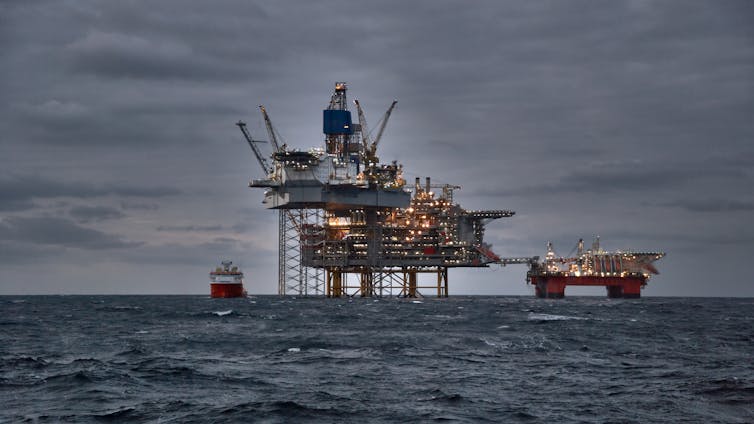
In a four-line statement announcing the approval of the new Rosebank oil field 80 miles west of Shetland, the UK’s offshore oil and gas regulator showed its mission no longer serves the public good.
The announcement by the North Sea Transition Authority (NSTA), which regulates oil and gas extraction in the waters off the British coast, asserted that net zero considerations had been taken into account – a technical definition that makes it appear long-term oil production is compatible with climate goals. This has outraged and dismayed climate scientists, campaigners, and the many other people concerned about the UK’s faltering climate leadership.
The approval greenlights a process that is expected to produce first oil by 2026, and around 300 million barrels of oil (and a smaller amount of gas) over the next two decades. The project’s developers are Equinor, an oil company owned for the most part by the Norwegian state, and Ithaca Energy, owned by the Delek Group listed on the Tel Aviv stock exchange.
The decision is out of step with demands for rapid action on climate change coming from a range of quarters. This includes shareholder activists demanding corporations accelerate decarbonisation, direct action groups such as Just Stop Oil, and financiers concerned about the risks of “asset stranding” as renewables become cheaper than fossil fuels.
Public protests and legal challenges to the NSTA spotlight the irrationality and recklessness in the government’s expressed support for issuing new licenses. Activists are not alone in making this point.
A welter of scientific studies and reports by international agencies confirm that new fossil fuel extraction is incompatible with keeping global temperature increases well below 2℃.
Rosebank has been a major focus for climate activism in the past couple of years, as science, international policy and campaigners turn their attention to stopping new extraction, rather than solely focusing on reducing emissions. Calls to end new licensing for oil and gas are in line with climate science.
But a climate politics focused on new licensing alone misses the point. The thing is, like other North Sea oil fields yet to be approved, Rosebank was licensed for oil and gas extraction years ago.
The NSTA approval process follows licensing, sometimes after considerable time has passed. And it is this approval process that locks the UK into hydrocarbon production for years to come.
End ‘maximising economic recovery’
The core objective of the NSTA is to maximise the economic recovery of UK petroleum – a principle shorthanded as MER – as set out in the 1998 Petroleum Act. In practice, this means the regulator’s primary mission is to facilitate the extraction of oil and gas.
A revised strategy in 2021 paired MER with an obligation to support the UK’s net zero commitments. And the former Oil and Gas Authority changed its name to include an explicit reference to the “transition” in 2022, underpinned by ambitions for emissions reduction and decarbonisation.
NSTA sees its job as effecting the industry’s alignment with these goals. It is now also in charge of licensing for carbon capture and storage and offshore hydrogen storage.
Rosebank’s approval therefore reveals a deeper truth: the regulator’s guiding objective fails the public good test. Regulation aims to avoid economic, environmental and social harms, and ensure the public good through delivering collective benefits and upholding socially-desirable ideals. The Rosebank decision arguably breaches this principle.
Supporters of Rosebank argue it will contribute to the UK’s energy security and deploy decarbonisation technologies that reduce CO₂ emissions overall. These arguments do not stand scrutiny, however: oil from Rosebank, like around 80% of North Sea oil production, will be sold directly into international markets and will not materially affect the price of petrol or diesel for UK motorists.
Much of the value of that oil will flow into the portfolios of Equinor and Ithaca. That value could be harnessed to speed up transition to renewables or ensure its benefits are widely distributed, but that’s largely down to Equinor and Ithaca – not the UK government.
A decade ago, a decision by NSTA would not have raised much attention. Now it highlights a significant problem in need of reform. Piecemeal adaptation has left MER and other core regulatory principles untouched, which is at odds with the climate emergency.
Existing licensed fields escape the weak scrutiny embodied in instruments such as the climate compatibility checkpoint, a series of tests to be applied in decisions about future licensing rounds. What’s more, as a litmus test for approval, Rosebank indicates other licensed projects may get the go-ahead, like Cambo.
Removing NSTA’s central objective to maximise economic recovery requires nothing less than a rewrite of the Petroleum Act. This would be an opportunity to fundamentally revise what the North Sea is for, and whether or how to exploit its resources in the future. A start would be to consider a reversal of direction – a “minimising” of economic recovery, for example – which redefines the “economic” in terms of what is socially necessary.
Such a move will inevitably entail reviewing licences already in place, and will likely generate challenges from the sector and other powerful incumbents. Rosebank exposes, however, how the new mission of the offshore regulator has to be about securing a new public good. This needs wider social debate, and should ultimately be decided through parliament.
Don’t have time to read about climate change as much as you’d like?
“One week ago, 75,000 people inundated New York City streets to demand the president end fossil fuels,” said one campaigner. “Now, climate-fueled rains are submerging those same streets.”
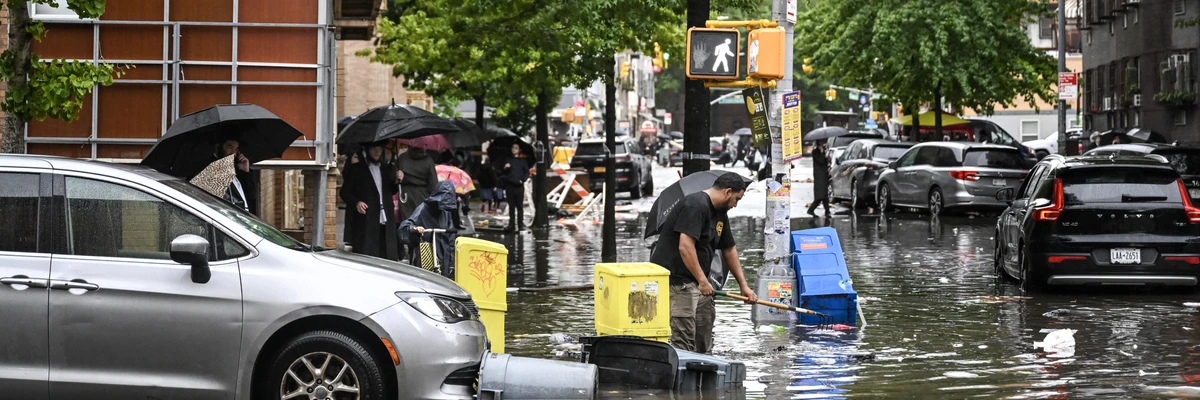
“This is the climate crisis,” said youth-led grassroots organization Sunrise Movement on Friday as photos and videos of flooded streets and subway stations in the largest city in the United States went viral across social media.
The group shared a video of cars struggling to drive through water that was up to pedestrians’ knees in Brooklyn, saying the image starkly illustrated the need to both prepare U.S. cities and infrastructure for fossil-fueled extreme weather events and to rapidly draw down planet-heating greenhouse gas emissions that have been linked to stronger hurricanes, rising sea levels, and other destructive changes.
“We need an all-out mobilization of our government and society to stop [the climate crisis] right now,” said the group.
New York is underwater.
THIS is the climate crisis. We need an all-out mobilization of our government and society to stop it right now. https://t.co/An3yS7UYh4
New York Gov. Kathy Hochul called the rainstorm that caused the flash flooding a “life-threatening rainfall event” and noted that there have been reports of some school buildings flooding, prompting administrators to move children to higher floors or close the buildings.
“No children are in danger as far as we know,” said Hochul, adding that many New York City children use public transportation to get home from school. “We want to make sure we get the subways, the trains, our communication system, our transportation system working.”
According to Richard Davis, president of Local 100 of the Transport Workers Union, some bus passengers on Friday were forced to stand on their seats as drivers navigated through high flood waters that seeped into buses.
Maintenance workers were using pumps to remove water from subway stations, and the Metropolitan Transportation Authority announced “extremely limited subway service,” with many lines suspended or rerouted.
New York City Councilmember Chi Ossé criticized Mayor Eric Adams for failing to address the public until the crisis was well underway and said the flooding shows the city is “severely underprepared for the climate crisis.”
This was @NYCMayor’s statement 3 months before he took office.
What is this administration’s climate resiliency plan for North and Central Brooklyn?
I know he doesn’t control the weather, but what safety measures/ investments have been put into Brooklyn to prepare for this? https://t.co/7tM2ZRBMxo
Earlier this month Adams announced a new initiative aimed at mobilizing business owners to comply with Local Law 97, which will take effect in 2024 and would reduce carbon emissions from buildings.
According toGothamist, “environmental experts say the new plan will weaken the law’s enforcement powers by giving qualified building owners an extra three years to meet carbon reduction deadlines.”
The climate crisis: heavier storms and major flooding b/c hotter air holds more moisture. It tends to pour harder.
Pols like Eric Adams talk like they care, but he’s attacking NYC’s landmark climate/jobs law right now. Making the crisis worse. https://t.co/Jw1LWoo2Vt
Jean Su, energy justice director at the Center for Biological Diversity, took aim at the offshore drilling plan proposed by President Joe Biden on Friday over the objections of scientists and climate advocates. The five-year plan includes three new offshore gas leases in the Gulf of Mexico despite Biden’s campaign promise to end offshore gas and oil drilling.
“We are in the climate emergency,” said Su. “Yet the president is continuing to drill for oil and gas. He has to stop to give us a chance at a livable planet.”
One week ago, 75,000 ppl inundated NYC streets to demand @POTUS#EndFossilFuels. Now, climate-fueled rains are submerging those same streets.
Earlier this month, noted Su, some of the same streets that were inundated with rainwater on Friday had been filled with tens of thousands of people demanding that Biden declare a climate emergency and take decisive action to speed the transition toward renewable energy.
“A week ago, we were hitting the streets of New York for Climate Week NYC,” said grassroots group Rising Tide North America. “We shut down Citibank’s headquarters and blockaded the New York Federal Reserve.”
“[The New York Police Department] arrested lots of our friends,” the group added. “Maybe they should have been arresting those bankers and bureaucrats who are responsible for this disaster.”