Experts warn UK’s regulations now lag behind those of the EU and that Britons will be exposed to more toxic chemicals as a result
The government is to loosen EU-derived laws on chemicals in a move experts say will increase the likelihood of toxic substances entering the environment.
Under new plans the government will reduce the “hazard” information that chemical companies must provide to register substances in the UK. The safety information provided about chemicals will be reduced to an “irreducible minimum”, which campaigners say will leave the UK “lagging far behind the EU”.
The UK’s scheme, called UK Reach, is falling behind the EU’s as it is. The UK has not been part of the bloc’s chemicals regulations scheme, EU Reach, since 2021. Eight rules restricting the use of hazardous chemicals have been adopted by the EU since Brexit, and 16 more are in the pipeline. The UK has not banned any substances in that time and is considering just two restrictions, on lead ammunition and harmful substances in tattoo ink.
Campaigners have called for the government to follow EU chemicals regulations as standard, diverging only if and when there is a good reason to do so. This would free up time and money for regulators and mean dangerous chemicals banned by the EU do not enter the environment before there is time to ban them.
Responding to Rishi Sunak’s extensive cabinet reshuffle today, co-leader of the Green Party, Adrian Ramsay, said:
“This reshuffle looks desperate and is a sign that Rishi Sunak has run out of talent. David Cameron started the programme of cuts to our public services which has now brought the NHS to near breaking point. Since his disastrous exit he has cashed in on dodgy lobbying for global oligarchs. And on the odd occasion where Cameron did take a principled stand – such as on maintaining the international aid budget – the government has since reneged.
“As to the departure of Therese Coffey as Environment Secretary, nature can at least temporarily breathe a sigh of relief as we await to see who replaces her. She put in place a subsidy system which is not working for farmers or the environment, and she has failed to tackle the blight of sewage in our rivers – a situation she herself described as ‘a scandal’ when I challenged her on it at a public meeting in Suffolk last month.
“We need a fresh start on the environment, with real action to stop the water companies profiting from failure and a proper system of nature-friendly farming payments which are easy for farmers to access.
“This chaotic and unprincipled government has reached the end of the road. It is doing great harm to the country. We need a general election now.”
UK Prime Minister Rishi Sunak has rowed back on UK net-zero targets, incurring the wrath of industry, charities and academics.
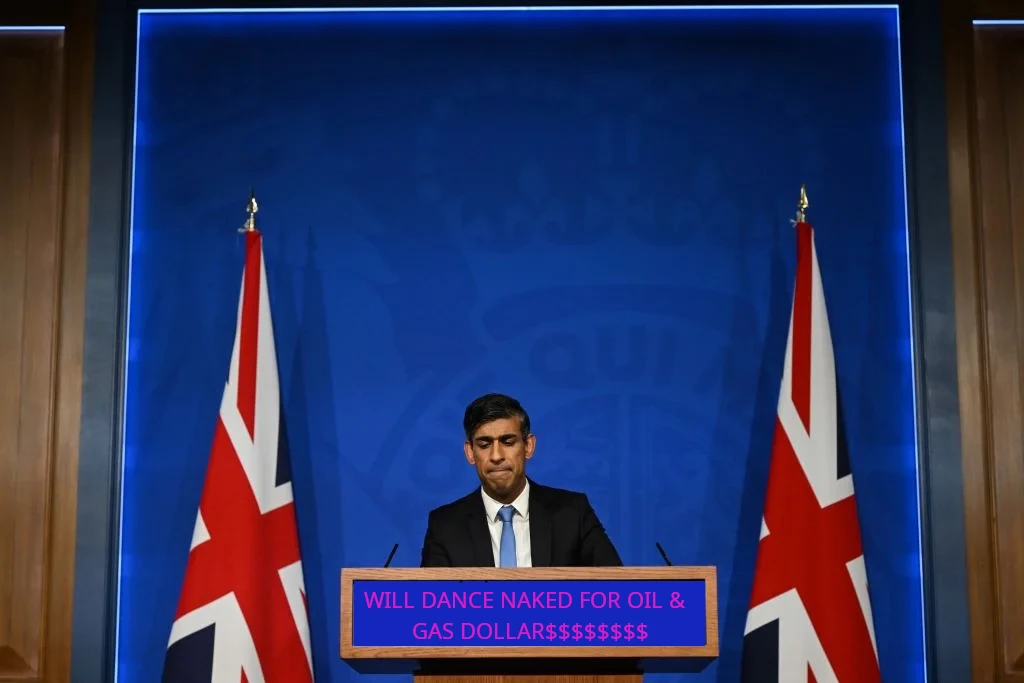
Rishi Sunak offers to dance
The UK will water down policies aimed at achieving its target of net-zero carbon emissions by 2050 following Prime Minister Rishi Sunak’s decision, announced on 20 September, to push back the ban on the sale of new petrol and diesel cars in the UK from 2030 to 2035.
Sunak also announced an easing of energy efficiency targets for rental properties and backtracked on plans to make homeowners replace gas boilers with heat pumps.
“We can adopt a more pragmatic, proportionate and realistic approach to meeting net zero” that would bring the UK in line with countries such as France and Germany, he said.
Reacting to the news, Halima Begum, CEO of ActionAid UK, told our sister site Investment Monitor that the UK Government’s sudden reversal of its net-zero commitments “is reckless and irresponsible”.
“Climate action is not a political bargaining chip that can be taken on and off the table to satisfy party political squabbles, but a global imperative,” she added. “The climate crisis is not a future event, it is happening now. People are facing flash floods, droughts, rising sea levels and irreversible damage that has already led to tragic deaths around the world this year alone.”
Meanwhile, Nick Kirsop-Taylor, an expert in environmental governance from the University of Exeter, joined a chorus of other academics in saying it is “truly disappointing news” since time is running out for the global action required to keep global temperatures to below 1.5°C, let alone 2°C.