Biden Offshore Drilling Plan Continues ‘Dangerous Cycle’

Spread the love

Original article by JESSICA CORBETT republished from Common Dreams under Creative Commons (CC BY-NC-ND 3.0). 

The Biden administration announced plans for three offshore fossil fuel lease sales for the Gulf of Mexico in 2025, 2027, and 2029.  (Photo: nightman1965/Getty Images)

“Offshore oil and gas drilling is not only dirty and dangerous, but it also supercharges the existing climate crisis,” said one campaigner.

The Biden administration on Friday finalized a five-year plan for offshore fossil fuel leasing that was initially released in September and sharply condemned as a “climate nightmare.”

The Department of the Interior (DOI) highlighted in a statement Friday that the 2024-29 National Outer Continental Shelf (OCS) Oil and Gas Leasing Program has the fewest sales in history, with just three for the Gulf of Mexico set to be held in 2025, 2027, and 2029.

The DOI also stressed that the Inflation Reduction Act (IRA) signed last year by President Joe Biden “prohibits the Bureau of Ocean Energy Management (BOEM) from issuing a lease for offshore wind development unless the agency has offered at least 60 million acres for oil and gas leasing on the OCS in the previous year.”

“BOEM continues to treat the Gulf as a region where community health and well-being can be sacrificed to allow continued oil and gas production.”

That part of the IRA is one of the key reasons it has been criticized by climate campaigners, who continue to warn that the landmark package is far from enough to meet the U.S. goal of halving planet-heating emissions by the end of this decade.

The DOI’s plan outraged the American Petroleum Institute and U.S. House Committee on Natural Resources Chairman Bruce Westerman (R-Ark.) for not being friendly enough to the fossil fuel industry while advocates for the planet warned that it’s not bold enough given the worsening climate emergency.

“Offshore oil and gas drilling is not only dirty and dangerous, but it also supercharges the existing climate crisis,” Beth Lowell, Oceana’s vice president for the United States, declared in a Friday statement about the finalized program. She pointed out that the process actually began under former President Donald Trump, who proposed 47 leasing sales.

“This five-year plan started with President Trump proposing to open nearly all U.S. waters to offshore oil drilling and ends with President Biden’s final plan that is the smallest to date,” she said. “The footprint of offshore drilling was not expanded, but the dangerous cycle of drilling and spilling must end.”

After the Biden administration released its proposal in September, Natural Resources Defense Council senior attorney Irene Gutierrez wrote the following month that “BOEM continues to treat the Gulf as a region where community health and well-being can be sacrificed to allow continued oil and gas production.”

“BOEM also fails to account for the severe risks from additional oil and gas leasing to the Gulf ecosystem and species like the critically endangered Rice’s whale,” Gutierrez charged. “BOEM’s analysis also treats catastrophic oil spills like the Deepwater Horizon disaster as events that are speculative and unlikely to repeat again, and the program excludes such spills from its analysis.”

“In our comments to the proposed program and in other advocacy, we urged BOEM to issue a program with no new lease sales. The agency has ample authority to do so,” she noted. “Further, declining fossil fuel demand and existing energy reserves mean that no new offshore leasing is needed for at least the next 30 years to meet national energy needs. BOEM could have issued a zero-lease sale plan, but declined to do so, despite calls from a wide range of community and environmental groups for no new leasing in the Gulf.”

The DOI plan comes near the end of what experts have said will be the hottest year on record. It also comes on the heels of United Nations climate talks that scientists called “a tragedy for the planet,” given that the final deal out of COP28 called for “transitioning away from fossil fuels,” but did not endorse the “phaseout” demanded by civil society and most participating countries.

Biden—who is seeking reelection next year and may face off against Trump—has previously come under fire from frontline communities and climate organizations for skipping that U.N. summitsupporting the Willow oil project and Mountain Valley Pipeline, enabling the expansion of liquefied natural gas exports, and refusing to declare a national climate emergency.

On Thursday, the Biden administration released new proposed guidance on clean energy tax credits from the IRA.

“President Biden must do so much more if he wants to be taken seriously by young voters,” Michele Weindling, political director of the youth-led Sunrise Movement, said in response to the guidance. “He is overseeing an explosion in oil and gas production that has resulted in the U.S. producing more fossil fuels than ever before.”

Original article by JESSICA CORBETT republished from Common Dreams under Creative Commons (CC BY-NC-ND 3.0). 

Continue ReadingBiden Offshore Drilling Plan Continues ‘Dangerous Cycle’

Eye watering legal cost of Sunak’s failed bid to withhold WhatsApp messages revealed

Spread the love
One of the many occasions climate destroyer and UK Prime Minister Rishi Sunak uses a private jet.

https://leftfootforward.org/2023/12/eye-watering-legal-cost-of-sunaks-failed-bid-to-withhold-whatsapp-messages-revealed/

How much did the Government’s failed legal challenge over a Covid Inquiry request come to

The cost of an unsuccessful legal challenge, launched by Rishi Sunak’s Government to stop ministers from having to hand over all WhatsApp messages to the Covid Inquiry, has come to hundreds of thousands of pounds it has been revealed.

Nearly £200,000 was wasted on legal advice to the Government over its failed legal battle at the High Court, a lengthy Freedom of Information Act battle launched by Liberal Democrat spokesperson Ian Rex-Hawkes has exposed.

The Cabinet Office had disputed the inquiry’s demand to provide two years of WhatsApp messages, initiating a legal challenge under the grounds that some messages were personal and “unambiguously irrelevant”.

But its challenge was rejected and the government was forced to concede to the Covid Inquiry requests.

In its response to the FOI request, the Cabinet Office noted that “of November 2023 the total legal costs for the Judicial Review on the production of Government and Ministerial WhatsApp messages to the Inquiry were £192,739.”

However, despite the money spent and legal battle, both Rishi Sunak and Boris Johnson have claimed to have lost large chunks of WhatsApp messages during the pandemic period anyway.

https://leftfootforward.org/2023/12/eye-watering-legal-cost-of-sunaks-failed-bid-to-withhold-whatsapp-messages-revealed/

Image of Elmo and former Prime Minister Tory idiot Boris Johnson
Image of Elmo (left) and former Prime Minister Tory idiot Boris Johnson (right)
Continue ReadingEye watering legal cost of Sunak’s failed bid to withhold WhatsApp messages revealed

Just Stop Oil activist handed shocking six-month prison sentence for slow marching

Spread the love

https://morningstaronline.co.uk/article/just-stop-oil-activist-handed-shocking-six-month-prison-sentence-slow-marching

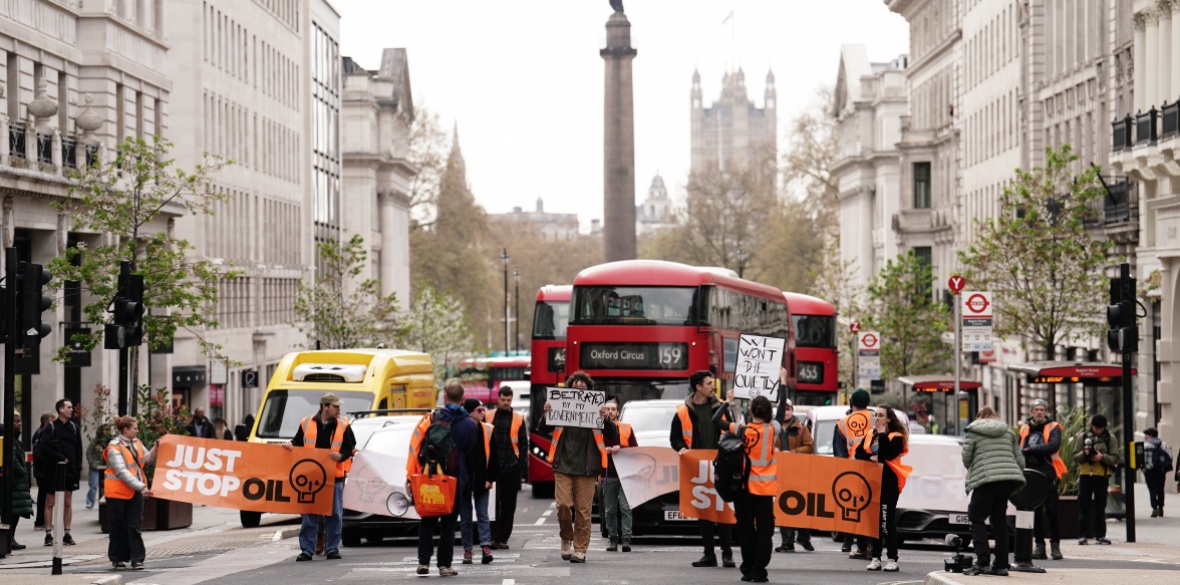
Just Stop Oil protesters as they take part in a slow march protest through London as part of the group’s campaign to convince the government to end all new oil and gas projects in the UK, April 24, 2023

THE government’s draconian anti-protest laws have been used to give a shocking six-month prison sentence to a climate activist for taking part in a peaceful slow march.

Just Stop Oil supporter Stephen Gingell, 57, was sentenced at Manchester magistrates’ court on Thursday.

The father-of-three was arrested on November 13 after taking part in a slow march in north London for about half an hour.

Mr Gingell pleaded guilty to breaching section seven of the Public Order Act, which bans any act “which interferes with the use or operation of any key national infrastructure in England and Wales.”

Passed in May, the widely condemned legislation allows police to ban peaceful protests merely on the grounds that they might become disruptive.

“It seems this government has now made walking down the road, walking on the public highway, an illegal act that is worthy of imprisonment,” a Just Stop Oil spokesperson said.

https://morningstaronline.co.uk/article/just-stop-oil-activist-handed-shocking-six-month-prison-sentence-slow-marching

Continue ReadingJust Stop Oil activist handed shocking six-month prison sentence for slow marching

Grouse shooting in Scotland has an alarming death toll – and not just for game birds

Spread the love

Mark Caunt/Shutterstock

Clair Linzey, University of Oxford

The Scottish moors are considered areas of outstanding beauty, and often assumed to be “wild” and “untamed”. However, these landscapes are the result of management techniques that are now under scrutiny by the Scottish government.

These practices include burning the moorlands (muirburn) and controlling the number of animals on the moors through trapping, snaring and poisoning. All of these measures are pursued to keep the number of red grouse artificially high so they can be shot in grouse season.

An estimated 260,000 animals are killed each year in Scotland as part of these legal “predator control” measures. Targeted animals include foxes, weasels, stoats, rats, rabbits and various types of corvid like crows, magpies, jackdaws and jays.

Many animals are also killed unintentionally. A report that was commissioned by the League Against Cruel Sports Scotland, a UK-based animal welfare charity, shows that as many as 39% of the trapped animals are not the intended target. These animals include pine martens, hedgehogs, badgers, deer and hares. But there have also been reports of endangered and protected animals, such as raptors and the capercaillie, being killed.

In a recent report, which I co-authored with Dr Katie Javanaud and Professor Andrew Linzey from the Oxford Centre for Animal Ethics, we examined the moral basis for these practices. We found that it is impossible to overstate the severity of the suffering caused to animals caught in traps.

The western capercaillie in a spruce forest.
Some endangered and protected animals, like the capercaillie (pictured) are unintentionally killed.
Jaroslav Macenauer/Shutterstock

Prolonged suffering

The Agreement on International Humane Trapping Standards, to which the UK is a signatory, is the primary measure against which the welfare of trapped animals is judged. The standards consider traps to be “sufficient” and “efficient” if the animals are killed in anywhere between 45 seconds and five minutes. In fact, the standards still consider traps efficient if 20% of animals do not die within five minutes.

Any system of killing that only causes death after 45 seconds to five minutes is unnecessarily cruel. The animals suffer an appalling range of injuries that would not be acceptable in any other context. Entrapment for free-living animals is at best a distressing experience that obviously involves psychological and emotional harm.

All forms of predator control, whether that be trapping, snaring or poisoning, are predicated on exposing animals to hours or days of prolonged suffering. And all of this supposes that these traps can practically be inspected often. This is a question in and of itself given the vast area over which the methods are used and the limited manpower available, as well as adverse weather conditions.

Stopping the suffering

The suffering caused by these “management techniques” is also made invisible, reduced to being a private matter on private estates. However, cruelty to animals is a public moral issue and should be subject to political accountability.

Effective legislation requires three important components: compliance, inspection and enforcement. However, the illegal trapping of raptors indicates that there is limited compliance with the current legislation.

All raptors are protected under the Wildlife and Countryside Act 1981. But traps and poisons kill animals indiscriminately. So, as long as traps and poisons continue to be in use, legally protected animals like raptors will continue to be caught and killed.

A golden eagle standing behind a clump of heather.
All raptors are protected under the Wildlife and Countryside Act 1981.
Ian Duffield/Shutterstock

Raptor persecution is one of the main concerns of the Scottish government’s proposed Wildlife Management and Muirburn Bill. The bill aims to change “rules around how people can capture and kill certain wild birds and wild animals” and “rules around the making of muirburn”.

The government plans to address these problems by licensing the use of traps and giving the Scottish Society for Prevention of Cruelty to Animals (SSPCA) powers of inspection, as well as introducing a licensing scheme for grouse hunting and the management of land.

It also intends to bring in an outright ban on glue traps. These traps consist of a small board coated with a sticky adhesive, a practice the RSPCA argue causes “unacceptable cruelty”.

We need to do more

The plan to introduce powers of inspection for the SSPCA should be commended. But licensing the killing of animals on Scotland’s moors serves only to codify and ingrain the suffering and deaths of those animals.

All current methods of “predator control” either cause (often prolonged) suffering or make animals liable to suffering. To license any of the traps currently in use is to institutionalise the suffering and death of thousands of animals a year.

Our report concludes that predator control is uncontrollable. There simply are not the mechanisms in place to control it. Poisons and traps of various kinds are readily available for purchase in shops and on the internet. There is no moral alternative to making all of these practices illegal.

We propose the promulgation of a new charter for free-living animals. Scotland could lead the way in pioneering legislation that protects all animals, domestic and free-living. This legislation should begin with the recognition of sentience and enshrine in law the value and dignity of wild animals such that their right to live unmolested is respected.


Imagine weekly climate newsletter

Don’t have time to read about climate change as much as you’d like?

Get a weekly roundup in your inbox instead. Every Wednesday, The Conversation’s environment editor writes Imagine, a short email that goes a little deeper into just one climate issue. Join the 30,000+ readers who’ve subscribed so far.The Conversation


Clair Linzey, Research Fellow in Animal Ethics, University of Oxford

This article is republished from The Conversation under a Creative Commons license. Read the original article.

Continue ReadingGrouse shooting in Scotland has an alarming death toll – and not just for game birds

Revealed: Where up to a quarter of your water bill is really going

Spread the love
Image of a burst water main.

https://leftfootforward.org/2023/12/revealed-where-up-to-a-quarter-of-your-water-bill-is-really-going/

It’s been branded ‘daylight robbery’

An investigation by the Guardian published today has revealed that staggering proportions of the public’s water bills are used to service private water firms’ debt. According to the paper’s analysis of financial data over a quarter of some water companies’ revenue goes on servicing debt.

The UK’s largest water firm, Thames Water, uses an astonishing 28 per cent of its revenue to service debt. Southern Water and South East Water both also use more than a quarter of their revenue for the same purpose.

Almost the entirety of water company revenue is made up of customer bills. As of March, the private water firms in England had racked up combined debts of more than £60 billion. Meanwhile, since privatisation of water in England in 1989, private water companies have paid out over £70 billion in dividends to shareholders.

The Guardian notes that Scottish Water, which remains publicly owned, spent just 10 per cent of its revenues financing its debt, less than all of the private water firms in England.

The revelations have led to a furious public backlash and renewed calls for England’s water to be taken back into public ownership.

Labour peer and Left Foot Forward columnist Prem Sikka branded the situation as ‘daylight robbery’, saying that money had been ‘borrowed to pay dividends, and that ‘companies want more from captive customers’.

https://leftfootforward.org/2023/12/revealed-where-up-to-a-quarter-of-your-water-bill-is-really-going/

dizzy: This ridiculous situation is on the Conservatives watch …

Image of cash and pre-payment meter key
Continue ReadingRevealed: Where up to a quarter of your water bill is really going