Israel Is Starving Gaza Civilians as ‘Method of Warfare’: Human Rights Watch

Spread the love

Original article by JULIA CONLEY republished from Common Dreams under Creative Commons (CC BY-NC-ND 3.0). 

A view of empty shelves are seen at a supermarket amidst Israel’s bombardments as Palestinians have trouble finding necessary food in Khan Yunis, Gaza on November 11, 2023.  (Photo: Mustafa Hassona/Anadolu via Getty Images)

“It’s critical to understand this is not simply a byproduct of the conflict, an unfortunate result of a terrible situation,” said one campaigner. “It is Israeli government policy.”

From bombing food production hubs and systematically razing crop fields to halting aid deliveries, Israel is waging a multi-pronged effort to starve the people of Gaza amid the Israel Defense Forces’ bombardment of the enclave, Human Rights Watch said in a report Monday—with evidence drawn from the Israeli government’s own statements as well as survivors’ accounts.

The group demanded that countries such as the United States, United Kingdom, Canada, and others that have provided Israel with military aid and other support since the country began its latest escalation against Gaza in October speak out against the use of starvation as a weapon of warfare—a war crime under the Rome Statute of the International Criminal Court.

“For over two months, Israel has been depriving Gaza’s population of food and water, a policy spurred on or endorsed by high-ranking Israeli officials and reflecting an intent to starve civilians as a method of warfare,” said Omar Shakir, Israel and Palestine director at Human Rights Watch (HRW). “World leaders should be speaking out against this abhorrent war crime, which has devastating effects on Gaza’s population.”

HRW pointed to satellite imagery it has collected in northern Gaza since the IDF began its air and ground assault in retaliation for an attack by Hamas on southern Israel on October 7.

The images have shown orchards, greenhouses, and farmland that have been razed over the last two months, “apparently by Israeli forces, compounding concerns of dire food insecurity.”

Only sand and dirt have been left behind where farmers in northeastern Gaza grew citrus, potatoes, dragon fruit, and prickly pear since Israeli forces took control of the area in mid-November and “systematically razed” the fields, said the group.

Palestinians in Gaza, home to about 2.3 million people, have lost the ability to grow their own food as Israel has refused to allow food, water, and fuel deliveries into the enclave, leaving bakeries and grocery store shelves empty.

Before the Israeli bombardment began, about 500 aid trucks filled with food and other goods entered Gaza on a daily basis to provide sustenance amid Israel’s unlawful occupation and its land, air, and sea blockade that began 16 years ago. Israel has allowed only 100 aid trucks to cross through Egypt’s Rafah crossing since October 7. The U.N. humanitarian coordinator for the Occupied Palestinian Territory, Lynn Hastings, said earlier this month that fuel deliveries—needed for farming, cooking, water desalination, healthcare operations, and other necessities—have been “utterly insufficient.”

Prior to the current escalation, about half of Gaza’s population was facing acute food insecurity and 80% were reliant on humanitarian aid.

The World Food Program (WFP) at the U.N. said earlier this month that 9 in 10 households in northern Gaza and 2 in 3 homes in the south had been without food for at least one full day and night since Israel’s assault. It also warned that 38% of families who had been displaced from their homes in northern Gaza were experiencing “severe levels of hunger” and that the enclave faces a “high risk of famine.”

“It’s critical to understand this is not simply a byproduct of the conflict, an unfortunate result of a terrible situation. It is Israeli government policy,” said Andrew Stroehlein, European media and editorial director for HRW.

In addition to the halting of aid and the destruction of Gaza’s agricultural sector, the last operational wheat mill was bombed on November 15 ensureing “that locally produced flour will be unavailable in Gaza for the foreseeable future,” said HRW.

The group interviewed 11 civilians who described their struggles with finding sufficient food in recent weeks.

A man identified as Taher said that after his family fled south to Gaza City in November, they resorted to eating “just once a day to survive.”

“The city was out of everything, of food and water,” he told HRW. “If you find canned food, the prices were so high… We were running out of money. We decided to just have the necessities, to have less of everything.”

Majed, who left his home in the north after his house was bombed, killing his six-year-old son, said he, his wife, and their four surviving children had no way of making bread for more than a month when they temporarily stayed in Gaza City.

“In those 33 days we didn’t have bread because there was no flour,” he said. “There was no water—we were buying water, sometimes for $10 a cup. It wasn’t always drinkable. Sometimes, [the water we drank] was from the bathroom and sometimes from the sea. The markets around the area were empty. There wasn’t even canned food.”

HRW noted that the Israeli government itself has made numerous statements in recent weeks pointing to the deliberate destruction of Gaza’s food access and the starvation of civilians.

Defense Minister Yoav Gallant infamously called Palestinians in Gaza “human animals” when he announced the “complete siege” and cutting off of aid into the enclave on October 9.

“No electricity, no food, no water, no fuel—everything is closed,” Gallant said.

Col. Yogev Bar-Shesht, deputy head of the Civil Administration, said in an interview that eliminating Palestinians’ ability to grow food is a deliberate tactic.

“Whoever returns here, if they return here after, will find scorched earth,” he said. “No houses, no agriculture, no nothing. They have no future.”

HRW’s report came as the death toll in Gaza hit at least 19,453, with more than 50,800 injured and thousands believed to be buried underneath rubble.

Article 54(1) of the First Additional Protocol to the Geneva Conventions and Article 14 of the Second Additional Protocol both prohibit starvation of civilians as a method of warfare.

“Although Israel is not a party to Protocols I or II, the prohibition is recognized as reflective of customary international humanitarian law in both international and noninternational armed conflicts,” said HRW.

The worsening humanitarian catastrophe, and Israel’s refusal to operate within the bounds of international law, “calls for an urgent and effective response from the international community,” said Shakir.

“The Israeli government is compounding its collective punishment of Palestinian civilians and the blocking of humanitarian aid,” he said, “by its cruel use of starvation as a weapon of war.”

Original article by JULIA CONLEY republished from Common Dreams under Creative Commons (CC BY-NC-ND 3.0). 

Continue ReadingIsrael Is Starving Gaza Civilians as ‘Method of Warfare’: Human Rights Watch

“It is clear that Israel is committing genocide in Gaza,” UN-Panel concludes

Spread the love

Original article by Pavan Kulkarni at peoples dispatch republished under Creative Commons Attribution-ShareAlike 4.0 (CC BY-SA) license.

While the ‘physical element’ of genocide is being documented and broadcast daily, the ‘mental element’ – i.e the intent behind the mass killing – which is more difficult to establish, has been repeatedly clarified by the leaders of Israeli government and military.

Israeli forces in Gaza. Photo: IDF

Amid the growing international consensus that the atrocities Israel has been committing in Gaza amount to genocide, a UN panel ahead has also concluded that “genocide is already happening” in Gaza.

The UN-mandated Committee on the Exercise of the Inalienable Rights of the Palestinian People (CEIRPP) convened this panel at UN headquarters in New York City on December 12, ahead of the vote in the General Assembly on the resolution calling for an “immediate humanitarian ceasefire”.

Tasked to “examine the legal implications of Israel’s military offensive against Gaza since 7 October and shed light on the applicability of key legal frameworks including those defining Genocide”, the panel was titled “2023 War on Gaza: The Responsibility to Prevent Genocide”.

“But sadly it is clear that genocide is already happening, so our question now is the responsibility to stop the ongoing genocide,” Hari Prabowo, Indonesia’s Deputy Permanent Representative to the UN who chaired the panel discussion, said at its conclusion.

On the same day, the International Federation for Human Rights (FIDH) also adopted a resolution recognizing that “Israel’s actions against the Palestinian people constitute an unfolding genocide.”

From November onwards UN experts, including several Special Rapporteurs and members of Working Groups on various issues, have been warning that there was “a genocide in the making” in Gaza.

Consensus on the genocidal nature of Israel’s war on Gaza has been consolidating since its early days. As early as October 15, just over a week after Israel started its bombardment, nearly 900 “scholars and practitioners of international law, conflict studies and genocide studies” from around the world had warned of a “potential genocide in Gaza.”

In the two months since this warning, the death toll has increased by over seven-fold, with over 19,000 Palestinians, mostly women and children, killed by the Israeli Occupation Forces (IOF) as of December 17. Thousands more remain buried under the rubble of the buildings Israel has bombed.

But the number of the killed is not the factor determining whether or not the mass killing amounted to genocide, Katherine Gallagher, Senior Staff Attorney at the US-based Center for Constitutional Rights, explained in her presentation at the UN panel discussion.

Pointing out that several Bosnian Serb political and military leaders were convicted of genocide for the “killing of over 7,000 Bosnian Muslim men and boys in Srebrenica” in 1995, she added that it is the deliberate nature of the targeting of a group, “the intent, coupled with action”, that determines that a mass killing amounts to genocide.

By “killing” and “causing serious bodily or mental harm”, and “deliberately inflicting” on Palestinians in Gaza “conditions of life calculated to bring about its physical destruction in whole or in part”, Israel has committed three of the five acts listed under the Genocide Convention.

These acts, which constitute the “physical element” of the genocide, have been documented thoroughly, shared widely on social media and broadcast on television daily – even hourly. However, these acts qualify as genocide only when the “mental element” is also demonstrated – namely that they were “committed with intent to destroy, in whole or in part, a national, ethnical, racial or religious group”.

“The intent is the most difficult element to determine,” explains the UN Office on Genocide Prevention and the Responsibility to Protect.

“But in this case, the intent” has been made “explicit” in the statements “by the Prime Minister, the President, by senior cabinet members and by the military leaders. These statements clearly constitute the mental element of the crime of genocide,” Hannah Bruinsma, a legal advisor at Law for Palestine, said at the panel discussion.

“We have collected so far 500 statements that demonstrate” the genocidal intent, “often of those in the chain of command,” she added. Such statements of genocidal intent have been made since the early days of the war on Gaza and systematically repeated time and again.

“Not mere rhetoric, but an admission of criminal intent”

Army’s spokesperson Daniel Hagari, who bragged of dropping “thousands of tons of munitions” on Gaza within the first couple of days of Israel’s campaign, had no qualms admitting that “we’re focused on what causes maximum damage”, rather than “accuracy”.

Referring to Palestinians as “human animals”, Defense Minister Yoav Gallant, who prided in having “released all the restraints” on the military, had said in the early days of the war that “we will eliminate everything” in Gaza.

Israeli tank in Gaza.

Doubling down that “human animals must be treated as such”, the army’s Coordinator of Government Activities in the Territories, Maj. Gen. Ghassan Alian told Palestinians in Gaza that, “there will be no electricity and no water, there will only be destruction.”

Legitimizing the mass killing of civilians in Gaza, Israeli President Isaac Herzog had declared that “an entire nation out there is responsible” for the October 7 attack on Israel by Hamas, arguing that the “rhetoric” about innocent civilians is “absolutely not true.”

“This practice of casting an entire population as enemies, as legitimate military targets, is a common genocidal mechanism,” Raz Segal, a prominent Jewish Israeli scholar of Holocaust and Genocide Studies, said in his remarks at the panel discussion.

Late in October, Prime Minister Benjamin Netanyahu went on to compare Palestinians with the biblical enemy of the Jews. “You must remember what Amalek has done to you,” he quoted from the Old Testament which prescribes, “Now go and smite Amalek, and utterly destroy all that they have, and spare them not; but slay both man and woman, infant and suckling, ox and sheep, camel and ass.”

These statements, which “have been given effect” must be understood to be “not mere rhetoric, but an admission of criminal intent”, Gallagher argued. “Israeli officials have done what they said they would do.”

Journalists guilty of inciting genocide

“These expressions of intent need to be understood also in relation to the widespread incitement to genocide in Israeli media since 7 October,” said a statement on December 9 by over 55 scholars in Holocaust and Genocide Studies.

From the calls to turn Gaza “into a slaughterhouse” and “violate all norms on the way to victory” to saying “let there be a million bodies” of dead Palestinians, there are “dozens and dozens of examples of incitement in Israeli media”, said Segal, one of the signatories of the statement.

“It is worth reminding” that in the aftermath of the Rwandan genocide, journalists who had been encouraging the crime when it was unfolding were “put on trial and convicted.. of incitement to genocide, which is a separate crime under Article 3 of the UN Genocide Convention,” he added.

“US is complicit in Genocide”

Also listed as a separate crime in the same article is “complicity in genocide”, of which the US is guilty, argued Gallagher. The Center for Constitutional Rights, which she represented in the panel discussion, has filed a legal complaint in a California District Court against US President Joe Biden, Secretary of State Antony Blinken and Secretary of Defense Lloyd Austin, for their complicity in Israel’s genocide.

“This unfolding genocide of the Palestinian people in Gaza has so far been made possible because of the unconditional support given” to Israel by the US in breach of its “responsibilities under customary international law…to prevent, and not further, genocide,” states the complaint.

The US, which is Israel’s “largest provider of military, economic and political assistance, and I would argue, political cover.. has the ability to use its considerable influence and unique position to take all measures to stop Israel’s unfolding genocide,” Gallagher argued.

“Instead”, she said, it “has done the opposite.” Biden, Blinken and Austin have “pledged and continue to pledge all support to Israel. They have rushed military support, ammunition, precision-guided munitions, 2,000-pound bunker bombs, and they’ve been flying drones overhead. The US military advisers have been in (Israel’s) war cabinet sessions.”

US is Israel’s biggest financial and military backer. Photo: IDF

In addition to the annual 3.8 billion dollars it hands out to Israel every year, it is now coughing up “an additional 14.5 billion dollars, without conditions.” US officials have reiterated in multiple press conferences that “there are no red lines or conditions for these weapons”, she said.

The Washington Post reported earlier this month that Israel has dropped more than 22,000  US-supplied bombs on Gaza within the first month and a half of the war. This amounts to almost one US bomb per every 100 of the 2.3 million Palestinians who are practically imprisoned in the 365 sq. km strip of land that Israel has held under siege for 17 years, which itself has been described by Jewish Israeli historian Ilan Pappe as an “Incremental Genocide”.

“Forced displacement…has figured in genocidal processes”

Situating “the ongoing genocide in Gaza” in the “broader context of Israel’s violent settler colonialism and occupation of Palestinian land,” Jehad Abusalim, Executive Director of The Jerusalem Fund, said “this process began in 1948” with the establishment of Israel.

The Nakba, the Arabic word meaning catastrophe, refers to the expulsion of 750,000 Palestinians from their land within a year of the establishment of this settler colonial state on 78% of Palestine. The process of the Nakba, he said at the panel discussion, never stopped.

“The Nakba was not just an event in the distant past”, but “continues to unfold in Gaza today. It is a process of continuous displacement and ethnic cleansing.”

“Forced displacement, what is commonly called ethnic cleansing, is not in itself an act of genocide, but we know that historically it has figured in genocidal processes,” added Segal, who describes Israel’s actions in Gaza as “a textbook case of genocide”.

“It took the Nazis two and a half years… of experimenting with various schemes of forced displacement of Jews” before implementing the “Final Solution”, he said.

Original article by peoples dispatch republished under Creative Commons Attribution-ShareAlike 4.0 (CC BY-SA) license.

Continue Reading“It is clear that Israel is committing genocide in Gaza,” UN-Panel concludes

Cambridge University reportedly could drop Barclays in favour of greener bank

Spread the love
Emmanuel College Canterbury University. Image by Cmglee, CC BY-SA 3.0 , via Wikimedia Commons

https://www.theguardian.com/education/2023/dec/16/cambridge-university-reportedly-could-drop-barclays-in-favour-of-greener-bank

UK lender is a major European funder of oil and gas projects and university has said it does not want to back fossil fuel expansion

Cambridge University could cut ties with Barclays after more than 200 years over the bank’s refusal to stop financing new oil and gas projects, according to the Financial Times.

It reported that Cambridge is looking for an institution with robust climate policies to manage “several hundred million pounds” in cash and money market funds – a mandate expected to cover more than £200m in assets and generate about £10m in fees a year.

The university said it was “exploring opportunities to find financial products that do not finance fossil fuel expansion” as part of its “net zero engagement strategy with the banking sector”.

Though Barclays has provided financing to the university for centuries, the bank was also the top European funder of fossil fuels between 2016 and 2022, according to a report by the Rainforest Action Network.

https://www.theguardian.com/education/2023/dec/16/cambridge-university-reportedly-could-drop-barclays-in-favour-of-greener-bank

Continue ReadingCambridge University reportedly could drop Barclays in favour of greener bank

‘Huge’: 1,600+ Institutions Holding $41 Trillion in Assets Have Now Divested From Fossil Fuels

Spread the love
A divestment message is shared on the Climate Clock in Union Square in New York City in June 2023.  (Photo: Climate Clock Union Square)

Original article by OLIVIA ROSANE at Common Dreams shared under Creative Commons (CC BY-NC-ND 3.0).

The milestone, one campaigner said, should “give hope to folks that we are making an impact.”

An earlier version of this story said that 16,000 institutions had divested. The correct number is 1,600 and it has been updated to reflect that.

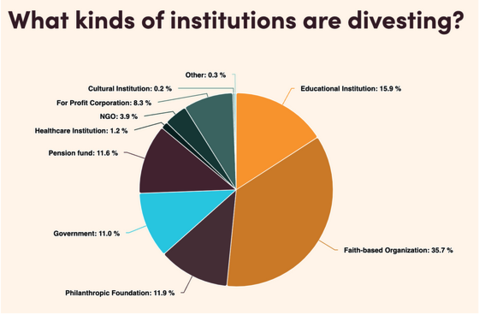
More than 1,600 institutions like universities, pension funds, and governments that hold more than $40.6 trillion in assets have now divested from fossil fuels, the Global Fossil Fuel Divestment Movement announced Friday.

The announcement comes days after the 28th United Nations Climate Change Conference wrapped with a call for “transitioning away from fossil fuels” but stopped short of agreeing to the stronger “phaseout” of oil, gas, and coal backed by climate advocates and frontline communities.

“This number is huge,” Amy Gray, Stand.earth climate finance associate director and coordinator of the Climate Safe Pensions Network, told Common Dreams. To put it in perspective, $40.6 trillion is equal to a little less than half of global gross domestic product.

The scale of the divestments to date, said Gray, “should show and give hope to folks that we are making an impact and we are making a difference and changing things for the better, regardless of these elitist events where the everyday person and the folks in the Global South and other places are discounted.”

A Decade of Divestment

Friday’s update to the Global Fossil Fuel Divestment Commitments Database reflects around a decade of organizing, Gray said. Organizers at 350.org started tracking divestment commitments when Gray and current Stand.earth climate finance director Richard Brooks worked there. When the pair moved to launch a climate finance team at Stand.earth, they brought the database with them.

While the divestment movement has seen ups and downs over that decade, Gray said it had picked up momentum over the last five or six years. In less than two years, the number of institutions divesting jumped by 120, holding a combined $1.4 trillion in assets.

“We’ve definitely seen a massive increase in divestment commitments as the divestment movement has built itself out and gotten stronger,” Gray said.

“This milestone follows years of attempted shareholder engagement, now a proven futile strategy, with fossil fuel corporations hell-bent on our destruction.”

Notable victories in 2023 included PMT, the largest private pension in the Netherlands; New York University, the National Academy of Medicine, and the Church of England.

The Church of England divestment was especially notable, Gray said, because of the statement that accompanied it. The church emphasized that it had tried to engage with the oil and gas companies it was invested in and urged them to adopt policies in line with the Paris agreement, but the companies did not change.

“The decision to disinvest was not taken lightly,” Alan Smith, first church estates commissioner, said at the time. “Soberingly, the energy majors have not listened to significant voices in the societies and markets they serve and are not moving quickly enough on the transition. If any of these energy companies come into alignment with our criteria in the future, we would reconsider our position. Indeed, that is something we would hope for.”

Gray remembered thinking at the time that it was the best divestment statement she’d ever read.

“It was really powerful,” she said.

The Church of England wasn’t the only institution that thought it could persuade Big Oil to change its ways without divesting.

“This milestone follows years of attempted shareholder engagement, now a proven futile strategy, with fossil fuel corporations hell-bent on our destruction,” Brooks said in a statement. “Instead of financing climate chaos-causing fossil fuels, violence, and extraction, financial institutions like big banks and pension funds must protect people and planet alike, cutting ties with fossil fuels and reinvesting in proven community-led climate-safe solutions.”

People vs. Fossil Fuels

The success of the divestment movement has been driven by “people power, 100%,” Gray said.

This includes larger organizations like Stand.earth or the Sierra Club and big-name activists like Bill McKibben or former New York Comptroller Tom Sanzillo, but ultimately comes down to smaller grassroots efforts.

“It’s the little group in Wisconsin that’s working on divesting their pension fund,” Gray said. “It’s a small group in the Bay Area who is pressuring Citi or one of the big banks, and it’s the kids at the colleges.”

“Oil companies are finding it increasingly difficult to raise financing amid rising ESG and sustainability concerns.”

There’s evidence that all this activism is making a difference for the industry. The “cost of capital” for funding new fossil fuel projects has risen steeply in the last decade, from 8% to 10% to around 20% as of 2021, according to Bloomberg.

During the same time, the cost for financing renewables has dropped from that same 8% to 10% to between 3% and 5%.

Bloomberg Intelligence analyst Will Hares laid the divergence at the feet of the push for environmental and social governance (ESG) in investing.

“Oil companies are finding it increasingly difficult to raise financing amid rising ESG and sustainability concerns, while banks are under pressure from their own investors to reduce or eliminate fossil-fuel financing,” Hares said.

Gray also added that Indigenous-led movements such as the Wet’suwet’en struggle against the Coastal GasLink pipeline in Canada have had a material impact on the industry.

The pipeline’s costs have more than doubled during that time from an estimated $6.6 billion to $14.5 billion, CBC News reported this month.

At the same time, divesting from fossil fuels is actually a financial win for pension funds and other institutions: A study released this year by the University of Waterloo found that six U.S. pension funds would actually be $21 billion richer today if they had quit fossil fuels 10 years ago.

The Next 1,600

In the context of a disappointing outcome at COP28, President Joe Biden’s greenlighting of drilling projects, and the specter of a second Trump presidency, the success of the divestment movement offers hope that climate campaigners can shift the world away from fossil fuels without needing to rely on international agreements or national legislation.

“It’s not necessary to enact the change we need to see,” Gray said. “We can change these systems of oppression from within.”

Looking ahead to 2024, Gray thinks there’s a good chance that California will finally pass legislation to divest its two pension funds, CalPERS and CalSTRS, from fossil fuels. The two funds, the largest public pensions in the country, control a total of $685 billion, including more than $42 billion in fossil fuels.

“Even the person with the smallest amount of investments can get involved.”

If California does pass the legislation, it will “cause a massive ripple effect,” Gray said.

“If we’re able to divest the two largest pension funds in the country, there’s nothing we can’t divest.”

Another thing Gray expects to see is more coordination between the efforts to divest from both fossil fuels and the weapons industry, as more and more people react with shock watching U.S.-made and -funded arms devastating the people of Gaza.

“War is a climate issue,” Gray said.

For people not yet involved in the divestment movement, Gray recommends signing up for email updates from Stand.earth or the Climate Safe Pensions Network and looking up local climate groups and going to a meeting.

“Even the person with the smallest amount of investments can get involved,” Gray said. “Anybody can join the climate movement, and we’re always ready to help folks take that step.”

Original article by OLIVIA ROSANE at Common Dreams shared under Creative Commons (CC BY-NC-ND 3.0).

Continue Reading‘Huge’: 1,600+ Institutions Holding $41 Trillion in Assets Have Now Divested From Fossil Fuels

Public showing ‘unwavering support’ for industrial action by nurses, finds survey

Spread the love
People on Warren Street in London, ahead of a Support the Strikes march in solidarity with nurse 11 March 2023
People on Warren Street in London, ahead of a Support the Strikes march in solidarity with nurses 11 March 2023

https://www.morningstaronline.co.uk/article/public-showing-unwavering-support-for-industrial-action-by-nurses-finds-survey

NURSES have “unwavering” public support for further strike action in their continuing dispute with the government over pay, staffing and working conditions, a survey revealed today.

The YouGov poll revealed that the public would support nurses withdrawing their labour next year over staffing levels (73 per cent), pay (66 per cent) and threats to patient safety caused by nurse shortages (85 per cent).

The Royal College of Nursing (RCN), which commissioned the poll, said it remained in dispute over NHS nurses’ pay in England after the government imposed a pay settlement.

It warned that nurses could strike again in the run-up to next year’s general election.

RCN chief nurse Professor Nicola Ranger said: “When politicians start canvassing voters and knocking on doors, nursing staff could again be standing on picket lines, fighting for fair pay and safe staffing levels.

https://www.morningstaronline.co.uk/article/public-showing-unwavering-support-for-industrial-action-by-nurses-finds-survey

Continue ReadingPublic showing ‘unwavering support’ for industrial action by nurses, finds survey