Original article republished from Carbon Brief under a CC license.
The UK can build a reliable, secure and cost-effective electricity system that is decarbonised by 2035, says the government’s advisory Climate Change Committee (CCC).
The CCC’s new report is based on new hour-by-hour modelling of the country’s electricity system out to 2035, which includes stress-tests of how it could ride out extended “wind droughts”.
In effect, the report is a 131-page answer to the question often posed by those sceptical of climate action: “But what about when the wind does not blow and the sun does not shine?”
The CCC sees cheap – but variable – wind and solar meeting 70% of demand. While nuclear and biomass might meet another 20%, they are “relatively inflexible”. Therefore, the final 10% is key.
This 10% will largely come from “flexible low-carbon” solutions, such as batteries, compressed air storage and responsive demand. Crucially, however, gaps lasting days to weeks at a time will be filled by gas with carbon capture and storage (CCS) and/or hydrogen power.
As an additional source of security, the committee endorses a small remaining role for unabated gas power in 2035. This would meet “up to around 2%” of annual demand, down from 40% today.
The importance of hydrogen is clear, as nearly one-quarter of the report is given over to its role.
However, the committee stresses the risks of medium-term scarcity in hydrogen supply, which would be even larger if the government prioritises using hydrogen to heat homes.
Overall, the CCC says the flexible, secure and decarbonised electricity grid of 2035 is “within sight”, but only with “urgent reform”.
Its 25 recommendations for government include easing the planning and regulatory regimes, so that energy infrastructure can be built at the speed necessary.
These reforms are required to unlock hundreds of billions in investment needed to build a reliable, decarbonised grid by 2035, the CCC says.
- What will power the UK’s electricity system in 2035?
- What modelling did the CCC commission?
- Where will the UK get electricity when it is not windy?
- How will the UK use hydrogen in 2035?
- What needs to change to decarbonise UK electricity by 2035?
- How can the electricity system withstand extreme weather?
What will power the UK’s electricity system in 2035?
The UK government is aiming to “fully decarbonise” Great Britain’s electricity system by 2035. (Northern Ireland is part of a separate electricity system covering the island of Ireland.)
This target was recommended by the CCC in 2020. It was then adopted by the government in its 2021 net-zero strategy and reiterated in the 2022 energy security strategy.
Today’s report stresses how important it will be to meet the 2035 target. It says this will be “the central requirement for achieving net-zero [by 2050]”. Moreover, it says that “reliable, resilient and plentiful decarbonised electricity – at an affordable price to consumers…is within sight”.
Yet “the government has not yet provided a coherent strategy to achieve its goal”, the CCC says. The report adds that “our increasingly electrified society…must have resilience embedded throughout”. (See: How can the electricity system withstand extreme weather?)
(The opposition Labour Party has proposed a “stretch” target of a decarbonised grid by 2030, five years earlier than the UK’s current goal. CCC chief executive Chris Stark told a pre-launch press briefing that this would be a “huge challenge”.)
The report sets out what a decarbonised electricity system might look like in 2035, how it would maintain security of supply, and what would be needed to bring it about. (See: What needs to change to decarbonise UK electricity by 2035?)
The starting point for the analysis is that electricity demand will rise to 50% above pre-Covid levels by 2035 and 100% by 2050, as shown in the figure below. Buildings (red), transport (purple) and industry (orange) will increasingly run on electricity, rather than fossil fuels.
(This assumption is based on the CCC’s “balanced pathway” to meeting the sixth carbon budget, the UK’s legally binding limit on emissions during 2028-2032.)
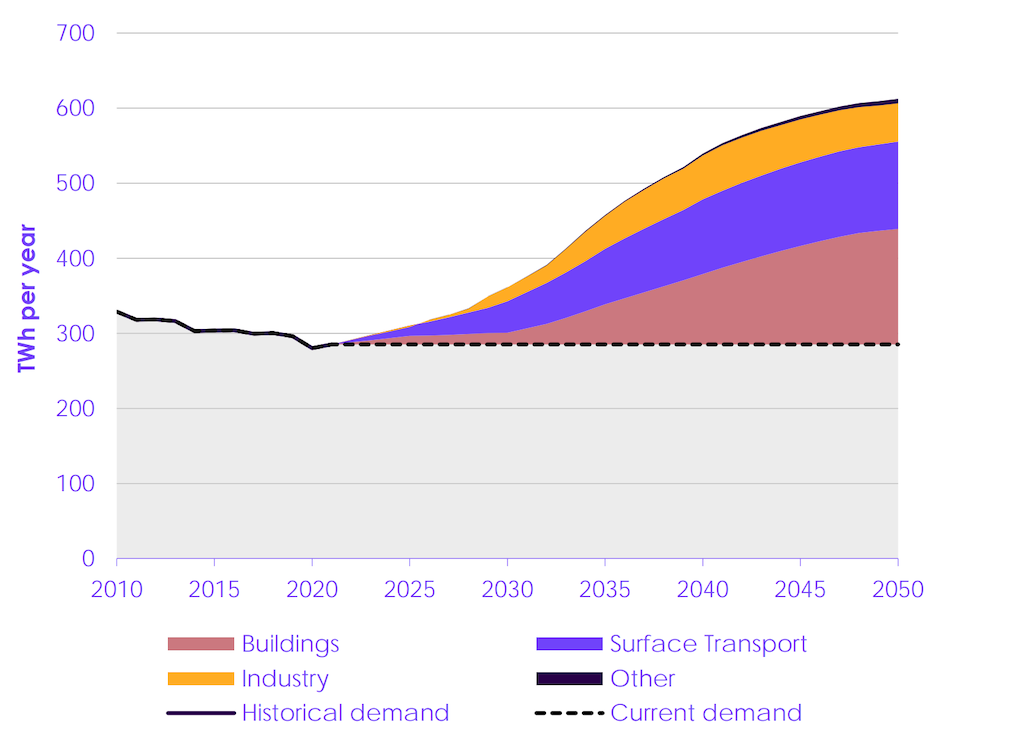
In addition to rising demand from electrification, the CCC accounts for shifts in energy use due to climate change, including hotter, drier summers and warmer, wetter winters.
To meet rising demand, the CCC points to wind and solar as the cheapest forms of electricity generation in the UK. (The same is true for the vast majority of the world’s population.)
The wider costs of integrating these variable renewables into the electricity system are also modest. According to the CCC, the cost of strengthening the grid and building flexible back-up supplies for wind and solar amounts to just £10-20 per megawatt hour (MWh).
As such, variable renewables remain the cheapest way to generate the bulk of the country’s electricity and the CCC says they “should form the backbone of the future system”.
In the report’s central pathway, 70% of electricity in 2035 comes from wind and solar. Other renewables, such as tidal, may also play a role, but are “currently relatively expensive”.
This is shown in the figure below, with offshore wind (blue), onshore wind (light blue) and solar (orange) making up the large bulk of electricity supplies by 2035.
(The remaining 30% of supplies are discussed below the chart.)
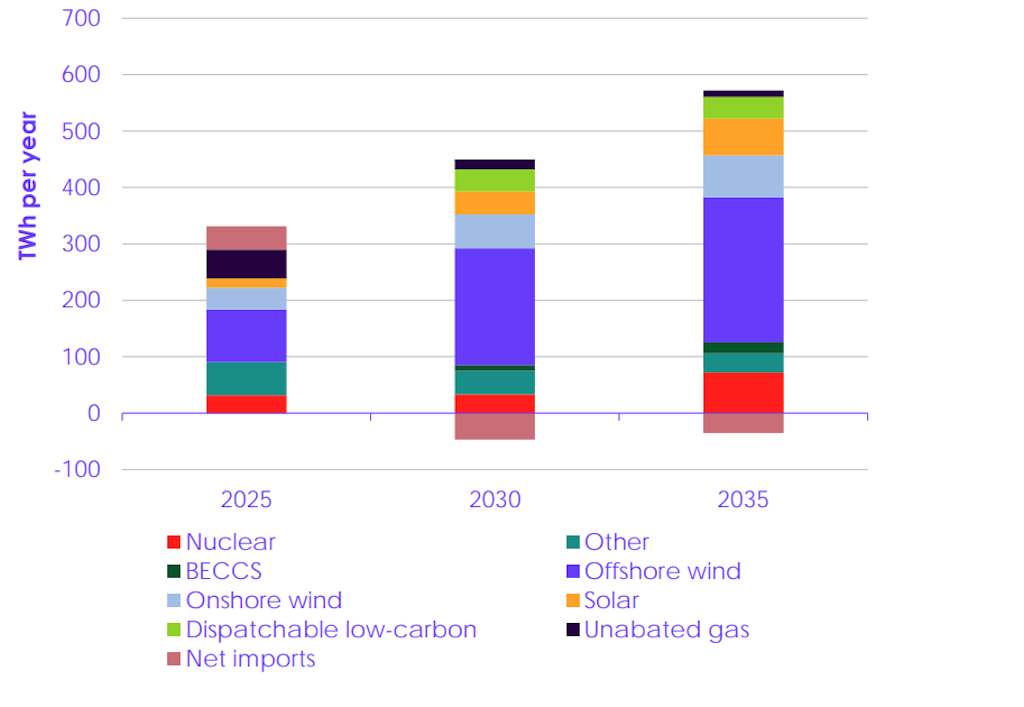
Nuclear is “relatively expensive on a levelised cost basis”, the CCC says, but it “can provide valuable zero-carbon generation at scale”. It could also have a role in hydrogen production.
The CCC also sees a role for bioenergy with carbon capture and storage (BECCS), as long as the biomass is sourced sustainably. Unabated bioenergy is costly and has “significant lifecycle greenhouse gas emissions”, the report says, so current subsidies should not extend beyond 2027.
In contrast, it says BECCS is one of the best ways to use limited supplies of sustainable biomass. It also says the UK should shift away from imported biomass, towards domestic supplies.
(The government’s biomass strategy, due at the end of 2022, has not yet been published.)
The CCC, therefore, sees nuclear and BECCS generating another 20% of electricity in 2035. However, these technologies are “relatively inflexible” – for practical and economic reasons – meaning they are not suited to balancing variable output from wind and solar.
This leaves a small, but “essential” chunk of electricity supplies – the last 10% in the CCC’s report – that must be met by “low-carbon flexible solutions”, which need “equal focus” from government. (See: Where will the UK get electricity when it is not windy?)
These flexible solutions will be needed to balance variable output from wind and solar on a range of timescales, the CCC explains. They will also be needed to absorb excess renewable output, which will exceed demand around one-third of the time in 2035, according to the CCC.
Short-term variability within each day includes the daily cycle of solar output. On daily to weekly timescales, the system will need to manage longer-lasting weather patterns, including what the report calls “wind droughts” – extended periods when generation from windfarms is low.
Finally, the report considers monthly to yearly variability, including across seasons. It notes that wind generation is highest during winter, when demand also peaks. Nevertheless, it says planning for potential seasonal variability in supply and demand will be needed.
What modelling did the CCC commission?
Having established the clear need for a portfolio of flexible low-carbon solutions, the CCC report explores what types and mixture of technologies might be needed.
To do this, it commissioned detailed, hour-by-hour modelling from consultancy Afry. The company has recently carried out related work for the UK government, looking at long-duration storage technologies, and for National Grid Electricity System Operator, looking at how to maintain a reliable grid on the path to net-zero, if some options fail to deliver as expected.
The modelling for the CCC looks at supply and demand in the electricity system, as well as the production and storage of hydrogen. (See: How will the UK use hydrogen in 2035?).
It covers the electricity system of Great Britain, broken down into 11 regions, as well as wider European markets that are connected via interconnector cables and shared weather patterns.
The modelling assumes the capacity of nuclear and renewables increases in line with government targets. Similarly, it assumes electricity demand rises in line with the CCC’s balanced pathway. (Side cases in the modelling look at higher or lower demand for electricity and hydrogen.)
With these assumptions, the model first calculates how much electricity would be generated by inflexible renewables and nuclear, in each hour in 2035, using a range of historical weather data.
Second, the model works out the cheapest way to meet any differences between inflexible supply and estimated hourly demand – the “residual demand” – using a variety of flexible solutions.
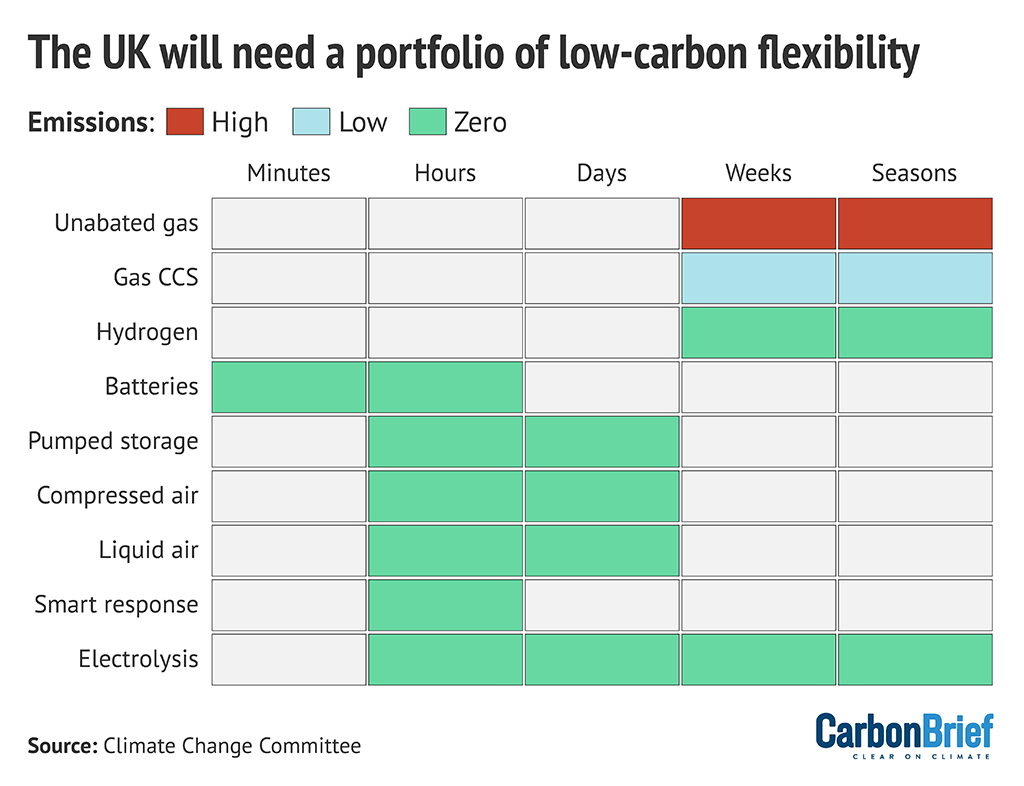
The report sets out a range of flexibility options, able to operate over different timescales and illustrated in the figure below. The top line shows the main source of flexibility today, unabated gas. This has high carbon dioxide (CO2) emissions, indicated by the red shading.
The next lines show low-carbon technologies also able to operate over the medium to longer term – namely, gas with carbon capture and storage (CCS, shaded blue to indicate low carbon emissions) or hydrogen turbines (green, indicating the potential to be zero-carbon).
The rest of the table includes energy-storage technologies, such as batteries, pumped hydro and compressed or liquid air storage, as well as flexible solutions on the demand side. These include smart response, where, for example, electric vehicles are charged when it is windy, and electrolysis, where excess electricity supplies are used to make hydrogen from water, for later use.
The CCC report notes that other storage technologies exist, including “flow batteries”, flywheels, gravity storage and thermal storage. However, it says these are generally at earlier stages of commercialisation and so they are not included in the modelling.
Finally, the report includes interconnectors that link the GB electricity grid with neighbouring countries. There are already a significant number of these cables and many more are planned.
These allow excess electricity generation to be exported or shortfalls to be covered by imports. However, the CCC notes: “Generation in neighbouring markets will also be impacted by climate and weather extremes, potentially impacting their ability to export to the UK at particular times.”
The modelling calculates the cheapest combination of these flexible solutions, needed to maintain a secure and reliable electricity supply in 2035. In the central scenario, it assumes a “normal” weather year, based on what the country experienced in 2012.
The findings are then “stress-tested” to see what would happen if certain technologies over- or under-deliver, as well as the impact of extreme weather events, such as “wind droughts”. (In Germany, this weather event is referred to as a dunkelflaute.)
This includes the low wind speeds seen during 2010, which was a one-in-50 year event. It also includes an “extreme”, 30-day wind drought combined with very high electricity demand. This extreme scenario is artificially constructed and has “[no] historical precedent”.
Where will the UK get electricity when it is not windy?
Based on the results of the modelling it commissioned, the CCC endorses a “renewables-based energy system” that “mak[es] the most of abundant natural resources”.
It says this system “can provide a secure and reliable supply of energy”, provided it is complemented by a portfolio of low-carbon flexibility drawn from the list above.
Gas CCS and hydrogen turbines, which is the “dispatchable” low-carbon backup identified as key to bridging longer gaps in renewable output, would generate 40 terawatt hours (TWh) a year.
This varies between 25 and 60TWh in the various scenarios and stress tests considered. While this low-carbon dispatchable supply is mostly made up of hydrogen generation in the modelling, the CCC groups the two together, due to uncertainty over their future costs.
(Table 2.1 of the report lists flexible low-carbon costs. It says gas CCS would cost £75-90 per megawatt hour in 2035, while hydrogen turbines would cost £65-125/MWh, in part depending on whether they are built at new plants or retrofitted at existing gas-fired power stations.)
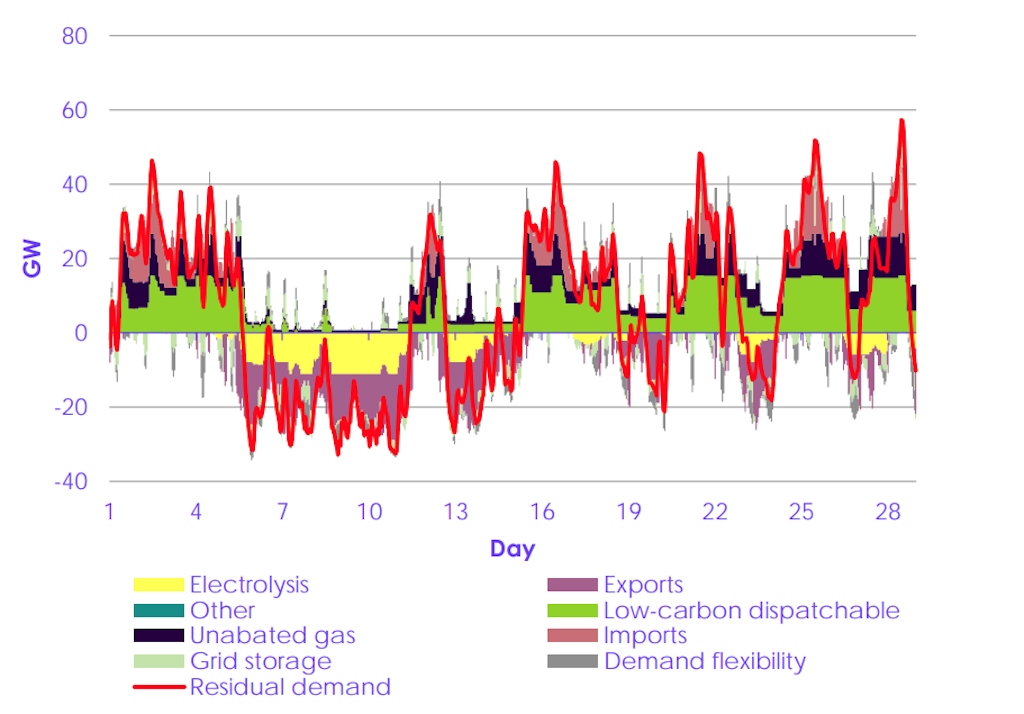
The need for low-carbon backup is illustrated in the figure below, showing how demand is met even when a lack of wind leaves large gaps in supply.
Low-carbon dispatchable generation (green) meets the bulk of this “residual demand”. However, unabated gas power (black), electricity imports (pink) and grid storage (pale green) also make important contributions to balancing supply and demand.
Note how, even in this example, which is chosen to illustrate the largest “residual demand” of any modelled four-week period in 2035, there are still times when supply from renewables and nuclear exceeds demand – and the residual turns negative (see next figure).
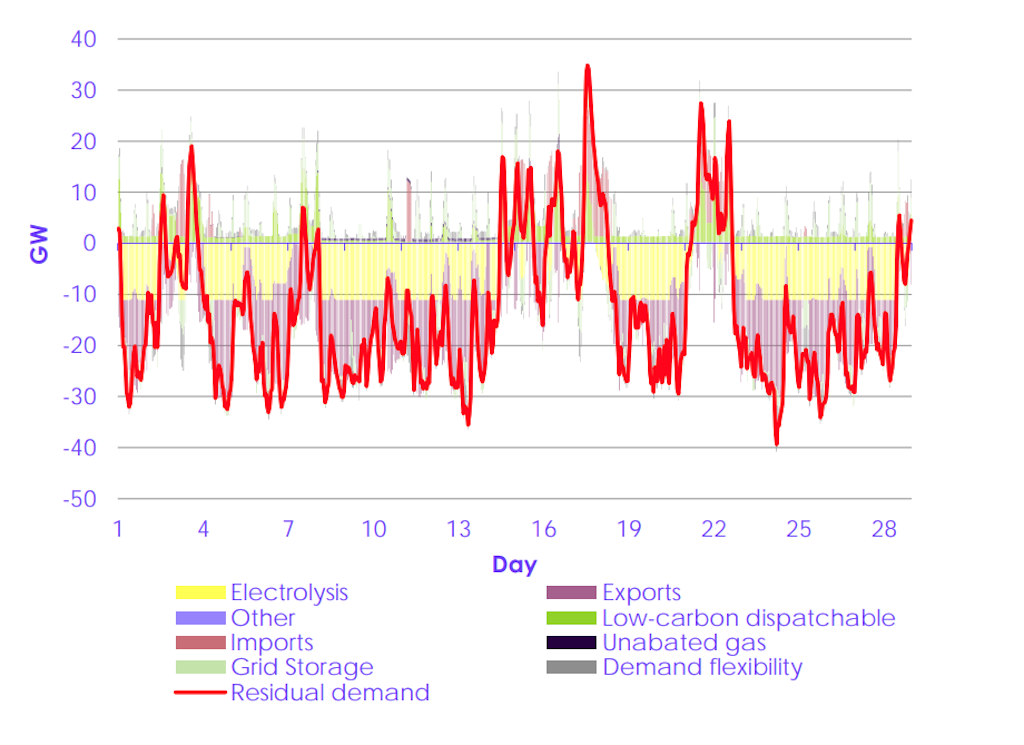
In addition to filling gaps in renewable generation, the CCC also looks at what would happen when output from wind, solar and nuclear exceeds demand, creating a surplus. It says this would largely be used to make hydrogen, by splitting water using electrolysis.
The modelled four-week period in 2035 with the lowest residual demand is shown in the figure below, with electrolysis (yellow) absorbing the bulk of the surplus. Electricity exports to neighbouring countries (lilac) would take up most of the remainder.
The modelling shows the UK would need significant numbers of low-carbon dispatchable power plants to keep the lights on when the wind is not blowing, totalling some 17 gigawatts (GW).
In addition, the CCC endorses the retention of a smaller number of unabated gas-fired power stations – some 11GW in its central case – which would only be switched on 10% of the time.
These backup capacities increase when modelling a “low wind year” based on 2010, which the CCC judges to have been a 1-in-50 year event. They would need to be slightly higher again to cope with the artificial extreme 30-day wind drought used to stress test the modelling results.
In these cases, the capacity of low-carbon dispatchable sources would reach 20 and 25GW, respectively, while unabated gas capacity would rise to 25GW.
The CCC says it is up to the government to decide “how much allowance to build into the system to account for uncertainties around future weather”. However, it recommends that any new gas plants should be “properly CCS- and/or hydrogen ready as soon as possible and by 2025 at the latest”, so that they can continue being used even if less unabated capacity is needed.
At a pre-launch press briefing, the CCC’s head of net-zero David Joffe told Carbon Brief that maintaining security of supply would justify using “a bit more” unabated gas in 2035, if necessary, even if that meant technically breaching the government’s target for a fully decarbonised system.
However, the report says:
“In the longer-term there should not be a role for unabated gas and there is more scope to sufficiently develop alternatives and address potential delivery risk.”
Other recommendations in the report include boosting the geographical diversity in the spread of offshore wind capacity between the east and west coasts of the UK. This would reduce the impact of wind droughts, by making wind generation more consistent.
Note that the modelling for the CCC assumes that government targets are met for the building of new renewable and nuclear capacities. Various other recent modelling studies have looked at the optimal mix of wind, solar, nuclear and flexible low-carbon technologies, in some cases taking into account the potential failure of certain options to deliver as expected.
While these other studies come up with different numbers for the specific levels of each technology that might be needed in 2035, their broad conclusions are all consistent with the CCC.
All of the modelling points to a decarbonised electricity system being primarily fueled by wind and solar, with essential supporting roles for low-carbon flexibility.
Overall, the decarbonised electricity system sketched out by the CCC would offer significant wider benefits, the report says, in addition to enabling the UK’s net-zero target.
The CCC says this system would be “cost-effective” because it would be built on cheap wind and solar – despite the costs imposed by their variable output. Buying the low-carbon flexibility needed to balance this variability will be expensive, but only makes up a fraction of demand.
In addition, the decarbonised system would “dramatic[ally]” reduce gas consumption, cutting the UK’s exposure to the volatile international fossil fuel markets behind the global energy crisis.
Finally, the CCC says the shift to a decarbonised energy system presents opportunities for economic growth. It points to the example of the offshore wind industry, where employment is set to reach nearly 100,000 by 2030 on the back of £155bn in private investment.
How will the UK use hydrogen in 2035?
The CCC report included hydrogen production and storage in its modelling due to the “important role” this will play in providing flexible electricity supply and demand.
A full quarter of the 131 pages are dedicated to hydrogen production, use and infrastructure. It stresses the medium-term scarcity of hydrogen and the gap between potential demand and reality.
One key recommendation, resulting from this scarcity, is for a “cross-sectoral infrastructure strategy” that “must narrow the space” for future hydrogen uses.
There has also been recent evidence that hydrogen emissions escaping from gas pipelines have a stronger warming effect in the atmosphere than previously thought, the CCC notes.
A clear target of these comments is hydrogen in heating, which the committee consistently frames as a potential hindrance to more important uses, such as the power sector.
Hydrogen power plants could provide a dispatchable power source in a low-carbon grid. As noted above, the CCC leaves open the question of whether the UK should focus on hydrogen turbines or their main alternative – gas plants with carbon capture and storage (CCS).
While the modelling for its report “typically favours” hydrogen over gas CCS, the CCC concludes that the balance between the two “remains unclear” due to uncertain future costs and efficiencies.
An additional benefit of using hydrogen is that it can be used to store low-carbon power when supply exceeds demand – on a particularly windy or sunny day, for example.
Overall, the CCC says hydrogen’s role in decarbonising electricity “remains uncertain”, largely due to concerns about how to make the gas in sufficient volumes.
It says the government’s hydrogen capacity targets of 2GW and 10GW by 2025 and 2030, respectively, are “on the lower end of what could be needed” across the UK economy.
Funding mechanisms and business models for meeting both hydrogen and CCS goals are still being developed and the report urges the government to finalise them this year.
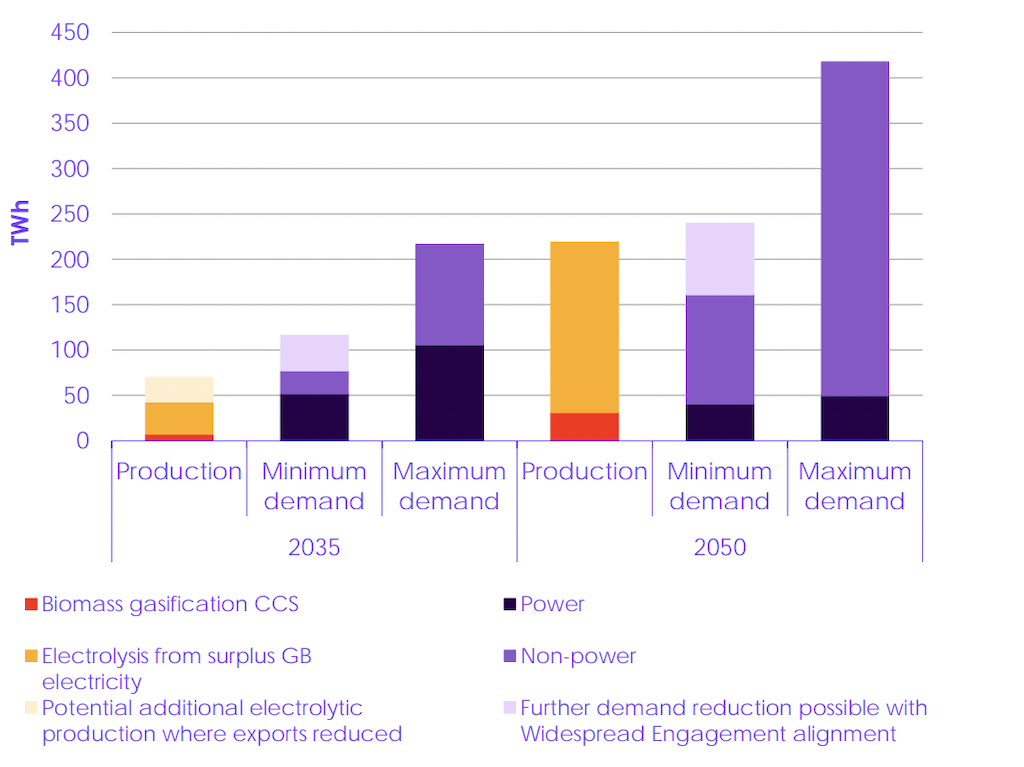
The report explores what it terms the “domestic hydrogen demand-supply gap”. As a starting point, it assesses how much hydrogen could be produced using surplus electricity during times of excess generation, plus a small amount of biomass gasification.
The results can be seen in the chart below, which shows the gap between hydrogen production (red and orange) and potential demand in different scenarios (purple). There will only be enough surplus electricity (dark orange) to make 36TWh of hydrogen by 2035, falling far short of the 52-106TWh that could be required in the power sector alone (dark purple).
David Joffe, head of net-zero at the CCC, told journalists at a pre-launch press briefing:
“There’s going to be a gap by 2035 and the more hydrogen that we use in 2035 the bigger the gap will be that we will then need to fill with imported energy, whether that’s importing fossil gas to produce hydrogen here, or whether that’s importing the energy in a different way.”
The report considers how the UK might close this gap. It looks at “green” hydrogen, made by splitting water with renewable electricity, and “blue” hydrogen, made from gas with the resulting CO2 emissions captured and stored.
It warns against building dedicated low-carbon power infrastructure solely to produce green hydrogen, at least in the short term, stating:
“Zero-carbon electricity must be prioritised to displace fossil generation and meet core electricity needs.”
Importing green hydrogen from nations where it is cheaper to produce is “unlikely to be cost-competitive in the near-term”, the report concludes, noting that such imports may compete with domestic supplies by 2050.
The CCC also points out that blue hydrogen has problems of its own, including reliance on imported gas and the fact that its production still results in greenhouse gas emissions, providing overall emissions savings of just 60-85% compared to regular gas.
However, in the absence of sufficient green hydrogen, blue hydrogen is described as having “an important part to play in filling the gap” for hydrogen in the power supply, at least until the 2040s.
Joffe says that it may be possible to become self-sufficient in hydrogen by 2050, but the more hydrogen demand there is in the system the harder this will be.
The CCC’s sixth carbon budget, published in 2020, included hydrogen being used to heat just 11% of homes, mostly in “hybrid” systems as backup for heat pumps. It explored other scenarios with more widespread use of hydrogen for home heating, with correspondingly higher demand overall.
However, in the new report it says high gas costs and new evidence on blue hydrogen’s risks “provide[s] further support for the limited role for hydrogen in building decarbonisation”. It also says hydrogen would be “much less efficient” than electric heat pumps.
The report explains that cutting overall hydrogen demand in the economy would reduce demand for blue hydrogen “with the volume of electrolysis largely unaffected”.
In addition to potential production shortfalls, the committee also points to risks around hydrogen storage. The production and use of hydrogen will be spiky, soaking up excess renewable output via electrolysis and then later using stored hydrogen to generate electricity when it is not windy.
Demand for hydrogen across the economy in 2035 is shown in the figure below. Some sectors will have relatively consistent demand, whereas the power sector will come in short sharp bursts.
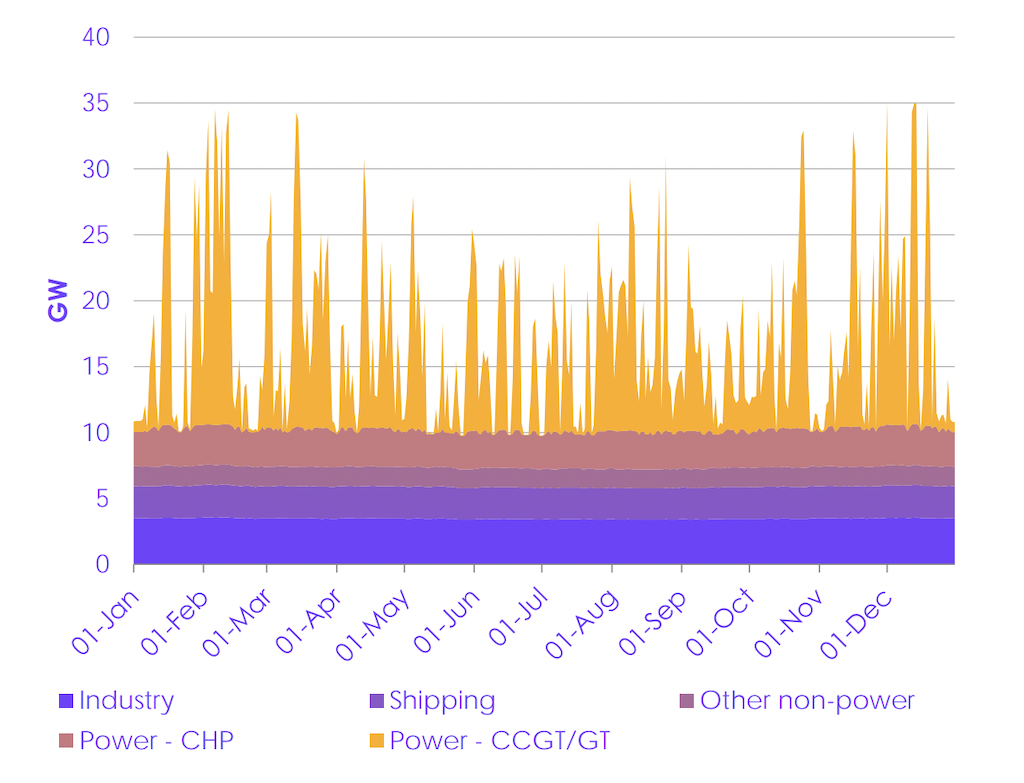
As a result, the UK will need significant hydrogen storage capacity, the CCC says. This could reach 2.8 terawatt hours (TWh) of storage in salt caverns by 2030 and up to 5.2TWh by 2035.
It notes that its 2030 estimate “remains in the middle-to-higher end of projections recently published as part of research undertaken for government”.
The report’s central scenario also sees 3,800km of pipeline being required to transport hydrogen around by 2035. The largest deployment would connect the north of England and Scotland with the extensive salt caverns of the Midlands.
Again, the CCC says that all of these considerable challenges will depend on the government’s decision on using hydrogen to heat homes. However, given an outcome on this is not expected until 2026, it states:
“It is not sensible to delay all decisions on hydrogen infrastructure until after decisions on the use of hydrogen for heating.”
Instead, it emphasises that the government “should identify a set of low-regret investments that can proceed now”.
What needs to change to decarbonise UK electricity by 2035?
Building the reliable, decarbonised electricity system of 2035 envisioned by the report will be a major challenge, the CCC says, which will require an “unprecedented” pace of construction.
Solar capacity will need to expand as quickly – every year – as its fastest recorded rate in the UK. Offshore wind will have to be built 40% faster than the record the CCC says it achieved last year.
Many of the flexible low-carbon solutions that will be essential complements to variable renewables have never been built at scale in the UK. This includes gas CCS and hydrogen turbines.
The CCC says there is an urgent need for a “co-ordinated and strategic approach to delivery”. This should include a government strategy for a “decarbonised, resilient, power system by 2035”. The CCC has been calling for such a strategy since 2020.
These concerns echo those of a recent National Audit Office (NAO) report that warned the government “cannot be complacent about the challenges involved in decarbonising further while continuing to ensure a secure supply that meets the predicted electricity demand increases”.
In all, the committee has set out 25 new recommendations for the government, 17 of which have deadlines this year or are already on-going. They can be seen in the interactive table below.
The report calls for “urgent reform” of planning, consenting and connections to the electricity network, all of which it says are vital for deploying infrastructure at the speed needed to meet government targets. While some progress is being made, the committee says these reforms need oversight from a minister-led delivery group.
CCC chief executive Chris Stark told reporters that, in his view, such measures would be more important than the kind of subsidy programmes currently being rolled out in the US:
“I think our best response, actually, is to get the planning regime and the consenting regime and the regulatory regime sorted out. It’s gummed up at the moment. That’s what’s causing us to fail on these targets. And I think that bit of it is actually quite mundane stuff – this is about giving far greater certainty to potential investors about how quickly their investments will turn into a reality.”
As it stands, he said the government was “asleep at the wheel”.
Other measures called for in the new report include “very large investments” in network capacity, creating a network that is prepared for major new sources of power generation out to 2050.
It also mentions the need to formalise the institutional responsibilities of ministers, energy regulator Ofgem and the under-development Future System Operator (FSO). This would give clarity over who is responsible for the planning and delivery of a decarbonised power system.
The CCC has previously convened a high-level expert group on market reform to investigate the best ways to incentivise low-carbon investment. Among other things, it concluded that existing policies were not sufficient to galvanise the £300-430bn of investment required.
The committee calls for the government to produce a strategy on market design, which sets out medium- to long-term changes in a way that avoids disruption and deterring investment.
(The government recently held a consultation on its review of electricity market arrangements, known as REMA. A summary of responses shows the government received a wide range of views. It was, nevertheless, able to rule out a number of the options that had been under consideration. A second consultation will be held later in 2023.)
How can the electricity system withstand extreme weather?
Cutting power-sector emissions to zero is a key enabler of the UK’s net-zero target.
However, the shift to an increasingly electrified economy brings new risks to resilience. In addition, climate hazards will continue to escalate, with significant implications for the UK’s electricity system.
Heatwaves, flooding and droughts are set to become more extreme, potentially damaging electricity infrastructure as power lines overheat and generators are inundated with water.
By 2035, the UK will need a large and varied array of new, low-carbon electricity sources. This will also involve replacing existing assets, the majority of which will reach their end of their lives by 2039, the CCC notes.
With this effort underway, the report emphasises that climate impacts “must be considered in site selection and design, maintenance and life extension” to ensure future resilience.
The CCC’s most recent risk assessment identified climate risks to the power system as a priority area for the government. Since then, events such as Storm Arwen and the 2022 heatwave have provided a taste of what is to come, jeopardising power supplies across the nation.
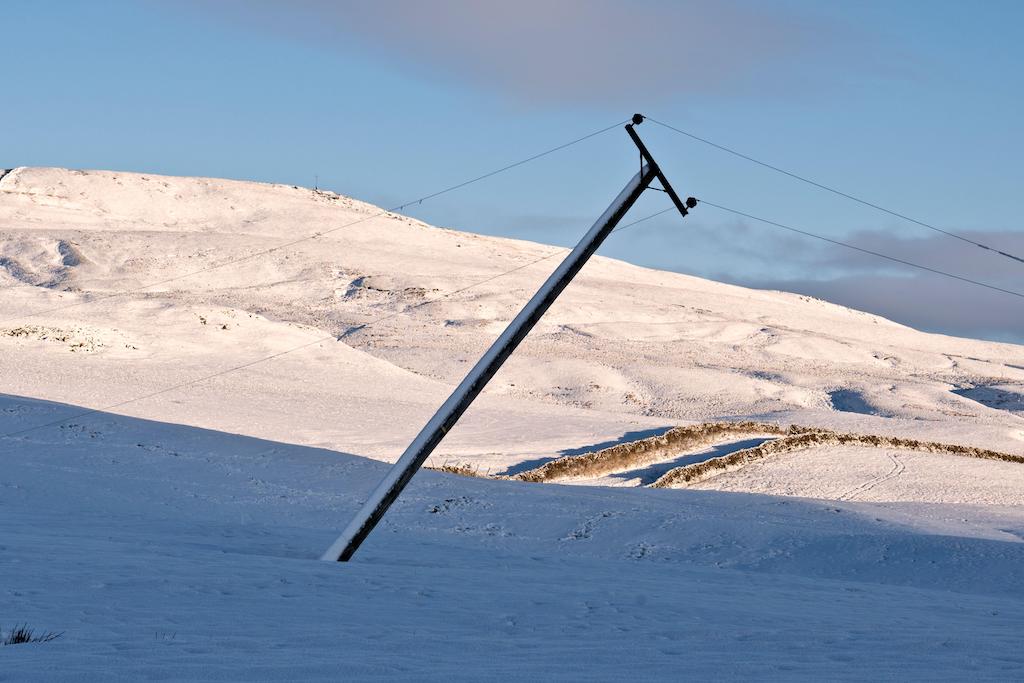
However, broadly speaking, the new report notes that there is no consistent collection of data on power failures triggered by extreme weather. The CCC recommends better reporting and further research into the impact of climate hazards on UK energy systems.
It also warns of the risk of “cascading failures”, triggered by damage to power infrastructure, particularly as the country becomes more reliant on electricity.
“Governments and industry may be significantly underestimating the vulnerability of interconnected systems,” it notes, stating that energy, water and IT infrastructure are often located together.
The CCC describes patchy standards and guidance for energy projects to guard against climate hazards, with some now “unlikely to be sufficient” in the face of ever-more extreme conditions.
For example, some component parts used in the electricity network are built to function up to 40C, a temperature that was exceeded in the south of England last year.
The report, therefore, recommends that the government should develop a pathway to “minimum resilience standards” for the electricity system, with a regular review and revision process.
The committee notes that governance of energy-system resilience is “complex”, with government, public sector agencies and private companies all playing a role. It says the government has yet to define a vision of a “well-adapted, climate-resilient energy system” and adds that this should be a priority in this year’s National Adaptation Programme.
Finally, the CCC highlights the issue of investment. It says that as money is poured into ambitious energy projects with the help of the UK Infrastructure Bank, there is an “opportunity” to ensure they are resilient to climate change – something that has not happened to date.
Original article republished from Carbon Brief under a CC license.
In-depth Q&A: Does the world need hydrogen to solve climate change?
Comment by dizzy: Hydrogen is a method to store energy. It can be created in many ways and how ‘green’ or ‘dirty’ climate-damaging it is depends on how it is produced.