Year: 2023
Canada May Soon Give a $15.3B ‘Carbon Bomb’ Subsidy to Big Oil, Experts Say
Original article by Geoff Dembicki republished from DeSmog
Business leader says government tax credit for oil and gas ‘extends the life of Canada’s largest industrial sector.’

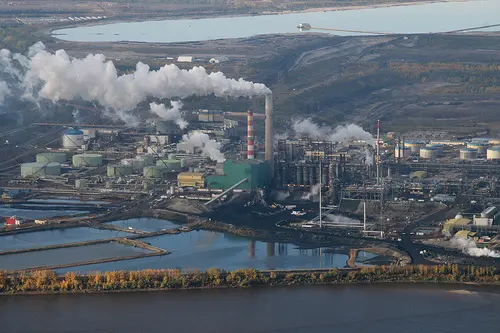
The government of Alberta, home to the tar sands pictured here, has announced taxpayer funding in the range of $3.5 billion to $5.3 billion for CCS projects. Credit: (CC BY-NC-ND 2.0) As world leaders meet in Dubai for the COP28 climate negotiations, federal and provincial governments in Canada are preparing to give an estimated $15.3 billion in new subsidies to oil and gas companies, and other heavy emitters, for expanding the production of fossil fuels, according to climate experts.
Those subsidies are taking the form of massive new tax credits for carbon capture and storage (CCS), which is a technology that companies use to grow their extraction of oil and gas while burying a fraction of their greenhouse gas emissions underground.
“I completely agree that Canada’s tax credit for carbon capture and storage is a subsidy to the oil and gas industry,” Jason MacLean, an adjunct professor who studies climate policy at the University of Saskatchewan, told DeSmog in an email.
The federal Canadian government is close to announcing details on a tax credit that will go to top oil and gas companies like Suncor, Cenovus, and Imperial Oil, along with other major industrial polluters. Policymakers previously estimated the value of these investment tax credits to be $10 billion. The government of Alberta, home to the tar sands, has meanwhile announced taxpayer funding in the range of $3.5 billion to $5.3 billion for CCS projects.
The Pathways Alliance, an industry lobbying and marketing group representing 95 percent of tar sands production, says these tax credits are essential for oil and gas producers to lower their emissions in line with achieving “net-zero emissions” by 2050. Reaching “net-zero” entails stabilizing global temperature rise at 1.5 degrees Celsius, a level beyond which scientists warn the impacts to humankind could be catastrophic.
Yet, in submissions to the federal government, the Pathways Alliance explained that lowering a portion of oil sands emissions via carbon capture will create opportunities for the industry to expand globally — even as other countries move away from fossil fuels. “We believe Canada should seek to increase its market share for responsibly produced, lower emissions energy, even if global market demand, as a whole, begins to decline,” the group said in one submission.
“We need to keep in mind that this is about reducing emissions and not reducing production,” the organization said last year in a separate submission, as revealed by DeSmog.
Representatives of the Pathways Alliance are among the 35 people with ties to the fossil fuel sector who are part of Canada’s official delegation to COP28 this year. At the climate talks, they are pushing for policies supporting global deployment of carbon capture, which will allow companies to keep producing oil as countries get stricter about regulating emissions.
“It is really important for the energy industry in Canada because it extends the life of Canada’s largest industrial sector and maintains our competitiveness over the long term,” Scott Crockatt of the Business Council of Alberta told the Calgary Herald last month.
However, tax credits supporting carbon capture risk accelerating already dangerous levels of global temperature rise, MacLean argues. Even if the technology can fully capture emissions from the production of oil and gas in Canada — which is an expensive and uncertain proposition — the vast majority of climate impacts occur when fossil fuels are burned in places like car and truck engines and house furnaces.
“No possible innovation or improvement to [carbon capture technology] can change the fact that it applies only to the direct and upstream greenhouse gas emissions arising from the production of oil and gas, not the downstream emissions resulting from the combustion of oil and gas, which represent approximately 85 percent of the total emissions,” MacLean told DeSmog.
Allowing oil and gas to expand while relying on carbon capture could result in the release of 86 billion additional tonnes of greenhouse gas emissions worldwide between 2020 and 2050, according to a new analysis from the organization Climate Analytics. This “86 billion tonne carbon bomb” could derail efforts to keep global warming from exceeding dangerous thresholds, the group argues.
The Canadian government earlier this year unveiled detailed plans to remove “inefficient” oil and gas subsidies, with Environment and Climate Minister Steven Guilbeault saying at the time that “the simple reality is that it’s no longer free to pollute in Canada.”
But climate campaigners say that promise risks being completely undermined by the new carbon capture tax credits.
Original article by Geoff Dembicki republished from DeSmog
More than 1,000 trade unionists block four Israeli weapons factories

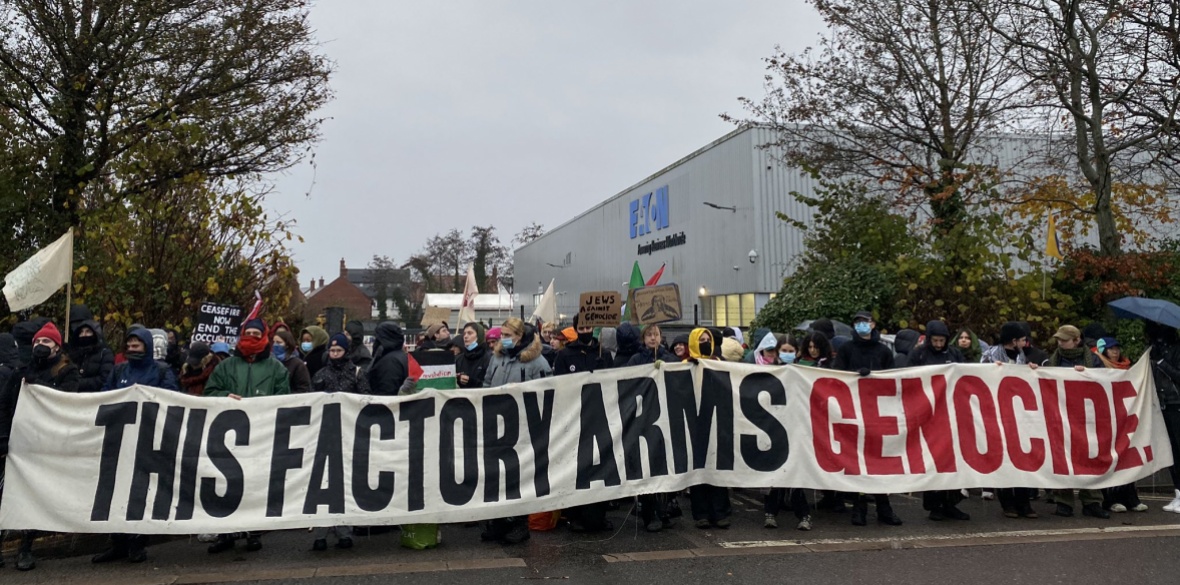
Activists blockade Eaton Mission Systems in Bournemouth Photo: Workers for a Free Palestine FOUR arms factories producing parts for Israeli fighter jets were shut down in protests by more than 1,000 trade unionists today.
Campaigners calling for an end to Britain’s complicity in war crimes being committed in Gaza blockaded sites at Bournemouth, Glasgow, Brighton and Lancashire.
The demonstrations were organised by campaign group Workers for a Free Palestine in co-ordination with workers in France, Denmark and the Netherlands, involving members from trade unions including Unite, Unison, GMB, the NEU, the BMA, UCU, Bectu and BFAWU.
The campaign group said they targeted sites run by defence giant BAE Systems which produces parts for the F-35 stealth combat jet currently being used by Israel to bombard Gaza.
More than 600 blockaded Eaton Mission Systems in Bournemouth alone.
A spokeswoman for Workers for a Free Palestine said: “The fighter jets these factories help to produce are being used to imprison the people of Gaza in a death trap.
“Workers all over Britain are rising up for Palestine, saying we will not allow arms used in a genocide to be supplied in our name and funded by our taxes.
…
Craig Murray discusses the positive legal obligation to prevent genocide.
Every single state in the world has a positive duty to intervene to prevent the Genocide in Gaza now, not after a court has reached a determination of genocide. This is made crystal clear in para 431 of the International Court of Justice judgment in Bosnia vs Serbia:
This obviously does not mean that the obligation to prevent genocide only comes into being when perpetration of genocide commences ; that would be absurd, since the whole point of the obligation is to prevent, or attempt to prevent, the occurrence of the act. In fact, a State’s obligation to prevent, and the corresponding duty to act, arise at the instant that the State learns of, or should normally have learned of, the existence of a serious risk that genocide will be committed. From that moment onwards, if the State has available to it means likely to have a deterrent effect on those suspected of preparing genocide, or reasonably suspected of harbouring specific intent (dolus specialis), it is under a duty to make such use of these means as the circumstances permit.
This case was specifically on the application of the Genocide Convention. That the ICJ has ruled there is a positive duty on states to act to prevent genocide makes it even more astonishing to me that no state has invoked the Genocide Convention over the blatant genocide being committed by Israel in Gaza.
…
Warren Leads Letter Pressing Biden on Israel’s Use of US Arms
Original article by BRETT WILKINS republished from Common Dreams under Creative Commons (CC BY-NC-ND 3.0).

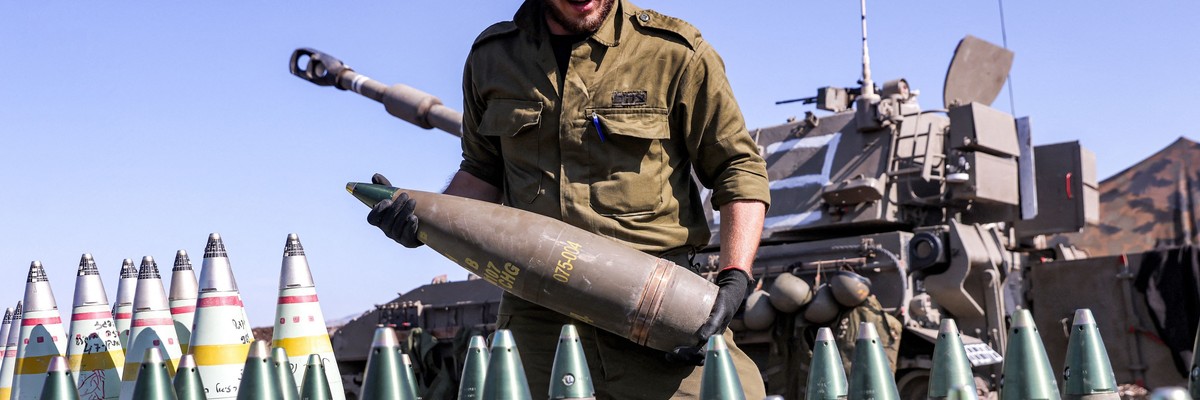
An Israeli soldier carries a 155mm artillery shell near a self-propelled howitzer deployed at a position near the border with Lebanon in the upper Galilee region of northern Israel on October 18, 2023. (Photo: Jalaa Marey/AFP via Getty Images) The senators—who are seeking improved oversight—sounded the alarm on the “staggering number of civilian deaths” caused by Israeli bombing with U.S.-supplied ordnance.
As the number of Gazans killed, maimed, or left missing by Israeli bombs and bullets—many of them manufactured in the United States— tops 60,000, a group of U.S. senators on Tuesday urged President Joe Biden to boost oversight of how American arms are used against Palestinian civilians.
Noting that Israel’s response to the Hamas-led attacks of October 7 “has killed over 15,000 Palestinians in Gaza, the vast majority of whom are civilians,” Sens. Elizabeth Warren (D-Mass.), Jeff Merkley (D-Ore.), Bernie Sanders (I-Vt.), Tim Kaine (D-Va.), and Martin Heinrich (D-N.M.) asked the White House for “information on the accountability and oversight measures that ensure any use of U.S. weapons is in accordance with U.S. policy and international law.”
“U.S. allies and human rights groups have argued many of these deaths were preventable,” the senators wrote in their letter. “In its campaign, Israel has also repeatedly targeted areas it previously designated as ‘safe zones,’ after telling Palestinians to move to these locations for safety.”
“[Israel Defense Forces] airstrikes have also hit the densely populated Jabalia refugee camp multiple times,” the lawmakers noted. “The first strike killed ‘more than 100 people’ and injured ‘hundreds’ more. The second strike left dozens wounded and rescuers said those killed included ‘whole families’… Other strikes and operations have targeted hospitals.”
A growing number of legal, human rights, and other experts have called Israel’s war on Gaza a genocide.
The senators’ letter continues:
While these strikes were aimed at Hamas, we have concerns that strikes on civilian infrastructure have not been proportional, particularly given the predictable harm to civilians. The United Nations Secretary-General António Guterres has said these strikes are ‘clear violations of international humanitarian law.’ Even Israeli Prime Minister Benjamin Netanyahu has admitted that his government’s efforts to minimize civilian casualties to date are ‘not successful.’
The letter singles out 155mm artillery shells, unguided explosive rounds with a “kill radius” of about 50 meters, with shrapnel able to kill and wound people hundreds of meters away.
“The IDF requires its ground forces to stay 250 meters away to protect its own forces,” the letter states. “The IDF has previously used these shells to ‘hit populated areas including neighborhoods, hospitals, schools, shelters, and safe zones,’ causing a staggering number of civilian deaths.”
“Over 30 U.S.-based civil society organizations warned against providing Israel 155mm shells in an open letter to [U.S. Defense Secretary Lloyd] Austin calling the shells ‘inherently indiscriminate’ and ‘a grave risk to civilians,’” the lawmakers added.
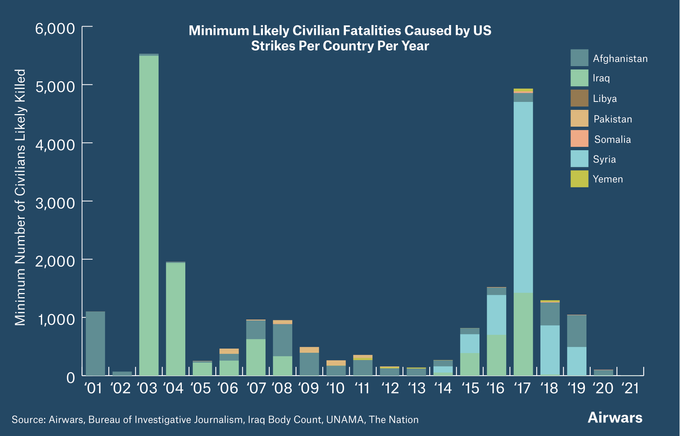
Claiming that “civilian harm prevention is a cornerstone of American foreign policy”—a curious assertion given that the United States has killed more foreign civilians by far than any other armed force on the planet since the end of World War II—the senators argued that “we must ensure accountability for the use of U.S. weapons we provided to our ally.”
“As you have acknowledged, Israel’s military campaign has included ‘indiscriminate bombing,’” they wrote. “Your administration must ensure that existing guidance and standards are being used to evaluate the reports of Israel using U.S. weapons in attacks that harm civilians in order to more rigorously protect civilian safety during Israel’s operations in Gaza.”

To that end, the senators ask Biden to answer 13 questions, including:
- Are U.S. officials aware of the IDF’s current policy on preventing civilian harm?
- What insights does the U.S. government have into how the Israeli military assesses issues of proportionality?
- What systems does the Israeli government have in place to investigate allegations of civilian harm?
- Does the U.S. Defense Department or State Department plan to provide Israel with guidance on how 155mm shells should be
used when civilians are nearby? - Are you aware of any requests for inspector general reviews or audits of U.S. military assistance provided to Israel?
The senators’ letter came ahead of Wednesday’s procedural vote on whether to begin debating a $106 billion “national security” spending package requested by Biden, which includes more than $10 billion in additional U.S. military aid to Israel atop the nearly $4 billion it receives each year from Washington.
On Tuesday, Sanders—who has angered progressives by failing to demand a Gaza cease-fire—said he opposes sending billions of dollars in unconditional U.S. armed aid to the “right-wing, extremist” Israeli government led by Prime Minister Benjamin Netanyahu.
“Israel must dramatically change its approach to minimize civilian harm,” he said, “and lay out a wider political process that can secure lasting peace.”
Original article by BRETT WILKINS republished from Common Dreams under Creative Commons (CC BY-NC-ND 3.0).
Human Rights Monitor Says 90% Killed by Israel in Gaza Were Civilians
US Official Won’t Call Forced Abandonment of Gaza Newborns a War Crime
‘Apocalyptic’ Horror in Gaza Called ‘Total Failure of Our Shared Humanity’
Scientists Say Risk of 5 Climate Tipping Points Means ‘Business as Usual Is Now Over’
Original article by OLIVIA ROSANE republished from Common Dreams under Creative Commons (CC BY-NC-ND 3.0).

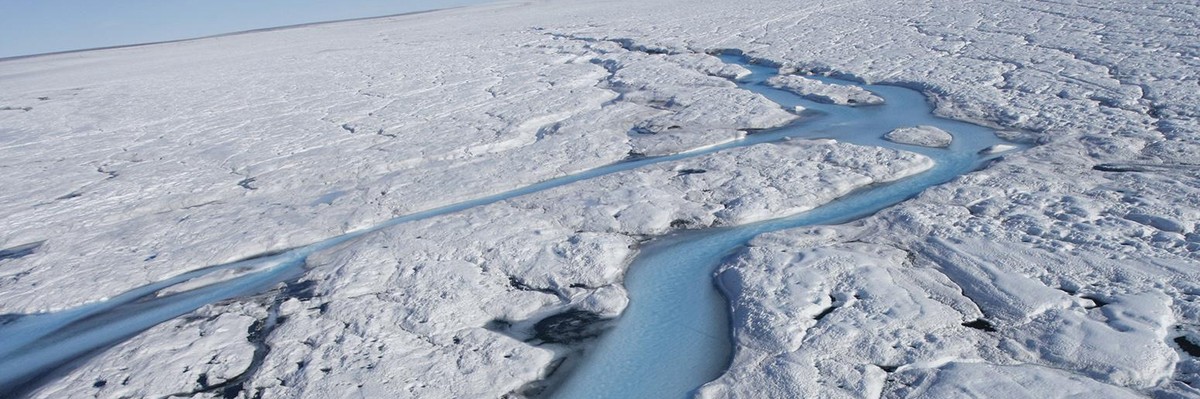
The collapse of the Greenland ice sheet, shown here, is one of five tipping points that could be triggered by current levels of warming. (Photo: Patrick Robert/Corbis) “Averting this crisis—and doing so equitably—must be the core goal of COP28 and ongoing global cooperation,” one expert said.
An earlier version of this article said the sea levels could rise by 656 feet by 2100 if the Antarctic ice sheet started to melt. It has been corrected to reflect the fact that they would rise by 6.6 feet.
Current levels of global heating from the burning of fossil fuels and the destruction of nature risk triggering five tipping points that could throw Earth’s systems further out of balance, with three more at risk of toppling in the next decade.
The Global Tipping Points Report, released Wednesday at the United Nations Climate Change Conference (COP28) in the United Arab Emirates, argues that policymakers have delayed climate action long enough that “linear incremental change” will no longer be enough to protect ecosystems and communities from the worst impacts of the climate crisis. However, world leaders can still choose to take advantage of positive tipping points to drive transformative change.
“The existence of tipping points means that ‘business as usual’ is now over,” the report authors wrote. “Rapid changes to nature and society are occurring, and more are coming.”
“Crossing these thresholds may trigger fundamental and sometimes abrupt changes that could irreversibly determine the fate of essential parts of our Earth system for the coming hundreds or thousands of years.”
The report defines a “tipping point” as “occurring when change in part of a system becomes self-perpetuating beyond a threshold, leading to substantial, widespread, frequently abrupt and often irreversible impact.” A group of more than 200 researchers assessed 26 different potential tipping points in Earth’s systems that could be triggered by the climate crisis.
“Tipping points in the Earth system pose threats of a magnitude never faced by humanity,” report leader Tim Lenton of Exeter’s Global Systems Institute said in a statement. “They can trigger devastating domino effects, including the loss of whole ecosystems and capacity to grow staple crops, with societal impacts including mass displacement, political instability, and financial collapse.”
Because current emissions trajectories put the world on track for 1.5°C of warming, this is likely to trigger five tipping points, the report authors found. Those tipping points are the melting of the Greenland and Antarctic ice sheets, the mass die-off of warm-water coral reefs, the thawing of Arctic permafrost, and the collapse of the North Atlantic Subpolar Gyre circulation.
The melting of just the Antarctic ice sheet, for example, could raise global sea levels by 6.6 feet by 2100, Carbon Brief reported, meaning 480 million people would face yearly coastal flooding. Three more tipping points could be triggered in the 2030s if temperatures rise past 1.5°C. These include the mass death of seagrass meadows, mangroves, and boreal forests, according to The Guardian.
“Crossing these thresholds may trigger fundamental and sometimes abrupt changes that could irreversibly determine the fate of essential parts of our Earth system for the coming hundreds or thousands of years,” co-author Sina Loriani of the Potsdam Institute for Climate Impact Research told The Guardian.
Contributor Manjana Milkoreit of the University of Oslo said in a statement that “our global governance system is inadequate to deal with the coming threats and implement the solutions urgently required.”
But that doesn’t mean the report authors believe that hope is lost. Rather, they see it as a call to ambitious action at the current U.N. climate talks and beyond.
“Averting this crisis—and doing so equitably—must be the core goal of COP28 and ongoing global cooperation,” Milkoreit said.
One way to do this is to take advantage of positive tipping points.
“Concerted actions can create the enabling conditions for triggering rapid and large-scale transformation,” the report authors wrote. “Human history is flush with examples of abrupt social and technological change. Recent examples include the exponential increases in renewable electricity, the global reach of environmental justice movements, and the accelerating rollout of electric vehicles.”
The report authors made six recommendations based on their findings:
- Immediately phasing out fossil fuels and emissions from land use changes like deforestation;
- Strengthening plans for adaptation and loss and damage in the face of inevitable tipping points;
- Taking tipping points into account in Paris agreement mechanisms like the global stocktake and national climate pledges;
- Collaborating to trigger positive tipping points;
- Organizing a global summit on tipping points; and
- Increasing research on tipping points, including through a special report by the Intergovernmental Panel on Climate Change.
“Now is the moment to unleash a cascade of positive tipping points to ensure a safe, just, and sustainable future for humanity,” Lenton said.
Original article by OLIVIA ROSANE republished from Common Dreams under Creative Commons (CC BY-NC-ND 3.0).
- With Amazon Rainforest At ‘Tipping Point,’ Big Banks Told To End Fossil Fuel Financing ›
- Study Warns Melting Of ‘One Of The World’s Most Dangerous Glaciers’ Could Cause 20-Inch Sea Level Rise ›
- Glaciologist Says New Melting Study ‘Frankly Scary. Even To Me.’ ›
- Study Shows Methane Leaks Put Climate Risk From Gas ‘On Par With Coal’ ›
- Flourishing Plants In Antarctica Seen As Possible ‘Climate Tipping Point’ ›
- ‘We Must Wake Up!’ Study Says Climate Tipping Points Loom–But Some Are Avoidable ›