Relying on Carbon Capture and Storage Could Unleash ‘Carbon Bomb’

Spread the love

Original article by JESSICA CORBETT republished from Common Dreams under Creative Commons (CC BY-NC-ND 3.0).

Activists protest against fossil fuels on the sidelines of the United Nations Climate Change Conference in Dubai, United Arab Emirates on December 5, 2023.  (Photo: by Karim Sahib/AFP via Getty Images)

“We need to cut through the smoke and mirrors of ‘abated’ fossil and keep our eyes fixed on the goal of 1.5°C,” said a co-author of a new analysis.

While the United Nations climate summit continued in the Middle East, researchers in Germany warned Tuesday that depending on technology to trap and sequester planet-heating pollution could unleash a “carbon bomb” in the decades ahead.

Specifically, the new briefing from the Berlin-based think thank Climate Analytics states that reliance on carbon capture and storage (CCS) could release an extra 86 billion metric tons of greenhouse gases into the atmosphere between 2020 and 2050.fcv

“The climate talks at COP28 have centered around the need for a fossil fuel phaseout,” the publication notes, referring to the United Arab Emirates-hosted U.N. conference. “But some are calling for this to be limited to ‘unabated’ fossil fuels.”

“The term ‘abated’ is being used as a Trojan horse to allow fossil fuels with dismal capture rates to count as climate action.”

Over 100 countries at COP28 support calling for “accelerating efforts toward phasing out unabated fossil fuels,” or operations that don’t involve technological interventions such as CCS,” as Common Dreamsreported earlier Tuesday.

The new briefing highlights the risks of targeting only unabated fossil fuels. Contrary to claims that significant oil and gas consumption can continue thanks to new tech, it says, “pathways that achieve the Paris agreement’s 1.5°C limit in a sustainable manner show a near complete phaseout of fossil fuels by around 2050 and rely to a very limited degree, if at all, on fossil CCS.”

Additionally, “there is no agreed definition of the concept of abatement,” and “a weak definition of ‘abated’—or even no definition at all—could allow poorly performing fossil CCS projects to be classed as abated,” the document explains. The report’s authors suggest that the focus on unabated fossil fuels is driven by polluters who want to keep cashing in on wrecking the planet.

“The term ‘abated’ is being used as a Trojan horse to allow fossil fuels with dismal capture rates to count as climate action,” declared report co-author Claire Fyson. “‘Abated’ may sound like harmless jargon, but it’s actually language deliberately engineered and heavily promoted by the oil and gas industry to create the illusion we can keep expanding fossil fuels.”

Climate Analytics CEO Bill Hare, who also contributed to the document, said that “the false promises of ‘abated’ fossil fuels risks climate finance being funneled to fossil projects, particularly oil and gas, and will greenwash the ‘unabatable’ emissions from their final use, which account for 90% of fossil oil and gas emissions.”

Report co-author Neil Grant stressed that “we need to cut through the smoke and mirrors of ‘abated’ fossil and keep our eyes fixed on the goal of 1.5°C. That means slashing fossil fuel production by around 40% this decade, and a near complete phaseout of fossil fuels by around 2050.”

As a Tuesday analysis from the Civil Society Equity Review details, a “fair” phaseout by mid-century would involve rich nations ditching oil and gas faster than poor countries, and the former pouring billions of dollars into helping the latter. The United States, for example, should end fossil fuel use by 2031 and contribute $97.1 billion per year toward the global energy transition.

The United States is putting money toward what critics call “false solutions” like carbon capture, and it is not alone. An Oil Change International (OCI) report from last week notes that “governments have spent over $20 billion—and have legislated or announced policies that could spend up to $200 billion more—of public money on CCS, providing a lifeline for the fossil fuel industry.”

OCI found that rather than permanently sequestering carbon dioxide, 79% of the global CCS capacity sends captured CO2 to stimulate oil production in aging wells, which is called “enhanced oil recovery.” The group also reviewed six leading plants in the United States, Australia, and the Middle East, and concluded that they “overpromise and underdeliver, operating far below capacity.”

Lorne Stockman, OCI’s research director, asserted last week that “governments need to stop pretending that fossil fuels aren’t the problem. Instead of throwing a multibillion-dollar lifeline to the fossil fuel industry with our tax dollars, they should fund real climate solutions, including renewable energy and energy efficiency. Fossil fuel phaseout must be the central theme of COP28, not dangerous distractions like CCS propped up with public money.”

Underscoring Stockman’s point that such projects are incredibly expensive, the University of Oxford’s Smith School of Enterprise and the Environment on Monday published research showing that a high carbon capture and storage pathway to net-zero emissions in 2050 could cost at least $30 trillion more than a low CCS pathway.

“Relying on mass deployment of CCS to facilitate high ongoing use of fossil fuels would cost society around a trillion dollars extra each year—it would be highly economically damaging,” said Rupert Way, an honorary research associate at the school.

“Any hopes that the cost of CCS will decline in a similar way to renewable technologies like solar and batteries appear misplaced,” he added. “Our findings indicate a lack of technological learning in any part of the process, from CO2 capture to burial, even though all elements of the chain have been in use for decades.”

Original article by JESSICA CORBETT republished from Common Dreams under Creative Commons (CC BY-NC-ND 3.0).

COP28 Stocktake Draft Reveals Vital Battle Over ‘Unabated’ Fossil Fuels

Big Oil Stifling Democracy to Keep Burning Fossil Fuels

​’Shameful’: Norwegian Government Backs Deep-Sea Mining

US Must Stop Extracting Fossil Fuels by 2031 for Fair Road to 1.5°C

Republicans Advance Boebert Plan Forcing Taxpayers to Foot Bill for Big Oil’s Mess

Continue ReadingRelying on Carbon Capture and Storage Could Unleash ‘Carbon Bomb’

UN Chief Invokes Article 99 to Spur Security Council Action on Gaza

Spread the love
United Nations Secretary-General António Guterres discusses climate change at U.N. headquarters in New York City on July 27, 2023.

“Facing a severe risk of collapse of the humanitarian system in Gaza, I urge the council to help avert a humanitarian catastrophe and appeal for a humanitarian cease-fire to be declared.”

With over 16,000 Palestinians dead just two months into Israel’s war on the Gaza Strip, United Nations Secretary-General António Guterres on Wednesday demanded immediate action by the U.N. Security Council.

For the first time since becoming secretary-general nearly seven years ago, Guterres invoked Article 99, a rarely used section of the U.N. Charter empowering him to bring to the attention of the council “any matter which in his opinion may threaten the maintenance of international peace and security.”

U.N. spokesperson Stéphane Dujarric said that Guterres was invoking Article 99 “given the scale of the loss of human life in Gaza and Israel, in such a short amount of time.”

“I think it’s arguably the most important invocation,” Dujarric told reporters at U.N. headquarters, “in my opinion, the most powerful tool that he has.”

“The international community has a responsibility to use all its influence to prevent further escalation and end this crisis.”

Guterres wrote to José Javier De la Gasca Lopez Domínguez, the Ecuadorian president of the Security Council, that “more than eight weeks of hostilities in Gaza and Israel have created appalling human suffering, physical destruction and collective trauma across Israel and the occupied Palestinian territory.”

The U.N. chief reaffirmed his condemnation of the October 7 Hamas-led attack on Israel—in which around 1,200 people were killed and over 200 others were captured—that led to the war. He called accounts of sexual violence “appalling” and stressed that the remaining hostages “must be immediately and unconditionally released.”

He also emphasized that “civilians throughout Gaza face grave danger,” with the Israeli airstrikes and raids damaging more than half of all homes and displacing about 80% of the 2.3 million residents. Over a million of them have sought shelter at U.N. facilities, “creating overcrowded, undignified, and unhygienic conditions,” while others “find themselves on the street.”

“The healthcare system in Gaza is collapsing,” he noted, pointing out that only 14 of 36 hospitals are operating at all. “I expect public order to completely break down soon due to the desperate conditions, rendering even limited humanitarian assistance impossible. An even worse situation could unfold, including epidemic diseases and increased pressure for mass displacement into neighboring countries.”

Already, conditions in Gaza are making “it impossible for meaningful humanitarian operations to be conducted,” Guterres added. “The capacity of the United Nations and its humanitarian partners has been decimated by supply shortages, lack of fuel, interrupted communications, and growing insecurity.”

“The situation is fast deteriorating into a catastrophe with potentially irreversible implications for Palestinians as a whole and for peace and security in the region. Such an outcome must be avoided at all cost,” the U.N. leader warned. “The international community has a responsibility to use all its influence to prevent further escalation and end this crisis.”

“I urge the members of the Security Council to press to avert a humanitarian catastrophe,” he wrote. “I reiterate my appeal for a humanitarian cease-fire to be declared. This is urgent. The civilian population must be spared from greater harm.”

The United States—a supporter of Israel’s war and one of the U.N. Security Council’s five permanent members—vetoed a mid-October resolution condemning violence against civilians in Israel and Gaza and urging “humanitarian pauses” for aid delivery.

Roughly a month later, the Security Council approved a Gaza resolution that calls on all parties to abide by their obligations under international law and advocates for “urgent and extended humanitarian pauses and corridors.”

Dr. Christos Christou, international president of Médecins Sans Frontières, or Doctors Without Borders, said at the time that “the unacceptably jumbled and sluggish process finally led to the adoption of a text that does not come close to reflecting the severity of the humanitarian catastrophe in Gaza.”

Continue ReadingUN Chief Invokes Article 99 to Spur Security Council Action on Gaza

Fossil CO₂ emissions hit record high yet again in 2023

Spread the love

Pep Canadell, CSIRO; Corinne Le Quéré, University of East Anglia; Glen Peters, Center for International Climate and Environment Research – Oslo; Judith Hauck, Universität Bremen; Julia Pongratz, Ludwig Maximilian University of Munich; Philippe Ciais, Commissariat à l’énergie atomique et aux énergies alternatives (CEA); Pierre Friedlingstein, University of Exeter; Robbie Andrew, Center for International Climate and Environment Research – Oslo, and Rob Jackson, Stanford University

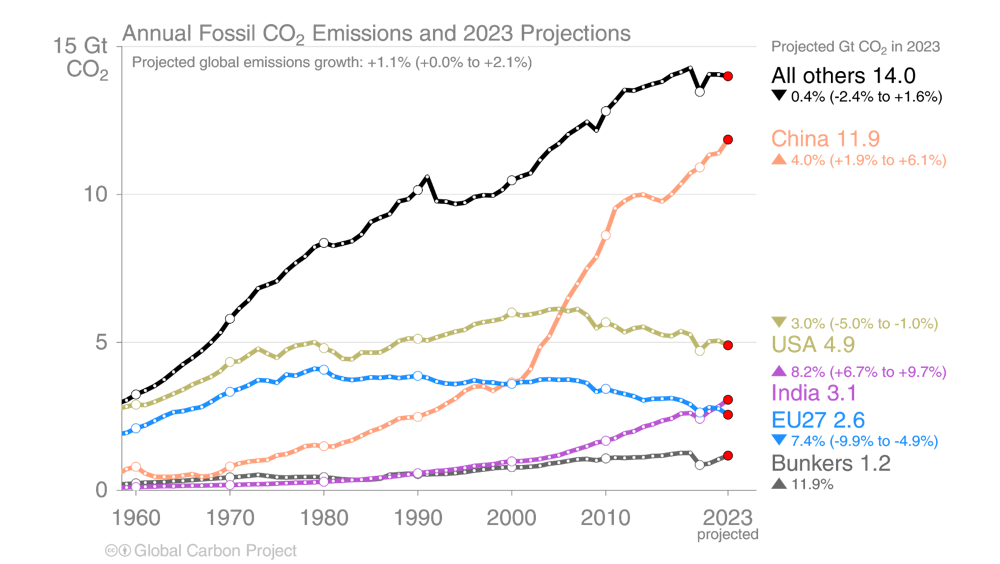
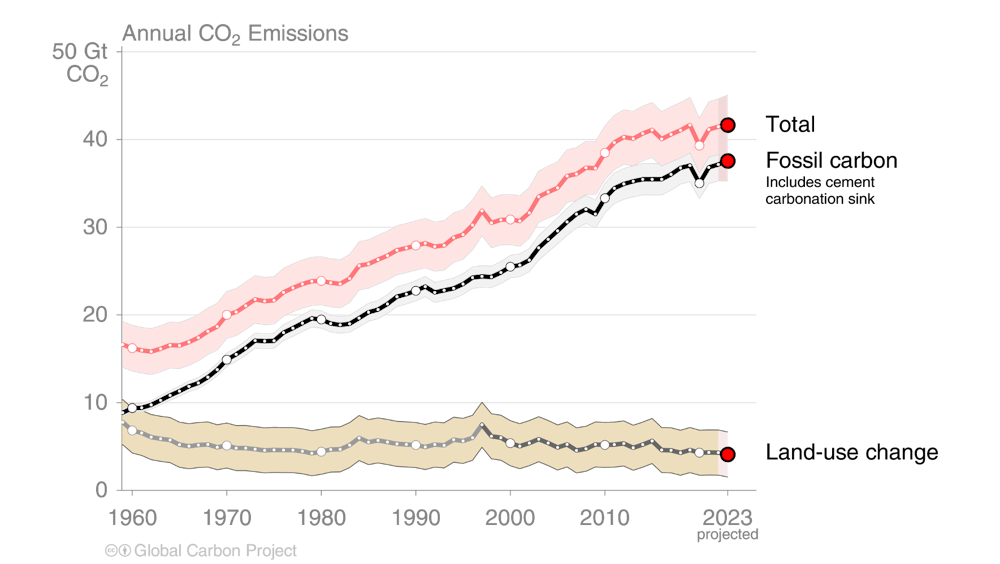
Global emissions of fossil carbon dioxide (CO₂), in yet another year of growth, will increase by 1.1% in 2023. These emissions will hit a record 36.8 billion tonnes. That’s the finding of the Global Carbon Project’s 18th annual report card on the state of the global carbon budget, which we released today.

Fossil CO₂ includes emissions from the combustion and use of fossil fuels (coal, oil and gas) and cement production. Adding CO₂ emissions and removals from land-use change, such as deforestation and reforestation, human activities are projected to emit 40.9 billion tonnes of CO₂ in 2023.

The world’s vegetation and oceans continue to remove about half of all CO₂ emissions. The rest builds up in the atmosphere and is causing increasing warming of the planet.

At current emission levels, the remaining carbon budget for a one-in-two chance to limit warming to 1.5°C will likely be exceeded in seven years, and in 15 years for 1.7°C. The need to cut emissions has never been so urgent.

Emissions from every fossil source are up

Fossil CO₂ emissions now account for about 90% of all CO₂ emissions from human activities. Emissions from every single fossil source increased this year compared to 2022:

  • coal (41% of global CO₂ emissions) up 1.1%
  • oil (32%) up 1.5%
  • natural gas (21%) up 0.5%
  • cement (4%) up 0.8%.
Line graph showing emissions from fossil fuels, land-use changes and total emissions from 1960 to 2023
All fossil fuel sources are driving the increase in total CO₂ emissions.
Global Carbon Budget 2023/Global Carbon Project, CC BY

Although global emissions have increased, the picture for individual countries is more diverse. There are some signs of progress towards decarbonisation.

China’s emissions (31% of the global total) increased by 4% with growth in all fossil fuel sources. The highest relative growth was from oil emissions. This was in part due to the transport sector’s recovery after COVID-19 pandemic shutdowns.

The United States’ emissions (14% of global) are down by 3%. The rapid retirement of coal-fired power plants drove most of this decline. US coal emissions are the lowest since 1903.

India’s emissions (8% of global) increased by 8.2%. Emissions for all fossil fuels grew by 5% or more, with coal the highest at 9.5%. India is now the world’s third-largest fossil CO₂ emitter.

European Union emissions (7% of global) are down by 7.4%. This decline was due to both high renewable energy penetration and the impacts on energy supply of the war in Ukraine.

During the decade of 2013-2022, 26 countries had declining fossil CO₂ emission trends while their economies continued to grow. The list includes Brazil, France, Germany, Italy, Japan, Portugal, Romania, South African, United Kingdom and USA.

Emissions by individual countries from 1960 to 2023
Individual country performances vary widely, but there are some signs of progress towards decarbonisation.
Global Carbon Budget 2023/Global Carbon Project, CC BY

Total CO₂ emissions are near a peak

While fossil CO₂ emissions continue to increase, net emissions from land-use change, such as deforestation (CO₂ source), minus CO₂ removals, such as reforestation (CO₂ sink), appear to be falling. However, estimates of emissions from land-use change are highly uncertain and less accurate overall than for fossil fuel emissions.

Our preliminary estimate shows net emissions from land-use change were 4.1 billion tonnes of CO₂ in 2023. These emissions follow a small but relatively uncertain decline over the past two decades.

The declining trend was due to decreasing deforestation and a small increase in reforestation. The highest emitters are Brazil, Indonesia and the Democratic Republic of the Congo. These three countries contribute 55% of net global CO₂ emissions from land-use change.

When we combine all CO₂ emissions from human activities (fossil and land use), we find very little trend in total emissions over the past decade. If confirmed, this would imply global CO₂ emissions from human activities are not growing further but remain at very high record levels.

Stable CO₂ emissions, at about 41 billion tonnes per year, will lead to continuing rapid CO₂ accumulation in the atmosphere and climate warming. To stabilise the climate, CO₂ emissions from human activities must reach net zero. This means any residual CO₂ emissions must be balanced by an equivalent CO₂ removal.

Nature’s a big help, with a little human help

Terrestrial vegetation and ocean absorb about half of all CO₂ emissions. This fraction has remained remarkably stable for six decades.

Besides the natural CO₂ sinks, humans are also removing CO₂ from the atmosphere through deliberate activities. We estimate permanent reforestation and afforestation over the past decade have removed about 1.9 billion tonnes of CO₂ per year.

This is equivalent to 5% of fossil fuel emissions per year.

Other non-vegetation strategies are in their infancy. They removed 0.01 million tonnes of CO₂.

Machines (direct air carbon capture and storage) pulled 0.007 million tonnes of CO₂ out of the atmosphere. Enhanced weathering projects, which accelerate natural weathering processes to increase the CO₂ uptake by spreading certain minerals, accounted for the other 0.004 million tonnes. This is more than a million times smaller than current fossil fuel emissions.

The remaining carbon budget

From January 2024, the remaining carbon budget for a one-in-two chance to limit global warming to 1.5°C has been reduced to 275 billion tonnes of CO₂. This budget will used up in seven years at 2023 emission levels.

The carbon budget for limiting warming to 1.7°C has been reduced to 625 billion tonnes of CO₂, with 15 years left at current emissions. The budget for staying below 2°C is 1,150 billion tonnes of CO₂ – 28 years at current emissions.

Reaching net zero by 2050 requires total anthropogenic CO₂ emissions to decrease on average by 1.5 billion tonnes of CO₂ per year. That’s comparable to the fall in 2020 emissions resulting from COVID-19 measures (-2.0 billion tonnes of CO₂).

Without additional negative emissions (CO₂ removal), a straight decreasing line of CO₂ emissions from today to 2050 (when many countries aspire to achieve net zero CO₂ or the more ambitious net zero for all greenhouse gases) would lead to a global mean surface temperature of 1.7°C, breaching the 1.5°C limit.

Renewable energy production is at a record high and growing fast. To limit climate change fossil and land-use change, CO₂ emissions must be cut much more quickly and ultimately reach net zero.The Conversation

Pep Canadell, Chief Research Scientist, CSIRO Environment; Executive Director, Global Carbon Project, CSIRO; Corinne Le Quéré, Royal Society Research Professor of Climate Change Science, University of East Anglia; Glen Peters, Senior Researcher, Center for International Climate and Environment Research – Oslo; Judith Hauck, Helmholtz Young Investigator group leader and deputy head, Marine Biogeosciences section a Alfred Wegener Institute, Universität Bremen; Julia Pongratz, Professor of Physical Geography and Land Use Systems, Department of Geography, Ludwig Maximilian University of Munich; Philippe Ciais, Directeur de recherche au Laboratoire des science du climat et de l’environnement, Institut Pierre-Simon Laplace, Commissariat à l’énergie atomique et aux énergies alternatives (CEA); Pierre Friedlingstein, Chair, Mathematical Modelling of Climate, University of Exeter; Robbie Andrew, Senior Researcher, Center for International Climate and Environment Research – Oslo, and Rob Jackson, Professor, Department of Earth System Science, and Chair of the Global Carbon Project, Stanford University

This article is republished from The Conversation under a Creative Commons license. Read the original article.

Continue ReadingFossil CO₂ emissions hit record high yet again in 2023

Rwanda plans are an affront to democracy and human rights, say Greens  

Spread the love
Image of the Green Party's Carla Denyer on BBC Question Time.
Image of the Green Party’s Carla Denyer on BBC Question Time.

Responding to the government publishing plans to disapply sections of the Human Rights Act to get around a Supreme Court ruling banning the deportation of people seeking asylum to Rwanda for processing, Green Party co-leader Carla Denyer said: 

“The fact that the government is going to try to use its parliamentary majority to over-ride established human rights protections is an affront to democracy. 

“We need a system that welcomes refugees through clear, open, safe and legal routes, that offers quick and efficient determinations and support for resettlement into local communities with properly funded local services.” 

“Instead of creating an asylum system that works, the government is deliberately making it chaotic and inaccessible to put people off using their right to seek asylum.  

“It is the use of cruelty and inhumanity as a tool of public policy and cannot be allowed to go unchallenged. 

“Everyone deserves to be treated in a way that is fair and humane. This new legislation will remove fundamental legal protections designed to protect us all from the arbitrary power of the state.”

Continue ReadingRwanda plans are an affront to democracy and human rights, say Greens  

‘Apocalyptic’ conditions in southern Gaza blocking aid, top UN official says

Spread the love
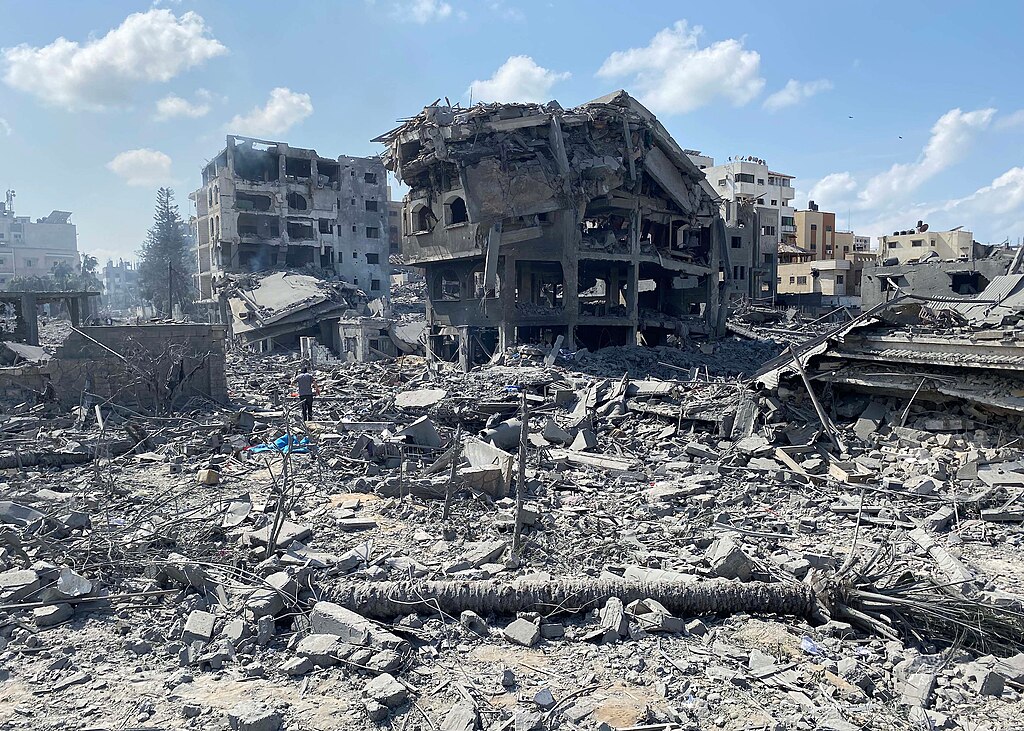
Palestinians inspect the damage following an Israeli airstrike on the El-Remal aera in Gaza City on October 9, 2023. Israel continued to battle Hamas fighters on October 10 and massed tens of thousands of troops and heavy armour around the Gaza Strip after vowing a massive blow over the Palestinian militants' surprise attack. Photo by Naaman Omar apaimages. licensed under the Creative Commons Attribution-Share Alike 3.0 Unported license.
Palestinians inspect the damage following an Israeli airstrike on the El-Remal aera in Gaza City on October 9, 2023. Israel continued to battle Hamas fighters on October 10 and massed tens of thousands of troops and heavy armour around the Gaza Strip after vowing a massive blow over the Palestinian militants’ surprise attack. Photo by Naaman Omar apaimages. licensed under the Creative Commons Attribution-Share Alike 3.0 Unported license.

https://www.theguardian.com/world/2023/dec/05/un-martin-griffiths-idf-campaign-southern-gaza-apocalyptic-conditions

The UN’s top aid official has said the Israeli military campaign in southern Gaza has been just as devastating as in the north, creating “apocalyptic” conditions and ending any possibility of meaningful humanitarian operations.

Martin Griffiths, the UN emergency relief coordinator, said he was speaking on behalf of the entire international aid community in saying the continuing offensive had robbed aid workers of any significant means of helping the 2.3 million people of Gaza, other than to call for an immediate end to the fighting.

His comments came as the Israeli military said it had stormed southern Gaza’s main city in the most intense day of fighting so far, and hospitals struggled to cope with scores of dead and wounded Palestinians.

“What we’re saying today is: that’s enough now. It has to stop,” Griffiths said in an interview with the Guardian, adding that the small amount of aid being allowed into Gaza could no longer be distributed, since the Israeli ground offensive had spread to southern Gaza and the city of Khan Younis, bringing the humanitarian operation effectively to an end.

“It isn’t really a statistically significant operation any more,” said Griffiths, who is also UN undersecretary general for humanitarian affairs. “It’s a bit of a patch on a wound and it doesn’t do the job, and it would be an illusion for the world to think that the people in Gaza can be helped by the humanitarian operation under these conditions.

“This is an apocalyptic situation now, because these are the remnants of a nation being driven into a pocket in the south.”

https://www.theguardian.com/world/2023/dec/05/un-martin-griffiths-idf-campaign-southern-gaza-apocalyptic-conditions

Zionist president Joe Biden. 27 July 2021 image by Official White House Photo by Adam Schultz. Original public domain image from Flickr
Continue Reading‘Apocalyptic’ conditions in southern Gaza blocking aid, top UN official says