Interior minister ordered activist group to be disbanded after violence at water reservoir protests.
Protests organized in March by the leaderless group Les Soulèvements de la Terre against the construction of large water reservoirs led to violent clashes with police that left hundreds injured and two people in a coma | Loic Venance/AFP via Getty Images
A top French administrative court on Friday suspended the government’s decision to disband a climate activist movement following clashes with police during protests earlier this year.
France’s Council of State court ruled that the disbanding order would restrict the activists’ freedom of assembly and said the interior ministry did not provide enough evidence to back up its claim that the group is inciting violence.
“Neither the documents in the file, nor the discussions at the hearing, make it possible to consider that the grouping in any way endorses violent acts against individuals,” the court said in a statement.
Protests organized in March by the leaderless group Les Soulèvements de la Terre (“Earth’s uprisings”) against the construction of large water reservoirs led to violent clashes with police that left hundreds injured and two people in a coma.
French Interior Minister Gérald Darmanin ordered the group to be disbanded following the incident, alleging the activists were inciting “ecoterrorism” across the country, and 18 people were arrested.
The climate movement decided to challenge the order in court, with the support of the French Greens and the far-left party France Unbowed, arguing that the disbanding order hampered their freedom of assembly and expression.
The court’s decision is a blow to Darmanin, as it means the activists can continue to organize demonstrations across the country, including a two-week march from Saint-Soline to Paris starting August 18 to protest the government’s water management policy.
But the ruling is also only the first step in a longer legal procedure, as it temporarily suspends the government’s disbanding order until the court can look into the merits of the case.
‘Direct air capture’ of carbon pollution is still experimental, but a fossil fuel company is embracing it as a way to keep drilling.
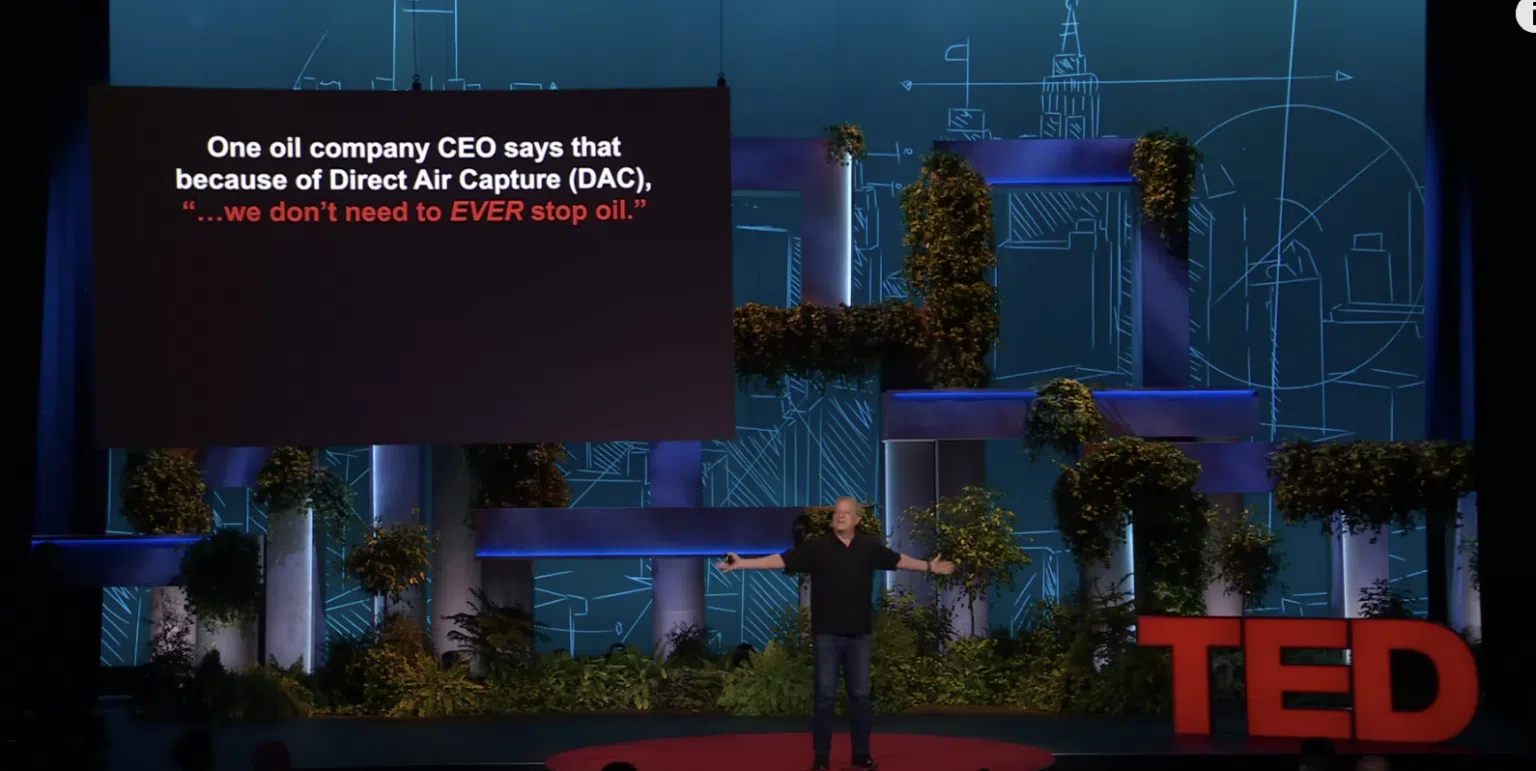
In a new TED Talk posted on August 7, 2023, former Vice President Al Gore pointed to Occidental CEO Vicky Hollub’s acknowledgement that direct air capture enables a fossil fuel forever strategy. Credit: Screen grab of <a href=”https://youtu.be/xgZC6da4mco”TED Talk video via YouTube.
The U.S. Department of Energy has announced that a subsidiary of U.S.-based oil company Occidental Petroleum will receive a grant to develop a commercial-scale direct air capture (DAC) facility in southern Texas.
It is one of two DAC projects selected under a $1.2 billion federal program to scale up DAC, which the Energy Department has called the “world’s largest investment in engineered carbon removal in history.”
This new DOE funding is part of a larger $3.5 billion allocation from Congress – under the Infrastructure Investment and Jobs Act, part of the Biden administration’s signature climate legislation – to develop four large-scale DAC hubs. But some critics contend that the federal government’s involvement in this new climate technology is giving fossil fuel companies cover, allowing them to create the impression that they are part of the transition to greener energy while they continue to focus most of their activities and money on their core oil and gas businesses.
Direct air capture is a nascent technology designed to capture carbon dioxide from the ambient air. In theory, it could help remove “legacy emissions,” or the carbon pollution that has already been emitted. Research and development projects to date have not yet shown how DAC can be scaled up to a global scale that would have an effect on slowing climate change.
Yet major polluters are already capitalizing on the conceptual promise of this technology to promote it as a climate solution.
“Oxy has said out loud that this is a ‘get out of jail free’ card, enabling the oil and gas industry to continue business as usual,” said researcher Kert Davies, director of special investigations with the Center for Climate Integrity, referring to Occidental Petroleum’s stock ticker symbol, “instead of heeding the urgent fossil fuel phaseout warning scientists have shouted in our faces for decades.”
Climate advocate and former Vice President Al Gore noted in a recent TED Talk that Occidental CEO Vicky Hollub has said that because of DAC, “we don’t need to ever stop oil,” and that the technology gives the fossil fuel industry “a license to continue to operate.”
According to Gore, “They’re using it in order to gaslight us, literally.”
Direct air capture may play a role someday, but the best option now is to halt carbon emissions in the first place, said John Fleming, senior scientist at the Center for Biological Diversity’s Climate Law Institute. “[Direct air capture] requires large amounts of energy, spurring more demand for the same fossil fuels that caused the climate crisis,” Fleming said.
Two of the four DAC hubs funded by the Department of Energy will be located on the Gulf Coast. In addition to Occidental’s hub in Kleberg County, Texas, a project proposed by Battelle, Climeworks, and other partners, called “Project Cypress,” will be constructed in Calcasieu Parish, Louisiana. On paper, the two projects together will have the capacity to remove two million metric tons of CO2 from the atmosphere per year. It is unclear exactly how much each project will receive in government funding, as they will be undergoing award negotiations.
DOE has not yet announced selection of the other two DAC hub projects. “We’re expecting in 2024 or soon thereafter that we will have another solicitation for additional hubs,” said Kelly Cummins, deputy director of DOE’s Office of Clean Energy Demonstrations.
Under the Inflation Reduction Act’s expanded tax credits for carbon capture technologies – a subsidy under section 45Q of the Internal Revenue Code for developers to capture CO2 from polluting facilities or from the atmosphere – qualifying DAC projects can receive $180 per ton of CO2 captured and stored, a significant increase from the previous credit of $50 per ton.
Occidental subsidiary 1PointFive, which focuses on developing carbon capture, utilization and storage (CCUS) and DAC projects, will be developing the South Texas DAC facility, according to DOE’s announcement. The company is currently building a smaller DAC facility in Ector County, Texas, in the Permian Basin, where Occidental continues to operate as one of the largest extractors of oil and gas.
Occidental has indicated that CO2 captured from its Permian Basin DAC plant could be used to drill for more oil through a process it has long used known as enhanced oil recovery (EOR). In its latest annual report, the company stated that its CO2 EOR operations “are critical to Occidental’s long-term strategy.”
However, according to DOE’s Cummins, this hub is not expected to be linked to enhanced oil recovery (EOR) operations.
A ‘Gimmick of the Fossil Fuel Industry’
Researchers who have analyzed the technical requirements of direct energy capture, such as energy load, warn that it is little more than a boondoggle. A 2020 analysis published in Nature Communications found that “the energy and materials requirements for [DAC] are unrealistic even when the most promising technologies are employed.”
In a 2019 study that examined the impacts of direct air capture, Mark Jacobson, a professor of civil and environmental engineering at Stanford University, found that it would increase CO2 emissions, air pollution, fossil mining and fossil infrastructure, largely because of the enormous amount of energy required to extract, compress, and separate the CO2.
Even if renewable energy is used to operate DAC, Jacobson told DeSmog that this would simply divert renewables away from directly replacing fossil fuels. At least for the next several decades or until fossil fuels are eliminated, “it is impossible for there to be a benefit of DAC, only an opportunity cost. It will only delay our solution to the climate problem,” Jacobson said.
“DAC is simply a gimmick of the fossil fuel industry to keep themselves operating and pretend they are doing something useful,” he added.
We really need to be smarter than this if we want to hold out any hope of solving global warming, air pollution, and energy security problems.
In a statement, Occidental’s Hollub said the company looks forward to partnering with DOE to “deploy this vital carbon removal technology at climate-relevant scale.”
June Sekera, a climate researcher who has studiedDAC, said that the feasibility of actually getting to that scale is “absurd,” and that DAC is meaningless from a climate change perspective.
Sekera, a research fellow at the Global Development and Environment Institute at Tufts University, told DeSmog that “the IPCC has said that DAC is going to be removing [essentially] zero CO2 by 2030.” The one commercial-scale DAC plant currently operating anywhere in the world, in Iceland, is designed to remove just 4,000 tons of CO2 a year, she said.
The IPCC, or Intergovernmental Panel on Climate Change, is the United Nations body that issues regular reports on the latest climate change science.
U.S. Secretary of Energy Jennifer Granholm told reporters on Thursday that if deployed at a commercial scale, DAC technology “can help us make serious headway on our net zero goals.” But climate and environmental justice advocates are largely opposed to the kinds of “carbon management” projects that fossil fuel interests are promoting, including direct air capture, and see them as a way for industrial polluters to continue operating as usual.
“We know that engineering-based removal activities are technologically and economically unproven, especially at scale, and pose unknown environmental and social risks,” said Marion Gee, co-executive director of Climate Justice Alliance.
Fenceline Watch, a Texas-based environmental justice organization, said in a statement that DOE’s funding of DAC hubs in Texas and Louisiana “represents, once again, the sacrifice of our communities along the Gulf Coast in the interest of the oil, gas, and petrochemical industry.”
Carbon180, an organization supporting carbon removal, told DeSmog that addressing environmental justice issues and not catering to polluters’ interests are key to building industrial-scale carbon removal in an equitable way. “We believe that the carbon removal industry can and should be built to redress the harms and injustices of the past. We’re keen to see DOE prioritize the interest of communities and not those of the fossil fuel industry,” said Sasha Stashwick, director of policy at Carbon180.
But Fenceline Watch contends that direct air capture further endangers communities already overburdened by industrial pollution.
“While the industry positions direct air capture facilities as a viable solution to removing carbon from the air, the reality is these hubs have never proven to be able to achieve these claims,” the organization said in an emailed statement. “This is a greenwashing campaign that will continue to put our communities’ health, environment, and safety at risk.”
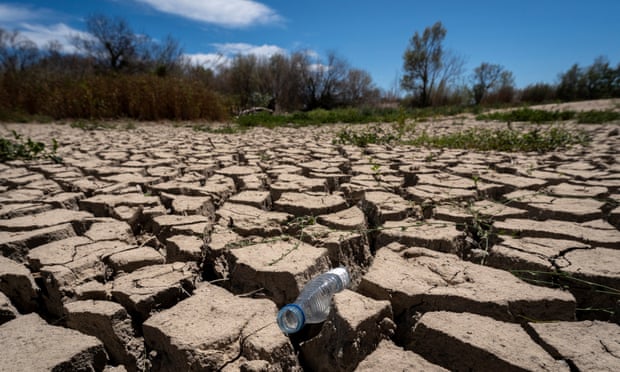
A dried-up part of the Muga riverbed in northern Spain. Photograph: David Borrat/EPA
Water scarcity threatening agriculture faster than expected, warns Cop15 desertification president
The world is likely to face major disruption to food supplies well before temperatures rise by the 1.5C target, the president of the UN’s desertification conference has warned, as the impacts of the climate crisis combine with water scarcity and poor farming practices to threaten global agriculture.
Alain-Richard Donwahi, a former Ivory Coast defence minister who led last year’s UN Cop15 summit on desertification, said the effects of drought were taking hold more rapidly than expected.
“Climate change is a pandemic that we need to fight quickly. See how fast the degradation of the climate is going – I think it’s going even faster than we predicted,” he said. “Everyone is fixated on 1.5C [above pre-industrial levels], and it’s a very important target. But actually, some very bad things could happen, in terms of soil degradation, water scarcity and desertification, way before 1.5C.”
The problems of rising temperatures, heatwaves and more intense droughts and floods, were endangering food security in many regions, Donwahi said. “[Look at] the effects of droughts on food security, the effects of droughts on migration of population, the effect of droughts on inflation. We could have an acceleration of negative effects, other than temperature,” he said.
This is obvious. We’ve seen huge droughts, floods, heatwaves, heatdomes, etc already with temperature increases at 1.1/1.2. Agriculture is already precarious.
“Fossil fuel interests see a clear benefit in promoting direct air capture as a means to preserve the dominance of dirty fossil fuels,” said one advocate.
Campaigners demand far-reaching climate action at a rally. (Photo: michael_swan/flickr/cc)
Climate action groups on Friday said the U.S. Department of Energy’s newly announced $1.2 billion in grants for two carbon capture projects are far from the climate action that scientists and advocates have demanded for years—despite the Biden administration’s claim that the “next-generation technologies” must be used alongside renewable energy sources to draw down carbon emissions.
The department said it will invest $1.2 billion to build the nation’s first commercial plants that will conduct “direct air capture,” in which “giant vacuums… can suck decades of old carbon pollution straight out of the sky,” as Energy Secretary Jennifer Granholm told reporters on Thursday.
The unproven technology has been a key focus of oil and gas lobbyists, who argue that fossil fuel companies can continue their planet-heating extraction activities if plants are built to remove the pollution they cause.
Advocacy group Food & Water Watch noted that one oil company, Occidental, stands to benefit directly from the grants because its wholly owned subsidiary, 1Point5, was selected by the Energy Department as one of the recipients.
“Direct air capture is expensive, unproven, and will ultimately make almost no difference in reducing climate pollution… Capturing just a quarter of our annual carbon emissions would require all of the power currently generated in the country.”
“Fossil fuel interests see a clear benefit in promoting direct air capture as a means to preserve the dominance of dirty fossil fuels,” said Jim Walsh, the group’s policy director. “The federal government is handing them hundreds of millions of dollars in subsidies, when it should be pursuing policies to end the era of fossil fuels.”
Occidental plans to build one of the plants in Kleberg County, Texas, while nonprofit research firm Battelle will build another in Calcasieu Parish, Louisiana—one of the state’s air pollution hotspots, according to New Orleans Public Radio.
“Frontline communities that have borne the brunt of environmental racism and climate change for generations say, ‘Enough!'” said Marion Gee, co-executive director of the national grassroots coalition Climate Justice Alliance. “In an effort to move quickly and carelessly to balance a ‘carbon budget,’ the backyards that he’s talking about building in won’t be [White House Deputy Chief of Staff John] Podesta’s, President [Joe] Biden’s, or their neighbors. It’ll be Black folks, Indigenous communities, and poor BIPOC neighbors—sacrificed, yet again, in the name of protecting corporate interests.”
Critics note that carbon capture is expensive and requires a huge amount of energy to run the “capturing” mechanisms, increasing the very emissions companies aim to remove from the atmosphere.
Former Vice President Al Gore said in a TED Talk last month that turning to carbon capture—as the Biden administration did when it included $3.5 billion to fund a total of four direct air capture plants in the 2021 bipartisan infrastructure law—is a “moral hazard” that will give fossil fuel giants “an excuse for not ever stopping oil.”
“That gives them a license to continue producing more and more oil and gas,” he said.
Basav Sen, climate justice policy director at the Institute of Policy Studies, accused the Biden administration of playing “cynical political game of squandering public funds on unproven, expensive, and potentially dangerous schemes such as direct air capture, purportedly to gain credibility for backing climate solutions, while doubling down on expanding fossil fuels.”
The grants were announced days after President Joe Biden angered campaigners by claiming that “practically speaking,” he has already declared a climate emergency, despite his approval earlier this year of a massive oil drilling project in Alaska and his recent proposal to update rules for—but not end—fossil fuel leasing on public lands.
As Common Dreams reported in May, Food & Water Watch recently unveiled an interactive online website titled Carbon Capture Scam to expose the “false narratives” being pushed by the fossil fuel industry and lawmakers to promote a “dangerous distraction from the pressing need to move off oil and gas.”
“Direct air capture is expensive, unproven, and will ultimately make almost no difference in reducing climate pollution,” said Walsh on Friday. “Capturing just a quarter of our annual carbon emissions would require all of the power currently generated in the country.”
“Even if the technology was effective, there are still serious questions about whether there is a safe and effective way to store the captured carbon dioxide,” he added. “A more practical and effective approach would be to invest money in wind and solar energy—which would be far more effective in actually reducing climate pollution.”
JUNIOR doctors walking out for a fifth time this weekend are blamed by Tory ministers for the NHS’s record-breaking waiting lists.
Their pay restoration demands are billed as greedy, though the case they make is straightforward, as the British Medical Association’s junior doctors committee co-chair Dr Robert Laurenson points out: “Over the last 15 years, the government has cut our pay by 31.7 per cent so we’re looking to restore that pay back to what it was like in 2008.”
Rishi Sunak declines even to discuss this — maintaining that the current offer is “fair and final,” on the grounds it has been recommended by an “independent” (by which he means government-appointed) pay review body.
…
Labour backs the Tory policy for reducing waiting lists, which is to increase NHS use of private-sector providers.
This cannot possibly work, since the private sector is parasitical on the NHS and poaches NHS staff. Commissioning more private-sector work actively worsens the NHS staffing crisis.
Our demand ultimately needs to be for more resources for the NHS. It needs more staff, it needs to pay them more and it needs to treat them better.
The Westminster consensus against raising spending needs to be challenged. It’s therefore disappointing that Scottish Labour simply carped at the Scottish National Party after research it commissioned exposed the huge funding gap between the NHS and European healthcare systems — with Germany and Norway spending a full third more per head on healthcare than we do.