The heatwave in the central Chilean Andes is melting the snow below 3,000 metres (9,840ft), which will have knock-on effects for people living in downstream valleys who depend on meltwater during the spring and summer.
Tuesday was probably the warmest winter day in northern Chile in 72 years, according to Raul Cordero, a climate scientist at the University of Groningen, who said the 37C recorded at the Vicuña Los Pimientos station in the Coquimbo region was caused by a combination of global heating, El Niño and easterly gusts, known by locals as Terral winds that bring hot, dry weather.
Dozens of meteorological monitoring stations at more than 1,000 metres altitude recorded temperatures above 35C in winter, according to the Extreme Temperatures Around The World blog.
South America is living one of the extreme events the world has ever seen Unbelievable temperatures up to 38.9C in the Chilean Andine areas in mid winter ! Much more than what Southern Europe just had in mid summer at the same elevation: This event is rewriting all climatic books pic.twitter.com/QiiUKllWWP
— Extreme Temperatures Around The World (@extremetemps) August 1, 2023
Government accused of ‘deliberately undermining’ green policies after slashing financial penalties for big polluters
Scientists and campaigners have slammed the government’s decision to hand unexpectedly large subsidies to the biggest polluters – making it far cheaper to pollute in the UK than in the EU.
But the government has quietly announced changes to the scheme that will see polluting industries given far more free permits than anticipated, according to a new report in the Financial Times.
The move means emitting a tonne of carbon in the UK now costs big polluters just £47, compared to £75 in the EU. It comes weeks after openDemocracy revealed the government gave free permits to a controversial Russian cargo airline the day after Russia’s full-scale invasion of Ukraine.
Leo Murray, an expert in emissions trading, told openDemocracy that the decision to slash the cost of polluting “should trigger a complete rethink of the entire scheme”, which he branded “the worst possible way to price carbon in our economy”.
The ETS, which replaced a similar EU scheme after Brexit, has been beset with difficulties. openDemocracy’s previous investigations have found that some of the biggest polluters were handed vast de-facto subsidies under the scheme, while others – including highly polluting incineration firms and owners of private jets – were exempt entirely.
Over-allocating permits can only be read as a deliberate move to undermine the shift away from fossil fuels
Leo Murray, We Are Possible
Murray, who is the director of the environmental campaign group We Are Possible, said: “It is so telling that the UK can’t even let the most market-friendly climate policy approach in the whole toolbox do its work without deliberately intervening to make sure it is totally ineffective at reducing emissions.
“Over-allocation of permits was the biggest reason why the EU ETS, which our own scheme is a pale shadow of, failed to reduce emissions for most of the first phases of its existence, so repeating this mistake can only be read as a deliberate move to undermine the economy-wide shift away from fossil fuels.”
Murray’s frustration was echoed by Natalie Bennett, a Green Party member of the House of Lords, who said: “We heard much talk, during the [Brexit] referendum campaign and subsequently, of a so-called ‘Green Brexit’… The hollowness of that claim, the reality that we could – and do – have far lower environmental and climate standards is today being driven home with great force.
Bennett continued: “The EU is continuing to – if not quickly enough – advance in climate action and on the protection of nature and human health, while the UK falls further and further behind.”
The EU is continuing to advance in climate action, while the UK falls further and further behind
Natalie Bennett, Green Party
Aaron Thierry, a climate expert at Cardiff University, added that the government’s decision to cut the cost of polluting shows that “the UK is continuing to backslide on its climate pledges”.
He added: “That this is happening even as we see extreme temperatures around the world topple all-time records, with southern Europe’s grain harvest down 60%, India forced to ban rice exports and fires around the Mediterranean, is an absolute scandal. Rishi Sunak is a danger to us all.”
Earlier this month, thousands of openDemocracy readers wrote to their MP to call on the government to stop giving away free pollution permits to big polluters. You can join them here, or sign our open letter to the government here.
Unable to ignore the catastrophic emissions produced by burning fossil fuels, the fossil fuel industry has turned to carbon capture and storage (CCS) as a solution that allows them to carry on business as usual.
But with serious concerns about this unproven technology, Global Witness and Friends of the Earth Scotland have commissioned world-renowned climate scientists at the Tyndall Centre in Manchester to assess the role of fossil fuel-based Carbon Capture and Storage (CCS) in the energy system, and its ability to help to achieve the Paris Agreement goal of limiting global average temperature increases to 1.5°C.
This ground-breaking research finds that CCS cannot be relied on to deliver global 2030 emissions reductions, whilst the majority of CCS that exists is being used to extract more oil. It finds:
Current status of fossil fuel-based CCS in the energy system
The scale of deployment of CCS to date is significantly less than proponents have predicted, with only 26 CCS plants currently in operation globally.
Global operational CCS capacity is currently 39MtCO2 per year, this is about 0.1% of annual global emissions from fossil fuels and less than Scotland’s territorial emissions in 2018.There is no operational CCS capacity in the UK or the EU at all.
81% of carbon captured to date has been used to extract more oil via the process of Enhanced Oil Recovery (EOR). This means CCS is being predominantly used for carbon-emitting oil extraction that wouldn’t have otherwise been possible.
Current CCS projects usually target 90% capture at peak capacity. The Petra Nova facility missed capture targets by around 17% between starting in 2017 and its mothballing in May 2020.
Key implications for delivering Paris Agreement goal to limit warming to 1.5°C
Fossil fuel-based CCS is not capable of operating with zero emissions. Many projections assume a capture rate for CCS of 95%, however, capture rates at that level are unproven in practice.
Fossil fuel-based CCS will continue to entail residual, process and supply chain greenhouse gas emissions. There must be consideration of whether fossil fuel hydrogen with CCS is sufficiently low-carbon relative to remaining carbon budgets.
Even if the technology is to become economically and technically viable at scale, optimistic forecasts do not anticipate significant CCS capacity until at least the 2030s.
A focus on CCS will not help achieve 2030 CO2 emission reduction targets being adopted by Governments, which have to be met if we are to prevent a climate catastrophe. The research emphasises the real danger of reliance on CCS in energy for delivering these vital emission reductions, given they cannot be expected to any degree until at least 2030.
On the basis of this research, Friends of the Earth Scotland and Global Witness believe the promotion of CCS in energy is a distraction from the rapid growth of renewable energy and energy efficiency required. We urge instead reliance on technologies that can deliver the emissions reductions required by 2030 if we are to deliver on the Paris Agreement goals.
Download a summary brief of the report produced by Global Witness and Friends of the Earth Scotland: Downloads
Rightwing groups penned a conservative wish list of proposals for the next conservative president to gut environmental protections
An alliance of rightwing groups has crafted an extensive presidential proposal to bolster the planet-heating oil and gas industry and hamstring the energy transition, it has emerged.
Against a backdrop of record-breaking heat and floods this year, the $22m endeavor, Project 2025, was convened by the notorious rightwing, climate-denying thinktank the Heritage Foundation, which has ties to fossil fuel billionaire Charles Koch.
Called the Mandate for Leadership: The Conservative Promise, it is meant to guide the first 180 days of presidency for an incoming Republican president. Climate experts and advocates criticized planning that would dismantle US climate policy.
The nearly 1,000-page transition guide was written by more than 350 rightwingers and is full of sweeping recommendations to deconstruct all sectors of the federal government– – including environmental policy.
Very rich US right-wing interests intent on destroying a transition to sustainable energy. UK’s Prime Minister Rishi Sunak and UK Labour leader Keir Starmer are aligned with and not in any way opposing these interests. There is little doubt that climate denier – I think that it’s just beyond his abilities to understand tbh – Trump will go along with this. Charles Koch is involved with this initiative.
In effect, he has become the chief annihilator of democracy.
Anti-Donald Trump protesters hold letters that spell out ‘justice’ in Washington, D.C., on Aug. 3 as former president Donald Trump was set to appear in federal court on charges that he sought to overturn the results of the 2020 presidential election. (AP Photo/Jess Rapfogel)
“He has trafficked in racism and xenophobia. He has incited violence. He has kowtowed to dictators and trashed our alliances. He has welcomed Russian attacks on our elections. He has locked children in cages. He has called for his opponents to be locked up.”
Put differently, Trump has criminalized both social problems and politics itself.
Trump and his allies have long created a culture of lies, illusions, cruelty and misrepresentation. He has waged an incessant attack on reason, critical thinking, informed judgment and social responsibility. His distaste for Black people, migrants and others he considers disposable is matched by his support for the financial and corporate elite.
Yet, despite the damage Trump has done to democracy, he has almost complete support of the Republican Party and a majority of Republican voters — slightly more than 58 per cent say they still plan to vote for him in the 2024 presidential election if he wins the Republican nomination. He appears poised to clinch that nomination.
Even more troubling are recent polls indicating he’s in a dead heat with U.S. President Joe Biden if they’re the presidential nominees in 2024.
Donald Trump and Joe Biden participate in a presidential debate in Nashville, Tenn., in October 2020. (Jim Bourg/Pool via AP)
What explains Trump’s appeal?
Most of media is focused on Trump’s legal troubles. But too little has been written about the conditions that have given rise to his authoritarian politics or why Trump is a national disgrace still backed by millions of Americans.
Trump’s grip on power is a collective nightmare that can only be understood in terms of the historical, economic, political and cultural conditions of which he is the endpoint.
“Odious as he may be, Trump is less the cause of America’s decline than a product of its descent.”
Trump embodies a society that has been in crisis for decades, but especially since the 1980s. This was a period when the right-wing counter-revolution emerged with the election of Ronald Reagan.
Ronald Reagan gives a thumbs up to the crowd while his wife, first lady Nancy Reagan, waves from a limousine during the inaugural parade in Washington following Reagan’s swearing in as the 40th president of the United States in January 1981. (AP Photo/File)
Since that time, the democratic values that informed the social contract and common good have been increasingly displaced by market values that stress self-interest, privatization, commodification, deregulation and the accumulation of profit and celebration of greed. Civic culture came under attack along with the erosion of the values of shared citizenship.
The market became a template for controlling not just the economy, but all of society. The language of rabid individualism replaced the notion of the common good and gave way to a disdain for community.
Government was discredited as a force for good, its public infrastructure was eroded and replaced by a culture of cruelty in which matters of compassion, care, and ethical responsibility began to disappear.
What emerged was society marked by precarity, loneliness and mass anxiety. The rising cult of individualism made it difficult for the public to translate private troubles into systemic considerations, weakening the public imagination. The rise of a media environment where politics becomes a form of entertainment helped silence any resistance to a growing culture of lies and greed.
Staggering levels of economic inequality also emerged, setting the ground for dark money shaping politics. This neoliberal poison helped to create a society of political monsters, immune to the virtues and conditions of democracy.
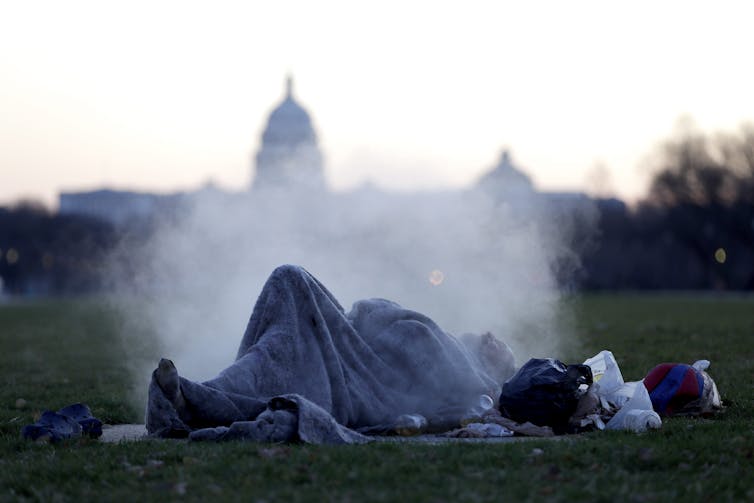
A homeless man resting on a steam vent on the National Mall in 2019 in Washington. (AP Photo/Julio Cortez)
Harnessed to exclusion and bigotry, the language of freedom was invoked eventually by Trump and other Republican Party politicians to produce policies that have banned books, crushed dissent, limited classroom and workplace discussions about race, whitewashed African American history and justified a virulent anti-democratic politics that echo the ghosts of a fascist past.
America at a crossroads
The most important issues Americans face today are not solely about Trump’s corruption, lawlessness or open authoritarianism — it’s about learning from history.
We must rethink the lies that neoliberal capitalism have told us about how American society defines itself while rethinking what it will take to challenge and overcome the anti-democratic forces that gave rise to Trump.
The 2024 election should be about more than Trump’s ongoing legal travails. It should be a directive for what kind of society Americans want and what kind of future they desire for their children. They should regard the election as a choice between democracy and the further criminalization of American politics.
Henry Giroux, Chaired professor for Scholarship in the Public Interest in the Department of English and Cultural Studies, McMaster University