North-east mayor slams Starmer’s green rollback after quitting Labour

Spread the love
Labour leader Keir Starmer (centre) with then US secretary of state Mike Pompeo (R) and then US ambassador to Britain, Woody Johnson, in London, 21 July 2020.
Labour leader Keir Starmer (centre) with then US secretary of state Mike Pompeo (R) and then US ambassador to Britain, Woody Johnson, in London, 21 July 2020. Pompeo said in 2019 “we will do our level best” to stop Jeremy Corbyn getting elected. (Photo: US State Department)

Original article by Adam Ramsay republished from OpenDemocracy under a Creative Commons Attribution-NonCommercial 4.0 International licence.
Exclusive: Jamie Driscoll says some voters think Starmer is ‘a liar’ and backing ULEZ would win votes

The ex-Labour mayor of the UK’s poorest region has slammed Keir Starmer for watering down the party’s environmental commitments.

In an exclusive interview with openDemocracy in his office in Newcastle, North of Tyne mayor Jamie Driscoll said: “There is no contradiction between protecting us from the climate emergency, and prosperity. In fact, if you fail to protect us from the climate emergency, you’re going to lose all prosperity in the future.”

Labour’s leadership has blamed its failure to take Boris Johnson’s former constituency of Uxbridge and South Ruislip in the recent by-election on London mayor Sadiq Khan’s plan to expand the city’s ‘ultra-low emission zone’ (ULEZ) into the area. But Driscoll, who dramatically quit Labour last month, said the party would have won the seat if it had stood by the scheme and campaigned against Tory cuts to bus services in the capital.

“Labour would have won the Uxbridge by-election if they had said: ‘Yes, it [ULEZ] is a problem, because the Tories have cut public transport in London – if we had better buses here, which we will do, you’ll be better off,’” he said. “That would have won them it… A lot of people who voted Green because they were outraged by Labour’s abandonment [of ULEZ] probably would have voted Labour.”

Labour’s candidate in the by-election had publicly opposed the ULEZ expansion during the campaign; the Green candidate won 893 votes, more than the margin separating Labour from the Tories.

Driscoll also argued that politicians’ failure to take climate breakdown seriously contributed to falling trust in politics: “We’ve got a climate juggernaut hurtling towards us, and [politicians] are saying ‘some people in outer London didn’t like ULEZ so let’s just burn the planet because we need their votes’. Almost any rational person, which is the majority of the electorate, I still believe, would say: ‘It doesn’t add up any more.’”

Deselected by Labour

Driscoll is currently mayor of the North of Tyne region, which extends northwards from Newcastle to the Scottish border. He has successfully negotiated an expansion of the region, meaning that when the post comes up for re-election next year, it will also cover areas of north-east England south of the Tyne, including Sunderland, Gateshead and County Durham.

With an engineering background and his own software business, Driscoll was first elected as a councillor in Newcastle in 2018. He was quickly chosen by Labour members to be the party’s candidate for North of Tyne mayor when the post was created in 2019, beating the longstanding leader of Newcastle Council in the selection. Calling himself a “pragmatic socialist”, he is generally identified with the left of the party, and was supported by Momentum.

But when Labour announced its shortlist of candidates for the mayor of the newly expanded North East seat, Driscoll’s name was notably absent. Party insiders briefed that he had been ‘purged’ because he once spoke at an event alongside the filmmaker Ken Loach, who was himself banned from Labour because of his prior support for the Left Unity party. While much of the media parroted this line, a simpler explanation is that he was binned because of his left-wing views, and as revenge for defeating one of the party’s big beasts.

Driscoll’s deselection was slammed by politicians across the political spectrum, with Labour mayors Andy Burnham and Steve Rotherham praising his approach to the role. His interview with openDemocracy is the first time he has so clearly attacked the Labour leadership since standing down from the party.

Speaking about Starmer’s recent equivocation on previous climate spending commitments, Driscoll characterised the Labour position as: “We might put £28bn into tackling the climate emergency at some point in the future if the fiscal rule allows it – a fiscal rule which we decided on, which is not real and has no legal basis in anything, on the basis that we just think it makes us look a bit more credible to some people.”

If you do a vox pop and say ‘do you think Keir Starmer keeps his word?’ you would have no one say ‘yes’

He added: “There is an underlying reality to people’s lives. Either your bus comes, or it doesn’t. Either you can get an operation, or you can’t. These are the things that are concrete and in the real world. The climate emergency is absolutely one of those.

“The science is uncontroversial – we already now have enough CO2 and other greenhouse gases in the atmosphere that even if they remain stable at that level, global heating is going to continue and we will pass way beyond 1.5°C. Even if we live in a magic world where no tipping points kick in, that will lead to mass people movements and crop failures around the world.”

For Labour’s leadership to respond to this reality by saying “yeah, but we need a fiscal rule” isn’t good enough, he argued. Criticising his former party for saying it won’t cancel oil and gas licences recently issued by the Tories, and for comments Starmer reportedly made to shadow climate change secretary Ed Miliband that he “hates tree huggers” (which he denied) and isn’t “into hope and change”, Driscoll asked: “What are they there for?”

‘Dishonest’

Speaking more broadly, Driscoll said some people perceive Starmer as a “liar”. He claimed: “If you would go out and do a vox pop and say ‘do you think Keir Starmer keeps his word?’ you would have no one say ‘yes’. Or some people think, ‘yes, he’s a liar but he’s not as much of a liar as the Tories’ – you know, lesser of two evils. But the lesser of two evils is still voting for evil.”

Referring to an event during Starmer’s Labour leadership campaign, Driscoll added: “I interviewed him in 2019. He said that you have to inspire people to party unity – you don’t discipline people to party unity.” Referring to Starmer’s promises at the time, Driscoll said: “Ten pledges, has he kept any of them? I don’t think he has. And the public know that.”

He added: “Regardless of what people say in politics, regardless of their ideologies, there is an objective reality. And when politicians forget that, they find themselves unable to tell the truth. The reason they are unable to tell the truth is that what they propose does not tally with reality.”

He also claimed Starmer and shadow health secretary Wes Streeting are unduly influenced by big business, pointing to Streeting’s donations from a hedge fund manager heavily invested in private healthcare and Starmer rowing back on commitments to tax Big Tech after a meeting with Google. “To abandon that,” he said, “shows you in whose interests they are operating.”

Whatever you’re interested in, there’s a free openDemocracy newsletter for you. HAVE A LOOK

Original article by Adam Ramsay republished from OpenDemocracy under a Creative Commons Attribution-NonCommercial 4.0 International licence.
Continue ReadingNorth-east mayor slams Starmer’s green rollback after quitting Labour

Climate chaos – with the UK government wilfully looking the other way

Spread the love

https://morningstaronline.co.uk/article/f/climate-emergency-wilfully-looking-other-way

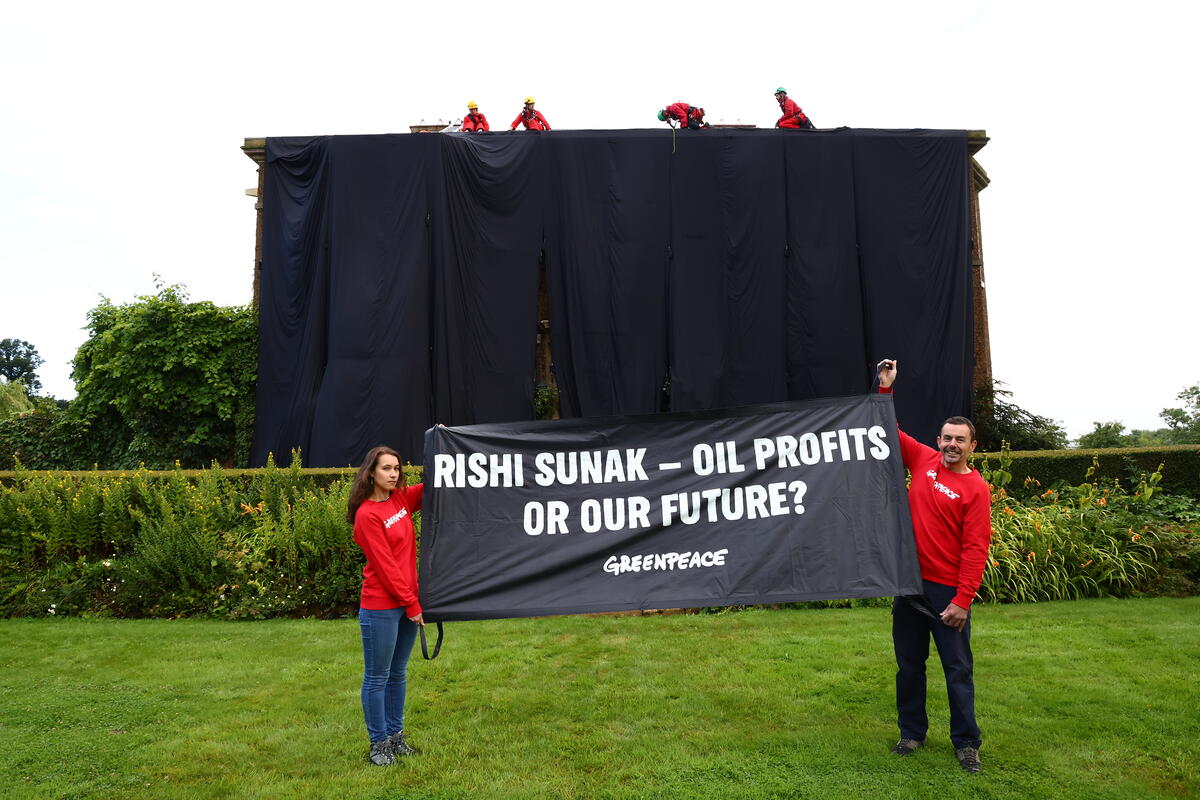
Greenpeace cover Rishi Sunak's home in black oily fabric in protests at Sunak's intended huge expansion of North Sea fossil fuel exploration.
Greenpeace cover Rishi Sunak’s home in black oily fabric in protests at Sunak’s intended huge expansion of North Sea fossil fuel exploration. Image © Greenpeace.

The British government’s current policies are about as far from being consistent with Britain’s net zero plan as it is possible to be, argues RICHARD HEBBERT

Last week Sunak announced that his government is granting over 100 new licences for oil and gas exploration in the North Sea, claiming in a peculiarly Orwellian statement that to do so is “consistent with the UK’s net zero plan.”

It isn’t. How could it possibly be?

Nor should we forget that the Tory government has approved the opening of a new coalmine in Cumbria and effectively banned on-shore windfarms — one of the quickest, cheapest and cleanest forms of renewable energy.

The British government cannot be ignorant of the manifest signs that the Earth’s climate is racing towards catastrophe, even quicker than has been previously forecast and yet it wilfully looks the other way.

https://morningstaronline.co.uk/article/f/climate-emergency-wilfully-looking-other-way

Continue ReadingClimate chaos – with the UK government wilfully looking the other way

‘Terrifying’: Scientists Raise Alarm Over Unprecedented Global Ocean Heat

Spread the love
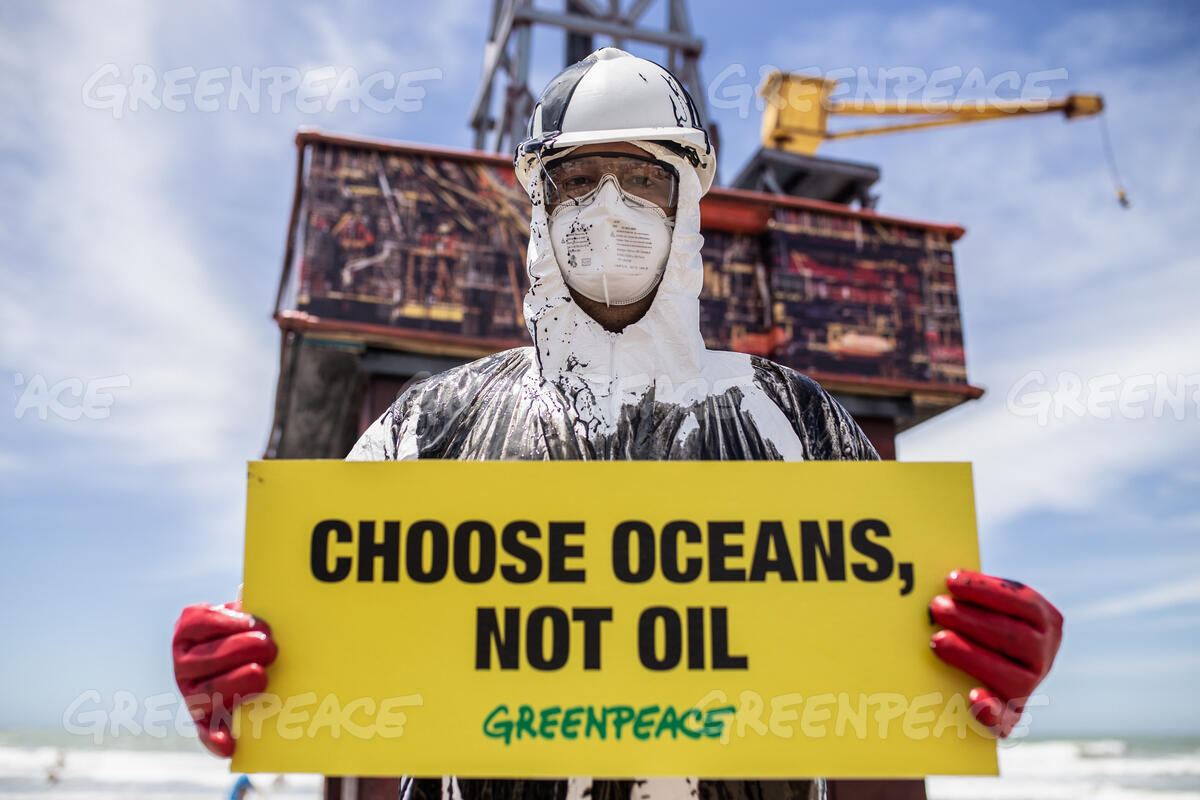
Greenpeace image, sign reads CHOOSE OCEANS, NOT OIL

Original article by JULIA CONLEY republished from Common Dreams under Creative Commons (CC BY-NC-ND 3.0).

The global average ocean surface temperature is expected to rise even further in the coming months as El Niño strengthens.

Climate scientists on Friday said the rapidly rising temperature of the planet’s oceans is cause for major concern, particularly as policymakers in the top fossil fuel emissions-producing countries show no sign of ending planet-heating oil and gas extraction.

The European Union’s climate agency, Copernicus Climate Change Service, reported this week that the average daily global ocean surface temperature across the planet reached 20.96°C (69.7°F), breaking the record of 20.95°C that was previously set in 2016.

The record set in 2016 was reported during an El Niño event, a naturally occurring phenomenon which causes warm water to rise to the surface off the western coast of South America. The weather pattern was at its strongest when the high ocean temperature was recorded that year.

El Niño is forming this year as well, but has not yet reached its strongest point—suggesting new records for ocean heat will be set in the coming months and potentially wreak havoc in the world’s marine ecosystems.

Samantha Burgess, deputy director of Copernicus, told the BBC that March is typically when the oceans are at their hottest.

“The fact that we’ve seen the record now makes me nervous about how much warmer the ocean may get between now and next March,” she told the outlet.

The warming oceans are part of a feedback loop that’s developed as fossil fuel emissions have increasingly trapped heat in the atmosphere.

Rising levels of carbon dioxide in the atmosphere are warming the oceans, leaving them less able to absorb the emissions and contributing to intensifying weather patterns.

“Warmer sea surface temperatures lead to a warmer atmosphere and more evaporation, and both of these lead to more moisture in the atmosphere which can also lead to more intense rainfall events,” Burgess told “Today” on BBC Radio 4. “And warmer sea surface temperatures may also lead to more energy being available for hurricanes.”

The warming ocean could have cascading effects on the world’s ecosystems and economies, reducing fish stocks as marine species migrate to find cooler waters.

“We are seeing changes already in terms of species distributions, prevalence of harmful algae blooms popping up maybe where we would not necessarily expect them, and the species shifting from warmer southern locations up into the colder regions as well which is quite worrying,” Helen Findlay, a biological oceanographer at the Plymouth Marine Laboratory in the United Kingdom, toldThe Evening Standard.

“We are also seeing more species coming up from the south, things like European anchovy or recently examples of Mediterranean octopus coming up into our waters and that is having a knock-on impact for the fish that we catch, and consequences of economics,” she added.

Certain parts of the world’s oceans provoked particular alarm among scientists in recent days, with water off the coast of Florida hitting 38.44°C—over 101°F—last week.

The National Oceanic and Atmospheric Administration told the BBC that ocean temperatures in that area typically hover between 23°C and 31°C at this time of year.

Since scientists first began measuring ocean temperatures using satellites and research buoys about four decades ago, the global average sea surface temperature has gone up by roughly 0.6°C.

On social media, climate scientists urged news outlets to explicitly connect the rising ocean temperatures to fossil fuel companies and the policymakers who are enabling them to continue fueling the climate emergency—such as British Prime Minister Rishi Sunak, who announced more than 100 new oil and gas licenses in the North Sea this week.

The New York Times this week reported “terrifying Earth breakdown but barely [mentioned] the cause is the fossil fuel industry,” said National Aeronautics and Space Administration climate scientist Peter Kalmus.

“The more we burn fossil fuels, the more excess heat will be taken out by the oceans, which means the longer it will take to stabilize them and get them back to where they were,” Burgess told the BBC.

Original article by JULIA CONLEY republished from Common Dreams under Creative Commons (CC BY-NC-ND 3.0).

Continue Reading‘Terrifying’: Scientists Raise Alarm Over Unprecedented Global Ocean Heat

The oil industry has succumbed to a dangerous new climate denialism

Spread the love
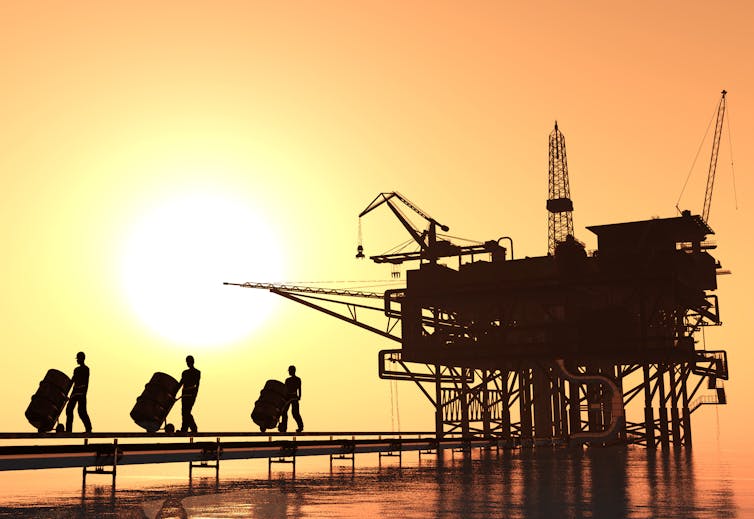
Opec predicts oil demand will be 10% higher by the 2040s.
Iurii

Adi Imsirovic, University of Surrey

If we have not been warned of the dangers of climate change this summer, we never will be. Extreme heat, forest fires and floods have been all over news reports. Yet the oil and gas industry remains largely in denial.

The International Energy Agency (IEA) says steep cuts in oil and gas production are necessary to reach the Paris (COP 21) goal of keeping global warming at 1.5℃. However, only a tiny fraction of the industry, accounting for less than 5% of oil and gas output, has targets aligned with the IEA’s “net zero” requirements.

The current secretary general of production cartel Opec, Haitham al-Ghais, expects global oil demand to rise by about 10% to 110 million barrels a day by 2045, a volume incompatible with the Paris goals. The UK government has just offered a helping hand, granting around 100 new North Sea licences. What are we to make of this mismatch?

The new denialism

Typical of the new breed of climate denialism is a recent report by the Energy Policy Research Foundation (ERPF), a body funded by the US government and various undisclosed corporate interests and foundations. It sees the IEA’s requirements as a “seal of approval … to block investment in oil and gas production by western companies”. The report views meeting the targets as too costly, too harsh on poor countries and too bad for the energy security of the west.

In fact, it is wrong on each account. Many eminent economists and scientists use the concept of the social cost of carbon (SCC), which is defined as the cost to society of releasing an additional tonne of CO₂. Expert estimates from 2019 put this at between US$171 and US$310 (£133 to £241). If we go with, say, US$240 per tonne, the social cost of continued carbon equivalent emissions comes out at almost US$8.5 trillion every year.

A recent study has factored into the calculation climate feedback loops. This is where one problem caused by global warming leads to others, such as melting permafrost unleashing stores of methane.

When the study estimated the economic damage that this could cause, it produced an SCC in excess of US$5,000. That implies annual costs of more like US$170 trillion a year, which makes the US$4 trillion investment into clean energy that the IEA thinks necessary to meet the Paris climate goals look like a drop in the ocean.

It may help to break this down to one barrel of oil. A special IEA report for COP28 estimates that on average, each barrel of oil emits 0.53 tonnes of CO₂ equivalent in greenhouse gas across its life cycle, 20% of which comes from production.

Going back to our average SSC per tonne of US$240, that points to a social cost of US$126 per barrel. With oil currently at US$85 per barrel, the societal damage from producing, transporting, refining and consuming it is far greater – and that’s before including climate feedbacks.

Meanwhile, the arguments by the EPRF and like-minded supporters about energy security are laughable. The history of the oil and gas industry is a history of wars and geopolitical tensions. Transitioning to cleaner fuels can only increase our energy security and reduce the need to police remote autocracies.

The argument that poor countries need to continue burning carbon for development reasons is no better. In its latest report from 2022, the Intergovernmental Panel on Climate Change (IPCC) said climate change would probably see an increase in “losses and damages, strongly concentrated among the poorest vulnerable populations”.

Equally, the World Health Organization estimates that: “Between 2030 and 2050, climate change is expected to cause approximately 250,000 additional deaths per year from malnutrition, malaria, diarrhoea and heat stress.”

How to respond

The denialists offer no alternatives to cutting carbon emissions, and often simply ignore climate change altogether. The recent ERPF report mentions climate change only four times. It is as if heatwaves, forest fires, flooding, rising sea levels and the demise of natural habitat caused by climate inaction were happening on another planet.

We still have time to limit global warming below 1.5℃. It is true that we will need oil and gas for many years, and that there are currently no alternatives for certain sectors such as air travel, shipping and some industries. Nonetheless, there is still much that can be done now to make a substantial difference.

To incentivise the transition to cleaner energy, governments need to end fossil fuel subsidies, which the IMF estimates amounted to US$5.9 trillion in 2020 alone. We also need to put a proper price on carbon – only 40 countries have attempted this so far, and none has it anywhere near the estimated social cost of emitting carbon.

Countries that resist charging their own polluters should face a carbon border adjustment mechanism, which is a tariff that effectively puts the polluter on the same footing as local players. If all the actors in the fossil fuel supply chain had to face the cost of the damage they cause, the need to phase out long-term investments in fossil fuels would become more obvious.

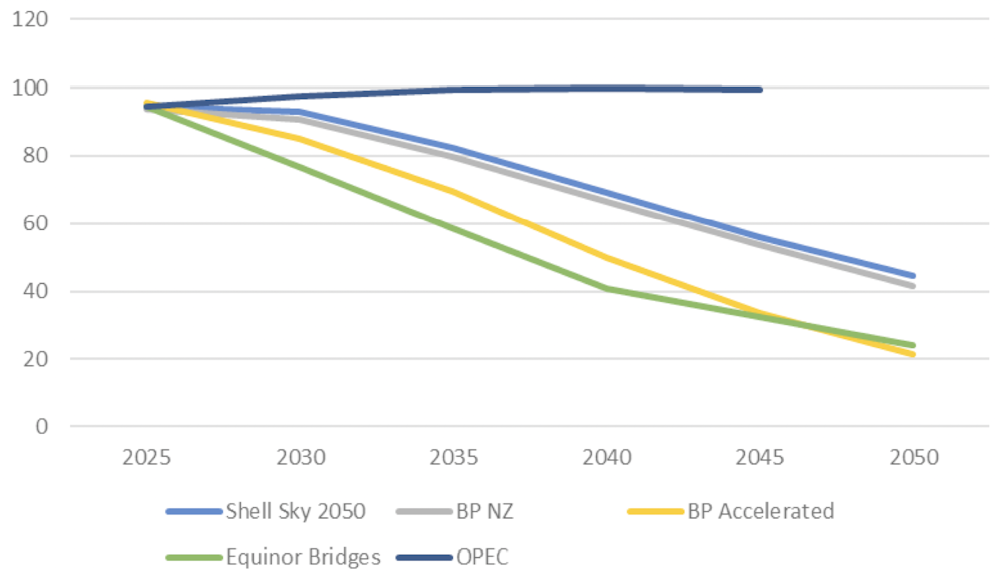
The IEA requirements for “net zero” are just one of the pathways towards meeting the Paris goal of 1.5℃ warming. Others are explored by some of the more credible actors in the petroleum industry, such as Shell, BP and Norway’s Equinor, but all require a substantial decline in oil demand and production by 2050.

Required production cuts

Graph showing the required production cuts to meet net zero
I left the IEA’s scenario off the graph because it published so few datapoints, but it is broadly in line with the others. Meanwhile, the Opec data is for reference and not a net zero scenario.
BP, Shell, Equinor and Opec

Instead of criticising efforts to slow climate change and sponsoring ridiculous reports calling for more fossil fuels, the oil industry should eliminate leakages, venting and flaring of methane, and electrify as many processes as possible using renewable power. It should also employ carbon capture, usage and storage technologies over the next ten years – yes this will increase the price of fossil fuels, but that is exactly what we need to make clean sources of energy competitive across the board and speed up the energy transition.

The sooner the industry starts facing up to the realities of climate change, the more chance it has to survive. The companies and even countries that produce fossil fuels will have to face and pay the cost for the damage they cause. Those costs are already massive and will grow. Those that survive will do so only as a provider of clean and sustainable energy.


Imagine weekly climate newsletter

Don’t have time to read about climate change as much as you’d like?

Get a weekly roundup in your inbox instead. Every Wednesday, The Conversation’s environment editor writes Imagine, a short email that goes a little deeper into just one climate issue. Join the 20,000+ readers who’ve subscribed so far.The Conversation


Adi Imsirovic, Fellow, University of Surrey

This article is republished from The Conversation under a Creative Commons license. Read the original article.

Continue ReadingThe oil industry has succumbed to a dangerous new climate denialism