Climbers drape Sunak’s £2m mansion in oil-black fabric as PM commits to fossil fuel frenzy
Read more about the article Climbers drape Sunak’s £2m mansion in oil-black fabric as PM commits to fossil fuel frenzy
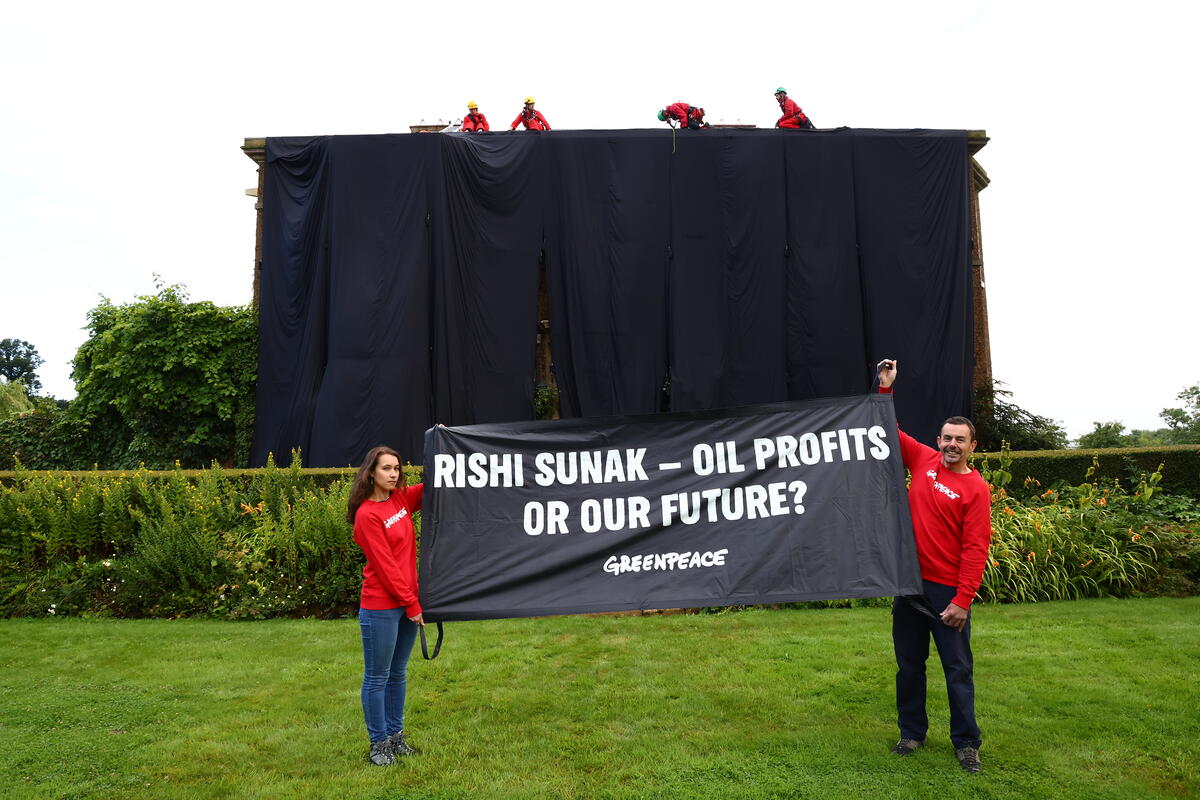
Greenpeace cover Rishi Sunak's home in black oily fabric in protests at Sunak's intended huge expansion of North Sea fossil fuel exploration. Image © Greenpeace.
Spread the love

Greenpeace activists have climbed onto the roof of Rishi Sunak’s £2m country mansion in protest at his backing for a major expansion of oil and gas drilling amid a climate crisis

Four Greenpeace activists climbed onto the roof of the Prime Minister’s £2m manor house in Yorkshire earlier this morning in protest at his backing for a major expansion of North Sea oil and gas drilling amidst a summer of escalating climate impacts.

After reaching the top of the building using ladders and climbing ropes, the activists unfolded 200 sq metres of oil-black fabric to cover a whole side of the luxury mansion. At the same time, two activists unfurled a banner emblazoned with the words “Rishi Sunak – Oil Profits or Our Future?” across the grass in front of the manor house. 

Sunak’s government has come under heavy criticism for pushing ahead with plans to hand out around 100 new oil and gas licences in the North Sea, and even hinting at additional ones in future. He has also indicated that he will approve drilling at Rosebank – the UK’s largest undeveloped oil field. The controversial move flies in the face of multiple warnings from the government’s own climate advisers, the International Energy Agency and the UN Secretary General that any new fossil fuel projects risk tipping the world into the danger zone above 1.5C of warming. 

The move, part of a series of climate policy row-backs following the Uxbridge by-election results, comes amidst a summer of devastating wildfires, floods and heatwaves. July has seen the hottest three-week period ever recorded, the three hottest days on record, and the warmest ocean temperatures ever for this season.

Campaigners are warning that any new oil and gas from the North Sea will do nothing for our energy security or bills despite government rhetoric. The companies that own it will simply export it overseas, and any that is sold back to us will be done so at the international market price. 

Commenting on the protest, Philip Evans, Greenpeace UK’s climate campaigner, said:

“We desperately need our prime minister to be a climate leader, not a climate arsonist. Just as wildfires and floods wreck homes and lives around the world, Sunak is committing to a massive expansion of oil and gas drilling. He seems quite happy to hold a blowtorch to the planet if he can score a few political points by sowing division around climate in this country. This is cynical beyond belief.

“Sunak is even willing to peddle the old myth about new oil and gas helping ordinary people struggling with energy bills when he knows full well it’s not true. More North Sea drilling will only benefit oil giants who stand to make even more billions from it, partly thanks to a giant loophole in Sunak’s own windfall tax.

“The experts are clear – we can’t afford any new oil and gas, and the fossil fuel industry certainly doesn’t need another helping hand in destroying the climate. What we need is a clean, affordable energy system fit for the 21st century. It’s time for Sunak to choose between Big Oil’s profits or our future on a habitable planet.”

The Sunak government is also expected to approve Rosebank, the largest undeveloped oil field in the North Sea. And thanks to a loophole in Sunak’s windfall tax, the UK public will foot the bill for 91% of the development costs as the Norwegian oil giant that owns it, Equinor, will be handed £3.75billion of public money to develop the field whilst being able to rake in tens of billions in profits.

There is wide agreement that there should be no new oil and gas exploration or development. Former Tory Net Zero Tsar, Chris Skidmore, has called for Rosebank to be halted, and former COP President and Tory MP, Alok Sharma, has also spoken out against Rosebank, highlighting that it won’t help bring down energy bills. 

Activists in swimwear queue up outside Sunak’s heated pool to highlight electricity grid scandal
Continue ReadingClimbers drape Sunak’s £2m mansion in oil-black fabric as PM commits to fossil fuel frenzy

All the evidence against the UK’s plans to expand oil and gas drilling

Spread the love

StudioByTheSea/Shutterstock

Jack Marley, The Conversation

The UK will extract as much oil and gas from the North Sea as possible, Prime Minister Rishi Sunak said on Monday as he announced more than 100 new drilling licenses. Only a few days earlier, United Nations chief António Guterres declared that record heat and extreme weather signalled a new era of “global boiling” had arrived.

How many new oil and gas fields can the climate sustain? None says David Waltham, a professor of geophysics at Royal Holloway University of London who has spent 36 years training young geologists to work in the fossil fuel industry.

“We cannot safely set fire to all the fuel we’ve already found, so why look for more?” he asks.


Imagine weekly climate newsletter

This roundup of The Conversation’s coverage of how more oil and gas drilling will affect climate change comes from our weekly climate action newsletter. Every Wednesday, The Conversation’s environment editor writes Imagine, a short email that goes a little deeper into just one climate issue. Join the 20,000+ readers who’ve subscribed.


This assessment is shared by the International Energy Agency (IEA), the UN and the Climate Change Committee (CCC) – the government’s own advisers on climate policy. Instead of expanding how much fossil fuel they extract, experts say countries must urgently reduce and even close down fossil fuel production.

An analysis of the world’s reserves in 2021 revealed how stark this decline must be to prevent catastrophic warming. Daniel Welsby, James Price and Steve Pye, the UCL energy researchers behind the research, said 60% of known oil and gas must remain underground in 2050 to prevent global temperatures exceeding 1.5°C above the pre-industrial average – the point at which damage to the climate is expected to rapidly become irreversible.

“Almost all of the world’s coal – 90% – will need to be spared from factory and power plant furnaces. Our analysis also showed that global oil and gas production must peak immediately and fall by 3% each year until mid-century,” they say.

The prime minister argued that pumping oil and gas in UK waters is at least greener than importing it from dirtier producers abroad. After all, the UK did create a climate compatibility checkpoint in 2021: six tests to assess how new fossil fuel projects might contribute to the emissions driving climate change.

“Only three tests remain,” say Tavis Potts and Daria Shapovalova, energy and development experts at the University of Aberdeen, “and each seems designed to wave through new rounds of oil and gas exploration and production.”

Fortunately, Sunak also promised to share £20 billion (US$25.4 billion) in public funding for carbon capture and storage technology with the Acorn project near Peterhead in Aberdeenshire, north-east Scotland. Historical research by Marc Hudson, a visiting fellow in science policy at the University of Sussex, shows how the future potential of this technology has been used to justify prolonging coal power and building gas power plants several times over the last two decades.

And evidence gathered by Nils Markusson indicates that hyping the promise of carbon capture and storage to offset rising emissions can actually delay necessary cuts to greenhouse gases. Markusson is a lecturer in environmental politics at Lancaster University.

What about energy security? Oil and gas from the North Sea is sold on the international market, so the UK’s licensing bonanza is unlikely to ease household energy bills. And the UK isn’t obliged to keep using oil and gas until 2050 as Sunak suggests. The CCC’s plan shows how the UK could meet all of its energy needs with low-carbon sources by mid-century.

The real cost of carbon

Is Sunak at least right in arguing that drilling for more fuel and doing it closer to home will make the UK safer in an era of growing political instability? Not according to Adi Imsirovic, a fellow in energy economics at the University of Surrey.

“The history of the oil and gas industry is a history of wars and geopolitical tensions,” he says. “Transitioning to cleaner fuels can only increase our energy security.”

Research by Imsirovic and others gives some idea of the consequences of the oil and gas industry’s zeal to pump more fossil fuel.

Economists estimate the cost to society of emitting an additional tonne of CO₂ between US$171 and US$310 (£133 to £241), he says.

“If we go with, say, US$240 per tonne, the social cost of continued carbon equivalent emissions comes out at almost US$8.5 trillion every year.”

But the effects of climate change aren’t so neat and self-contained. One problem caused by rising temperatures leads to others which ultimately accelerate the rate of warming, such as melting permafrost releasing heat-trapping methane gas. A study which attempted to include these feedback loops in calculations of economic damage put the social cost of releasing another tonne of CO₂ into the atmosphere at more than US$5,000.

“That implies annual costs of more like US$170 trillion a year, which makes the US$4 trillion investment into clean energy that the IEA thinks necessary to meet the Paris climate goals look like a drop in the ocean,” he says.

Would a new production boom in the North Sea at least benefit the UK’s public services through a flood of tax receipts? Because of loopholes in the government’s windfall tax on the North Sea industry, that’s not likely either says İrem Güçeri,
associate professor of economics and public policy at the University of Oxford.

“There is a lot of research to show how to design a strong windfall tax that will bring in solid revenues for a government and its citizens,” Güçeri says.

The UK government doesn’t appear to have heeded it though, as it allows firms to reap a huge tax relief by investing profits into new extraction sites. “This is a massive subsidy,” she says.

“This is how some oil majors have avoided paying very much tax on their UK profits in recent quarters, despite massive gains.”


Imagine weekly climate newsletter

Don’t have as much time to read all the news about climate change you’d like to?

Get a weekly roundup in your inbox instead. Every Wednesday, The Conversation’s environment editor writes Imagine, a short email that goes a little deeper into just one climate issue. Join the 20,000+ readers who’ve subscribed.The Conversation


Jack Marley, Environment + Energy Editor, The Conversation

This article is republished from The Conversation under a Creative Commons license. Read the original article.

Continue ReadingAll the evidence against the UK’s plans to expand oil and gas drilling

Science shows the severe climate consequences of new fossil fuel extraction

Spread the love
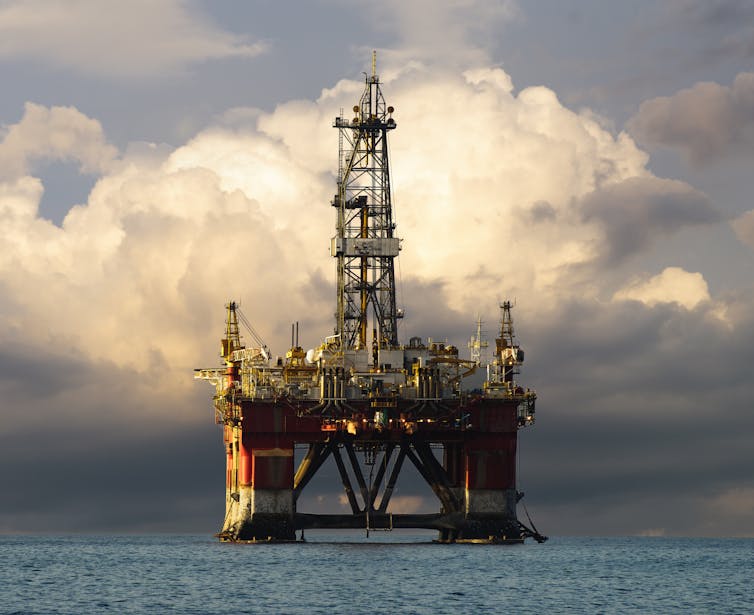
An offshore drilling platform.
Mike Mareen/Shutterstock

Ed Hawkins, University of Reading

The world has just suffered through its warmest month ever recorded. Heatwaves have swept across southern Europe, the US and China, breaking many temperature records in the process.

Climate scientists have been sounding the alarm for decades that this type of event will become more frequent as the world continues to warm. The major culprit behind this is the burning of fossil fuels. So it’s extremely concerning that the UK government has announced its intention to grant hundreds of licences for new North Sea oil and gas extraction.

Although burning fossil fuels to generate power and heat has enabled society to develop and flourish, we are now experiencing the unintended side effects. The carbon dioxide that has been added to the atmosphere is leading to a rise in global temperatures, causing heatwaves to become hotter and downpours more intense. The resulting large-scale disruption and suffering is becoming ever more visible.

This warming will continue, with worsening climatic consequences, until we reduce global carbon dioxide emissions to “net zero”. After that, we will still have to live and suffer in a warmer climate for generations. The collective choices we make now will matter in the future.

The small-scale, but high-profile, disruptions caused by Just Stop Oil protesters in the UK are extremely frustrating for many. But their single demand – for no licenses for new UK coal, oil and gas projects – is consistent with the science underpinning the international agreements that the UK has signed.

Temperatures are rising

Since the 1860s, the scientific community has understood that adding more carbon dioxide to the atmosphere would warm the climate. And as long ago as 1938, the burning of fossil fuels was linked to the observed rise in both carbon dioxide levels and global temperatures. Fast forward to now and global temperatures are warmer, and increasing faster, than at any point in human civilisation.

In response to the overwhelming scientific evidence, the UK and 193 other nations came together in 2015 to ratify the Paris agreement on climate change. One of the agreed goals is to limit global warming to well below 2℃, and even aim for 1.5℃, compared to the pre-industrial era.

However, the latest synthesis report from the Intergovernmental Panel on Climate Change, which all governments explicitly endorsed, paints a stark reality. If we burn all of the fossil fuels that we currently have access to, then global warming will exceed 1.5℃ and may reach 2℃.

To avoid breaching the limits set out by the Paris agreement, some of the coal, oil and gas that we can already extract must remain unburnt. New fossil fuel extraction projects will make it even harder to stop further global warming.

Build up renewable infrastructure

There are other options. The UK government’s official advisers, the Climate Change Committee, have put forward a vision for UK power generation consistent with a net zero future. They say that the UK could provide all of its energy needs by 2050 through a combination of renewables, bioenergy, nuclear, hydrogen, storage and demand management, with some carbon capture and storage for fossil gas-based generation in the meantime.

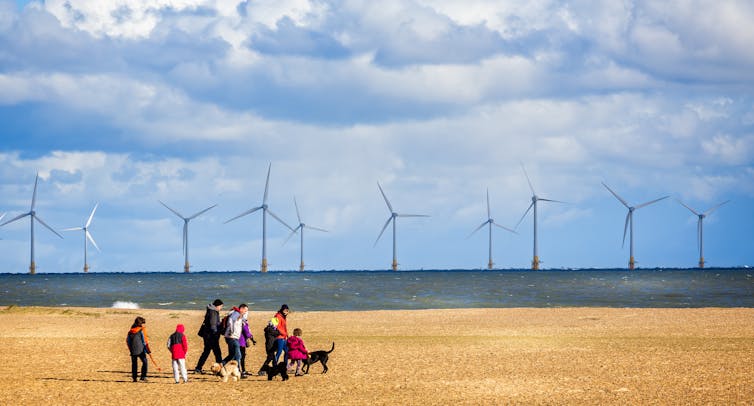
A family walking dogs on a beach in front of an offshore wind farm.
The UK can achieve energy security without causing additional global warming.
Nigel Jarvis/Shutterstock

If the UK followed the example of China and rapidly increased its investments in renewable energy, then it could achieve energy security without causing additional global warming. China emits the most carbon dioxide of any country in the world. But it is installing more renewable energy generation than the rest of the world combined.

Rapidly reducing our reliance on fossil fuels, and not issuing new licenses to extract oil and gas, is the most effective way of minimising future climate-related disruptions. The sooner those with the power to shape our future recognise this, the better.


Imagine weekly climate newsletter

Don’t have time to read about climate change as much as you’d like?

Get a weekly roundup in your inbox instead. Every Wednesday, The Conversation’s environment editor writes Imagine, a short email that goes a little deeper into just one climate issue. Join the 20,000+ readers who’ve subscribed so far.The Conversation


Ed Hawkins, Professor of Climate Science, University of Reading

This article is republished from The Conversation under a Creative Commons license. Read the original article.

Continue ReadingScience shows the severe climate consequences of new fossil fuel extraction

‘Crimes against humanity’

Spread the love

https://morningstaronline.co.uk/article/b/crimes-against-humanity

Rishi Sunak and Grant Shapps

PRIME MINISTER Rishi Sunak jetted into Scotland today [Monday] to announce a cash bonanza for the oil majors, just days after the United Nations announced that “the era of global boiling has arrived.”

Companies such as Shell and BP, which coined £3 billion each in just the last three months, continue to enjoy the Prime Minister’s generosity.

Having already doled out billions of pounds worth of windfall tax breaks to fossil fuel majors in the North Sea, Mr Sunak has said he will back the granting of over 100 new oil and gas licences and provide up to £20bn in state handouts to carbon capture and storage.

Despite the proposed fields not likely to come on stream for over a decade, Mr Sunak and ministers such as Energy Secretary Grant Shapps claim that the supply would ensure energy security and aid in “safeguarding bills for British families.”

Mr Sunak argued his policy to prolong production of oil and gas by decades “is entirely consistent with our plans to get to net zero” — a target due to be met in just seven years.

The Prime Minister’s remarks united climate activists, anti-poverty campaigners, trade unionists and opposition politicians in their condemnation of a policy they argue ditches international commitments on climate change, fails to deliver a fair transition for workers, and will not help those struggling to pay heating bills this winter.

In a statement, climate activists Just Stop Oil branded the 100 new licences expected to be granted this autumn as “100 new crimes against humanity,” adding: “Rishi Sunak and his fossil fuel backers are taking us all for fools.

https://morningstaronline.co.uk/article/b/crimes-against-humanity

Continue Reading‘Crimes against humanity’

Neoliberalism can’t solve the climate crisis. We need activism

Spread the love

Original article by Paul Rogers republished from Open Democracy.

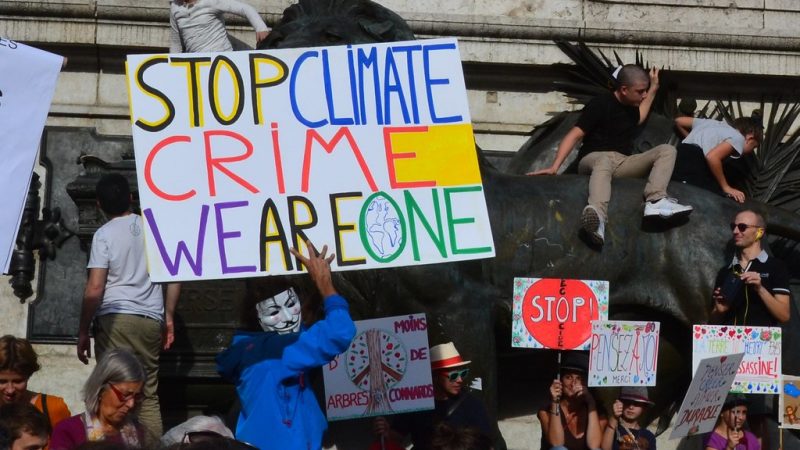
Protest banner reads Stop Climate Crime. We are One.

Radical action is essential to stop the transition from global warming to global boiling

Extreme weather events have increased in frequency and intensity over the past decade, with the last month seeing a rare combination of problems across North America, the Mediterranean and Middle East, northern China and South Korea. For the British, there has been the separate added shock of seeing tourists fleeing wildfires, especially in Greece.

These events are all part of the early stages of climate breakdown, which will get progressively worse unless the world makes a revolutionary and rapid transition to a low carbon economy, yet there is little evidence that political leaderships are even remotely prepared for this. At least UN secretary general António Guterres is using different language, not least his use of “global boiling” rather than “global warming” for his warnings of what is to come.

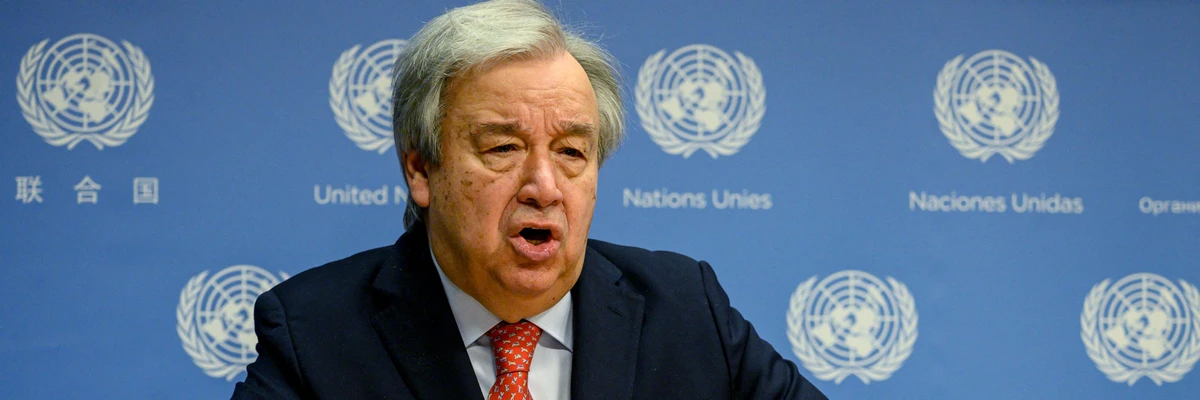
United Nations Secretary-General António Guterres discusses climate change at U.N. headquarters in New York City on July 27, 2023.

He is an exception, and public opinion overall is still not aware of the huge changes required. All the warnings from climate scientists, coupled with the evidence of our own eyes, seems to count for little as we move towards an unstable, chaotic and overheating planet.

Why is this? More importantly, why is it that radical decarbonisation isn’t happening, even though we know it’s possible? And, most important of all, how can things be turned round in time?

Let’s start with the inaction. Here, three elements interact. First, we are talking about fundamental changes in how we live, not just in the UK or western Europe but across the whole world. The result would be a cleaner, safer and healthier world, but it would involve years of huge change – which is a lot for ordinary people to take in. We shouldn’t underestimate this. Poorer communities, in particular, will find it very difficult to cope with the changes, while richer elites everywhere in the world will likely maintain the naive belief that their wealth will keep them secure.

Second, what must be done runs directly counter to the way the economy currently works. The market fundamentalist system is rooted in competition and the false belief that the millions of people left behind will benefit from trickle-down from the rich and be content. It believes that while central government, in partnership with wealth, may hold the ultimate levers of control, it should have a minimal role in how the market works. Cooperation is anathema to this way of thinking, but cooperation is essential to prevent global boiling.

Neoliberals see this market fundamentalist approach as necessary for an ordered and stable society, and believe that if the millions of marginalised people do not upset the apple cart, all will be well. At root is a belief that the elite knows best.

In Britain, there was the unexpected risk of a seriously radical Labour government taking over in 2017. Fortunately for the neoliberals, that was narrowly avoided and since then the threat from the Labour left has been well and truly suppressed.

Despite this, the system still has wider concerns over potentially violent responses from the margins. In many countries, and especially Britain, new laws have been brought in and others strengthened, and police and security forces are much better equipped and trained to handle public dissent. Heavy prison sentences for even small acts of nonviolent direct action are now there to be used.

The problem is that a market economy system simply cannot act fast enough to handle climate breakdown. The system knows this, so finds it preferable to support the view of any “experts”– of whom there are plenty – who still deny there is a problem.

The anti-climate breakdown forces are exceptionally well entrenched in society and have the easy job of convincing people that no action is required

This brings us to the third point: the relentless propaganda from the fossil fuel industry and associated think tanks over half a century to deny the problem, even when their own scientists are saying otherwise. In a fairer world there would be an offence of global corporate manslaughter, but in the real world there isn’t.

Overall, the anti-climate breakdown forces are exceptionally well entrenched in society and have the easy job of convincing people that no action is required – just when they are being told that action will be personally costly. Politicians will play on this, especially when elections are in the offing. This can even reap electoral favour. The current behaviour of Britain’s Sunak government is a case in point, with Sunak declaring that climate policy must be “proportional and pragmatic”, following a by-election win in a constituency where the Tory candidate had opposed extension of the ULEZ low-emissions scheme.

So where do we go from here? One way to look at it is to view the current issue as two very broad global trends that are on course to converge, and when they finally meet there will be a chance of radical change because there will be no alternative.

One of these trends, as we have seen, is a system set in its ways and highly unlikely to change. Carbon emissions will continue rising, temperatures will head well above 1.5°C and those with the power will reap the rewards, at least in the short term.

The other trend is much more positive and has three elements.

Climate science has come on by leaps and bounds in the past half century. The science community is far more confident of its expectations of climate breakdown and is, at last, saying so bluntly. That welcome change also has greater force because of the manner in which the beginnings of climate breakdown are frequently exceeding the warnings of predictive models.

The second trend is, at last, a growing public awareness that things must change, and change quickly. The power of the movements in many countries is remarkable, so much so that far more people are willing to risk prison for the sake of the future.

Finally, numerous impressive developments in renewable energy technology have brought down the cost of electricity by huge margins, bringing it well below grid parity in price with fossil fuels.

That leaves just two huge questions, on which so many futures depend, particularly for our children and grandchildren. When will the convergence happen, and how quickly can changes then be made?

If it takes another 20 years to the early 2040s, then the task will be almost insurmountable, with action only happening after numerous appalling catastrophes, and bitter anger from the marginalised billions. If change comes before the mid-1930s then prospects will be brighter, but the later the convergence the greater the challenge.

It is therefore a matter of the sooner the better, so the rest of the 2020s has to be a time of intense activism whenever and wherever possible. Whether it is by persuasion, argument, nonviolent direct action or other means, it might then be possible to convince enough people that radical action is essential before the transition from global warming to global boiling risks becoming irreversible.

Whatever you’re interested in, there’s a free openDemocracy newsletter for you. HAVE A LOOK

Original article by Paul Rogers republished from Open Democracy.

Continue ReadingNeoliberalism can’t solve the climate crisis. We need activism